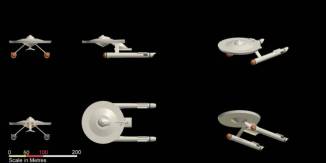
2242 – Ptolemy (Modified)

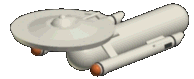
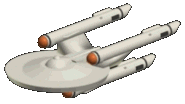
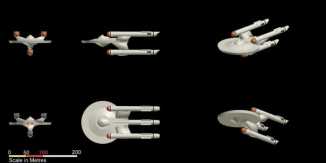
The Ptolemy class transport was the first in a line of successful high-load warp transports used by the Federation. Equipped with specially designed warp engines suitable for towing mass never before realized, the vessels were a boon to infrastructure building outside the core of the Federation. Initially, production contracts called for 30 ships of this class to be constructed. However, due to the fleet-wide ship build-up at the time it was commissioned, limited appropriations permitted the construction of only 15 of the class.

The Ptolemy class was designed for easy and efficient transporting of cargo within outboard cargo containers. The cargo containers were easily attached and detached via a specially designed coupling unit fitted to the neck of the primary hull of the starship. Depending upon total mass, up to two containers could be towed by the Ptolemy at one time. These containers were mass-produced and supplied to both Starfleet and private shipping concerns (at a reduced rate) to promote the use of these standardized containers. Practically a ship unto themselves, these containers were a break-through in shipping technology just as the high-load warp engines mounted on the Ptolemy were.

The containers came in five basic types:

  • Mk I Liquids
  • Mk II Dry Bulk Goods
  • Mk III Refrigerated/Thermal Goods
  • Mk IV People (starliners, mass transport)
  • Mk V Products (non-food stuffs and misc.)

The Mk I-III and V containers had their own cargo transporters (up to six), turbolifts for carrying goods to various levels and self-contained environmental machinery. The Mk IV containers also included 6 personal transporters and could accommodate 800 passengers. This container also had its own sensors array, was capable of sub-light speed and could sustain its passengers in case of an emergency for up to 18 years.
During the Four Years War, an urgent need arose for military cargo transports. Because of their slow speeds, the Ptolemy was not a viable candidate. However, the need was so great that all Ptolemys in service at the time were converted to Mk IIs. The Mk II mounted the FWB-1 engine which improved the speed of the transport, but at the cost of limited cargo capacity. The Mk II could only carry approximately 121,000 mt of cargo in smaller outboard cargo containers. However, this was sufficient in its role as a military transport.

After the Four Years War, surviving Ptolemys were retrofitted with the FHLWA-1 and returned to their pre-war roles. Many of the Mk IV containers were converted to starliners, with luxurious accommodations for up to 500 passengers. These starliners contained a park promenade, numerous recreation lounges, 2 full theaters, a gymnasium, pool and hydroponic gardens.

This modified version was first built in 2242 alongside the standard version, it featured more discreet hull mounted deflectors as opposed to the large dish of the standard ships. Post war most of the class were converted to this standard, which gave no performance benefits, but considerably improved reliability.

Class: VII Year: 2242
Ship Source: Starfleet Technical Manual/The Starfleet Museum Ship Datasheet: Download PDF

masao-ptolemy-pod-70masao-ptolemy-nopod-70

2247 – L6 (Defender)


The first encounters with the L-6 frigate came during the Four Years War. Though few of them were met in actual battle, those that did were usually victorious; none was ever captured and only three were destroyed.

In 2252, in an engagement that was to typify all subsequent encounters with these vessels in the war, two Larson class destroyers and a Loknar class frigate were bludgeoned by a single L-6. The destroyers Eylau and Jutland were patrolling the outer fringes of the Falgor system, left behind with the frigate Proxima when the main body of the Federation fleet withdrew to reform and ready itself for the inevitable Klingon thrust. The destroyers encountered the L-6 as it entered the area, readied themselves for combat, and dispatched a message to the Proxima requesting assistance. The Jutland called for the Klingon vessel to surrender as it approached. The L-6 responded by firing on the Eylau, damaging its impulse drive system. The Jutland closed to extreme range and opened fire, but the damage it inflicted was negligible. While the Klingon ship was concentrating on the incoming Jutland, the Eylau managed to damage a warp engine, causing the L-6 to turn on the Eylau with a withering barrage, destroying the Eylau’s warp drive controls and causing it to go dead in space. Once again, the Jutland fired to minimal effect, and the L-6 renewed its fire on the Jutland, which was no match for the Klingon frigate either in terms of firepower or range. The Jutland received one damaging blow after another, all from extreme range for its weapons. When the L-6 eventually closed for the kill, it was frustrated by the arrival of the Proxima. Approaching the Klingon from the rear, the Proxima closed rapidly and delivered a devastating blow to the engineering section, only to be surprised by the Klingon’s aft-firing disruptors, which delivered a volley into the bridge and forced it to withdraw. Luckily for the Federation vessels, the moderately-damaged L-6 decided to withdraw, leaving the Eylau damaged beyond repair, the Jutland severely damaged, and the Proxima lightly damaged.

The L-6 went through an interesting change around 2268, when the warp engines were changed from the KWD-1 to the KWE-1, and the impulse system was upgraded to the more powerful KIE-2. The warp engines delivered less power than the earlier designs but were more efficient. The impulse system increased its power output over the earlier system by 600%. The overall output of power decreased, however the maneuverability increased. Further changes included the addition of more troops and shuttlecraft as well as improved weaponry and shields. This modification did not alter the basic weakness in the L-6 design, its amidships warp engines.

Of the approximately 300 L-6s built, about 230 remain in active service and about 50 have been destroyed; the disposition of the remainder is unknown. Operation Dixie reports indicate that the L-6 is produced at the Kodal facility. The class name is translated from the Klingon th’lar.

Class: VIII Year: 2247
Ship Source: FASA Ship Datasheet: Coming Soon


2245 – D16 (Swiftwind)

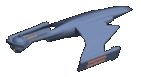
Of the 192 D-16s built, 27 are in reserve fleets, 123 have been destroyed, 11 have been captured (6 by Star Fleet, 4 by Romulans and 1 by Orions), 8 are listed as missing, 3 have been scrapped, 16 have been sold to ranking and prominent families in the Empire, and 4 have been sold to private interests within the Triangle. The D-16, named from the Klingon kisarza, was produced at losia.


Class: VI Year: 2245
Ship Source: FASA Ship Datasheet: Coming Soon


d16-100


2239 – D4 (Predator)

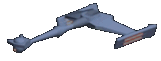
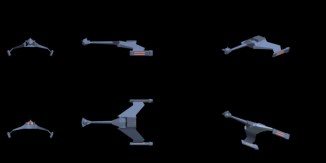
The D-4, predecessor to the famed D-7 class, pioneered the modern iteration of the command pod forward design that has become the standard for most modern Klingon warships. The class was introduced in 2239 with the commissioning of eight ships, which had been produced at the alarming rate of one per month at facilities operating as if under wartime production orders. This was a clear signal that the Klingons were either preparing for a war with either Romulan or Federation forces or were involved in a conflict along an unknown border. Only recently, because of intelligence gained from Operation Dixie, has it come to light that the Klingons were in fact being attacked by an unknown enemy along their coreward border. During this conflic the D-4 saw extensive action and went through several different modifications, many of which were never brought into production. This conflict ended somewhere around 2241, slowing further development.

In 2249, the D-4E was tested and proclaimed successful. Production was converted over to this newer model, and, by Stardate 1/9203, the first vessels were commissioned. By 2253, the D-4A was no longer being produced, and most of the D-4A’s in service were being converted to D- 4E’s, which mounted a more powerful impulse drive system.

The major improvement was the replacement of the KD-2 by the KD-3, with a range of 120,000 km, extending the offensive capability of the D-4 by 20,000 km. The shielding system was also upgraded, with the new KSE system giving the ship 65% more protection from incoming fire. The superstructure was strengthened to handle the uprated equipment. Even though the D-4 proved to be valuable in combat, witnessed by its class name of “Predator” from the Klingon “d’ama”, its days were numbered. The D-7, with its higher firepower and more powerful engines, would replace it by 2266.

Of the 814 D-4’s built, 277 are in reserve fleets (48 A’s and 229 E’s), 462 were destroyed, 14 have been captured (3 A’s and 6 E’s by Star Fleet and 2 A’s and 3 E’s by the Romulans), 6 reported as missing, 16 were scrapped, 11 sold to the Orions (4 A’s and 7 E’s), and 28 sold to prominent families of the Empire (10 A’s and 18 E’s).

Class: VII Year: 2239
Ship Source: FASA Ship Datasheet: Coming Soon


d4-fasa-100

2254 – D9 (Seeker)

Class: VIII Year: 2254
Ship Source: FASA Ship Datasheet: Coming Soon

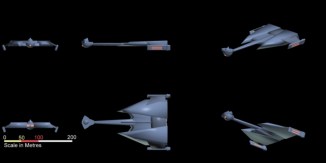
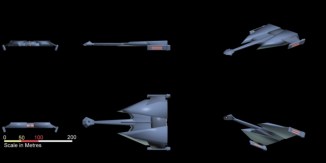
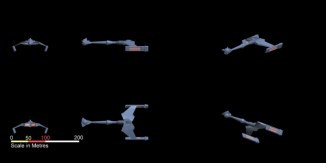
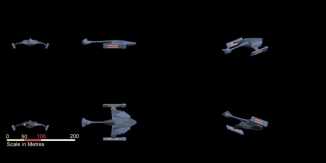
The D-9 cruiser was brought into service during the Four Years War to act as a research vessel. For years, the Klingon Empire had been halted in its attempts at expansion. To the rimward lay the Federation; towards the trailing arm were the Romulans; and it has been speculated that to the core-ward lay some unknown power able to hold the Klingons in check. This left the spinward area, as yet not fully explored. Expansion into this void had been slow due to the great distances from the homeworld of Klinzhai and the apparent lack of suitable worlds for conquest, but the desire to outflank the Federation altered that. The newly constructed D-9 cruiser was intended to lead this effort.

The D-9A prototype of 2254 was considered to be undergunned and was dropped from production even before it had been commissioned. An upgunned version, the D-9B with mainly defensive weaponry, was commissioned in 2255 and was immediately sent into the new expansion area. These ships and their accompanying scout ships were to map new areas and evaluate the cultural levels of any races encountered. The war with the Federation ended one year after the D-9B’s entered service, and the sense of urgency for the flanking expansion effort diminished. The flanking movement is portrayed in a Star Fleet commanders test known as Operation Armageddon.

After the end of the Four Years War, most of the facilities set up to produce these research cruisers were converted over to warship designs, accounting for the small number produced. The D-9, named “Seeker” from the Klingon “z’gal”, is manufactured at Gnuu Re, with production at three per year. These vessels are still operating in the spinward areas. Of the 82 D-9’s built, 68 remain in active service, 9 have been destroyed, 3 are listed as missing, and 2 have been sold to private interests in the Triangle.

Class: VIII Year: 2252
Ship Source: FASA Ship Datasheet: Coming Soon

d9-100

2251 – D10 (Riskadh)

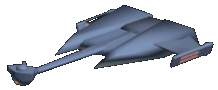
In 2251, the D-10 cruiser, the design of which was strongly influenced by the D-7, was commissioned into service. The Klingon Imperial Command hoped to counter Star Fleet’s Constitution class cruisers with this new vessel. The Four Years War was in its second year, and the Klingons had learned some of their lessons well. The D-10 featured a sturdy superstructure and the most effective shields the empire had to offer. The fore and aft-mounted disruptors were far superior to the Federation lasers, but were not as destructive as the Federation’s accelerator cannons.

The D-10 used the same command pod as the D-7, thus eliminating the need for additional production facilities. Like the D-7s pod, that of the D-10 is capable of being jettisoned and has similar sub-light maneuvering and life support capabilities. In 2253, Star Fleet captured a pod that had been jettisoned during the Battle of Kesse 16 months earlier; the crew were alive and as well as could be expected.

The main hull of the early D-10s contain the engineering section, shuttlebays, crew quarters, and assault troop hypothermia capsules; later models have no troop-carrying capabilities but instead have large research facilities. The warp engines are mounted on short pylons and are jettisonable. With the additional removal of the hypothermia capsules, the ship is capable of running on its impulse power alone for up to one year. The shuttle hangars are located on the upper wing surface of the main hull and are seen as two large doors. Directly aft of these doors are located the aft firing disruptors; aft-firing photon torpedo tubes are located at the stern of the vessel just below the impulse exhaust port.

The D-10 is the only Klingon warship whose class name honors a Klingon family line: the Riskadh line, which died with its founder, Kahless the Unforgettable, the greatest of all emperors. D-10s are manufactured at the Taamar, Gnuu Re’, Fonawl, Z’hai, and Mustaka facilities. The combined production rate is 14 D-10Ds, 12 D-10Gs, and 10 D-10Hs per year.

The D-10A first entered service in 2251, the first ships being rapidly sent into the Four Years War, where they proved to be the most powerful and feared ships in the Klingon Imperial Navy.

The model used a powerful warp engine, but mounted a fairly weak impulse system, the only real shortcoming of the vessel; the main engines allowed the ships to cruise at Warp 6, with emergency speeds as high as Warp 8. The weapons system consisted of six individually-mounted KD-6 disruptors and two aft-
mounted KD-3s, giving the cruiser an offensive range capability 80,000 km greater than Federation warships. 

With the Klingons having range superiority, if it had not been for the superior tactics of the Star Fleet commanders, the Four Years War might have turned out much differently. Star Fleet commanders were able to neutralize the range superiority in many cases, however. Klingon tactics were to send a D-10 with a small escort of three-to six destroyers into a system to secure it. Federation commanders would leave the system, making it appear unprotected; they would then return from several different directions and take the unsuspecting Klingons in flanking attacks. This tactic was not always successful, but it did deter the Klingons from mounting many attacks into the interior of Federation space. In the last months of the war, the Klingons faced the newly-developed phaser and photon torpedo, and the days of the D-10 as the “Queen Of Battle” were over. 

Of the 444 D-10As built, 27 are in reserve fleets, 268 have been converted to D models and 14 to F models, 106 have been destroyed, 8 have been captured (6 by Star Fleet and 2 by the Romulans), 6 are listed as missing, 7 have been scrapped, 6 have been sold to ranking families within the Empire, and 2 have been sold to private interests in the Triangle.

The first modification to the D-10 came in 2254, when the KIB-2 impulse drive system was replaced with the KID-2. Though the new D-10B was ordered into production, it never was produced in numbers because the KWE-2 warp drive system was brought into the navy’s inventory just as the new 8 models were ready for installation of their warp drives. These engines were installed, and, in 2260, the first D-10C was taken out for maneuver trials. In 2261, the completed ships were outfitted with the newly-created KD-9 disruptors, KP-4 photon torpedo, and the KSO shield systems, replacing the original equipment with upgraded systems. The D-10D entered service in 2262 with the simultaneous commissioning of 23 ships, the largest number of new ships to be commissioned at one time in known space.

The KWE-2 warp drive system allows the D-10D to achieve cruising speeds of Warp 7 and emergency speeds of Warp 8, even though it adds 30,000 mt to the overall weight. The KD-9 disruptors produce slightly less damage than the KD-6 models found on the D-10A, but they have an increased range of 20,000 km. The real increase in weapons power lies in the KP-4 torpedo, which is mounted fore and aft. The addition of so many new systems required an in- crease in the superstructure strength.

Of the 455 D-10Ds built, 389 remain in active service, 2 are used as training vessels, 47 have been destroyed, 2 have been captured by Star Fleet, 6 are listed as missing, 2 have been scrapped, I has been traded to the Romulans, 1 sold to the Orions, and 5 are in the service of ranking families of the Empire.

In the space of a few years,  the Klingons created 5 new warp drive engines, 2 impulse drive systems, 5 new disruptor types, 4 photon torpedo types, 5 shield systems (of which 2 used a trinary powertransformer), and 2 powerful computer systems. With all these new systems, the D-10F, incorporating many of them, was inevitable; it was commissioned in 2263. The KWE-3 engines produce 10% more power, and the KIE-1 impulse drive systems produce 50% more power than the systems installed on the D models, adding maneuverability. On Stardate 2/1312, the Klingons had acquired 14 Romulan plasma weapons of the RPL-1 type, and these weapons also were installed on the D-10F, instead of the photon torpedo. The KD-9 disruptors were replaced with KD-13s, increasing the range another 20,000 km, and the aft-firing KD-3s were replaced by 2 KD-9s and 2 KD-5s. The superstructure strength was increased by 16%, and the shields were upgraded.

After the completion of the D-10F models, the Klingons continued to use the Z’hai facility to construct D-10Gs, with two changes from the F model. The hypothermia capsules were removed and the area rebuilt as a laboratory facility, allowing the D-10G to act as a research cruiser in hostile areas where lightly-armed ships like the D-9 could be easily destroyed or damaged if attacked while alone. To further augment weaponry, fore and aft-firing photon torpedo bays were installed for the KP-4 torpedo to replace the RPL-1.

In 2267, the D-10H was commissioned, the first model that has an exterior change. Instead of mounting the old style command pod, the ship mounted the command pod from the L-9 frigate, making the class easier to identify on visual scan but a more potent adversary. This model mounts the new KIE-2 impulse drive system, giving it more maneuvering power than most ships in either the Romulan Navy or Star Fleet. The disruptors were all refitted to KD-1 3s, not only to give the vessels a longer range of fire in all directions but also to ease the maintenance chore. The photon torpedo bay was converted to fire the new KP-6, which causes as much damage as any of those employed by Star Fleet and twice the damage as any used by the Romulans. With this array of weapons, and with its strengthened superstructure, the D-10H is, by far, the most powerful of the class and also stronger than most others in space.

Class: VIII-X Year: 2251
Ship Source: FASA Ship Datasheet: Coming Soon
 

d10-100

D10A- D10G

d10-late-100

D10H

2248 – Mission X

The Mission-X was ordered by Starfleet Intelligence Command in 2248. Externally identical to the standard Mission Class scout/courier, the Mission-X had a combat capability greater than many destroyers and cruisers. The major drawback of the design was the high cost of fitting such components into a small hull. Additionally the design compromised the crew facilites and fuel storage, making missions of more than seven days duration impossible.

Prior to the Four Years war the ships were primarily used in Intelligence gathering duties along the border away from the glare of publicity. But war changed that, as some of these ships were stationed at what became known as ‘Malta Station’ which was beseiged by Klingon Forces for much of the war. The ships assigned to that station earned Federation wide fame for their brave actions supporting the defence of the station. These four ships ‘Faith’, ‘Hope’, ‘Charity’ and ‘Desperation’ collectively destroyed 34 Klingon Vessels, and crippled a further 46. Starfleet refuses to confirm whether the original four ships survived the war, or whether they were secretly replaced during the war after being destroyed.
30 Mark 1 ships were built, and 20 new build Mark 2s. The 18 Surviving Mark 1 vessels were uprated to Mark 2 standards, the only difference being the FWA-2 engine installation.

2256 saw the testing of an enhanced Phaser and Photon Torpedo armed Mark 3 version. This ship was marginally less combat effective than the Mark 2 and more expensive to build. Only the prototype vessel was built of this mark as it was clear that the earlier ships were still highly effective. The Mission-X class was finally withdrawn from service in the 2280’s, it was the last FL/FAC Armed ship on the active service list. Rumours do persist though of special variants still serving with Intelligence command, but these cannot substantiated.

Class: III Year: 2248
Ship Source: FASA/Steve Bacon Ship Datasheet: Download PDF

100mission_large4xmission

2248 – Mission

When most citizens of the Federation think of the ships of Starfleet, their thoughts may soar with the mighty designs of the Constitution ,Enterprise and Excelsior classes. However, one of the most successful and influential designs in the history of the Federation is the modest Mission class. This versatile little ship will forever be linked to the success of the Federation in many ways.

Class: II Year: 2248
Ship Source: FASA Ship Datasheet: Download PDF

100mission_large4xmission

2256 – Warrior

The Warrior Class (classed by many as a DW – War Destroyer) was another of the classes that entered service during the Four Years War. The three engine arrangement was chosen to create a Destroyer which was capable of operating with the Federation Class Dreadnought which was due to enter service imminently.

The Warrior was armed with the latest Photon Torpedoes and Phasers, and also was equipped with the best in class warp propulsion systems. The price paid was a very limited range at full speed, this made the class dependent upon deuterium tankers which served to limit their utility when used at high speeds.

Class: TBC Year: 2256
Ship Source: Based on Starfleet Battles DW Ship Datasheet: Coming Soon

dw_large

2252 – Predator

In the late 2240’s a need was identified for smaller combatants which were designed to be extremely fast, well-armed, stealthy, and inexpensive to construct and operate. To meet this need, two different classes were proposed, the long range, powerfully armed, twin-nacelled Avenger class, and shorter ranged, less powerfully armed, single-nacelle  Predator class. In total the requirement was for one hundred ships of each design to be built at yards throughout the Federation. A number of new technologies developed for the Constitution and Pyotr Velikiy classes were to be used in these new classes, out notably including a scaled down version of the Pyotr Velikiy’s main sensor suite.

Design work on Avenger and Predator in late 2250. Although a smaller design, the configuration of the Predator was much like that of the physically larger Hermes/Saladin class of the 2240’s.

The warp power plant for both of new ships was  the new FWB-1 warp drive, coupled to the powerful FIB3 Impulse drive. The use of the same drive systems across both design resulted in further construction and cost efficiencies, and also led to the ships being provided with a good blend of power and manoeuvrability.

The primary hulls of both classes were nearly identical, and were 77-m in diameter. The primary  hulls held the bridge, the M1 computer core,  crew quarters, life support machinery, and cargo holds. The hull’s dorsal bulge housed the twin accelerator cannons (FAC3 on both designs. Unlike the larger Constitution and Pyotr Velikiy classes the bridge module was slightly submerged and slightly forward of the hull’s centre. Mounted either side of the bridge were emitters for the FSF shield system, these were mounted in this unconventional external position because of the small size of the hull. The rear of the primary hull housed the shuttlecraft bay, which extended along the connecting dorsal. Embedded in the rim of the primary hull was an emission suppression system which formed a key part of the  stealth capabilities of the designs.

To the rear of the primary hull was a thick, deep connecting dorsal structure. In Avenger, the neck held the FIB3 impulse drive, and deuterium tanks. Beneath the neck was the small secondary hull mounting the FWB1 warp system with the distinctive Bulldog warp nacelles attached to either side. In Predator, the connecting dorsal was occupied mainly by engineering spaces for the impulse deck, the FWB1 warp drive connecting directly to the single centerline Bulldog warp nacelle. The single engine configuration of the Predator decreased the range and maximum warp speed but improved performance at impulse.

The the large numbers of ships ordered meant that construction was shared among six shipyards throughout the Federation, despite this all ships were built to the same exacting standards with many important subsystems manufactured at Mars and shipped to the yards for assembly.  The six yards competed to construct ships most quickly or with the fewest flaws, the best performance being that of Andor’s Shesshik 7 facility which assembled and launched USS Drummer (NCC-D124) in 22 days.

USS Predator (NCC-D200) commissioned in early 2252, with USS Avenger (NCC-D100) following late the same year. Both classes immediately found use in a wide range of roles. In many cases they were used for policing duties, including anti smuggling and piracy patrols. Such actions freed larger ships, such as those of the Valley Forge, Constitution, and Pyotr Velikiy classes for duties in the burgeoning four years war. These ships were also used in a defensive role in areas away from the Klingon frontier, again to release larger combatants for service elsewhere. The Avenger class in particular also saw military usage in the Klingon theatre of operations.

Post war these ships were occasionally based at the borders of Federation territory in a pure defensive role, but more frequently they used to lead and escort survey, mining and colonisation vessels following in the wake of Starfleet heavy cruisers. The latter part of the war saw many these ships rearmed with FH2 phasers and FP1 photon torpedoes, which effectively doubled the combat efficiency of both designs.

A definitive refit program in 2258 saw the adoption of the new FWB2 in both designs, further improving performance and giving these classes an appreciable boost in available power.

To their crews and to Starfleet, the Avenger and Predator classes truly lived up to the description applied to a class of destroyer 300 years ago on Earth: “magnificent in appearance, majestic in movement, menacing in disposition.” These destroyers continued to serve in Starfleet until 2302, following life-extension refits in the early 2280s.

The Avenger-class destroyer USS Matador (NCC-D141) and the Predator-class destroyer USS Berserker (NCC-D208) are on display at the Starfleet Museum.

  • Class: VI
  • Year: 2252
  • Ship Source: Starfleet Museum
  • Ship Datasheet: Download PDF

masao-dd1-196-100

Commissioned Ships
USS Predator NCC-D200
USS Aggressor NCC-D201
USS Ambusher NCC-D202
USS Annihilator NCC-D203
USS Archer NCC-D204
USS Attacker NCC-D205
USS Basher NCC-D206
USS Battler NCC-D207
USS Berserker NCC-D208
USS Biter NCC-D209
USS Blaster NCC-D210
USS Blazer NCC-D211
USS Blocker NCC-D212
USS Bombardier NCC-D213
USS Boomer NCC-D214
USS Brawler NCC-D215
USS Breaker NCC-D216
USS Bruiser NCC-D217
USS Buccaneer NCC-D218
USS Cannoneer NCC-D219
USS Charger NCC-D220
USS Charioteer NCC-D221
USS Chevalier NCC-D222
USS Conqueror NCC-D223
USS Crusader NCC-D224
USS Crusher NCC-D225
USS Cuirassier NCC-D226
USS Devastator NCC-D227
USS Disrupter NCC-D228
USS Dominator NCC-D229
USS Enforcer NCC-D230
USS Executor NCC-D231
USS Fencer NCC-D232
USS Fighter NCC-D233
USS Freebooter NCC-D234
USS Gladiator NCC-D235
USS Grenadier NCC-D236
USS Growler NCC-D237
USS Gunner NCC-D238
USS Hunter NCC-D239
USS Hurler NCC-D240
USS Hussar NCC-D241
USS Infiltrator NCC-D242
USS Interceptor NCC-D243
USS Intimidator NCC-D244
USS Invader NCC-D245
USS Jäger NCC-D246
USS Jouster NCC-D247
USS Lancer NCC-D248
USS Marauder NCC-D249
USS Mauler NCC-D250
USS Musketeer NCC-D251
USS Persecutor NCC-D252
USS Preserver NCC-D253
USS Privateer NCC-D254
USS Provocateur NCC-D255
USS Punisher NCC-D256
USS Pursuer NCC-D257
USS Raider NCC-D258
USS Ranger NCC-D259
USS Raptor NCC-D260
USS Rattler NCC-D261
USS Ravager NCC-D262
USS Resister NCC-D263
USS Rocketeer NCC-D264
USS Roughrider NCC-D265
USS Sapper NCC-D266
USS Scorcher NCC-D267
USS Sharpshooter NCC-D268
USS Sidewinder NCC-D269
USS Signaller NCC-D270
USS Skirmisher NCC-D271
USS Slasher NCC-D272
USS Slayer NCC-D273
USS Slinger NCC-D274
USS Smasher NCC-D275
USS Smiter NCC-D276
USS Snapper NCC-D277
USS Sniper NCC-D278
USS Spanker NCC-D279
USS Spiker NCC-D280
USS Spoiler NCC-D281
USS Stalker NCC-D282
USS Stinger NCC-D283
USS Striker NCC-D284
USS Terminator NCC-D285
USS Thrasher NCC-D286
USS Thriller NCC-D287
USS Thruster NCC-D288
USS Thumper NCC-D289
USS Thunderer NCC-D290
USS Tormentor NCC-D291
USS Trapper NCC-D292
USS Trooper NCC-D293
USS Trouncer NCC-D294
USS Usurper NCC-D295
USS Vanquisher NCC-D296
USS Vindicator NCC-D297
USS Warrior NCC-D298
USS Wrestler NCC-D299