| Class: | VI | Year: | 2230 | |
| Ship Source: | Starfleet Battles | Ship Datasheet: | Download PDF | |
|
|
||||

| Class: | VI | Year: | 2230 | |
| Ship Source: | Starfleet Battles | Ship Datasheet: | Download PDF | |
|
|
||||

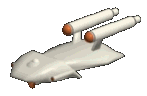
The Andorian ship-building industry was in a poor condition by 2218. During the Earth- Romulan War, Andorian naval ship yards in orbit had built ships of local design totaling many millions tons’ displacement. However, after 2161 few Andorian designs found favor with the new Starfleet as it preferred ships with separate primary and secondary hulls were preferred for reasons of safety and flexibility. Andorian ships placed all ship’s equipment into a single hull with integrated nacelles.
The first ship in many years to be adopted by the fleet based on Andorian designs was the Aryabhatta class Cruiser which began trials in 2221. Hovever, as this ship began testing an urgent need emerged for additional Light Cruisers for Military Operation Command. The Kestrel emerged from this requirement as an upgraded variant of the basic exploration cruiser design. Weaponry included laser cannons and torpedoes. Most science facilities were removed to increase space for fuel, weapons, better damage control facilities, and a larger sickbay. The exploratory bridge module was replaced with a combat bridge with high capacity links to weapons-control processors and target acquisition sensors. The low draft typical of Andorian designs and the countermeasures suite contributed to Kestrel’s small sensor profile. Long-range passive sensors allowed Kestrel to quietly scan extensive areas of the frontier for enemy raiders and scoutships. USS Kestrel, the first ship of the class, commissioned in February 2223.
An engagement in April 2226 with Kzinti raiders in the Little Crescent sector is typical of the actions along the Federation frontier. After an automated station reported a sensor contact with a small group of unidentified ships, USS Caudiptyrex and USS Goshawk were sent to investigate. They discovered six Kzinti heavy cruisers heading to the Federation colony on Slavin H-3. By hcarrying out alternating attack and suppression runs, the two Kestrels inflicted considerable damage on the Kzinti. These actions held the Kzinti for some 5 hours until heavier reinforcements arrived from Starbase 55 to engage the Kzinti. Five of the already weakened invaders were destroyed, and the sixth ship surrendered and was tractored back to Starbase 55.
During their courageous action, the Kestrels were struck at least 25 times each by enemy fire; however, serious casualties were avoided because of the ships robust design and powerful shields. Both ships returned to Starstation Nike under their own power, where they underwent repairs in drydock before returning to duty.
USS Shrike (NCC-1434) of the Kestrel Class is now on display at the Starfleet Museum.
| Class: | VI | Year: | 2223 | |
| Ship Source: | Starfleet Museum | Ship Datasheet: | Download PDF | |
|
|
||||
Commissioned Ships
| USS Kestrel NCC-1406 USS Falcon NCC-1407 USS Aquila NCC-1408 USS Warhawk NCC-1409 USS Kingfisher NCC-1410 USS Caudiptyrex NCC-1411 USS Osprey NCC-1412 USS Vulture NCC-1413 USS Pelecyornis NCC-1414 USS Harrier NCC-1415 USS Roc NCC-1416 USS Diornis NCC-1417 USS Harpy NCC-1418 USS Condor NCC-1419 USS Krechet NCC-1420 |
USS Deinonychus NCC-1421 USS Kite NCC-1422 USS Goshawk NCC-1423 USS Accipiter NCC-1429 USS Pterodactyl NCC-1430 USS Rhamphorhynchus NCC-1431 USS Mononykus NCC-1432 USS Shrike NCC-1434 USS Owl NCC-1435 USS Peregrine NCC-1436 USS Merlin NCC-1439 USS Velociraptor NCC-1442 USS Skua NCC-1443 USS Hobby NCC-1444 USS Sparrowhawk NCC-1445 |

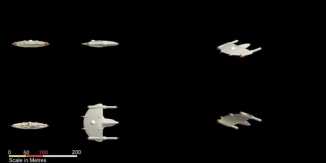
The Eclipse class was designed in parallel with the Asia class. While not a direct sister design they do share many components, most notably the weapons systems are identical on both designs.
| Class: | VI | Year: | 2211 | |
| Ship Source: | Ex Astris Scientia /Bernd Schnieder | Ship Datasheet: | Download PDF | |
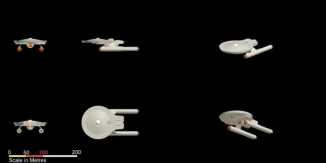

The Detroit Class was produced as the light Cruiser counterpart to the Asia class, although it did not enter service until some 20 years after the Asia class. They were intended to supplement the earlier Eclipse class cruiser, but they were found to be not as versatile.
The class had some notable firsts, including the first shuttlebays on the aft edge of the primary hull, either side of the impulse drive.
The roles intended for the class were mainly exploration and transport, and although relatively lightly armed the class could hold its own in combat.
The class was relegated to second line roles in the late 2240s when the Anton and Tyrannus class commissioned, and the surviving ships were finally withdrawn in the 2260s as they were judged to be unsuitable for upgrading
| Class: | VIII | Year: | 2222 | |
| Ship Source: | Ex Astris Scientia /Bernd Schnieder | Ship Datasheet: | Download PDF | |
Commissioned Ships:
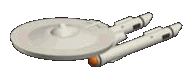
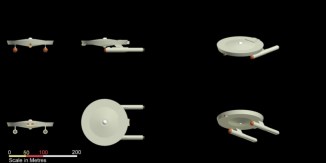
As part of the lesson learnt from the Four Years War, Starfleet realised that the sheer multitude of destroyer classes in service (around 15 different classes) and in production (10) was wholly impractical. The usefulness of twin engine destroyer has been demonstrated during the war, offering extra power for movement and weapons (although at the expense of range and cost). The simple solution proposed to meet the need for twin engine destroyers was to utilise existing single engine designs with a ‘minimum change’ addition of a second engine.
The ‘Twin Saladin’ class was one example of this approach, the design basically added a second warp nacelle to a Saladin Class Destroyer. Unlike the Warhawk class (which added a ventral nacelle), this design added a small secondary hull, upon which warp nacelles were mounted. As with the Warhawk the additional nacelle connected directly into the existing power systems of the Saladin design with no major modification to the design other than some uprating of components to handle the additional power.
After evaluation the decision was made that the Warhawk class would be adopted as it was a more simple design to build. However the promise shown by the ‘Twin Saladin’ meant that it was instead chosen to be intoduced in a new role, as a medium cruiser.
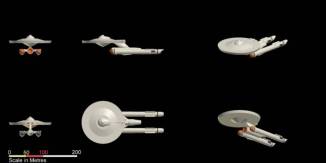
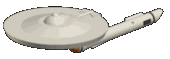
The Saladin was the Destroyer version of the Hermes class scout. The class was 50% more powerful than the similarly sized Larson class. The Saladin was often deployed in Destroyer groups to hunt down enemy shipping. These groups were frequently led by a Cygnus class command ship.
A number of vessels of this class were built in an experimental configuration with a neck mounted deflector dish, instead of the original that was mounted below the primary hull. This modification improved reliability of the deflector system, but did not affect combat performance.
The Hermes class scout was based on the same design as the Saladin class destroyer. As it was more powerful and than the earlier Nelson class it was generally assigned as a scout for battle fleets.
A number of vessels of this class were built in an experimental configuration with a neck mounted deflector dish, instead of the original that was mounted below the primary hull. This modification improved reliability of the deflector system, but did not affect combat performance.

The Hermes class scout was based on the same design as the Saladin class destroyer. As it was more powerful and than the earlier Nelson class it was generally assigned as a scout for battle fleets.
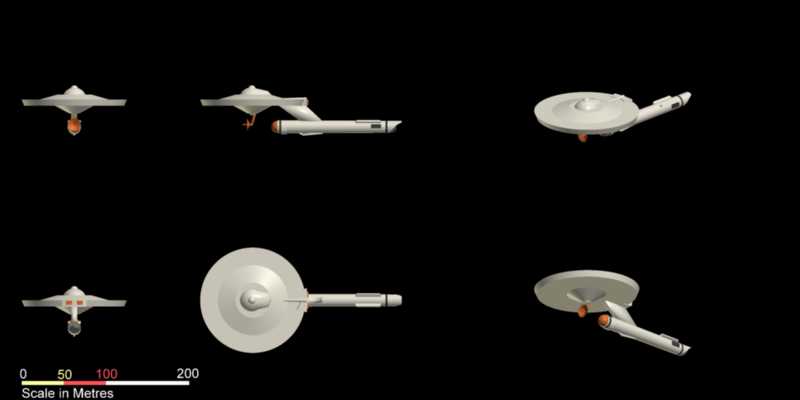

The Cygnus Class entered service in 2246 as a Command Courier version of the highly successful Saladin/Hermes class. The Intention was that an Admiral could use the ship as a sector command post. To this end the design was given the FWC-1 warp drive, giving it more power than its half sisters, the weapons were entirely laser based to make more room for the Admiral’s facilities and command centre.
In 2250, the USS Columbia was converted to a more heavily armed configuration as an experiment to evaluate the benefits of an FWC-1 powered heavy destroyer type. These trials amounted to nothing, but the Columbia was left in this configuration, and was assigned as a Destroyer Leader to a flotilla of Saladins in the Klingon Border Area.
The outbreak of the Four Years War saw a major change in Starfleer Operational Procedure, a number of the Cygnus class ships were involved in near disasters in 2252, as operating independently without escorts as they had been designed to do made them tempting targets. In a fleet role the additional speed of the Cygnus was wasted, so it was ordered to convert the other 8 mk1 vessels to mk2 standards.


 Vintage Starships
You must be logged in to post a comment.