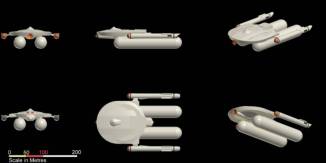
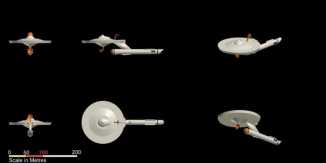
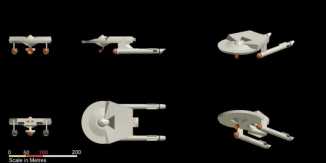
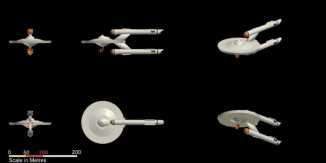
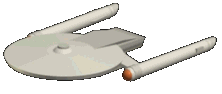
2250 – Cygnus II

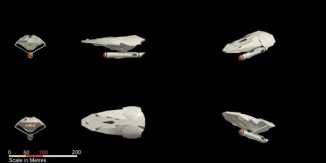
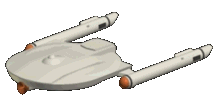
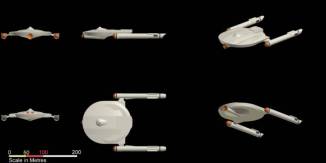
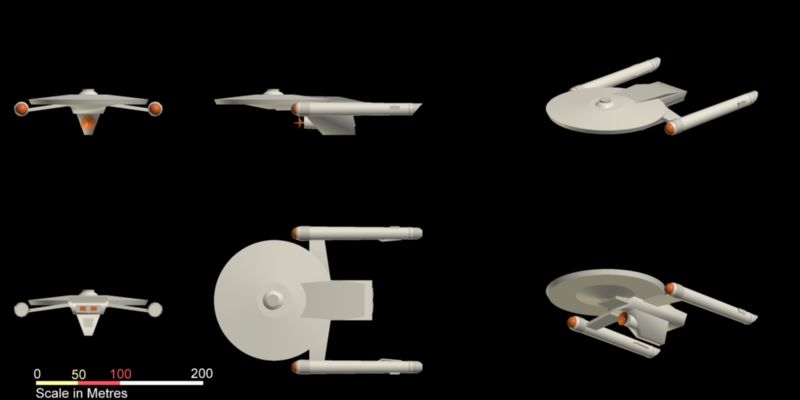
The Cygnus Class entered service in 2248 as a Command Courier version of the highly successful Saladin/Hermes class. The Intention was that an Admiral could use the ship as a sector command post. To this end the design was given the FWC-1 warp drive, giving it more power than its half sisters, the weapons were entirely laser based to make more room for the Admiral’s facilities and command centre.

In 2250, the USS Columbia was converted to a more heavily armed configuration as an experiment to evaluate the benefits of an FWC-1 powered heavy destroyer type. These trials amounted to nothing, but the Columbia was left in this configuration, and was assigned as a Destroyer Leader to a flotilla of Saladins in the Klingon Border Area.
Compared to the Mk1, the Mk2 mounted a pair of rear firing Lasers and also added a pair of FAC-2 accelerator cannons at the expense of the Flag Cabins. The extensive Combat Information Centre initially fitted for the use of an Admirial was retained for suadron level operation command.

The outbreak of the Four Years War saw a major change in Starfleer Operational Procedure, a number of the Cygnus class ships were involved in near disasters in 2252, as operating independently without escorts as they had been designed to do made them tempting targets. In a fleet role the additional speed of the Cygnus was wasted, so it was ordered to convert the other 8 mk1 vessels to mk2 standards.

The nine Cygnus class ships performed valiantly throughout the war, and in many ways paved the way for the later Strike Cruisers which adopted the role of command ship for a Destroyer squadron. Post war the future of these ships was uncertain, as the fleet backed away from a purely military posture, it was eventually decided to convert all of the ships to Hermes specifications to make good the losses suffered by that class.

  • Class:VIII
  • Year:2250
  • Ship Source:Based on Class from Starfleet Technical Manual
  • Ship Datasheet:Download PDF

cygnus_2_large


2249 – Diligent

The Diligent Class Combat Support Tender commissioned in 2249, the ships were intended to provide frontline support to damaged ships, towing them out of the battlefield with the powerful tractors, then assisting them with repairs.

The Class was based on the Coventry Class hull, but with a vertically enlarged rear hull which housed the massive spare part storage bins and the enlarged hanger bays. The Twin FTB-1 Tractors (also fitted in the aft hull) could each haul 300,000 mt. The maximum mass that the Mark 1 could haul was 330,250mt (this covered all class 14 ships, and some class 15), where as the later Mark 2 could haul 480,250mt (including all ships up to class 17, and the majority of class 18 ships as well).

The ships were armed with 4 FL-6 lasers which were meant to give a measure of self defence, in fact coupled with the state of the art shielding the Diligent was a surprisingly capable combat vessel, capable of a very robust defence. With the advent of the four years war these ships were plunged into action. They were initially used in there intended role of recovering crippled Federation ships, but their role developed as the war continued.

In 2255 the USS Stevenson and USS Brunel were employed in a most unorthodox operation, a Klingon Z-3 Station had been placed in a position where it could easily monitor Starfleet Traffic. All previous attacks on a Z-3 had failed as insufficient ships were available locally to push home the attack. The two Diligent class ships were tasked to pull the Z-3 out of its stable orbit and start it moving down towards the planet’s surface, a a Federation Task group was simultaneously attacking the station to prevent it diverting power to its station keeping thrusters. The operation succeeded, but the losses on the Federation side were such that the exercise was not repeated, the losses included the USS Brunel.

2256 saw a more daring but more conventional mission, Starfleet Intelligence learnt of a crippled Klingon D-10 with only a skeleton crew aboard in the vicinity of ‘Malta Station’ within Klingon controlled space that was awaiting recovery. The USS Diligent, the USS Sir Lancelot (an Eagle class Troop ship) and an escort squadron of Baton Rouge class cruisers crossed into Klingon space and successfully captured the vessel, then towed it back to the Federation at the painful speed of warp six. This was the first intact D-10 captured by the Federation and was the source of much valuable intelligence. In all 8 ships of this class were lost or destroyed during the war, but they recovered an estimated 4.5 million mt worth of ships from the battlefields to fight another day.

Class: VIII Year: 2249
Ship Source: Steve Bacon, based on Coventry from Ships of the Starfleet. Ship Datasheet: Download PDF

diligent_large

2258 – Warhawk

As part of the lesson learnt from the Four Years War, Starfleet realised that the sheer multitude of destroyer classes in service (around 15 different classes) and in production (10) was wholly impractical. The usefulness of twin engine destroyer has been demonstrated during the war, offering extra power for movement and weapons (although at the expense of range and cost). The simple solution proposed to meet the need for twin engine destroyers was to utilise existing single engine designs with a ‘minimum change’ addition of a second engine.

The Warhawk class was one example of this approach, the design basically added a second warp nacelle to a Saladin Class Destroyer. As such this second dorsal nacelle could be mounted to feed directly into the existing power systems of the Saladin design with no major modification to the design other than some uprating of components to handle the additional power.

The large numbers of destroyers in service meant that production of the Warhawk was limited to only 24 ships. However this general configuration was later reused on other destroyer types, most notably the Wilkerson class.

  • Class:TBC
  • Year:2258
  • Ship Source: Based on designs from Starfleet Prototype & Starfleet Technical Manual
  • Ship Datasheet:Coming Soon

warhawk_large

2251 – Aaken

The Aakenn Class transport entered service in large quantities during the Four Years War, during which the class was used to move men and materiel to the front and supplies to the rear to keep the Federation’s wartime production at high levels.

Class: VI Year: 2251
Ship Source: FASA Ship Datasheet: Coming Soon

aaken_large

2258 – Pyotr Velilkiy

Ordered as an alternative in case of the failure of the Constitution Class. The delays to Constitution Class and poor performance of the Ranger II meant that the Pyotr Velilkiy served as an interim Heavy Cruiser, and was ordered in quantity in response to Klingon aggression in 2244.

The eventual entry of the Constitution Class to service in large numbers meant that the Pyotr Velikiy was relegated to less glamorous duties, and some were converted to serve as tugs. The Cruiser version was phased out by 2312.

The Pyotr Veliky class was conceived as fall back design in case of delays to the Constitution Class Program. The Protoype, USS Pyotr Veliky named for the Tsar who created Russia’s Imperial Fleet, entered service in 2241. The ship mounted the ultimate non dilithium warp drive to enter service, the FFTL-7B and was the only class fitted with this engine. The other technology of this design was also well proven, in direct contrast to the advanced systems chosen for the Constitution Class. The class was designed and built at Andorian shipyards in an effort to disperse the strategically important role of building heavy cruisers away from Earth, additionally much of Earth’s ship building and design capacity was tied up in the Constitution class program.

Delays to the Constitution Class led to the ordering of 5 Mk 2 ships, the first of which entered service in 2244. The Mk 2 featured improved laser weaponry and improvements to cargo handling systems. The Pyotr Veliky class, despite it’s old technology warp reactor did have the same nacelle design as would be used on the Constitution, and many minor improvements made to the nacelles on these ships found their way into the Constitution class nacelles.

As the Mk2 ships entered service, increased Klingon aggression prompted an order to be placed for 14 Mk3 ships. The Mk3, which entered service in 2245 mounted the brand new FAC-4 accelerator cannon, but the main advance was with shielding. The New unary shields were now coming into service, and the FSG was selected to replace the inefficient system mounted on earlier ships. The FSG required the addition of a new style M series computer, and the M3 was accordingly fitted.

With the Constitution class beginning to be available in quantity by 2250, steps were taken to refit the 20 Pyotr Veliky ships for further service. 14 Ships were refitted to MkIV standards for service with Military Operations Command, and 6 to MkV for service with Galaxy Exploration Command.

The MkIV adopted the FWD-1 warp drive, this drive at half the weight of the FFTL-7B meant that the ship’s mass dropped by almost a 100,000mt. The resultant ships, although less powerful, were more efficient in movement and had a higher maximum speed, useful for patrol duties. The only old technology system retained aboard the ships was the dependable FNSP-X impulse system, as no newer style engines could yet power ships of Class XI. The refits were all complete at the outbreak of the Four Years War, where this class served distinction.

The MkV adopted the even lighter FWE-1 Warp drive, and had a major physical change with the removal of the secondary hull. These ships had been intended for use in an exploration role, but the Four Years War saw them serve as Frigates until the Surya and Coventry classes entered full service. The MkV mounted the same weapons as the MkIV and the FIC-3 impulse engine meant that it had the same amount of power as its larger sibling, but the lighter structure could absorb less damage.

Postwar surviving vessels were used in second line roles, some for exploration (Mk6) and some as cargo tugs(Mk7) or transports (mk8), although a small number did remain in defence roles with the Blue Fleet (Mk9).

The last Pyotr Veliky was not retired from service until 2312, that vessel, the USS Salah Ad-Din is now on display in the Starfleet Museum.

  • Class: IX
  • Year: 2250 (Mk V)
  • Ship Source: Starfleet Museum
  • Ship Datasheet: Download PDF

pv-tug-70

Commissioned Ships

USS Pyotr Velikiy NCC-1670

USS Shrelev II NCC-1671

USS Yi Sun-Shin NCC-1672

USS John Paul Jones NCC-1673

USS Tav NCC-1674

USS Elizabeth I NCC-1675

USS Etrox NCC-1676

USS Togo NCC-1677

USS Rommel NCC-1678

USS Friedrich Barbarossa NCC-1679 USS Goyathlay NCC-1680

USS Washington NCC-1681

USS Niakenchiis NCC-1682

USS Salah Ad-Din NCC-1683

USS Giap NCC-1684

USS Hannibal NCC-1685

USS Zerisshebi NCC-1686

USS De Grasse NCC-1687

USS Rexx NCC-1688

USS Gantu NCC-1689

2250 – Pyotr Velilkiy

Ordered as an alternative in case of the failure of the Constitution Class. The delays to Constitution Class and poor performance of the Ranger II meant that the Pyotr Velilkiy served as an interim Heavy Cruiser, and was ordered in quantity in response to Klingon aggression in 2244.

The eventual entry of the Constitution Class to service in large numbers meant that the Pyotr Velikiy was relegated to less glamorous duties, and some were converted to serve as tugs. The Cruiser version was phased out by 2312.

The Pyotr Veliky class was conceived as fall back design in case of delays to the Constitution Class Program. The Protoype, USS Pyotr Veliky named for the Tsar who created Russia’s Imperial Fleet, entered service in 2241. The ship mounted the ultimate non dilithium warp drive to enter service, the FFTL-7B and was the only class fitted with this engine. The other technology of this design was also well proven, in direct contrast to the advanced systems chosen for the Constitution Class. The class was designed and built at Andorian shipyards in an effort to disperse the strategically important role of building heavy cruisers away from Earth, additionally much of Earth’s ship building and design capacity was tied up in the Constitution class program.

Delays to the Constitution Class led to the ordering of 5 Mk 2 ships, the first of which entered service in 2244. The Mk 2 featured improved laser weaponry and improvements to cargo handling systems. The Pyotr Veliky class, despite it’s old technology warp reactor did have the same nacelle design as would be used on the Constitution, and many minor improvements made to the nacelles on these ships found their way into the Constitution class nacelles.

As the Mk2 ships entered service, increased Klingon aggression prompted an order to be placed for 14 Mk3 ships. The Mk3, which entered service in 2245 mounted the brand new FAC-4 accelerator cannon, but the main advance was with shielding. The New unary shields were now coming into service, and the FSG was selected to replace the inefficient system mounted on earlier ships. The FSG required the addition of a new style M series computer, and the M3 was accordingly fitted.

With the Constitution class beginning to be available in quantity by 2250, steps were taken to refit the 20 Pyotr Veliky ships for further service. 14 Ships were refitted to MkIV standards for service with Military Operations Command, and 6 to MkV for service with Galaxy Exploration Command.

The MkIV adopted the FWD-1 warp drive, this drive at half the weight of the FFTL-7B meant that the ship’s mass dropped by almost a 100,000mt. The resultant ships, although less powerful, were more efficient in movement and had a higher maximum speed, useful for patrol duties. The only old technology system retained aboard the ships was the dependable FNSP-X impulse system, as no newer style engines could yet power ships of Class XI. The refits were all complete at the outbreak of the Four Years War, where this class served distinction.

The MkV adopted the even lighter FWE-1 Warp drive, and had a major physical change with the removal of the secondary hull. These ships had been intended for use in an exploration role, but the Four Years War saw them serve as Frigates until the Surya and Coventry classes entered full service. The MkV mounted the same weapons as the MkIV and the FIC-3 impulse engine meant that it had the same amount of power as its larger sibling, but the lighter structure could absorb less damage.

Postwar surviving vessels were used in second line roles, some for exploration (Mk6) and some as cargo tugs(Mk7) or transports (mk8), although a small number did remain in defence roles with the Blue Fleet (Mk9).

The last Pyotr Veliky was not retired from service until 2312, that vessel, the USS Salah Ad-Din is now on display in the Starfleet Museum.

  • Class: IX
  • Year: 2250 (Mk V)
  • Ship Source: Starfleet Museum
  • Ship Datasheet: Download PDF

pv_nopod_70

Commissioned Ships

USS Pyotr Velikiy NCC-1670

USS Shrelev II NCC-1671

USS Yi Sun-Shin NCC-1672

USS John Paul Jones NCC-1673

USS Tav NCC-1674

USS Elizabeth I NCC-1675

USS Etrox NCC-1676

USS Togo NCC-1677

USS Rommel NCC-1678

USS Friedrich Barbarossa NCC-1679 USS Goyathlay NCC-1680

USS Washington NCC-1681

USS Niakenchiis NCC-1682

USS Salah Ad-Din NCC-1683

USS Giap NCC-1684

USS Hannibal NCC-1685

USS Zerisshebi NCC-1686

USS De Grasse NCC-1687

USS Rexx NCC-1688

USS Gantu NCC-1689

2243 – Nelson

The Nelson class scout was primarily designed to act as a scout for Galaxy Exploration command, it had much in common with the Constitution class Cruisers and the other ships of the period. The class can be distinguished from the similar Hermes class scout by the V formation of the warp nacelle supports

Class: VI Year: 2243
Ship Source: FASA Ship Datasheet: Download PDF


nelson_large

2255 – Detroyat

Detroyat by VintageStarships on Sketchfab

The Detroyat class Heavy destroyer holds the distinction of being the Largest destroyer type built in the 22nd or 23rd centuries. One of the most powerful ships in known space when commissioned, the class remained in a frontline role for 50 years, although the class was reclassified as a long range scout in 2255. The class has an enviable reputation for surviving no matter what the odds. Only one ship of the class was lost in all those years of service.

Class: XI Year: 2255 (Reclassification)
Ship Source: USS Detroyat Class Heavy Destroyer Blueprints Ship Datasheet: Download PDF

detroyat_mod_100

2224 – Detroyat


The Detroyat class Heavy destroyer holds the distinction of being the Largest destroyer type built in the 22nd or 23rd centuries. One of the most powerful ships in known space when commissioned, the class remained in a frontline role for 50 years, although the class was reclassified as a long range scout in 2255. The class has an enviable reputation for surviving no matter what the odds. Only one ship of the class was lost in all those years of service.

Class: XI Year: 2224
Ship Source: USS Detroyat Class Heavy Destroyer Blueprints Ship Datasheet: Download PDF

detroyat_mod_100