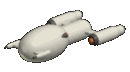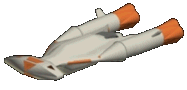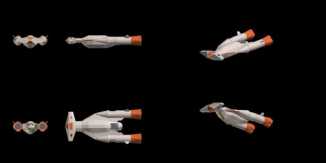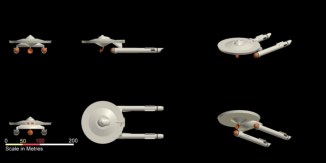
2243 – Apache

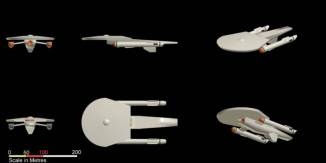
Historically, Starfleet had only ever fielded one heavy Destroyer class, the Detroyat class of 2224. In 2243, Starfleet Tactical suggested the development of a new tactic for Destroyer operations, the use of leaders. New sensor technology, such as that fitted to the Constitution class offered massive range improvements, but it was felt that the sensor suite and associated systems were too large to be fitted to standard Destroyers. As a result the 10 Detroyat class ships were refitted with modern warp drives, and with the new sensor systems, it was also decided to order 26 vessels to supplement the Detroyats. The total of 36 Heavy Destroyers was felt to be sufficient to allocate one to each group of 6 standard destroyers operating along the Klingon and Romulan borders. The Heavy Destroyer would act as the command ship for the group, and also provide long range sensors.

The design, later to be named Apache, started off as a modified Detroyat design. During the design process the class evolved, the saucer was modified to feature an elongated rear edge and the secondary hull was massively enlarged compared to that of the Detroyat. It was intended that the Apache would be allocated to Destroyer groups allocated to more remote areas, and as a result the secondary hull was enlarged to enable it to carry spares and supplies to support its assigned group.

In service the Apache proved to be as dependable as its illustrious ancestor. Destroyer groups led by Apaches served with distinction throughout the Four Years War, and a group led by the USS Tartar was instrumental in the Attack of Convoy Y-16Z in 2253, the first significant Federation fleet victory of the war. So effective was the Leader concept, that a number of Cygnus class command couriers were rearmed and modified to act as Leaders to supplement the insufficient numbers of Detroyats and Apaches.

Postwar the fortunes of the Apache, and the leaders in general waned. The progress in miniaturisation meant that conventional destroyers could now mount the long range sensors far more economically. As a result the Detroyats were reclassified as long range scouts and assigned to exploration duties, and the new leader class, the Derf, was modified to become a tender. The 18 surviving Apaches were retained in service, but were grouped together to form three heavy destroyer groups, which were assigned to the defence of Terra, Vulcan and Alpha Centauri. In 2258 the ships were rearmed with phasers and photon torpedoes.

Heightened tensions leading up to the Organia conflict led to the Apaches being refitted again, and recalled to the Klingon Border. This time they served as sector command ships, supplementing the Perimeter Action Ships of the Kiaga and Agilis classes. The success of the ships in this role led to them being reclassified as Strike Cruisers (interim) in 2268, and they served in this capacity until the Belknap class entered full service.

The Apaches were progressively retired to reserve from 2280 onwards as the Belknap class ships assumed their role.

The Apache class was named by Admiral Wood, commander of Military Operations Command in commeration of his first command, the Mann class Cruiser USS Apache.

  • Class:TBC
  • Year:2243
  • Ship Source:Starship Size Comparison Chart
  • Ship Datasheet:Coming Soon

apache_2_final_70

2250 -D7B ‘ugh (Heavy)

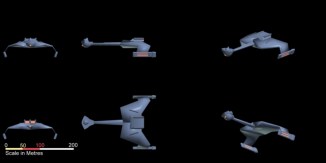
The Heavy Cruiser variant of the D7, the D7B was produced for some of the more militant of the Klingon houses. Compared to the standard D7 the ship was far more effective in combat efficiency terms, although more costly and time consuming to build. Some 280 ships were built between 2250 and 2252, when production was switched to the more capable still D10 class.

Although highly capable and successful, production of the ‘ugh (heavy) version of the D7 was limited as it was viewed as an interim counter to the Federation Heavy Cruisers program prior to the D10 entering service in large numbers.

Class: X Year: 2250
Ship Source: Paramount Pictures/ The Starfleet Museum Ship Datasheet: Download PDF

d7a-100


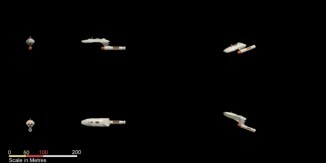
2241 – D7A ‘Painbringer’ Class

The Immortal D7 cruiser, which became an enduring symbol of Klingon military power in the second half of the 23rd century, was rushed into service in the early 2250s to fulfil roles of offense, defense, and diplomacy. The design was a scaled up version of the D-1 cruiser of almost 100 years earlier. The D-7A was the first of the lighter more agile family of D-7 variants that ultimately led to the D-7M k’t’inga.

  • Class:VIII
  • Year:2241
  • Ship Source:Paramount Pictures/ FASA
  • Ship Datasheet:Coming Soon
d7a-100


2240 – XD7

The Original intention was for the D-7 to have dorsal mounted Warp engines. Limited production of this variant took place, but trials showed the layout was inferior to the traditional low nacelle layout.

Class: TBC Year: 2240
Ship Source: The Art of Star Trek/ Matt Jeffries Ship Datasheet: Coming Soon

xd7-100

2155 – Fireball

The Fireball class was created as an experimental cruiser type that was intended to test new technologies and new warp field configurations. In early Engineers speculated that dividing a spacecraft’s enveloping warp field into a smaller forward “penetrating” lobe and a larger trailing lobe would decrease subspace resistance and increase warp efficiency. The Fireball class was designed with the innovative feature of a small command hull separated by a thin neck from the larger engineering hull to test this theory. Another change from most recent designs of the era was that the Warp nacelles were raised above the hull, this was again in an effort to boost warp efficiency.

The Fireball class used the new FFTL-2A warp drive system. This drive as much power as the old EFTL-5, but at less than half the mass, this allowed the Fireball class to be far smaller than the previous generation of cruisers. The Fireball and her sister ship Rocket had originally been planned to just be technology demonstrators, but the design was to successful that an armed variant was ordered in late 2158, this became the Comet class.

These two ships continued to be as test beds in the development of the second-generation of M/AM-powered ships. In 2165, at the conclusion of their research careers they were allocated to Starfleet and served as couriers until 2193.

USS Fireball is now on display at the Starfleet Museum.

The Experimental NG (New Generation) engines and shield systems were redesignated as part of the Federation Designation System in 2161.

comet_side_large


2158 – Torsk

The Torsk class destroyers were designed as multi role vessels. The first intended role was to gather intelligence along border areas, and return that information to the fleet. The Second designed role was to act in a hunter killer role against enemy scout ships. Accordingly the Torsk class was designed to be faster than the Krechet class, but more lightly armed as it was intended for fleet actions.Torsk class ships were the first to carry the improved EFTL-6 warp reactor, which was 30% smaller but only 10% less powerful than the EFTL-5 carried by the Krechet class ships.

Because of the narrowly defined roles that the Torsk class ships were designed to play, they were much less expensive to build and operate than the Krechet class cruisers. They carried fewer weapons, had a 35% smaller crew, and were 25% lighter. Fourteen TORSK-class destroyers entered service from February through December 2158. However, they saw little action in their intended roles as Romulan forces withdraw and consolidated in anticipation of an UE Alliance offensive. They were, however, used as radar pickets and scouts when UE Alliance task forces pushed into Romulan territories in the final 2 years of the war, and five were lost in the course of these actions. Torsk ships did well in these limited roles, but were eventually superseded by the significantly more capable and versatile Powhatan class.

The TORSK-class Destroyer UES STINGRAY (CEM-6) is now on display at the Starfleet Museum.


Class: VII Year: 2158
Ship Source: The Starfleet Museum Ship Datasheet: Download PDF

Commissioned Ships:

UES Torsk CEM-1
UES Nautilus CEM-2
UES Holland CEM-3
UES Dolphin CEM-4
UES Navaga CEM-5
UES Stingray CEM-6
UES Porpoise CEM-7
UES Seawolf CEM-8
UES Han CEM-9
UES Rickover CEM-10
UES Shalki CEM-11
UES Borei CEM-12
UES Haifa CEM-13
UES Hai Lung CEM-14
 

2154 – Marshall

“The ambush and loss of the UES Patton began the Romulan War. The Marshall class was the Earth’s staunchest line of defence, and these ships’ superior performance and firepower provided a crucial tactical edge. In fact, the class supposed to succeed it could not better its specifications and so was never built, the reason why the Marshall class had the longest commissioned lifespan in interstellar history (at that time).”

The Marshall class destroyer was produced in vast numbers during the Romulan War. It was not the most powerful ship of its type, but it was easy and quick to produce at a time when every ship that could be built was a valuable addition to the Fleet. It was generally used as a convoy escort and patrol vessel. The USS Patton of this class has the dubious distinction of being the first ship destroyed in the Romulan War

Class: III Year: 2154
Ship Source: Space Flight Chronology Ship Datasheet: Download PDF

marshall_sharp

2141 – Cavalry

“The Cavalry Class entered service in 2141, and was the main Destroyer class in service until the advent of the Marshall Class. These ships gave sterling service, but have been overshadowed in history by the prolific Marshall Class. In terms of basic layout, these ships can be considered the precursor of later Destroyers and Scouts of the Saladin Class family.”

The Cavalry Class entered service in 2141 as the UESN’s primary destroyer type. Visually very distinctive with its boat like hull and single underslung warp nacelle, the class was a very familiar site throughout the period 2140s and 50s. The Class did have some notable advances, it was one of the first designed to have routinely jettisonable/reattachable warp nacelle, which meant that major work on the nacelle could be undertaken by simply swapping the nacelle assembly. As a design created during the ‘peaceful’ 2140s, despite its destroyer nomenclature, the class was used primarily for policing and customs work.

A limited upgrade in 2151, following encounters with the Klingons, equipped the ships with a lighter improved warp drive (still fusion based) and a modest increase in weapon capacity. The main improvement resulting from these changes was 50% reduction in energy cost during manouevering, allowing more power to be used for shields and weapons.

Heightening tensions with the Romulans led to a final upgrade in 2156, when one of the first mass produced M/AM powerplants replaced the fusion systems. This gave the ships space for further weapons upgrades, and a another 50% cut in maneouevering energy costs. The downside of the changes was that the shield had to be downgraded to an EDS-M to keep the class in its mass limits, however given the limited power available for shields, the effect of this change was minimal.

During the war, these ships were employed in second line roles, given the emergence of the far more powerful Torsk and Marshall clases, but they did as a result provide a valuable role in allowing the more modern classes to be directed to the front lines. All Cavalry class ships were retired at the end of the war, and as such none saw service in the UFP Starfleet.

Class: II Year: 2141
Ship Source: Image based on FASA design  (labelled as Marshall Class).
Stats by David Gaba
Ship Datasheet: Download PDF

cavalry_b_100


2243 – Cassard

The Cassard class Missile Destroyer was designed in 2242 to provide the fleet with accelerator cannon support.

The USS Cassard commissioned in mid 2243, and made use of the recently introduced M-1 control computer.

The Cassard served well in the skirmishes and conflicts with the Klingon Empire over the from 2243 until 2288. The first time they were really tried in combat was in 2248. In this encounter near Federation Outpost 1 a Klingon task force of three D-7A’s and six D-16’s  attacked six ships from the 6th fleet. Four Cassard class ships led a counter attack by eight other ships of the 6th fleet, making full use of their accelerator cannons. The Klingon flagship was destroyers by the opening volleys, and the Cassards then continued to attack the other ships in turn. The battle ended 30 minutes later with the loss of three Federation vessels, while the Klingons all but three of the D-16’s. The Cassards  continued to perform well in fleet actions when used in concert with other starships providing beam weapon suppor, but when used without such support they were found to be extremely vulnerable. As a result the Cassard class was redeployed  from independent patrol duties and mainly assigned to fleet support duties..

In 2258 the MK II version was introduced, this version mounted the new Photon Torpedoes, but the beam weapons remained weak. It was not until 2268 when the MK III version entered service that the beam weapons were finally upgraded. Until the class left service it retained the ‘classic’ design and PB series circumferential warp nacelles.

Starfleet decommissioned the last units of the Cassard class in 2288, when the remaining ships where mothballed.  26  of these ships were sold to the Affiliation of Outer Free Worlds in 2304. The USS Cassard was placed into the Starfleet museum in 2305.

Class: VI Year: 2243
Ship Source: Bill Colley Ship Datasheet: Available at tacticalstarshipcombat.com

cassard_side