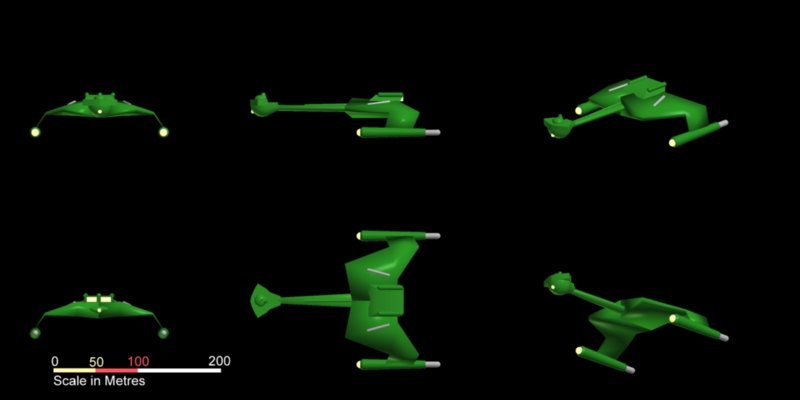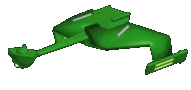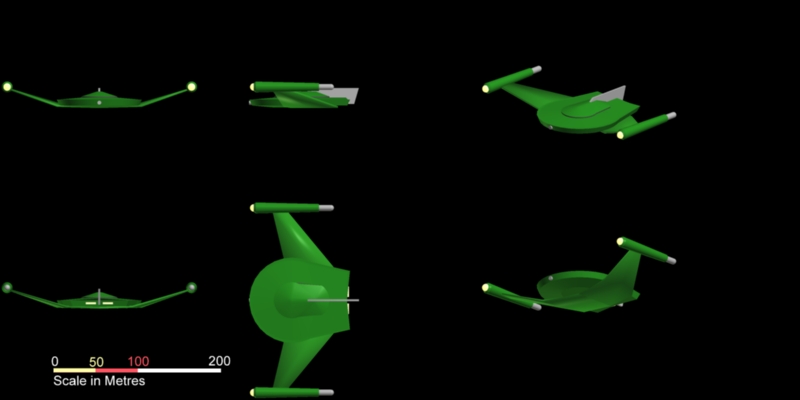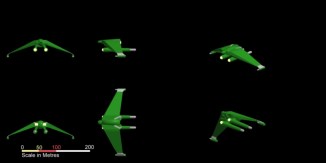
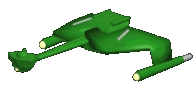
2269 – V11B Thevas’kalabam (Stormbird B)

Because of the Romulan-Klingon technological exchange treaties, the Klingons agreed to exchange their D-7A Class cruisers for Romulan plasma weapons and several old-style cloaking devices.  These vessels, delivered Stardate 2/09, 2/12, and 2/17 became the V-11 Class.

The 80 vessels in the initial shipment were stripped of their weapons, but the Klingon engines were retained to form the Type 1.  The 42 in the second shipment were delivered without engines, shields, or weapons; these were fitted as the Type 2 with a plasma weapon and more efficient shielding.  The 50 vessels in the final shipment also were delivered completely stripped, and these were fitted as the Type 5, with fore and aft-mounted photon torpedoes reminiscent of the Klingon D- 7M Class.  Types 3 and 4 are modified Type 1s.

Although 172 of these ships have entered Romulan service, they are not liked by their commanders or crews, many of whom consider them to be enemy vessels.  In recent years, the Romulans have begun deploying many of the approximately 160 remaining in active service along the Klingon borders in direct violation of the signed accords.  The class is named for thevas’kalabam (bird of storms), a small, flying predator of Remus.  These nocturnal avians are often seen gliding on the rising winds before a storm and it is said they are capable of traveling hundreds of miles in the vanguard of a storm.

Class: VIII Year: 2269
Ship Source: FASA/Paramount  Pictures Ship Datasheet: Coming Soon

v-11b-100

2266 – V11A Thevas’kalabam (Stormbird)

Because of the Romulan-Klingon technological exchange treaties, the Klingons agreed to exchange their D-7A Class cruisers for Romulan plasma weapons and several old-style cloaking devices.  These vessels, delivered Stardate 2/09, 2/12, and 2/17 became the V-11 Class.
The 80 vessels in the initial shipment were stripped of their weapons, but the Klingon engines were retained to form the Type 1.  The 42 in the second shipment were delivered without engines, shields, or weapons; these were fitted as the Type 2 with a plasma weapon and more efficient shielding.  The 50 vessels in the final shipment also were delivered completely stripped, and these were fitted as the Type 5, with fore and aft-mounted photon torpedoes reminiscent of the Klingon D- 7M Class.  Types 3 and 4 are modified Type 1s.
Although 172 of these ships have entered Romulan service, they are not liked by their commanders or crews, many of whom consider them to be enemy vessels.  In recent years, the Romulans have begun deploying many of the approximately 160 remaining in active service along the Klingon borders in direct violation of the signed accords.  The class is named for thevas’kalabam (bird of storms), a small, flying predator of Remus.  These nocturnal avians are often seen gliding on the rising winds before a storm and it is said they are capable of traveling hundreds of miles in the vanguard of a storm.

Class: VIII Year: 2266
Ship Source: FASA/Paramount  Pictures Ship Datasheet: Coming Soon

v-11a-100

2265 – V9 Temar Vastaram (Night Flyer)

The V-9 Class, created from plans for the older V-8 (Bird Of Prey) Class, was constructed in response to the need for increased firepower and speed.  Its similarity to the V-8 on casual inspection is responsible for the prolonged myth that the V-8 was the mainstay of the Romulan Navy. 

The Type 1 was introduced about Stardate 2/0805.  It was the first vessel in the Romulan fleet to carry two plasma weapons, and it had an impressive array of disruptors and a cloaking device.  This vessel reportedly became extremely popular with front line commanders, because of its ability to deliver multiple plasma weapon strikes.  It did not, however, address the speed problem still seen in the concurrent Type 4 V-8, and several power plant changes resulted in the successful Type 6.

Of the approximately 180 V-9s constructed, about 160 remain in active service; of these, some are known to be assigned to Romulan Intelligence as training vessels.  There are reports of these vessels operating within the Triangle.

The class is named from the RomuIan temar vastaram (night flyer), in reference to a small, nocturnal, flying predator native to Remus.  The Eridam Papers state that they were the source of many ancient legends and myths about invisible predators from another dimension.

2257 – V7 Aye Mosaram (Whitewind)

Like their counterparts in the V-6 Class, the V-7s were designed for multiple roles, with spacious in- teriors and complete onboard research facilities.

The Type 1 entered service about Stardate 2/12 and is still being produced as a support ship, even though it is not as efficient in combat as later models.  Mounting the RPL-2 plasma weapon and a cloaking device, the Type 1 is capable of operating alone.

The Type 3, introduced about Stardate 2/17, is the preferred model of the class.  It mounts two additional disruptors and three photon torpedoes, and it has more efficient shields.

Of the approximately 80 V-7s built, nearly all remain in active service.  Current production of the Whitewind is estimated at six per year.

The aft weaponry of the V-7s has set the standard for the Romulan Navy, as exemplified by this Project Grey Ghost report of an incident between two V-7s and two Klingon L-9 class frigates. The V-7s, investigating asteroid clusters, detected the Klingons as they approached.  Both V-7s cloaked and deployed.  As the unsuspecting Klingons began surveying the asteroids, the V-7s de-cloaked and opened fire, only to have the Klingons disappear from view and sensor, obviously taking advantage of cloaking capabilities acquired in the technological exchange.  In the waiting game that followed, all four ships remained cloaked and invisible to sensors for several hours.  Finally, one of the Klingon commanders became impatient and attempted to warp away from the area.  Unfortunately, his path of departure resulted in a collision and catastrophic explosion.  The remaining ships immediately de-cloaked, only to find themselves lying aft to aft, which put the Klingon at a disadvantage because of its lack of torpedoes to the rear.  It suffered serious damage and surrendered to the Romulan commander, who allowed the Klingon to leave after surrendering the cloaking device.

The class is named for a meteorological disturbance peculiar to Remus.  As described in The Eridam Papers, twice per Remus year, a hot wind blows across the northern hemisphere for as long as five days.  Mineral particles from the western cliffs are borne aloft by the winds, and, at night, their phosphorescense causes the hemisphere-wide nightglow that gives the weather phenomenon its name aye mosaram (white wind).

Again, to make this class fit in the right position I’ve bought it forwards, this can be attributed to an error in Project Grey Ghost’s data.

2257 – V8 Vas Hatham (Bird of Prey) (“Cricket”)

On Stardate 2/0710 (2266), a V-8 was encountered by a Star Fleet cruiser patrolling the Neutral Zone, the first such contact in over 100 years and the very first visual contact with a Romulan war vessel.  The incursion into Federation space obviously was intended to test UFP defenses, and the V-8 destroyed several listening posts and bases before being heavily damaged by the Federation vessel and self-destructing to avoid capture.  Because of this incident, and because these ships were encountered in increasing numbers afterward, this vessel, more than any other, has been identified with Romulan military actions.  For many years, these vessels were believed to be the mainstay of the Romulan fleet, but improved intelligence reveals that this was a misconception.

The vessel was designed to carry the RPL-2 plasma weapon; because of its size and bulk, the Type 1 ships–136 meters long–actually were built around the 110-foot-Iong weapon.  The other major feature of the Type 1 was the use of new shielding technology.  The Type 4, with upgraded disruptors, was introduced to overcome the inadequate firepower of earlier models.

Of the approximately 100 ships built, about 40 are assigned to reserve fleets.  Six have been modified and sold to the civil sector, including two Type 1s, one each of Type 2 and Type 3, and two Type 4s, all of which operate in and out of the Triangle.

The class is named for the Romulan vas hatham (bird of prey), in reference to a huge, flying predator reportedly native to Romulus, but so revered that they have been transplanted to several of the conquered worlds in the empire.  Living for nearly 100 years, these avians can reach nearly giant proportions, some having wingspans as wide as 50 feet and weighing as much as 400 pounds.

Class: IX Year: 2257
Ship Source: The Starfleet Museum FASA Ship Datasheet: Coming Soon

v8-100

2256 – V6 S’ten Vastam (Gallant Wing)

The V-6 class was considered to be the ultimate replacement to fill the need for both a military vessel and a research vessel.  Designed much like Star Fleet research cruisers, they are well equipped for research duties and for combat.

At the time of their introduction about Stardate 2/09, they were the most powerful ships in the fleet.  The Type 1 mounted six of the most powerful disruptors available and the RPL-2 plasma weapon.  Although these vessels never saw combat with any Federation ships, it is speculated that this model would have been an even match for a Constitution Class cruiser.

With the Type 5, introduced about Stardate 2/11, the combat efficiency improved because its more powerful disruptors, more efficient shields, and stronger superstructure.  At this time, all Type 1s were recalled for refitting to the new configuration, and, by Stardate 2/13, this process had been completed.  The Type 5 remained in service until about Stardate 2/22, when all had been converted to the Type 7.

The Type 7, introduced on Stardate 211607, mounted improved engines and was structurally improved.  Vessels of this type are expected to remain a mainstay of the active Navy.

Of the approximately 100 V-6s built, nearly all remain in active service.  One operates as a private research vessel, appearing infrequently in the Triangle.

The class is named from the RomuIan s’ten vastam (gallant wing).

NB To fit in I’ve decided that this class was actually commissioned 10 years prior to the converted FASA date

2253 – V5 Ralaaram Ocala (Skyfire)

The V-5 Class, apparently brought into service to supplement the V-2 Class, combines the need for a military vessel with that of a research vessel.  Though it reportedly is quite capable for combat roles in which the V-2 is a failure, it fills its research roles less well.  The Type 1 mounted an impressive array of disruptors with very good fields of fire.  The Type 2, introduced about Stardate 2/00, saw the removal of the forward firing disruptors in favor of a bow-mounted plasma weapon, but this version did not prove to be as combat efficient as the earlier model and has not been reported in any great numbers.

Of the approximately 80 built, about 50 are assigned to reserve fleets.  Several are used as training vessels, and eight are reported to be in use as private research vessels or cruisers.

The class is named from the RomuIan ralaaram ocala (fire from the sky), in reference to its military capabilities.

2251 – V4B Vastam cl’vangas (Wing of Vengeance)

The V-4 class has, by far, the most unusual design to come from Romulan engineers; fashioned like a giant wing, it was created not only for aesthetics but for combat.  When the vessels were first introduced, they were intended to lead an expansion effort, but the war between the Klingons and Federation caused them to be sent to patrol the Klingon border.  The Type 2 mounted a more powerful impulse drive system and improved disruptors, which accounted for its greater combat efficiency.

The V-4s were painted by crewmembers in a variety of patterns.  These ships, though popular with their crews, were removed from service sometime after Stardate 2/16 for more powerful designs.  Of the approximately 135 built, about 65 are in reserve fleets.  Six are reported to be used as training vessels, and two are used as spaceborn museums, one each stationed at Remus and at Corill.  Eighteen are known to be operating in the civil sector.

On Stardate 1/9611, nine of these vessels are known to have been sent into the Triangle to liberate a small system from the Klingons.  The Romulans pressed the attack against the three D-7s protecting the system, immediately destroying two and driving the other away.  Flushed with victory, the Romulan commander sent five of his group after the fleeing enemy, but they encountered nine D-7s and three D-10s arriving to reinforce the area.  The Romulans flew into a classic trap laid by the Klingon battlegroup, and three were destroyed before getting off one shot.  The remaining Romulans miraculously crippled four of the Klingon vessels before one was crippled itself and the remaining vessel fled.  The Klingons abandoned the effort and withdrew from the area.

This battle caused a stir in the Klingon High Command, as the ship had never before been encountered.  Because the stories told of its abilities were inflated to make the Klingon fleet commander look good, the V-4s enjoyed an undeserved notoriety amongst the Klingons for many years.

The class is named from the Romulan vastam cl’vangas (wing of vengeance), in reference to the vessel’s combat capabilities.

Class: Year:
Ship Source: FASA Ship Datasheet: Coming Soon

v4-long-100

2248 – V2 Hathos (Hunter)

The V-2 Class, first encountered by Project Grey Ghost, is believed to have been built for research missions, much like the Federation research cruisers are.  Reportedly, spacious laboratory facilities and shuttlebays for cargo storage make this ship an oddity in the Romulan navy.  Several recent combat encounters with the Klingons and forces to the coreward have proved the vessel to be undergunned and unsuitable for combat.

Several attempts were made to up-gun the ship, with the last being the introduction of the Type 5, approximately Stardate 2/00.  This version is reported to carry a small plasma weapon and improved impulse drive system.  Even so, the V-2 did not prove popular, and has been replaced by the V-5 and V-6 cruisers.

Of the approximately 70 Hunters built, about half are reported to be in reserve fleets and about 20 are reportedly working as research vessels for private firms.  This vessel has not yet been scanned at close range, and plans given are highly speculative.  The ship is named from the RomuIan hathos (hunter), likely in reference to its mission in the Exploration Division.

2245 – V1 Vadaso Stelri (Star Glider)

Soon after its introduction into exploratory service, the V-1 vessels were found to be unsuitable for their mission.  The cramped quarters and work areas would not permit extensive onboard research and testing, which meant that the ships were compelled to land on most worlds to carry out their studies.  Not only were such atmospheric operations difficu It, but the exposure of the entire ship to unknown environments put them in constant danger.  These risks were unacceptable to the Romulan High Command, so the class was reassigned as cruisers to supplement the fleets.  It evidently saw no greater success in this role, for it was removed from active service about Stardate 2/0806.  The Type 2 mounted better, bank-mounted weaponry and a more powerful impulse drive.

Of the approximately 100 built, half are assigned to reserve fleets.  Eighteen have been sold to the civil sector, where they are used as private research vessels; two operate exclusively within the Triangle.

The class is named for Vadaso Stelri (glider in the stars), an asteroid in the Romulan home system.  Ancient legend is reported to state that this glider was a returning message from the gods, directing the Romulans to follow it on its road through the stars.