
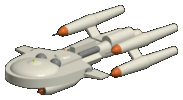
The 2206 Horizon class explorer was amongst the first Starfleet ships designed for extended range science missions in uncharted space. At the time of commissioning the ships were dismissed as an idealistic extravagance’, the Horizon can be seen as the forerunner of Starfleet’s later exploration ships.
Prior to 2200 Galaxy Exploration Command’s ship performance and their value for scientific research were limited. The longest-range starshipsin service were the Hyperion class of 2194, which had an unrefuelled range of 34 light years and carried sufficient stores for 20 months of operations. However, the majority of exploratory vessels in service at the time (such as the Daedalus and Moskva classes) were only able to visit 3 or 4 star systems before needing resupply. In addition, many Starfleet ships were not fully equipped for extensive scientific research, only those dedicated to survey missions had sensors that were optimized for research and stellar mapping. The other limitation (at least until the Hyperion class entered service) was that subspace-based sensors were generally passive, because the size of subspace transmitters precluded their installation on most starships.
What Galaxy Exploration Command required was a starship which combined the range, speed, and endurance of a heavy cruiser with the scientific facilities of a surveyor. It was not until the late 22nd century that the technology to build such a ship became available, but even then such a ship was likely to be extremely expensive to build and operate.
Commodore Matías Tolbert, who became commander of Galaxy Exploration Command in 2199, was an idealistic and adventurous officer. He had served as an ensign aboard the survey cruiser UES Ericson (CX-19, Republic class), which made Earth’s first contact with the Altair system in 2155. As captain of USS Blériot (NCC-539, Gagarin class), he made the Federation’s first contact with 8 races, including the Saurians. He believed that Starfleet’s future lay in exploration missions rather than as a purely military force.
Ambassador Skon of Vulcan led a vocal minority faction of Federation Council members who felt that the Federation was expanding too quickly and too far, and that Starfleet emphasising military force to drive the expansion. After the dual role Paris class was deployed in a military role only, Skon realised that if he could not restrain Starfleet’s military operations command, he would instead encourage a greater emphasis on exploration.
Working with Commodore Tolbert, Skon requested funding for a new “explorer class” starship in April 2200. The request was controversial, because this explorer would be as expensive to build as a heavy cruiser, and more expensive to maintain and operate.Amongst other concerns, the issue of the expense of the project led to the proposal’s rejection.
In October 2200, the Federation Council began debate on the funding for the new Lancaster class heavy cruiser. Skon threatened to block funding for the Lancaster unless funding was also approved for the explorer. After much debate and argument funding was authorized for 12 explorers (now named Horizon after the UES Horizon class and the lost USS Horizon), and 50 Lancasters.
The specifications called for a cruising speed greater than warp 5 and an unrefuelled range of at least 100 light years. The ship was to have 10 science labs, with a crew of 300 (30% of these being scientists and laboratory technicians). It was also to carry enough stores to allow for an unprecedented 5 years of independent operations.
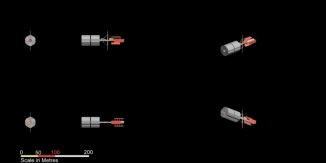
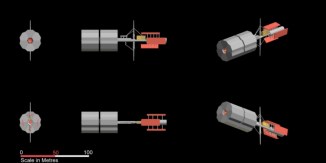
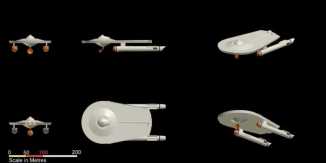
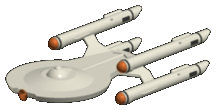
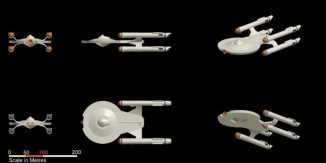
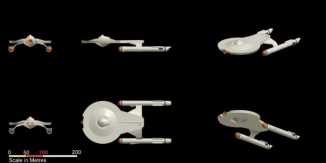
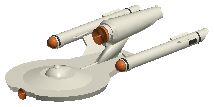
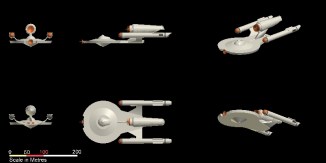
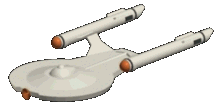
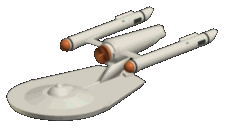
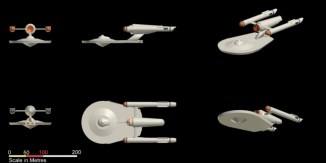
The primary hull contained the bridge, crew facilities, computer and sensors, as well as defensive weaponry. The primary hull was elongated to accommodate a large shuttlebay, impulse drives, and rotating outboard ultra long range sensor panels. The secondary hull containing the warp drive reactor was aft of the primary hull on a 43-meter neck. Up to 6 external modules were mounted externally around the neck to carry additional fuel, stores, cargo, or specialized mission modules.
The design board also specified the mounting of 4 warp nacelles, making this the first class to use this configuration since the Yorktowns of 2158. The 4 nacelles allowed the power to be spread across a larger number of warp coils, thereby increasing their longevity. Also, in the event of a failure the ship could still return to base, or even continue its mission, with only 2 or 3 nacelles.
To facilitate long-range exploration and enable communication with base, Horizon carried a large navigational deflector and subspace transmitter module below the primary hull in a tertiary hull. Due to extended mission profile, the resultant supplies, crew facilities, and redundant equipment meant that at 203,000 tons Horizon would be Starfleet’s largest starship since the Conqueror class of 2159.
USS Horizon was launched in July 2206, and was followed by the other 11 ships of the class over the following 4 years. As a shakedown, Horizon completed a 9-month survey of star systems in the Hyralan sector. Following the successful completion of the shakedown, Horizon commenced a 3-year mission beyond the Groma Hollow. During this mission the Horizon travelled more than 150 light years, surveyed more than 7,000 cubic light years of space, and made first contact with 4 spacefaring races.
As the other Horizons entered service they too started to expand the knowledge of the Federation. In 2207 USS Venture was the first starship to encounter a complex space-dwelling life form (the Kento). The following year, USS V’Shon-Pal was the first starship to survey the Mutara Nebula, and in 2210 USS Yinghuo discovered ancient ruins left by the Preservers.
The range and endurance of the class enabled Starfleet to launch its first 5-year missions. Starting in March 2209, Captain Fabiola Kalani commanded the USS Odyssey on a 62 month mission exploring spinward of the Rigel system. During this mission the Odyssey made first contact with 12 spacefaring races, including the Edosian
Despite the success of the Horizon class, funding for Galaxy Exploratorion Command became more limited following Skon’s death in 2208, as resources were gradually directed back to Military operations command. As a result no further explorer starships entered Starfleet service until 2222 with the commissioning of the smaller and less expensive Aryabhatta class.
Horizon-class ships were at times diverted to border patrol and long-range observation missions as Horizon’s unparalleled sensor suite made it useful asset for surveillance. Such missions were not common as the the Horizon needed a sizeable escort in hostile areas.
The Horizon class remained in service until 2254, and during this time only a single ship of the class was lost. USS Victoria was destroyed in 2235 while surveying a particle fountain in the Moab sector.
The Horizon-class explorer USS Odyssey, which completed four 5-year missions, is on display at the Starfleet Museum.
| Class: | XII | Year: | 2206 | |
| Ship Source: | The Starfleet Museum | Ship Datasheet: | Coming Soon | |
 Commissioned Ships
| USS Horizon NCC-1197 USS Odyssey NCC-1198 USS Venture NCC-1199 USS V’Shon-Pal NCC-1200 USS Kumari NCC-1201 USS Beagle NCC-1202 |
USS Yinghuo NCC-1203 USS Endurance NCC-1204 USS Nadezhda NCC-1205 USS Victoria NCC-1206 USS T’Plana-Hath NCC-1207 USS São Gabriel NCC-1208 |






 Vintage Starships
You must be logged in to post a comment.