2243 – Cassard

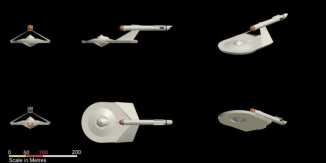
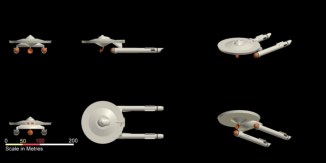
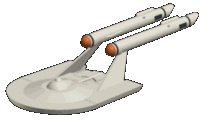
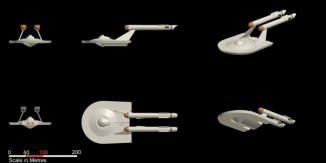
The Cassard class Missile Destroyer was designed in 2242 to provide the fleet with accelerator cannon support.

The USS Cassard commissioned in mid 2243, and made use of the recently introduced M-1 control computer.

The Cassard served well in the skirmishes and conflicts with the Klingon Empire over the from 2243 until 2288. The first time they were really tried in combat was in 2248. In this encounter near Federation Outpost 1 a Klingon task force of three D-7A’s and six D-16’s  attacked six ships from the 6th fleet. Four Cassard class ships led a counter attack by eight other ships of the 6th fleet, making full use of their accelerator cannons. The Klingon flagship was destroyers by the opening volleys, and the Cassards then continued to attack the other ships in turn. The battle ended 30 minutes later with the loss of three Federation vessels, while the Klingons all but three of the D-16’s. The Cassards  continued to perform well in fleet actions when used in concert with other starships providing beam weapon suppor, but when used without such support they were found to be extremely vulnerable. As a result the Cassard class was redeployed  from independent patrol duties and mainly assigned to fleet support duties..

In 2258 the MK II version was introduced, this version mounted the new Photon Torpedoes, but the beam weapons remained weak. It was not until 2268 when the MK III version entered service that the beam weapons were finally upgraded. Until the class left service it retained the ‘classic’ design and PB series circumferential warp nacelles.

Starfleet decommissioned the last units of the Cassard class in 2288, when the remaining ships where mothballed.  26  of these ships were sold to the Affiliation of Outer Free Worlds in 2304. The USS Cassard was placed into the Starfleet museum in 2305.

Class: VI Year: 2243
Ship Source: Bill Colley Ship Datasheet: Available at tacticalstarshipcombat.com

cassard_side

2252 – Portsmith

“The Portsmith class was a small cheap destroyer designed for mass production. During the four years war vast numbers were built to act in numerous roles. Despite its size and low cost, the class was amongst the more powerful destroyers in service during the war. Post war the class was not fitted with phasers as the cost of conversion would have exceeded the cost of construction.”

The Mk1 Portsmith Class entered service in 2246 as a cheap simple customs cutter, and was produced at numerous merchant and military shipyards throughout the Federation. The design had no weapons save for four lasers, and was powered by the heavy but effective FWH-1 warp drive system, In all some 300 were built between 2246 and 2252.

The growing hostilities prior to the advent of the Four Years war in 2252 found the Federation desperately short of effective escorts. A program was instituted to design a new escort destroyer class for mass production. It was realised that designing a new class from scratch would take a number of years. It was suggested that the existing Portsmith class could form the basis for a very capable Light Destroyer.

The FWH-1 engines of the Mk1 were replaced by the new FWA-2, and the ship had three accelerator cannons crammed into the former cargo hold. The resultant ship was a revelation to Starfleet Commanders, the more efficient Warp Drive, coupled to the heavy weapon load (for the size of vessel) meant that the Mk2 had a combat efficiency better than full size destroyers, and indeed better than some cruisers.

The price paid for this efficiency was two fold, the range of the Portsmith could not compare to that of the larger destroyers, and the superstructure, although reinforced compared to the Mk1 was not as resilient as that of the larger destroyers. However when deployed in groups escorting convoys the capabilities of the Portsmith meant that they were a force to be reckoned with. Some 360 Mk2s were built, and a large number of Mk1s were upgraded.

Postwar, the Portsmith class had no real role, although a large number were retained in reserve fleets until the 2270’s. A large number of these ships were sold onto planetary defence forces, or onto the civil sector after being disarmed.

Class: IV Year: 2252
Ship Source: Spaceflight Chronology Ship Datasheet: Download PDF

portsmith_large

2255 – Daring

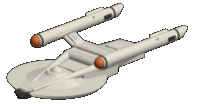
The Daring was designed as a destroyer leader, but improvements in sensor technology in the Four Years War  rendered this type of ship obsolete. It was then proposed to be re-roled as an exploration cruiser (Derf class), but the decision to produce further ships of the Constitution and Anton classes meant that it could not fulfill that role either. Finally the USS Derf was borrowed for a demonstration of the buoy tender concept. This demonstration was so successful that serial production of the Derf was ordered immediately and eventually totaled 600 vessels over a period of 35 years. Few vessels in Starfleet history have achieved either that level or longevity of production and it is certain that had the class been adopted in either of the other two intended roles it would not have gotten anywhere near either figure.

Of the 26 Daring Class hulls laid down, only five commissioned (Daring, Diamond, Diomede, Derwent and Daedalus) in their intended role. USS Derf commissioned in the exploration cruiser configuration before being converted for trials as a tender in 2255. The other five were also subsequently converted to the tender configuration in 2256, and the other 20 were commissioned in that configuration

Class: IX Year: 2255
Ship Source: FASA Original/ Additional material by Lee Wood/Steve Bacon Ship Datasheet:

derf_side

2243 – Siva (William Howe)

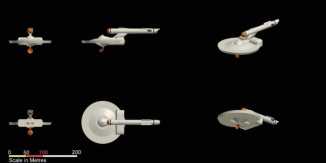
The Siva class destroyer mounted the best in Federation technology for its size at the time it was built. First commissioned in 2243, it mounted the M-1 computer, FWB-1 warp engine, FIC-1 impulse engine and FSA shield generator. A controversial military design due to its accelerator cannon arrangement, the Siva was unique in that it possessed only one laser cannon mounted aft purely for defensive purposes.

The Siva was assigned to Military Operations as a light missile destroyer to be used offensively with fleet support. The ships were designed to work together in groups of three. In these squadrons, they were to attack an enemy vessel while it was engaged in combat with a larger friendly vessel.

Until the Four Years War, the Siva class did not see any combat action. However, at the outbreak of the war, Sivas were some of the first vessels deployed in combat. Starfleet was conscious of the limited combat mission the Siva could perform and did not dispatch Sivas alone. Starfleet deployed them as designed when suitable capital vessels could be mustered (which proved quite a chore in the early days of the war).

As the war stabilized and the urgency of ship allocation lessened, the Siva class came into its own. Working mainly with Coventry class frigates and Heston class cruisers, a squadron of Sivas would be assigned to a single larger vessel. After a space battle had occurred in which a Klingon task force had been splintered or largely destroyed, a single Heston or Coventry would engage any lone, surviving Klingon capital ships. Staying well away from the larger Starfleet vessel so as not to be detected, the Sivas would lie in wait until the capital vessels engaged in combat. The Sivas would fly in a perpendicular path to the enemy vessel, avoiding any hostile forward weapons. The Sivas would fire their forward accelerator cannons at optimum range and then fly-by their target. Then, they would release their aft cannons and keep on going until out of range of the enemy vessel. Here they would turn around and line up for another attack. It took great skill and power management to perform the maneuver safely and effectively.

Usually captained by young Lieutenant Commanders, these ships and their crews were especially noted for their “e’sprit de corp”. This was especially the case with the Siva crews, since the entire complement of ten vessels were always assigned to the same fleet. Since their combat duties were limited by their design, they often served as scouts, pairing up with one another for safety.

It was no secret that the Siva was severely under-powered. Due to the limitations of its design and the technology of the era, no additional models of the ship were constructed and no other builds took place. The power limitations also left Sivas vulnerable, especially to Klingon gunboats and escorts that protected capital ships. Of the ten Siva class destroyers built, four were destroyed in the Four Years War. Two were damaged beyond repair and scrapped. The surviving four were assigned to Starfleet Training Command after the war where they served until being scrapped in 2269. One vessel, the USS William Howe, NCC 3216, participated in the evacuation of the Alerian homeworld in 2268 (2/11).

The USS Siva was amongst amongst those severely damaged, and the hulk was used as the prototype for the more conventional Siva subclass of the Saladin class in 2248. Upon the recommissioning of the Siva in this new configuration the former class was renamed the William Howe class.

  • Class: V
  • Year: 2243
  • Ship Source: FASA
  • Ship Datasheet: Download PDF

apache_large

2254 – Ares

From Star Trek Expanded Universe:

The USS Ares (NCC-1650) was the prototype of the Ares-class. It was commanded by Garth of Izar during the Four Years War. (Star Trek: Axanar)

During the first two years of the four years war, Starfleet was experiencing near constant defeat at the hands of the Imperial Klingon Navy’s D-6 battlecruiser. Whole systems were being seized, with the populations slaughtered at their hands. Changes needed to be made to save the Federation. The Starfleet Commander in Chief, Admiral Conrad Slater, was replaced by Admiral Marcus Ramirez. Ramirez’s first action was ordering the design and production of the Ares-class. The simulations showed promise, but its first real test would be on the battlefield. The Vulcans restricted their involvement to environmental, propulsion, and defensive sytems, though there were voices that demanded Vulcan remove their participation completely. In the words of Admiral Samuel Trask, “A Vulcan’s gonna do what a Vulcan’s gonna do. But the Andorians… they were happy to supply us the phasers.” The first ship in the class, the USS Ares, would be assigned to the Captain of the Destroyer Xenophon: Captain Kelvar Garth. There were over a dozen other member worlds waiting on the Ares class. Operation Pegasus would be the proving ground.

On stardate 2244.1, the Ares took part in its first combat engagement near the planet Cygnus III during Operation Pegasus. (“Prelude to Axanar”). In the words of the Supreme Warlord of the Imperial Klingon Navy (“Kharn the Undying”), “The new class Starfleet vessels were… unexpected.” Kelvar Garth, pushing his vessel’s capabilities to the maximum, surprised the Klingons and delivered a victory to Starfleet at Cygnus III. Following those events, Starfleet would go on to regain much of their lost territory. The USS Ares was faster, more agile, more heavily-armed than any operation Klingon vessel. With the new Ares-class and with the hard-won experience of their battle-tested commanders, three systems were retaken within 30 days. The Klingon ship captains began to give the Federation their due as a worthy adversary, primarily taking notice of Garth of Izar. The Captain of the USS Hercules, Samuel Trask, was quoted as saying, “That mad Izarian son of a bitch – that was his day.” Captain Sonya Alexander of the USS Ajax added, “Garth likes to play down what he did. Don’t you believe it. What he did that day no Starfleet Captain had ever done.”

In total 12 Ares class ships were built, production was curtailed in favour of additional ships of the Constitution class and related designs. The Constitution class was marginally cheaper and quicker to build,  was more combat efficient, and it was recognised it would be a more a versatile design to retain postwar.

9 of the Ares class ships survived the war, and post war they served as guard ships for key installations before being mothballed in 2262. All were recalled for service in 2267 when the fleet was put on a war footing prior to the Organian conflict, after the imposition of the treaty the ships returned to reserve.

Class: IX Year: 2254
Ship Source: Star Trek Axanar Ship Datasheet: Coming Soon
NB The write up of the Ares creates an issue in that it clearly states that the design is a product of the four years war, but at the same time places the first Constitution class ships under construction (which is 9 years too late). I have chosen to keep the wartime date and ignore the Constitution reference.

ares

2247 – Marklin

The Marklin class, despite some limitations, gained an impressive combat record. This is largely due to the Actions of Captain Garth of Izar aboard his command the USS Xenophon. The lightest of the 2240-50 Destroyers, the Marklin was used extensively in an independent role as the twin engine design was deemed to be more survivable than the single engine design of most of its contemporaries.

For its time, the Marklin class destroyer was one of Starfleet’s most capable light offensive vessels. Having good power output and excellent maneuverability, it was a favorite with Military Operations. However, the design was also a victim of politics and only 20 were built.

The Marklin, an Andorian design, was first proposed to Starfleet by Chiokis Starship Construction in 2239 (1/82). Chiokis believed it could construct a light vessel which could serve in a military role, but also double as a solid platform for routine scientific study, much like the role of Starfleet’s cruisers. Impressed with the possibility of having a capable combat vessel and modest research vessel for the cost of a destroyer, Starfleet ordered 20 Marklins for immediate production.

Although the design had been approved, the controversy was just beginning. One week after the USS Marklin began construction, a lawsuit was filed against Chiokis Starship Construction and Starfleet Procurement by M’Yengh Yards for corporate conspiracy. M’Yengh Yards accused Starfleet Procurement (mainly one member in particular who had financial interests in Chiokis) with accepting Chiokis’ design without competition or bidding for the purpose of individual and corporate financial gain. This created a firestorm within Starfleet and the corporate world and the case was fast-tracked through the Federation Judiciary.

Eighteen months later, the Federation Tribunal overturned Quadrant One’s Appellate Court verdict and ruled against M’Yengh Yards in principle. The court determined that Starfleet could entertain solicitations from firms in confidence, without announcing the details of the proposal. Chiokis was, the court determined, acting in the best interests of its shareholders and company when it proposed the Marklin to Starfleet.

The court also determined that Starfleet could not, however, enter into an exclusive contract with Chiokis, meaning that most of the components used to build the Marklin would have to be open to bid. In addition, the court recommended that members of the board at Starfleet Procurement should relinquish any financial interests or other possible conflicts of interests when serving on the board. This policy was accepted and is still in place today.

In 2245, Starfleet announced that it would not order any more Marklins over the initial 20. Starfleet cited lower than expected performance for the decision, but those involved with the Marklin project were shocked. Many still believe that Starfleet decided to cut the Marklin project to repair its public image after the M’Yengh lawsuit.

Although tarnished by politics, the Marklin would serve with distinction throughout the Four Years War. It was one of her number, the USS Xenophon commanded by Captain Garth of Izar, which played the crucial role in the First and Second Battles of Axanar. All surviving Marklin class vessels were decommissioned shortly after the Four Years War.


Class: V Year: 2247
Ship Source: Based on FASA Image Ship Datasheet: Download PDF

marklin_large

2243 – Larson

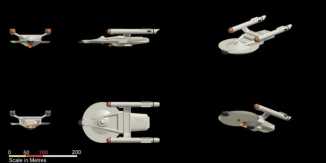
The Larson Class was one of the large numbers of Destroyers that commissioned in the 2240s. Although not as powerful as the Saladin class it was still built in large numbers. It was generally employed as an escort vessel for larger fleets.

Designed at the same time as the Nelson class scouts and the Constitution class cruisers, Larson class destroyers shared many of the same physical features of these ships. An efficient ship that served well, it was intended to perform the same tasks as other dual-function vessels, namely both research and defense. Even so, most of the existing Larsons in service were employed by Starfleet’s Military Operations Command, with several serving in the Galaxy Exploration Command.

Destroyers such as the Larson frequently were employed on patrol duty along the frontier areas. In time of war or other military emergencies, such destroyers were assigned to escort convoys or used as scouts by squadrons or small fleets. This methodology is still practiced today with Starfleet’s modern destroyers. With its array of weapons, the Larson was a fine combat vessel, though not as powerful as a cruiser or larger ship.

As can be seen by reviewing the statistics, the Larson Mk I was introduced into service in January 2245 (1/8801), remaining unchanged until the outbreak of the Four Years War in 2253 (1/95). After several fierce battles with Klingon forces, it was evident that the Larson was weaker than their Klingon counterparts. As quickly as possible, all Larsons were scheduled to be upgraded to Mk Ib standard. This provided the Larson with more efficient shielding, allowing more power for its new FL-3 lasers and existing FAC-1 accelerator cannons.

Finally in early 2256 (1/98), the first Mk II Larsons were produced. The production schedule was split into two lines: the Mk IIa and the Mk IIb. All Mk Ia Larsons upgraded during the conflict were upgraded to Mk IIa standard and all Mk Ibs became Mk IIbs. This helped speed up the turn around time for upgrades because only the weaponry and single warp engine, now upgraded to the FWC-2, changed on the vessels.

The Mk IIa mounted the FP-2 photon torpedo system, still in its prototype stage. The Mk IIb mounted the powerful FP-1 system. Starfleet was split on this issue, however: Larsons were seeing heavy action, but they were vulnerable ships. If mounted with the FP-1, the Larson’s firepower would increase, but at the sake of exposing the FP-1 photon technology to the Klingons if a Larson were captured in battle. In addition and unforeseen in static tests, the superstructure of the relatively light Larson was not strong enough to absorb the shock of repeated firings of the two FP-1 launchers. In rare cases, some firings caused structural damage to the starship. This problem was never fully resolved and in the later Mks, all Larsons mounted the smaller FP-2. All Mk I vessels were refitted with new weapons by September of 2258 (2/0109). Several small interior changes were also made, but these did not affect the combat performance of the vessel until the introduction of the Mk VI.

The Mk VI mounted improved phaser weapons and the more efficient FSD shield generators. The Mk VII, introduced in March of 2269 (2/1403), mounted the newer style engine nacelle and a more powerful impulse drive system. This increased the overall power output by 25% and extended the service life of the Larson class by several years. By May 2285 (2/2205), all Larsons in active service at that time had been upgraded to the Mk VI, and several had been modified to
Mk VIIs.

Production of the Larson class was halted in August of 2281 (2/1808) with the commissioning of the USS Juno. In October 2291 (2/2710), the last Larson class destroyer in service, the USS Tana Re, returned from its duty station and moored at Starbase 24. With this, the end of the Larson class era fell upon Starfleet Destroyer Command and all Larsons were placed in reserve fleets. As a part of Starfleet’s reserve fleet budget, a project has been underway since 2293 (2/29) to slowly upgrade all remaining Mk VI Larsons to Mk VII standard.

No ships sold to the private sector have been refit, and most retain the characteristics they had at the time of sale. All vessels sold were disarmed by Starfleet, though the weapon-mounting hardpoints usually were left intact.

Larsons were named for military leaders and battles of Terran origin. The class vessel is named for Admiral William G. Larson, hero of the battle at Gamma Hydra during the Romulan War. The only exception to this naming convention is NCC 4305, the USS Thelenth, which is named after an Andorian admiral who defeated the Klingons in a pitched battle at Donovan’s Star at the cost of his own ship and crew.
Historical Notes:

The ships Hammurabi and Troy were both destroyed while escorting a convoy of merchant ships bound for a frontier area. During this battle, seventeen freighters were destroyed and an additional four were taken as prizes by the Klingons. Of the five ships that survived the encounter, all reported that the Hammurabi destroyed two Klingon D-7 cruisers and crippled two others before being destroyed itself. The Troy apparently was disabled in the initial exchange of fire and left for dead. When a Klingon cruiser ventured too close to the derelict, however, it opened fire and destroyed the enemy vessel in a single volley. Of course, without maneuvering power, the Troy was later easily dispatched.

In August 2259 (2/0208), the Bolivar led a small detachment consisting of the Normandy, Alesia, Babur, and Tecumseh into an uncontrolled area near the Romulan Neutral Zone. The task force maintained radio silence and failed to report back at its scheduled time. When extensive communications attempts were made unsuccessfully, a rescue group was dispatched to the last reported position of the task force. Upon arrival, nothing was to be found, and an extensive search was begun, ultimately discovering the engine nacelle of the Alesia adrift in an unknown asteroid cluster. At the time no determination was made as to what had caused the loss of the ships, but it was suspected by many that the Romulans had ambushed the group and successfully destroyed them before they were able to send a call for aid. This theory was never proved, and no action was ever taken against the Romulans, largely because it was felt that the Romulans could not have crossed the Neutral Zone unnoticed. Since the discovery of the Romulan cloaking capability, the theory has been given new weight.

In February 2270 (2/1502), the USS Richtofen was recalled for an engine refit and scheduled maintenance to shipboard systems. As the ship’s refit and maintenance checks neared completion, spirited Ensigns and sympathetic workers painted it bright red in honor of its namesake. Starfleet Command decided to leave the ship this color despite the breach of regulations, though all Ensigns were mildly disciplined. The vessel was assigned to the Klingon sector.

On its maiden flight, the USS Sheridan experienced a critical overload in its warp drive system. All backup systems failed to correct the problem. It was decided to jettison the engine pod because an uncontrolled matter anti-matter mix was underway and could not be stopped. The systems used to eject the engine also failed, and the ship was totally destroyed in the subsequent explosion. Three crewmembers who had taken refuge in a shuttle survived.

The Larson class destroyers were produced at the Sol V and Proxima shipyards.

Class: VII Year: 2243
Ship Source: FASA Ship Datasheet: Download PDF

larson_large