
After 30 years of service, with no replacement in sight, the Marshall class was refitted for further service.
| Class: | III | Year: | 2185 | |
| Ship Source: | Space Flight Chronology | Ship Datasheet: | Coming Soon | |

After 30 years of service, with no replacement in sight, the Marshall class was refitted for further service.
| Class: | III | Year: | 2185 | |
| Ship Source: | Space Flight Chronology | Ship Datasheet: | Coming Soon | |
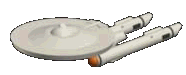
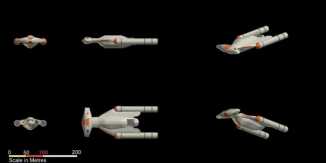
As part of the lesson learnt from the Four Years War, Starfleet realised that the sheer multitude of destroyer classes in service (around 15 different classes) and in production (10) was wholly impractical. The usefulness of twin engine destroyer has been demonstrated during the war, offering extra power for movement and weapons (although at the expense of range and cost). The simple solution proposed to meet the need for twin engine destroyers was to utilise existing single engine designs with a ‘minimum change’ addition of a second engine.
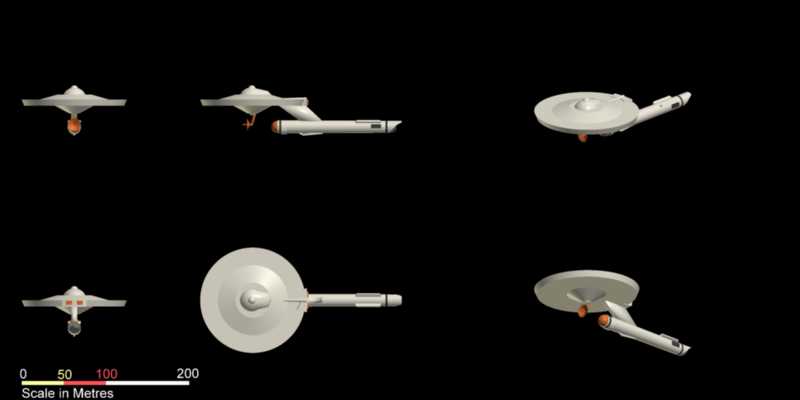
The ‘Twin Saladin’ class was one example of this approach, the design basically added a second warp nacelle to a Saladin Class Destroyer. Unlike the Warhawk class (which added a ventral nacelle), this design added a small secondary hull, upon which warp nacelles were mounted. As with the Warhawk the additional nacelle connected directly into the existing power systems of the Saladin design with no major modification to the design other than some uprating of components to handle the additional power.
After evaluation the decision was made that the Warhawk class would be adopted as it was a more simple design to build. However the promise shown by the ‘Twin Saladin’ meant that it was instead chosen to be intoduced in a new role, as a medium cruiser.
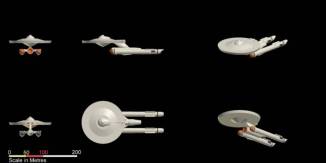
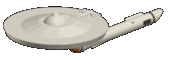
The Saladin was the Destroyer version of the Hermes class scout. The class was 50% more powerful than the similarly sized Larson class. The Saladin was often deployed in Destroyer groups to hunt down enemy shipping. These groups were frequently led by a Cygnus class command ship.
A number of vessels of this class were built in an experimental configuration with a neck mounted deflector dish, instead of the original that was mounted below the primary hull. This modification improved reliability of the deflector system, but did not affect combat performance.

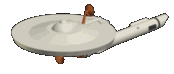
The Cygnus Class entered service in 2248 as a Command Courier version of the highly successful Saladin/Hermes class. The Intention was that an Admiral could use the ship as a sector command post. To this end the design was given the FWC-1 warp drive, giving it more power than its half sisters, the weapons were entirely laser based to make more room for the Admiral’s facilities and command centre.
In 2250, the USS Columbia was converted to a more heavily armed configuration as an experiment to evaluate the benefits of an FWC-1 powered heavy destroyer type. These trials amounted to nothing, but the Columbia was left in this configuration, and was assigned as a Destroyer Leader to a flotilla of Saladins in the Klingon Border Area.
Compared to the Mk1, the Mk2 mounted a pair of rear firing Lasers and also added a pair of FAC-2 accelerator cannons at the expense of the Flag Cabins. The extensive Combat Information Centre initially fitted for the use of an Admirial was retained for suadron level operation command.
The outbreak of the Four Years War saw a major change in Starfleer Operational Procedure, a number of the Cygnus class ships were involved in near disasters in 2252, as operating independently without escorts as they had been designed to do made them tempting targets. In a fleet role the additional speed of the Cygnus was wasted, so it was ordered to convert the other 8 mk1 vessels to mk2 standards.
The nine Cygnus class ships performed valiantly throughout the war, and in many ways paved the way for the later Strike Cruisers which adopted the role of command ship for a Destroyer squadron. Post war the future of these ships was uncertain, as the fleet backed away from a purely military posture, it was eventually decided to convert all of the ships to Hermes specifications to make good the losses suffered by that class.
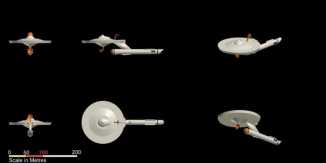
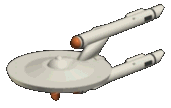
As part of the lesson learnt from the Four Years War, Starfleet realised that the sheer multitude of destroyer classes in service (around 15 different classes) and in production (10) was wholly impractical. The usefulness of twin engine destroyer has been demonstrated during the war, offering extra power for movement and weapons (although at the expense of range and cost). The simple solution proposed to meet the need for twin engine destroyers was to utilise existing single engine designs with a ‘minimum change’ addition of a second engine.
The Warhawk class was one example of this approach, the design basically added a second warp nacelle to a Saladin Class Destroyer. As such this second dorsal nacelle could be mounted to feed directly into the existing power systems of the Saladin design with no major modification to the design other than some uprating of components to handle the additional power.
The large numbers of destroyers in service meant that production of the Warhawk was limited to only 24 ships. However this general configuration was later reused on other destroyer types, most notably the Wilkerson class.
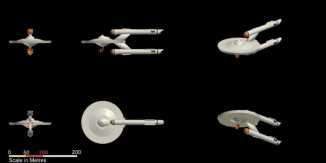
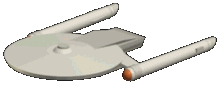
The Detroyat class Heavy destroyer holds the distinction of being the Largest destroyer type built in the 22nd or 23rd centuries. One of the most powerful ships in known space when commissioned, the class remained in a frontline role for 50 years, although the class was reclassified as a long range scout in 2255. The class has an enviable reputation for surviving no matter what the odds. Only one ship of the class was lost in all those years of service.
| Class: | XI | Year: | 2224 | |
| Ship Source: | USS Detroyat Class Heavy Destroyer Blueprints | Ship Datasheet: | Download PDF | |
|
|
||||


Historically, Starfleet had only ever fielded one heavy Destroyer class, the Detroyat class of 2224. In 2243, Starfleet Tactical suggested the development of a new tactic for Destroyer operations, the use of leaders. New sensor technology, such as that fitted to the Constitution class offered massive range improvements, but it was felt that the sensor suite and associated systems were too large to be fitted to standard Destroyers. As a result the 10 Detroyat class ships were refitted with modern warp drives, and with the new sensor systems, it was also decided to order 26 vessels to supplement the Detroyats. The total of 36 Heavy Destroyers was felt to be sufficient to allocate one to each group of 6 standard destroyers operating along the Klingon and Romulan borders. The Heavy Destroyer would act as the command ship for the group, and also provide long range sensors.
The design, later to be named Apache, started off as a modified Detroyat design. During the design process the class evolved, the saucer was modified to feature an elongated rear edge and the secondary hull was massively enlarged compared to that of the Detroyat. It was intended that the Apache would be allocated to Destroyer groups allocated to more remote areas, and as a result the secondary hull was enlarged to enable it to carry spares and supplies to support its assigned group.
In service the Apache proved to be as dependable as its illustrious ancestor. Destroyer groups led by Apaches served with distinction throughout the Four Years War, and a group led by the USS Tartar was instrumental in the Attack of Convoy Y-16Z in 2253, the first significant Federation fleet victory of the war. So effective was the Leader concept, that a number of Cygnus class command couriers were rearmed and modified to act as Leaders to supplement the insufficient numbers of Detroyats and Apaches.
Postwar the fortunes of the Apache, and the leaders in general waned. The progress in miniaturisation meant that conventional destroyers could now mount the long range sensors far more economically. As a result the Detroyats were reclassified as long range scouts and assigned to exploration duties, and the new leader class, the Derf, was modified to become a tender. The 18 surviving Apaches were retained in service, but were grouped together to form three heavy destroyer groups, which were assigned to the defence of Terra, Vulcan and Alpha Centauri. In 2258 the ships were rearmed with phasers and photon torpedoes.
Heightened tensions leading up to the Organia conflict led to the Apaches being refitted again, and recalled to the Klingon Border. This time they served as sector command ships, supplementing the Perimeter Action Ships of the Kiaga and Agilis classes. The success of the ships in this role led to them being reclassified as Strike Cruisers (interim) in 2268, and they served in this capacity until the Belknap class entered full service.
The Apaches were progressively retired to reserve from 2280 onwards as the Belknap class ships assumed their role.
The Apache class was named by Admiral Wood, commander of Military Operations Command in commeration of his first command, the Mann class Cruiser USS Apache.
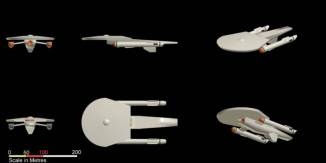

The Ajax Class was designed to utilise some components of the Daedalus design, they were initially proposed during the war as a long range scout and convoy interdictor. The end of the War led to the class being delayed, and the four ships built eventually were classed as Destroyers.
| Class: | IV | Year: | 2166 | |
| Ship Source: | Ex Astris Scientia/ Bernd Schnieder | Ship Datasheet: | Download PDF | |
|
|
||||
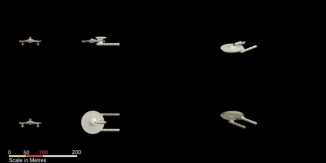
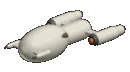
The Torsk class destroyers were designed as multi role vessels. The first intended role was to gather intelligence along border areas, and return that information to the fleet. The Second designed role was to act in a hunter killer role against enemy scout ships. Accordingly the Torsk class was designed to be faster than the Krechet class, but more lightly armed as it was intended for fleet actions.Torsk class ships were the first to carry the improved EFTL-6 warp reactor, which was 30% smaller but only 10% less powerful than the EFTL-5 carried by the Krechet class ships.
Because of the narrowly defined roles that the Torsk class ships were designed to play, they were much less expensive to build and operate than the Krechet class cruisers. They carried fewer weapons, had a 35% smaller crew, and were 25% lighter. Fourteen TORSK-class destroyers entered service from February through December 2158. However, they saw little action in their intended roles as Romulan forces withdraw and consolidated in anticipation of an UE Alliance offensive. They were, however, used as radar pickets and scouts when UE Alliance task forces pushed into Romulan territories in the final 2 years of the war, and five were lost in the course of these actions. Torsk ships did well in these limited roles, but were eventually superseded by the significantly more capable and versatile Powhatan class.
The TORSK-class Destroyer UES STINGRAY (CEM-6) is now on display at the Starfleet Museum.
|
|
||||
| Class: | VII | Year: | 2158 | |
| Ship Source: | The Starfleet Museum | Ship Datasheet: | Download PDF | |
|
|
||||
Commissioned Ships:
| UES Torsk CEM-1 UES Nautilus CEM-2 UES Holland CEM-3 UES Dolphin CEM-4 UES Navaga CEM-5 UES Stingray CEM-6 UES Porpoise CEM-7 |
UES Seawolf CEM-8 UES Han CEM-9 UES Rickover CEM-10 UES Shalki CEM-11 UES Borei CEM-12 UES Haifa CEM-13 UES Hai Lung CEM-14 |

 Vintage Starships
You must be logged in to post a comment.