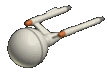
2175 – Wasp II

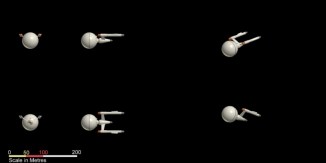
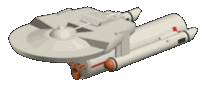
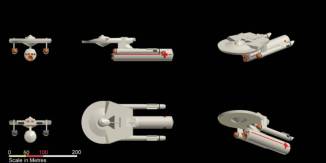
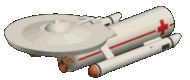
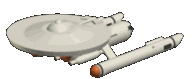
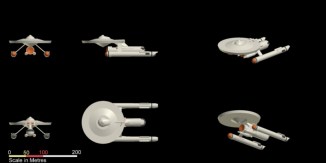
The Wasp was intended as a successor to the Daedauls class. The lead ship of the new class, USS Wasp, was launched in December 2173 and commissioned in November 2174.

The large primary hull of the Wasp class, and the overall increase in size over the Daedalus class was intended to improve the range and habitablility of the design when compared to its predecessor. Another intention was to provide greater crew safety than on previous designs. This increased safety was demonstrated in 2177 when the USS Cumberland suffered a warp core containment breach while on a survey mission. The secondary hull was evacuated, and the primary hull was then successfully detached and maneuvered to a safe distance by the time the warp core exploded. No casualties were sustained during evacuation and separation. The command hull of Cumberland (which had been christened “The Deathstar” by the crew) entered orbit around Theta Draconis VII 5 months later. She was subsequently towed to spacedock, where a new engineering hull was attached, and the ship was relaunched 14 months after the accident.

The warp performance of the Wasp class was worse than expected. This was due to two causes, firstly owing to production delays the first eight ships were forced to use three FFTL- 2A warp engines rather than two of the more powerful FFTL-3A warp engines as had been intended. Although in trials the three engine fit was successful, in active service the Warp fields proved hard to keep aligned. When the FFTL-3A engined ships finally appeared they were found to be only marginally more capable. As a result the last 5 ships in the projected 20 ship class were canceled after construction had already begun. All 8 Mk 1 ships built were converted to the Mk 2 standard as it was a more reliable and simpler to maintain engine installation.

Of the 15 ships built, 3 were lost in the line of duty and 1 is overdue and presumed lost. Five ships were later sold to commercial concerns and converted to starliners or transports. After being decommissioned in 2217, USS Kearsage was restored to her original three-nacelle configuration and is now on display at the Starfleet Museum.


Class: VI Year: 2177
Ship Source: Starfleet Museum Ship Datasheet: Download PDF

wasp_2_large_SIDE

Commissioned Ships

USS Wasp NCC-223
USS Decatur NCC-224
USS Ranger NCC-225
USS Kearsarge NCC-226
USS Jupiter NCC-227
USS Ericsson NCC-228
USS Cumberland NCC-229
USS Mars NCC-230
USS Holland NCC-231
USS Bushnell NCC-232
USS Armstrong NCC-233
USS Hunley NCC-234
USS Tang NCC-235
USS Nautilus NCC-236
USS Nelson NCC-237

*Hull numbers NCC-238 to NCC-242 were assigned, but construction was canceled.


2174 – Wasp I

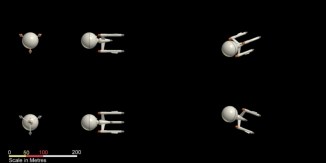
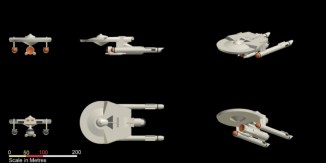
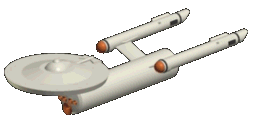
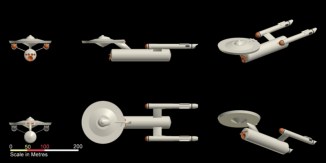
The Wasp was intended as a successor to the Daedauls class. The lead ship of the new class, USS Wasp, was launched in December 2173 and commissioned in November 2174.

The large primary hull of the Wasp class, and the overall increase in size over the Daedalus class was intended to improve the range and habitablility of the design when compared to its predecessor. Another intention was to provide greater crew safety than on previous designs. This increased safety was demonstrated in 2177 when the USS Cumberland suffered a warp core containment breach while on a survey mission. The secondary hull was evacuated, and the primary hull was then successfully detached and maneuvered to a safe distance by the time the warp core exploded. No casualties were sustained during evacuation and separation. The command hull of Cumberland (which had been christened “The Deathstar” by the crew) entered orbit around Theta Draconis VII 5 months later. She was subsequently towed to spacedock, where a new engineering hull was attached, and the ship was relaunched 14 months after the accident.

The warp performance of the Wasp class was worse than expected. This was due to two causes, firstly owing to production delays the first eight ships were forced to use three FFTL- 2A warp engines rather than two of the more powerful FFTL-3A warp engines as had been intended. Although in trials the three engine fit was successful, in active service the Warp fields proved hard to keep aligned. When the FFTL-3A engined ships finally appeared they were found to be only marginally more capable. As a result the last 5 ships in the projected 20 ship class were canceled after construction had already begun. All 8 Mk 1 ships built were converted to the Mk 2 standard as it was a more reliable and simpler to maintain engine installation.

Of the 15 ships built, 3 were lost in the line of duty and 1 is overdue and presumed lost. Five ships were later sold to commercial concerns and converted to starliners or transports. After being decommissioned in 2217, USS Kearsage was restored to her original three-nacelle configuration and is now on display at the Starfleet Museum.

Class: VI Year: 2174
Ship Source: Starfleet Museum Ship Datasheet: Download PDF

wasp_1_large_side

Commissioned Ships (Mk 1)

USS Wasp NCC-223
USS Decatur NCC-224
USS Ranger NCC-225
USS Kearsarge NCC-226
USS Jupiter NCC-227
USS Ericsson NCC-228
USS Cumberland NCC-229
USS Mars NCC-230

2160 – Daedalus

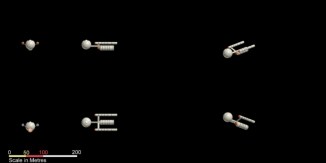
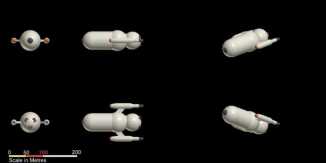
Compared to the Comet class that it was developed from, the Daedalus was a far lighter vessel. The Mk 1, which the first 25 ships were built as was designed as an exploration vessel, hence the relatively weak armanent. The 25 Mk 2 ships were intended as mixed use Cruisers, so were more heavily armed.

The Daedalus had many changes to its structure, equipment, and drive system compared to the Comet. These included simplifying the spaceframe, reducing offensive and defensive weaponry, moving the shuttle bay to the rear of the secondary hull, adding scientific facilities, enhancing the sensor suite and increasing the ship’s range. In addition, for the first time, the bridge was placed atop the command hull.
The UES Daedalus joined the fleet in September 2160, just 1 month before the end of the war. Due to their exploration mission profile these ships cruisers were used on scientific missions far from the front line. On these internal missions, the class served admirably without major malfunctions or system failures.

In a formal ceremony held on October 14, 2161 UES Daedalus (CCM-127) was struck from the UESN list and recommissioned as the Federation Starfleet’s first cruiser, USS Daedalus (NCC-150). Although the Deadalus class ships were not the fastest, largest, or most powerful explorers, they made first contact with more civilizations and mapped more star systems at the greatest risk to their crews than any other explorer type of their generation.

USS Carolina, a Mk1 Daedalus Class is now on display in the Starfleet Museum

Class: IV Year: 2160
Ship Source: Starfleet Museum Ship Datasheet: Download PDF

daedalus_large_side

Commissioned Ships (UESN/UFP)

UES/USS Daedalus CLM-127/NCC-150
UES/USS Icarus CLM-128/NCC-151
UES/USS Phoenix CLM-129/NCC-152
UES/USS Valiant CLM-130/NCC-153
UES/USS Clarke CLM-131/NCC-154
UES/USS Dakota CLM-132/NCC-155
UES/USS Proteus CLM-133/NCC-156
UES/USS Voyager CLM-134/NCC-157
UES/USS Columbus CLM-135/NCC-158
UES/USS Diana CLM-136/NCC-159
UES/USS Carolina CLM-137/NCC-160
UES/USS Soyuz CLM-138/NCC-161
UES/USS Apollo CLM-139/NCC-162
UES/USS Louisiana CLM-140/NCC-163
UES/USS Torvaldson CLM-141/NCC-164
UES/USS Sputnik CLM-142/NCC-165
UES/USS Jefferson CLM-143/NCC-166
UES/USS Tokyo CLM-144/NCC-167
UES/USS Arronax CLM-145/NCC-168
UES/USS Mir CLM-146/NCC-169
UES/USS Bowman CLM-147/NCC-170
UES/USS Roosevelt CLM-148/NCC-171
UES/USS Dolphin CLM-149/NCC-172
UES/USS Essex CLM-150/NCC-173
UES/USS Robinson CLM-151/NCC-174
USS Frontier NCC-175
USS Horizon NCC-176
USS Liberty NCC-177
USS Asimov NCC-178
USS Zond NCC-179
USS Marco Polo NCC-180
USS Spaulding NCC-181
USS Lincoln NCC-182
USS Maury NCC-183
USS Viking NCC-184
USS Johnson NCC-185
USS Shenandoah NCC-186
USS Nelson NCC-187
USS Independence NCC-188
USS Archon NCC-189
USS Columbia NCC-190
USS Challenger NCC-191
USS Discovery NCC-192
USS Atlantis NCC-193
USS Endeavor NCC-194
USS Gaines NCC-195
USS Venera NCC-196
USS Buena Vista NCC-197
USS Cassini NCC-198
USS Cochrane NCC-199


2158 – Comet

Following the successful tests of the Fireball class, the UESN made plans for introducing the design into military service to boost the war effort. The Only changes made to the excellent Fireball design were addition of weapons, and the upgrading of the shields to FDS-2.

The Comet class light cruiser began to enter service in October 2158. They were amongst the fastest ships of the Romulan war and saw extensive service as scouts and light strike cruisers. Originally 50 of the class were been ordered, but the end of the war saw the final 25 cancelled in favor of 25 of the Comet derived Daedalus class exploratory cruisers. 23 Comet class ships survived the war, and were allocated to Starfleet, where they served until 2192.

The Comet class cruiser USS Meteor is now on display at the Starfleet Museum.

The Experimental NG (New Generation) engines and shield systems were redesignated as part of the Federation Designation System in 2161.

  • Class: V
  • Year: 2158
  • Ship Source: Starfleet Museum
  • Ship Datasheet: Download PDF

comet_side_large

Commissioned Ships (UESN)

UES Comet CLM-102
UES Meteor CLM-103
UES Aurora CLM-104
UES Nova CLM-105
UES Pulsar CLM-106
UES Nebula CLM-107
UES Quasar CLM-108
UES Eclipse CLM-109
UES Equinox CLM-110
UES Solstice CLM-111
UES Corona CLM-112
UES Constellation CLM-113
UES Galaxy CLM-114
UES Flare CLM-115
UES Proxima CLM-116
UES Polaris CLM-117
UES Zodiac CLM-118
UES Mercury CLM-119
UES Venus CLM-120
UES Luna CLM-121
UES Mars CLM-122
UES Jupiter CLM-123
UES Saturn CLM-124
UES Uranus CLM-125
UES Neptune CLM-126

2255 – Kildare

With the outbreak of the four years war, the need for more medical ships became apparent. Four Dollond, and two Doppler class transports were taken up from mercantile service and converted to Kildare standards. The modifications were similar to those that created the Nightingale class, namely improved shields and interior modifications.

Compared to the early Nightingale, the Kildare has far superior hangar facilities. As a result the Nightingale is used primarily as a hospital ship, ferrying wounded back from the war zones to the home planets of the Federation, while the Kildare is used more often in a casualty receiving role, or as rescue vessel.

The Kildares were retained in the fleet post war in a humanitarian and rescue role.


Class: VII Year: 2255
Ship Source: General Plans and Specifications – Dollond Class MK-VIC Heavy Transport Patrick Lichty & Associates Ship Datasheet: Coming Soon

kildare-70

2242 – Nightingale

Based on the ubiquitous Ptolemy Class Transport Hull, the Nightingale entered service in 2242 replacing the obsolete Mercy class. Compared to a standard Ptolemy, the class has improved shielding and internal modifications to make the class more suitable for the medical role. Due to these modifications Nightingale class ships are rarely used in standard transport duties, and are virtually permanently attached to their medical pod. The two Mk 1 Nightingales are based on the Ptolemy hull and systems, the single Mk 2 is based on a Keppler hull.

With the outbreak of the four years war, five Ptolemy’s taken up from mercantile service were also modified to Nightingale standards, as Mk 3s. The other three ships were also modified to this common standard.


Class: VII Year: 2242
Ship Source: Based on Ptolemy class from Star Fleet Technical Manual Ship Datasheet: Coming Soon

nightingale-70

2158 – Mercy

The Olympus Mons family of ships was developed from the Bison class. The Olympus Mons class was an armed Assault transport, The Reid Fleming class was a Deuterium Tanker, and the Mercy class was Starfleet’s primary Medical ship type for many years.

Class: XVII Year: 2158
Ship Source: The Starfleet Museum Ship Datasheet: Download PDF

mercy_large

Commissioned Ships

  • UES Mercy AHM-4
  • UES Solace AHM-5
  • UES Comfort AHM-6
  • UES Sanctuary AHM-7
  • UES Consolation AHM-8
  • UES Refuge AHM-9
  • UES Hope AHM-10
  • UES Tranquility AHM-11

.


2254 – Tikopai

The Four Years War saw the need for large number of escort cruisers to be quickly commissioned. The Achernar and Tikopai classes of supplemental cruisers met this need. The Achernar class was adapted from the mark two versions of the standard Ptolemy (Achernar Mark 1) and Keppler (Achernar Mark 2) classes of Transport Tug. The Tikopai class was adapted from the mark two versions of the Dollond (Tikopai Mark 1) and Doppler (Tikopai Mark 2) classes. All four of these tug classes were in both Starfleet and Civilian service, and ships originally destined for civilian lines were diverted to this program.

The supplemental cruisers were created by the addition of a specialist pod with a hanger, enhanced sensors and weapons. The mother ship itself was unchanged, except for the impulse drive if it required upgrading and retained its own light weapons fit. This solution meant large numbers of the supplemental cruisers could be built quickly, as the Tugs were already mass produced in civil yards, and the weapons hull could be easily built by the smaller warship builders. These ships, although underpowered, were an invaluable asset in convoy escort duties throughout the war. Post-war these ships were all swiftly de-commisioned and converted to standard tug configuration, and then either sold off for commercial transport use, or used to replace wartime tug losses in the fleet.

The weapon pod contained 8 FL-4 Lasers in 4 banks, with 2 banks covering each arc of fire, a pair of FAC-3 accelerator cannons was positioned on the sides of the pod to fire forward. These ships provided a valuable role escorting convoys, often hiding amongst innocent looking standard configuration tugs to lure attackers in. The main criticism that could be levelled at both of the classes was the weak shielding systems, but the adoption of more advanced shielding systems would have prevented the construction of the ships in civilian yards.

Class: V-VI Year: 2253
Ship Source: Franz Joseph Designs/FASA Ship Datasheet: Download PDF
 The design is based on the FJ tugs, the name is from FASA to provide a way for these classes to serve in the four years war prior to the commissioning of the heavy cruisers.

tikopai_ii_100

2253 – Achernar

The Four Years War saw the need for large number of escort cruisers to be quickly commissioned. The Achernar and Tikopai classes of supplemental cruisers met this need. The Achernar class was adapted from the mark two versions of the standard Ptolemy (Achernar Mark 1) and Keppler (Achernar Mark 2) classes of Transport Tug. The Tikopai class was adapted from the mark two versions of the Dollond (Tikopai Mark 1) and Doppler (Tikopai Mark 2) classes. All four of these tug classes were in both Starfleet and Civilian service, and ships originally destined for civilian lines were diverted to this program.

The supplemental cruisers were created by the addition of a specialist pod with a hanger, enhanced sensors and weapons. The mother ship itself was unchanged, except for the impulse drive if it required upgrading and retained its own light weapons fit. This solution meant large numbers of the supplemental cruisers could be built quickly, as the Tugs were already mass produced in civil yards, and the weapons hull could be easily built by the smaller warship builders. These ships, although underpowered, were an invaluable asset in convoy escort duties throughout the war. Post-war these ships were all swiftly de-commisioned and converted to standard tug configuration, and then either sold off for commercial transport use, or used to replace wartime tug losses in the fleet.

The weapon pod contained 8 FL-4 Lasers in 4 banks, with 2 banks covering each arc of fire, a pair of FAC-3 accelerator cannons was positioned on the sides of the pod to fire forward. These ships provided a valuable role escorting convoys, often hiding amongst innocent looking standard configuration tugs to lure attackers in. The main criticism that could be levelled at both of the classes was the weak shielding systems, but the adoption of more advanced shielding systems would have prevented the construction of the ships in civilian yards.

Class: V-VI Year: 2253
Ship Source: Franz Joseph Designs/FASA Ship Datasheet: Download PDF
 The design is based on the FJ tugs, the name is from FASA to provide a way for these classes to serve in the four years war prior to the commissioning of the heavy cruisers.

achernar_ii_100

2255 – Copperhead

The Copperhead was a one off command cruiser, created from a Class I primary hull, coupled to a specially converted shipping container coupled to warp drives.

The design was conceived to meet an urgent need for a command ship capable of controlling operations across a broad battlefield. The single Copperhead, with a strategic operations crew of almost 400 could easily coordinate hundreds of ships across the entire battle space.

The end of the war in 2256 meant the Copperhead was left with a mission, as the peacetime Starfleet could ill afford the level of resources required. The sensor and communications equipment was still of use, so the ship was redeployed to fill a role providing intelligence around the Romulan Neutral zone.

copperhead_100