
| Class: | IX | Year: | 2190 | |
| Ship Source: | Starstation Aurora | Ship Datasheet: | Coming Soon | |
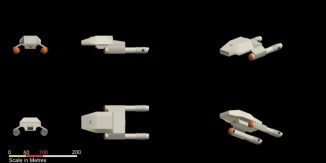
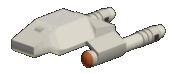
| Class: | IX | Year: | 2190 | |
| Ship Source: | Starstation Aurora | Ship Datasheet: | Coming Soon | |
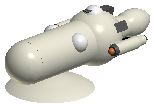

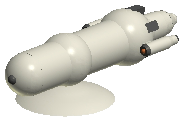
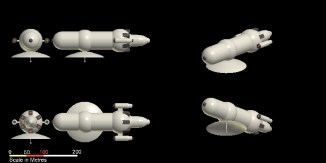
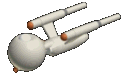
The Refit of the Lincoln class saw 10 ships upgraded. The completed ships were almost the equal of the new Valley Forge class.
| Class: | VII | Year: | 2230 | |
| Ship Source: | Ex Astris Scientia/Bernd Schnieder | Ship Datasheet: | Download PDF | |
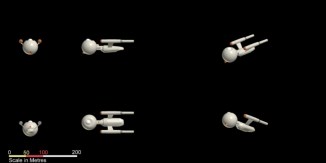
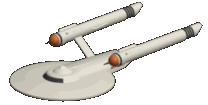
The Bennett Class cruiser entered service in 2217, and served in both exploration and military roles.
Notable amongst the ships of this class is one that was in fact not built. The fifteenth unit of the class was scheduled to be named USS Enterprise, but was renamed USS Meyer prior to launching.
| Class: | VII | Year: | 2217 | |
| Ship Source: | Based on Design for Star Trek: Star Fleet Academy movie | Ship Datasheet: | Coming Soon | |
|
|
||||

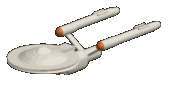
By the mid-2190s, transtator based subspace transmitters were compact enough to be suitable for fitment to Starfleet vessels other than specialized communications ships. The first ships to carry the new compact transmitters were the Hyperion Class Cruisers launched in 2194. The class had initially been designed as a exploratory follow-up to the Moskva class of 2179. However, when the Mercury subspace communication and sensor system became available, the Hyperion class was seen as an ideal platform. The Mercury system was mounted in a specially shielded housing on the primary hull. The Mark 2 features new more efficient and faster warp engines.
| Class: | VI | Year: | 2210 | |
| Ship Source: | The Starfleet Museum | Ship Datasheet: | Mk2 Coming soon |
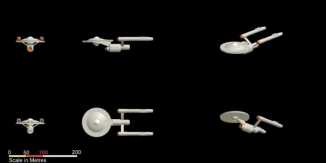

The Archon class was a more developed version of the Horizon class of 2190
| Class: | VIII | Year: | 2200 | |
| Ship Source: | Heavy Cruiser Evolution Chart | Ship Datasheet: | Download PDF | |

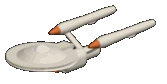
Early Federation exploration efforts were hampered by the lack of effective communication between command and distant ships, all long range communication required the user of booster buoys. By the mid-2190s, transtator based subspace transmitters were compact enough to be suitable for fitment to Starfleet vessels other than specialized communications ships. The first ships to carry the new compact transmitters were the Hyperion Class Cruisers launched in 2194. The class had initially been designed as a exploratory follow-up to the Moskva class of 2179. However, when the Mercury subspace communication and sensor system became ravailable, the Hyperion class was seen as an ideal platform. The Mercury system was mounted in a specially shielded housing on the primary hull.
The Hyperion class design’s basic structure and equipment were otherwise generally similar to the Moskva class, with eolutionary improvements to ship’s systems. The primary hull had become a flatter biconvex disc that was raised above the longitudinal axis of the secondary hull. The warp drive system comprised the FFTL-3B matter/antimatter reactor powering twin warp nacelles.
A dividend of the long-range subspace sensor was higher starship speeds, and the Hyperion was one of the first classes equipped with the new ‘B’ series warp drives. Earlier ships were limited to speeds less than warp 5 because their short-range navigational sensors gave at most a few seconds’ warning to avoid objects in their paths. The new sensors linked to the L series computers allowed Warp 5 to be reached safely for the first time since the NX class with its experimental Vulcan sensor suite.
Perhaps the most famous ship of the class was USS Triton, which had an unfortunate contact with the Klingon Empire while attempting to establish diplomatic and commercial relations. As modern diplomatic protocols had not yet been introduced, Triton’s captain, Natalia Thibodeaux, decide to beam herself and a diplomatic team into the Great Hall on Qo’onoS on October 11, 2218. Unfortunately, the Klingons had assembled in the Great Hall to celebrate their “expulsion” of the H’urq 11 centuries earlier and killed 7 members of the first-contact team. Thibodeaux and the survivors of the team managed to beam back safely, but USS Triton was severely damaged and nearly brought out of orbit by Klingon attacks. A total of 32 crew members were killed. By the time Triton limped back to Starstation McCall, the Federation was on the verve of war with the Klingon Empire. These hostilities led to the four years war some 40 years later were unremitting for the next 80 years until the signing of the Khitomer accords.
Ships of the Hyperion class served in a wide range of roles, including long-range explorers, command ships, border-patrol ships, and escort/sentries. Several ships also served with civilian agencies, such as the UFP Institute of Science. However the class was relatively lightly armed and rarely used in a front line role The last ship was retired from active service in 2229.
USS Pacatrix, which saw extensive service as a long-range explorer both inside and outside Federation space, is now on display at the Starfleet Museum.
| Class: | VI | Year: | 2194 | |
| Ship Source: | The Starfleet Museum | Ship Datasheet: | Download PDF | |
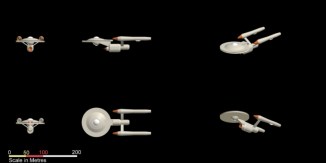
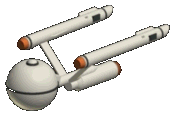
The Horizon Class Cruiser was the Largest sized ship to commission in Starfleet since the Romulan War era vessels. The Cruiser, although retaining the spherical command hull had a more modern layout with the twin nacelles mounted in a V formation, and a secondary hull linked by a distinct neck. The Horizon built on the design of the Lincoln, although scaled up.
| Class: | VIII | Year: | 2190 | |
| Ship Source: | Heavy Cruiser Evolution Chart | Ship Datasheet: | Download PDF | |
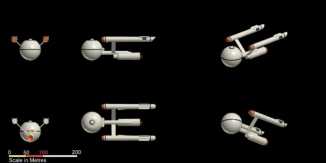

Developed from the Daedalus class, the Lincoln Class constituted a large proportion of Starfleet’s cruiser strength in the late 22nd century. The class has the distinction of being the first type produced at the then new Utopia Planitia shipyards. A number of these vessels were upgraded in 2230.
| Class: | VII | Year: | 2182 | |
| Ship Source: | Ex Astris Scientia/Bernd Schnieder | Ship Datasheet: | Download PDF | |
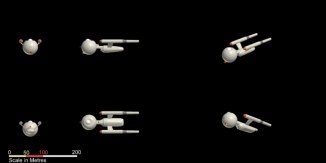
 Vintage Starships
You must be logged in to post a comment.