2156 – Columbia

From Memory Beta:

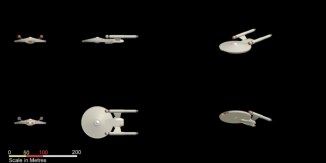
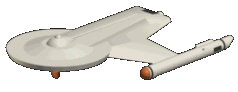
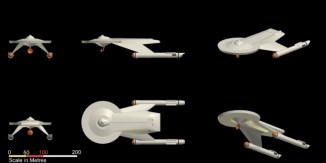
The Columbia-class was born out of the existing, and proven, NX-class design, and included retrofitted ships such as the  SS Enterprise and the USS Endeavour. It was named, at the insistence of Admiral Jonathan Archer, after the first vessel of the NX-class to be lost in action, the Columbia.

As well as the refitted ships, eight new Columbia-class vessels were slated for construction: USS Buran,  USS Shenlong, USS Apollo, USS Soyuz, USS Ares, USS Charybdis, USS Phoenix and USS Valiant.

The most noticeable difference between the NX and Columbia classes was the addition of a secondary hull which was slung underneath the  primary hull. The secondary hull included a new navigational deflector, and also a new large warp core which allowed speeds over warp 6. The room in the primary hull released by the removal of main engineering allowed for improvements in crew accommodation, although the connection of the secondary hull did result in the loss of the main shuttle bay in favour of smaller drop bays.
2158 – Powhatan

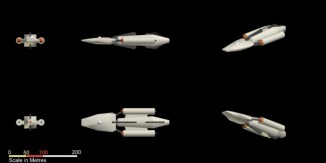
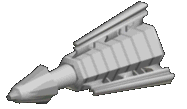
The Powhatan class ships were intended to serve as escorts for Yorktown class carriers on strike missions. Since the carriers carried only short-range area defense missiles, they were considered vulnerable to attack by smaller, more maneuverable vessels. If a carrier was accompanied by one or more smaller, heavily armed ships, the mission could be performed with a much lower risk of interference by enemy ships. Even before the launch of the EFTL-5 powered UES Krechet, engineers had begun developing a series of compact reactors for smaller ships. The first to enter service was the EFTL-6 in the Torsk class. Although smaller and lighter than it was also slightly less powerful. This was considered acceptable for border patrol ships, which were expected to operate in a limited geographic area. However, escorts for carriers had to be capable of sustained operations at high speeds for month-long missions into enemy territory.

The EFTL-8 was smaller and lighter but provided higher peak output levels for longer periods of time. Compared to earlier cruisers, Powhatan could be considerably smaller than earlier cruisers but have significantly improved performance, also the sleek lines were also strikingly different, she was long and thin where Krechet had been fat and round. Powhatan mounted a four nacelle system to improve maneuverability, and also used the new J-4A computer, which was a special version of the J-4 for smaller ships.
No carriers under their protection were lost to enemy action in the last 15 months of the war.

The long range, high speeds, and heavy weaponry of the class also made it useful in a wide range of other roles. By early 2159, Powhatans had largely superseded all other small cruisers in the roles of escorts, destroyers, scouts, and cruisers. Several ships were modified to perform intelligence missions deep within enemy territory. Even after the introduction of the Comet class in October 2158, the superior firepower of the Powhatans ensured that they continued in front line service. However, when peace came, a lack of space for scientific facilities meant that Powhatans had only limited use in the new Starfleet. They were replaced in 2185 by the more versatile Moskva class cruisers.

The POWHATAN-class escort USS PHAETON (CEM-18) is now on display at the Starfleet Museum.


Class: VI Year: 2158
Ship Source: The Starfleet Museum Ship Datasheet: Download PDF

powhatan_large


2134 – Horizon

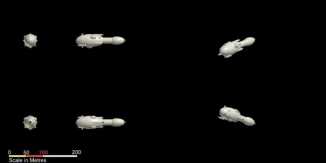
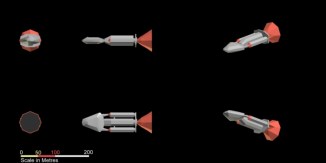
“The Horizon was one of the most important ships and classes in spaceflight history. The flagship for early Earth space exploration, the UES Horizon journeyed to the edge of the galaxy, encountering many new worlds in its numerous voyages. At the end of its commissioned life it was retired to Star Fleet’s spaceflight museum on Memory Alpha.”

Class: IV Year: 2134
Ship Source: Spaceflight Chronology Ship Datasheet: Download PDF

ues_horizon

2106 – Messier (Type II)

“.. the Pollux and its fellow Messier class ships were ..refitted for military use. The Pollux saw considerable action during the Romulan War.”

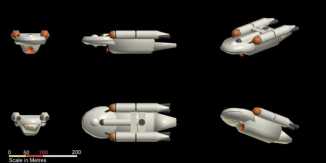
The Messier class cruisers were built in two distinct different variations, when  the Messier specification was issued two different shipyards submitted design and built bids. To satisfy competing political interests the order was split between the two yards (one terran and one martian). Both yards used identical equipment, and broadly similar dimensions, but the execution of the design was considerably different. Although the approach met political needs and also served to drive down costs to a degree by encouraging competition, it did lead to a duplication of parts and components which led to overall increased costs.

Class: IV Year: 2106
Ship Source: Starfleet Tactical Database II Ship Datasheet: Download PDF
NB Dates incorrect

messier_100

2106 – Messier (Type 1)

“.. the Pollux and its fellow Messier class ships were ..refitted for military use. The Pollux saw considerable action during the Romulan War.”

The Messier class cruisers were built in two distinct different variations, when  the Messier specification was issued two different shipyards submitted design and built bids. To satisfy competing political interests the order was split between the two yards (one terran and one martian). Both yards used identical equipment, and broadly similar dimensions, but the execution of the design was considerably different. Although the approach met political needs and also served to drive down costs to a degree by encouraging competition, it did lead to a duplication of parts and components which led to overall increased costs.

Class: IV Year: 2106
Ship Source: Spaceflight Chronology Ship Datasheet: Download PDF
NB Dates incorrect

sfc_messier_100


2267 – Baker

The Baker Class is a notable ‘what if’ in the history of Starfleet’s cruisers. The requirement that the Baker was built for, was for a smaller stablemate for the Constitution Class to replace the earlier Antares class, and to allow the diversion of the smaller exploration cruisers to more localised duties.

The class would have been notable in being the first major new cruiser class designed and built since the end of the four years war. However, in the event though the decision was made that existing Cruiser classes would be sufficient to meet requirements and that the Baker class design was better suited for use as a Destroyer, a role it has proved very suitable for. Only the USS Baker was ever completed as a Cruiser using circumferential warp drive, as part of the refit to Destroyer standards the Baker was refitted with linear warp engines.


lass: VIII Year: 2267
Ship Source: FASA Ship Datasheet: Coming Soon

baker_100


2261 – K’Kmarak

The K’Kmarak class was developed as a research ship only. It was never intended for combat and only carries weapons for defense. When the Mk I was commissioned, the need for a research vessel in the rimward areas of the Federation was greatest. As each ship in this class was completed, it was sent to this area to aid in the expansion of the territory. The K’Kmarak was instrumental in mapping this great expanse of space and in establishing contact with heretofore unknown races.

All ships in this class are designed for extended stays and therefore have large living quarters and working areas. Also, ships of this type have some of the most extensive laboratory facilities aboard any Starfleet ship. They are capable of performing the most intricate of planetary studies and have monitored and recorded several novas. It was during one of these investigations that a K’Kmarak class vessel the USS T’Pool (NCC 24307) was engulfed by a stellar explosion that covered 1200 A.U.s in 20 hours. Luckily for the crew aboard, their ship was caught up in a solar wind of phenomenal proportions which pushed away the T’Pool from the main thrust of the radiation. When all had settled, the T’Pool was still intact and flight worthy. The crew, however, had begun to suffer from radiation poisoning within a few days. The ship wandered about for several weeks until it was discovered by the USS Agincourt (NCC 4314), a Larson class destroyer. The crew was beamed aboard the Agincourt and the T’Pool was left adrift with marker beacons on, warning any approaching vessels to stay away. When ships were dispatched to recover the hull, the T’Pool was no where to be found and has not been seen or heard from since.

The Mk II version of this ship mounted the more powerful FWC-2, although maximum warp speed was slightly decreased. The Mk III version has improved firing arcs for its defensive FH-2 phasers. This upgrade was in response to the destruction of the research vessel USS Grissom in 2285 (2/22). After the Grissoms’ destruction, Starfleet reevaluated its research fleet and began a program to upgrade their defensive capabilities.

The K’Kmarak vessels were not built in substantial numbers, but the class is a capable one. All in all, the K’Kmarak class has served its purpose well and is still in service today. It should be noted that all K’Kmarak class ships are crewed by Vulcans.

Of the 14 K’Kmaraks built, 11 remain in active service. One Mk I is listed as missing. One Mk I and 1 Mk II have been scrapped. All remaining vessels have been upgraded to Mk IIIs. The K’Kmarak is no longer in production.

The K’Kmarak class has been named in honor of an early Vulcan scientist and explorer. K’Kmarak vessels carry on in the tradition of their namesake.

Class: VI Year: 2261
Ship Source: FASA/Lee Wood Ship Datasheet: Download PDF

kk