
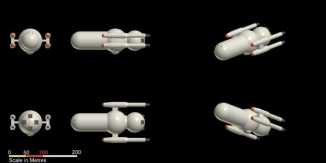
The Coronado class was a successful attempt to utilise the Constitution Class design as a light carrier…..
- Class: XI
- Year: 2258
- Ship Source: Ships of the Starfleet Volume 1
- Ship Datasheet: Not yet available
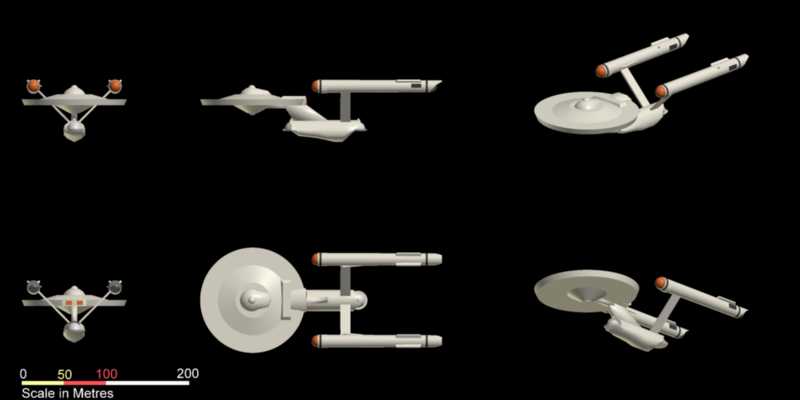
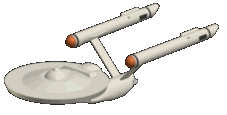
The Coronado class was a successful attempt to utilise the Constitution Class design as a light carrier…..

A Carrier Adaptation of the Successful Valley Forge Class Cruiser. These ships carried Penguin Class Fighters.
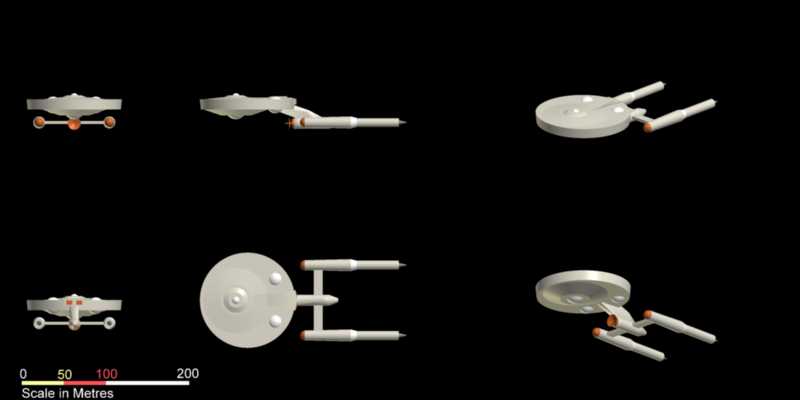

A Carrier adaptation of the successful Lancaster class Heavy Cruiser. The design had two nacelles housed side by side in a single bulbous housing. These ships carried Puffin Class Fighters.
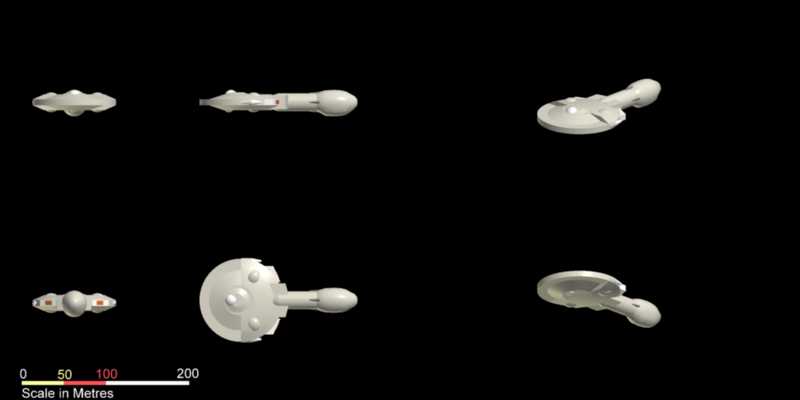

Introduced in June 2158, the Minotaur fighter and the M/AM-powered Yorktown Class carrier were an attempt to overcome the operational limitations of early M/AM ships by combining the speed and range M/AM-powered warp flight with the maneuverability of high-impulse fighters. Yorktown was based on the Pioneer class cruiser, which had entered service in 2154 and had itself been developed from the Bison-class transport. YORKTOWN carried a new M/AM reactor and four paired EFTL-7A warp nacelles. The impulse drive and its fusion reactor were moved to the extreme stern.
At the front of the cylindrical hull, which had been lengthened by some 20 m, were the ship’s sensors and navigational deflector, as well as command centers, the computer core, crew facilities, and life-support machinery. In the center section were docking cradles for 5 Minotaur long-range fighters. In the aft section were auxiliary deuterium tanks, the missile room, and support facilities for the fighters. With a displacement of some 670,000 tons, Yorktown was by far the largest Earth-designed warship produced to that time and would not be surpassed until the Ambassador class was launched in the 2330s.
After the war, many Yorktowns were converted to fast transports and tankers or sold
The YORKTOWN-class carrier UES SARATOGA and the MINOTAUR fighter Gwendoline are now on display at the Starfleet Museum.
Commissioned Ships
** Denotes Lost or missing ship
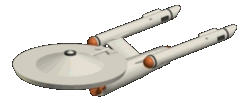
The Heston class, although now largely forgotten, was the leading Cruiser type in the four years war. Although not as powerful as the Constitution in terms of engines, it made up for that with its greater firepower and overlapping arcs of fire.
Advances in Klingon Ship design and weaponry capability led to concerns amongst some elements of Starfleet in the early 2240s. It was planned that the Constitution class would form the vanguard of Starfleet’s strength after they began commissioning in 2245, but the dual role nature of the design led to the military capabilities being reduced to allow for science and exploration capability. Additionally the advanced sensors and science instrumentation fitted meant that the class was prohibitively expensive to procure in quantity.
To counter this problem Military Operations Command pushed for a cheaper military roled heavy cruiser, which would dispense with th e extensive science equipment of the Constitution class, this ship became the Heston class. The first Heston class ship commissioned in 2249; it was in many ways a more heavily armed variant of the Constitution class design. Superficially, the ships looked similar, but externally, and internally there were a number of changes.
The Heston mounted the FWD-1 warp drive, as opposed to the FWC-1 of the Constitution. The only way to fit the required weapon load in the class was use the lighter warp drive which additionally was 20% cheaper than the FWC-1. of the ship. The cost of this change was that the Heston class was always short of power, but to remedy this the class was fitted with the revolutionary FSI shield generator, the first trinary shield generator. Because of leaving out the science facilities of the Constitution class, the ships had the capability to carry 200 marines as well as fighter craft and assault shuttles. It had been planned to make the ship larger, but suitable impulse drives were not available to power ships of more than class XI until 2256.
The Mark 2 Heston of 2253 was perhaps the ultimate laser equipped warship to serve in Starfleet. She adopted the new FWE-2 warp drive, which allowed additional structural reinforcing due to its lower weight, as well as being both more efficient and more powerful. All 7 surviving Mk 1s were upgraded to this standard. The Mark 2 was designed purely to counter the D10 class Cruiser.
Postwar the ships were deemed obsolete due to their reliance on lasers, and the lower power of the warp drives. Additionally the single role nature of the vessels meant that they could not be redeployed on exploration duties, which made them less attractive for refits than the Constitution class ships.
In another blow to the future of the Heston class, the Federation Class usurped the military role of the class, the Federation class was essentially a Heston class hull with the addition of a third nacelle. A limited refit was carried out in 2257, when three ships gained FWD-2 warp drives, but this was only a temporary reprieve, as the lasers and accelerator cannons were not replaced. USS Heston became flagship of the Federation reserve fleet in 2258, just 9 years after commissioning. Subsequently it was decided that the Heston class spaceframes could be most effectively used if refitted to Federation Class Dreadnought specifications.
To this end, all 13 surviving vessels were mothballed or in reserve by 2260. From 2266 onwards 12 of the 13 survivors were stripped back to their spaceframes with the intention of being be rebuilt to Federation class specifications, however when the Federation class production was halted early these hull were scrapped or expended as targets.
The USS Heston (NCC-1685) was the only ship not scrapped, and was later allocated for display purposes. She is still in the Starfleet Museum today.

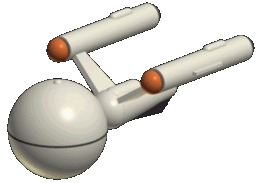
“Because of the failure of the Tritium class, concern for defence capabilities results in the building of an advanced prototype battle cruiser. This ship doesn’t become part of the fleet, but many of its improvements do.”
The 2210 Battle Cruiser (Sigma Class) was another attempt to produce a front line combatant. Again the design was excellent in principle, but was again found to be underpowered. This time however the basic design (in terms of systems) was used, as it was integrated into the design of the Quetzalcoatl class semi Dreadnought.
|
|
||||
| Class: | XIV | Year: | 2210 | |
| Ship Source: | Space Flight Chronology/Starfleet Tactical Database II | Ship Datasheet: | Download PDF | |


The Juggernaut uniquely represents one of the major intelligence triumphs of the Romulan War, and one of the major engineering failures of the post war era.
Snatched from it’s Romulan builders prior to completion by operation ‘Golden Pheasant’ in 2157, the ship was docked safely at Andor. It was stripped of its equipment by Intelligence and Engineering personnel in a bid to learn as much as possible about Romulan Technology. The ship was to be refitted with Earth and Andorian technology and turned loose against it’s former owners.
In the event, the war ended before the ship was completed, and work was slowed to such an extent that the ship was not completed until 2168. After competitive trials against the USS Goliath (a Federation prototype battle cruiser) she was quietly decommissioned as an expensive failure (as was the Goliath, as the new technology used was not yet mature enough to allow these ships to operate efficiently). Later she was moved to Memory Alpha as a museum ship, were she remained for almost a century until Orion pirates hijacked her.
Juggernaut was recovered, but not before the Orions had carried out considerable work in upgrading the shipboard systems and weapons to 23rd century standards. As a result Starfleet Corps of Engineers completed the work began by the Orions, and the ship was finally commissioned, over a century after being commenced, to act as a Training ship attached to the Academy at Andor. In 2295, the ship was again decommissioned, and rededicated as a memorial to lives lost on both sides in the Romulan War.
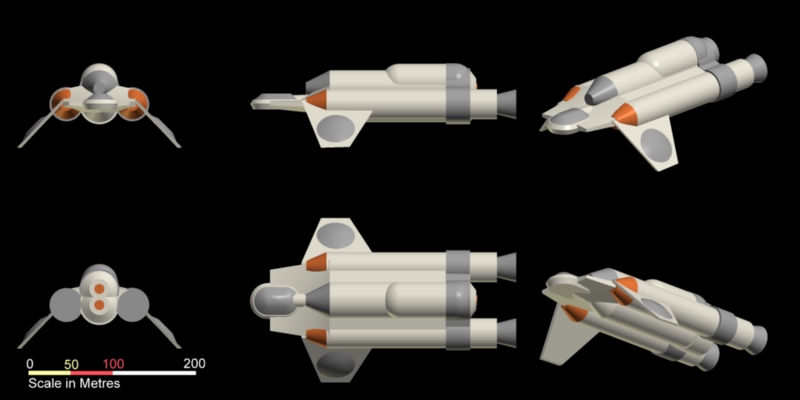
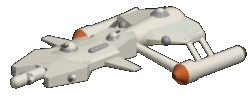
“During the darkness of the Romulan War, when the prospect of prolonged hostility seemed only too real, Star Fleet Command ordered this battle cruiser prototype built and feasibility tested, However the ship proved tremendously unwieldy and never entered active service. Its failure to perform to specification was a major reason why both the Horizon and Marshall classes enjoyed such an extended commissioned life.”
The 2168 Battle Cruiser program was intended to produce a new generation ship to replace the aging Romulan war era vessels. Although the design was in principle excellent experience in testing showed that the ship was chronically underpowered. Additionally the cost of the ship was deemed to be prohibitive and the design was cancelled.
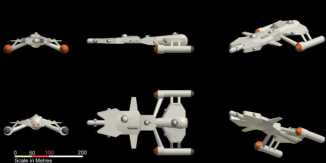

The Conqueror Class battle cruisers were the final Bison class based ships to be built during the Romulan war
These cruisers, introduced in 2159, were basically improved Tannhauser class ships with the new more powerful EFTL-9 Warp drive with nacelles mounted outboard above the centerline, and an upgraded sensor suite.
New weapons included a forehead-mounted, high-velocity “missile rifle” with a rotary feed system for the ET-4 missile, and a ship-to-ship version of the ELC-2 Electron laser cannon first used in the Farragut class.
These immense cruisers gave invaluable service during the last year of the war, particularly at the battle of Cheron, where their steady missile barrages helped batter the Romulan fleet into submission. UES Charger was the flagship of Task Force 41, which led the final drive towards the Romulan Homeworlds.
However, when peace came in 2160 the class proved prohibitively expensive to maintain and crew, and accordingly all were retired by 2163.
The Conqueror class battlecruiser UES Charger is now on display at the Starfleet Museum.
| Class: | XVII | Year: | 2159 | |
| Ship Source: | The Starfleet Museum | Ship Datasheet: | Download PDF | |
|
|
||||
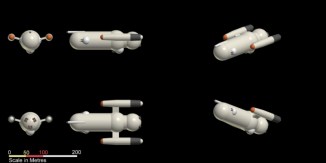 Commissioned Ships
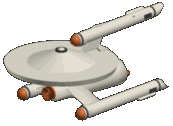
The Mindbender class was an experiment using the same components as the conventional Federation Class Dreadnought, but creating a more compact craft to reduce target cross section. Just one prototype was built and was used in competitive trials against the Federation class. The Mindbender was more manoeuvrable. but top speed suffered as the design was less warp dynamic, it also suffered from restricted firing arcs for the primary hull lower phasers.
After the trials were complete Mindbender was retained as a trials and training ship.
| Class: | Year: | |||
| Ship Source: | Chris Cornelius | Ship Datasheet: |

 Vintage Starships
You must be logged in to post a comment.