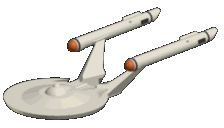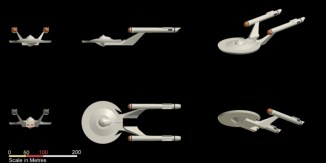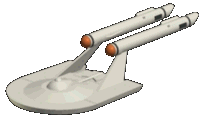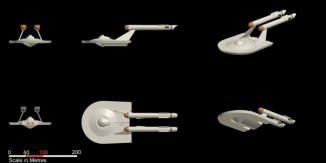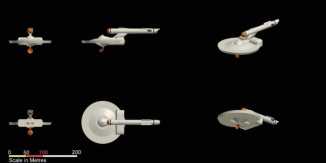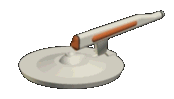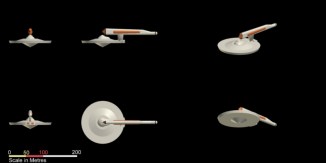

2165 – Dragon (as built)

After the end of the Romulan war, most ships in the  Starfleet were small, lightly armed exploratory cruisers (such as the former UESN Daedalus and Comet classes). Most of the UESN’s heavy cruisers (Conqueror class) and fighter-carriers (Yorktown class) had been mothballed, repurposed, scrapped, or sold off to local defense forces, with only a small number entering service with Starfleet.

To meet any potential remaining Romulan  threat, Starfleet needed to replace its Conqueror-class heavy cruisers.  The large crew complements and offensive mission profile made them poorly suited for a more defensive role.

In April 2163 Starfleet issued a request for proposals for the Dragon class of border-defense heavy cruisers. The requirement was for firepower (both missile and beam weaponry) at least 33% greater than that of Conqueror. Cruising and maximum speeds were wf 3.4 and wf 4.5,again an improvement over the Conqueror. Displacement was planned to be 150,000 tons or less with a crew of 430 officers – both approximately a third of those of Conqueror. These ships were planned to be less expensive to design, construct, and operate, but still  be more effective for border defence than the wartime Cruisers. 20 Ships were planned, to commission for 2166 onwards. This baseline ship is shown as the Dragon Mk1 on the Data sheet.

The successful design was in essence a scaled up Daedalus, using some Comet style components as well. Construction of the  class began in August 2164, but problems were encountered as the first Dragon began to be fitted out with various components supplied by subcontractors. The challenging requirements led to many of these systems being designed specifically for the Dragon class, and also to these systems having an impact on the overall design. In addition Starfleet Intelligence threat analysis led to a requirement for across-the-board performance increases for all ship’s systems. Accordingly, the damage and ranges of all weaponry were to be increased by an average of 25%;  and cruising and maximum speeds were increased to wf 3.6 and wf 4.7. This improvement was to be delivered from just a 10% increase in crew size and displacement.

To meet the new performance requirements, numerous changes were made. To increase the cruising and maximum speeds, a more powerful warp drive with larger reactor  was installed requiring the addition of a separate “reactor hull”. In addition, the 129-m-long nacelles were replaced by 157-m-long units. As well as the increase in firepower the missile load was increased, and the shuttle bay enlarged.  These  changes further decreased the space that could be used for crew quarters, stores, and life-support systems. Dragon was now 257 m long, with an estimated displacement of 180,000 tons, and the various technical issues were still to be overcome. This is the Mk2 configuration.

In December 2165, Hull #1 was christened USS Fafnir (NCC-213) and launched to begin trials despite the ongoing integration problems. Upon commencement of trials  construction was authorized to begin on the next 3 ships of the class. However the trials of Fafnir quickly revealed numerous problems. The most severe being that the firing of a full missile salvo from the forward missile tubes at attack speed  caused the mounts for the p forward deflector and targeting sensors to become misaligned. This was resolved by structural reinforcement. High speed warp runs revealed harmonic flexing from the nacelle supports propagating throughout the length of the ship – these vibrations played havoc with navigation, weapons targeting, and prevented Fafnir from reaching design speeds. In the longer term these vibrations would lead to fatigue failure possibly resulting in the catastrophic loss of spaceframe integrity. To resolve these issues it was necessary to shorten and thicken the neck connecting the primary and secondary hulls and adding redundant supports for the nacelles on the reactor hull. Fafnir was now 247 m long but displaced 194,000 tons

By October 2166 most of the outstanding problems were being solved: the lead ship, USS Fafnir, was commissioned. Unfortunately by  2167 Starfleet’s requirements had changed, and the defensive posture of the Dragon meant they were ill suited for use in a exploration role. The lack of internal space owing to the level of equipment and weaponry fitment meant that there was no space for the installation of laboratories, scientific equipment, crew quarters, common areas, and long-term life-support systems. With the Romulan threat in abeyance, the Dragon had become a costly and immobile white elephant, and  in November 2167 Starfleet cancelled the final 10 ships of the class before construction had begun.

Despite these problems the 10 completed Dragons proved to be rugged and reliable ships –  however, all Dragons were withdrawn from front-line service by 2180 without ever having fired a shot in anger.

The Dragon-class heavy cruiser USS Jörmungandr (NCC-218) is on display in the Starfleet Museum.

Class: XI
Year: 2165
Ship Source: Starfleet Museum
Ship Datasheet: Coming Soon

Dragon Mk2 Configuration:
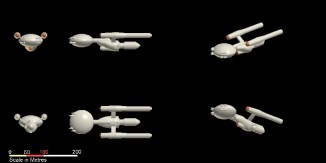
dragon2

Commissioned Ships

  • USS Fafnir NCC-213 completed in this configuration, but was modified during trials

2164 – Dragon (Design)

After the end of the Romulan war, most ships in the  Starfleet were small, lightly armed exploratory cruisers (such as the former UESN Daedalus and Comet classes). Most of the UESN’s heavy cruisers (Conqueror class) and fighter-carriers (Yorktown class) had been mothballed, repurposed, scrapped, or sold off to local defense forces, with only a small number entering service with Starfleet.

To meet any potential remaining Romulan  threat, Starfleet needed to replace its Conqueror-class heavy cruisers.  The large crew complements and offensive mission profile made them poorly suited for a more defensive role.

In April 2163 Starfleet issued a request for proposals for the Dragon class of border-defense heavy cruisers. The requirement was for firepower (both missile and beam weaponry) at least 33% greater than that of Conqueror. Cruising and maximum speeds were wf 3.4 and wf 4.5,again an improvement over the Conqueror. Displacement was planned to be 150,000 tons or less with a crew of 430 officers – both approximately a third of those of Conqueror. These ships were planned to be less expensive to design, construct, and operate, but still  be more effective for border defence than the wartime Cruisers. 20 Ships were planned, to commission for 2166 onwards. This baseline ship is shown as the Dragon Mk1 on the Data sheet.

The successful design was in essence a scaled up Daedalus, using some Comet style components as well. Construction of the  class began in August 2164, but problems were encountered as the first Dragon began to be fitted out with various components supplied by subcontractors. The challenging requirements led to many of these systems being designed specifically for the Dragon class, and also to these systems having an impact on the overall design. In addition Starfleet Intelligence threat analysis led to a requirement for across-the-board performance increases for all ship’s systems. Accordingly, the damage and ranges of all weaponry were to be increased by an average of 25%;  and cruising and maximum speeds were increased to wf 3.6 and wf 4.7. This improvement was to be delivered from just a 10% increase in crew size and displacement.

To meet the new performance requirements, numerous changes were made. To increase the cruising and maximum speeds, a more powerful warp drive with larger reactor  was installed requiring the addition of a separate “reactor hull”. In addition, the 129-m-long nacelles were replaced by 157-m-long units. As well as the increase in firepower the missile load was increased, and the shuttle bay enlarged.  These  changes further decreased the space that could be used for crew quarters, stores, and life-support systems. Dragon was now 257 m long, with an estimated displacement of 180,000 tons, and the various technical issues were still to be overcome. This is the Mk2 configuration.

In December 2165, Hull #1 was christened USS Fafnir (NCC-213) and launched to begin trials despite the ongoing integration problems. Upon commencement of trials  construction was authorized to begin on the next 3 ships of the class. However the trials of Fafnir quickly revealed numerous problems. The most severe being that the firing of a full missile salvo from the forward missile tubes at attack speed  caused the mounts for the p forward deflector and targeting sensors to become misaligned. This was resolved by structural reinforcement. High speed warp runs revealed harmonic flexing from the nacelle supports propagating throughout the length of the ship – these vibrations played havoc with navigation, weapons targeting, and prevented Fafnir from reaching design speeds. In the longer term these vibrations would lead to fatigue failure possibly resulting in the catastrophic loss of spaceframe integrity. To resolve these issues it was necessary to shorten and thicken the neck connecting the primary and secondary hulls and adding redundant supports for the nacelles on the reactor hull. Fafnir was now 247 m long but displaced 194,000 tons

By October 2166 most of the outstanding problems were being solved: the lead ship, USS Fafnir, was commissioned. Unfortunately by  2167 Starfleet’s requirements had changed, and the defensive posture of the Dragon meant they were ill suited for use in a exploration role. The lack of internal space owing to the level of equipment and weaponry fitment meant that there was no space for the installation of laboratories, scientific equipment, crew quarters, common areas, and long-term life-support systems. With the Romulan threat in abeyance, the Dragon had become a costly and immobile white elephant, and  in November 2167 Starfleet cancelled the final 10 ships of the class before construction had begun.

Despite these problems the 10 completed Dragons proved to be rugged and reliable ships –  however, all Dragons were withdrawn from front-line service by 2180 without ever having fired a shot in anger.

The Dragon-class heavy cruiser USS Jörmungandr (NCC-218) is on display in the Starfleet Museum.

Class: X
Year: 2164
Ship Source: Starfleet Museum
Ship Datasheet: Coming Soon

Dragon Mk1 Configuration:

dragon1

Commissioned Ships

  • USS Fafnir NCC-213 was commenced in this configuration but was modified before commissioning,

2252 – Portsmith

“The Portsmith class was a small cheap destroyer designed for mass production. During the four years war vast numbers were built to act in numerous roles. Despite its size and low cost, the class was amongst the more powerful destroyers in service during the war. Post war the class was not fitted with phasers as the cost of conversion would have exceeded the cost of construction.”

The Mk1 Portsmith Class entered service in 2246 as a cheap simple customs cutter, and was produced at numerous merchant and military shipyards throughout the Federation. The design had no weapons save for four lasers, and was powered by the heavy but effective FWH-1 warp drive system, In all some 300 were built between 2246 and 2252.

The growing hostilities prior to the advent of the Four Years war in 2252 found the Federation desperately short of effective escorts. A program was instituted to design a new escort destroyer class for mass production. It was realised that designing a new class from scratch would take a number of years. It was suggested that the existing Portsmith class could form the basis for a very capable Light Destroyer.

The FWH-1 engines of the Mk1 were replaced by the new FWA-2, and the ship had three accelerator cannons crammed into the former cargo hold. The resultant ship was a revelation to Starfleet Commanders, the more efficient Warp Drive, coupled to the heavy weapon load (for the size of vessel) meant that the Mk2 had a combat efficiency better than full size destroyers, and indeed better than some cruisers.

The price paid for this efficiency was two fold, the range of the Portsmith could not compare to that of the larger destroyers, and the superstructure, although reinforced compared to the Mk1 was not as resilient as that of the larger destroyers. However when deployed in groups escorting convoys the capabilities of the Portsmith meant that they were a force to be reckoned with. Some 360 Mk2s were built, and a large number of Mk1s were upgraded.

Postwar, the Portsmith class had no real role, although a large number were retained in reserve fleets until the 2270’s. A large number of these ships were sold onto planetary defence forces, or onto the civil sector after being disarmed.

Class: IV Year: 2252
Ship Source: Spaceflight Chronology Ship Datasheet: Download PDF

portsmith_large

2243 – Loknar

The Loknar Class frigates were built during “The Great Awakening”, a period of expansion by the Federation. During this time, many research and exploration vessels were designed and built to aid in the efforts to solidify an enlarged and growing United Federation of Planets. Also during this period, a smaller number of warships were built. The Loknar, the most noted of these warships, is still in service to this day, a tribute to the quality of the Andorian design.

Soon after the Federation Appropriations Committee granted Starfleet the funds necessary to construct fleets to expand and patrol the limits of the UFP, Andorian factions began pushing for warship construction. The basic Andorian philosophy was that, in expanding, the Federation might come upon races as hostile as the Romulans and Klingons, leading to another protracted war for which the Federation and Starfleet were unprepared. The Andorians argued that, were this to happen or were the Klingons or Romulans to escalate hostilities, Starfleet needed to be better prepared and would need ships to protect the new borders and colonies. The Andorian arguments were successful, and Starfleet began a limited build- up of warships. Several ship building facilities were constructed by Andorian firms to design and manufacture these warships, the most notable of these on Sol IV and Salazaar, the largest and most productive in the Federation.

Introduced in October of 2247 (1/90), the Loknar class frigate mounted the new, but already proven, FWE-1 warp drive, in Starfleet’s inventory for only two years. The FIC-2 impulse engine was introduced on the Loknar and has since proven itself to be one of the most reliable of all production. The Loknar Mk I was considered a ‘muscle’ ship because of its four heavy lasers and single accelerator cannon, making it equal to all but the largest Klingon vessels and more powerful than any ship in the Romulan navy. In addition, the Loknar mounted FSH shield generators, more efficient than any used by the enemies of the Federation.

During the Four Years War, the Loknar saw more action than any other vessel in Starfleet. As the war dragged on however, Starfleet realized the need for vessels with more firepower. When they could be spared, Loknars began being refitted at forward supply and repair stations. The Mk Ib Loknar mounted two additional laser cannons and an aft accelerator cannon. The lasers were banked to provide more flexibility in combat. Late in the war, the Mk Ic was introduced. This version of the Loknar mounted a curious blend of old and new technologies; it retained the lasers of its predecessors, but replaced the accelerator cannons with FP-1 photon torpedoes.

Although it was considered to be successful, the Andorian designers felt a need to improve the Loknar. The FWE-2 warp drive systems, still being tested, would produce 60% more power than the FWE-1 and would increase the ship’s overall performance. The Mk II was commissioned into service in January of 2256 (1/98) mounting the FWE-2, even though this engine was not officially adopted by Starfleet until February of 2259 (2/00).

The most significant advance in starship technology came with the phaser and photon torpedo. The phaser delivered more firepower at longer ranges, weighed less, and required less structural reinforcing than the laser. The newly developed photon torpedo delivered the same explosive power at 75% less power requirement, was considerably lighter and required less structural reinforcement than the accelerator cannon. Eight FH-5 phasers and new photon torpedo technology were incorporated into the Mk II, making it more powerful than anything in the Klingon fleet with the exception of the D-10. The Mk II also mounted an upgraded binary shield generator, the FSK, giving 33% more protection at the same output level as the earlier system. The Mk IIa Loknars were refits from surviving Mk Ic’s- no new builds occurred of this version. The Mk IIb mounted 3 FP-3 photon torpedoes forward and 1 aft (the FP-3 was experimental when first mounted to the Loknar). This arrangement favored redundancy: during the Four Years War, several Loknars were placed at a severe disadvantage when their single forward missile weapon was damaged during combat. The Mk IIa’s were refitted to Mk IIb standard by 2260 (2/03). Both versions saw limited action in the Four Years War.

The next major change in the Loknar’s design came with the introduction of the FWD-2 warp drive to the Mk IV. Along with the FIC-3 impulse drive, this increased the power output and overall performance by 40%. Furthermore, this model replaced the 4 FP-3 photon launchers with the FP-1. The Mk V is the latest model of the Loknar class and is armed with FP-6 torpedoes.

Loknar class frigates have served Starfleet faithfully for over 40 years and will remain in the inventory for many years to come. A major push was begun by the Andorians to create the next generation of Loknar- the Mk VI. However, with four newer frigate designs already being produced, Starfleet Appropriations did not accept the proposal. The final Loknar was constructed in May of 2288 (2/24). Loknars were produced at the Salazaar and Sol IV facilities at a rate of 2 ships per year, including refits. At the behest of the Andorian government, all Loknars are to be refitted to Mk V standard and retained in active service.

Historical Notes:

The Loknar class frigates are named after cities and provinces of the Federation. More than half of these vessels are crewed by Andorians and the majority of these are assigned to the ‘Blue Fleet’, ships whose officer contingent and crew are entirely Andorian. The USS Loknar was the first ship commissioned into the Blue Fleet, serving as the flagship for many years.

The infamous IKSV Staav’e Mara (Slave Of Justice), was originally the USS Morgan City, a Loknar Class frigate captured by Admiral Kamato’s forces during the Four Years War and later used in Kamato’s abortive coup attempt on the Klingon throne. After failing, Kamato retreated into the Triangle, taking the Loknar class frigate with him. From their location in the Triangle, the Klingon rebels began attacking unprotected convoys and merchant vessels by using the Staav’e Mara to lure them in. This ruse lasted for several years, then a general recall of all Loknar class vessels made it difficult for the Klingon vessel to operate as though it were from Starfleet. The IKS Admiralty then decided to have the vessel painted in the standard steel-gray color of their Navy. The Staav’e Mara still operates with the IKS Navy and has been seen as recently as January 2287 (2/23).


Class: VIII Year: 2243
Ship Source: FASA Ship Datasheet: Download PDF

loknar_side

2256 – Derf

The Derf was designed as a destroyer leader (Daring Class), but improvements in sensor technology in the Four Years War  rendered this type of ship obsolete. It was then proposed to be re-roled as an exploration cruiser (Derf class), but the decision to produce further ships of the Constitution and Anton classes meant that it could not fulfill that role either. Finally the USS Derf was borrowed for a demonstration of the buoy tender concept. This demonstration was so successful that serial production of the Derf was ordered immediately and eventually totaled 600 vessels over a period of 35 years. Few vessels in Starfleet history have achieved either that level or longevity of production and it is certain that had the class been adopted in either of the other two intended roles it would not have gotten anywhere near either figure.

USS Derf was the only ship of this design commissioned in the exploration cruiser configuration (in January 2256), but she was soon converted for trials as a tender in July 2256.

Class: IX Year: 2256
Ship Source: FASA Original/ Additional material by Lee Wood/Steve Bacon Ship Datasheet:

derf_side

2255 – Daring

The Daring was designed as a destroyer leader, but improvements in sensor technology in the Four Years War  rendered this type of ship obsolete. It was then proposed to be re-roled as an exploration cruiser (Derf class), but the decision to produce further ships of the Constitution and Anton classes meant that it could not fulfill that role either. Finally the USS Derf was borrowed for a demonstration of the buoy tender concept. This demonstration was so successful that serial production of the Derf was ordered immediately and eventually totaled 600 vessels over a period of 35 years. Few vessels in Starfleet history have achieved either that level or longevity of production and it is certain that had the class been adopted in either of the other two intended roles it would not have gotten anywhere near either figure.

Of the 26 Daring Class hulls laid down, only five commissioned (Daring, Diamond, Diomede, Derwent and Daedalus) in their intended role. USS Derf commissioned in the exploration cruiser configuration before being converted for trials as a tender in 2255. The other five were also subsequently converted to the tender configuration in 2256, and the other 20 were commissioned in that configuration

Class: IX Year: 2255
Ship Source: FASA Original/ Additional material by Lee Wood/Steve Bacon Ship Datasheet:

derf_side

2256 – Derf

The early history of the Derf Class is an amazing story of near abandonment. The Derf was designed as a destroyer leader (Daring class), but improvements in small ship sensor technology during the Four Years War rendered this type of ship obsolete. It was then re-roled as an exploration cruiser (Derf class), but the decision to produce further ships of the Constitution and Anton classes meant that it could not fulfill that role either. Finally the USS Derf was borrowed for a demonstration of the buoy tender concept. This demonstration was so successful that serial production of the Derf was ordered immediately and eventually totaled 600 vessels over a period of 35 years. Few vessels in Starfleet history have achieved either that level or longevity of production and it is certain that had the class been adopted in either of the other two intended roles it would not have gotten anywhere near either figure.

The Derf class tender has been operational in Starfleet for more than 25 years. When it entered service in July of 2256 (1/9807), the Derf class marked a new concept in navigational beacon repair. Before its introduction, marker buoys and navigational beacons had to be retrieved and returned to a repair facility to be serviced. Derf class tenders eliminated this need because they carried repair facilities on board.

When a Derf arrives at a malfunctioning beacon’s location, a shuttle uses a tractor beam on the beacon and tows it into the lower hull, which is the tender’s main repair facility. The beacon is then placed on an assembly line and repaired robotically. When the work is finished, the shuttle tows the beacon back into the spacelanes, and the Derf moves on.

Although the Derf is not designed as a fighting vessel, it is capable of aggressive defense. Most repair missions take place along the borders between the major powers, where the chances of encountering enemy ships is very high. Because of this high risk, the Derf is armed with medium-range phasers.

This protection does not prevent them from falling prey to enemy ships. In February 2263 (2/0702), the USS Acropolis responded to signals from a malfunctioning marker buoy. As its shuttle neared the beacon, a Klingon warship appeared and opened fire before defensive action could be taken. The volley crippled the Acropolis’ engines, and the tender was boarded and towed into Klingon territory.

Intelligence later discovered that the beacon had been planted by Klingon operatives to entrap the repair tender. It is theorized that the Klingons gained technical information concerning robotics and repair techniques that they lacked, but it is not known just what gain this action brought them in the overall situation. Some analysts believe that study of the robotic repair systems will make it possible for Klingons to alter the functioning of navigation beacons robotically, creating potential havoc in border spacelanes. However, a crash program of buoy upgrading and fitting of encryption systems, which occupied the entire fleet of Derf’s and many other ships, prevented this from happening.

The design of the Derf evolved over a number of Marks. The Mk II would have offered improved impulse and warp drives compared to the Mk I, but a further improved Mk III was designed while the early Mk IIs were being tested. All Mk IIs were updated to Mk III specifications to keep the number of variations within the fleet as low as possible.

In 2285 (2/22), a number of Derfs were taken in hand for conversion to a new Mk V standard. The increase in tensions on the Klingon frontier meant that Derfs now required an armed escort in order to operate safely. The Mk V refit introduced improved shields and enhanced weapons in order to allow the ship to operate without escort in most situations. Not all ships have been refitted to this standard, but all new production was to this standard until production ceased. The Derf class was built at Merak by Chandley Works, Ltd. Buoy maintenance is now carried out by civilian ships in most areas of the Federation, but Starfleet maintains a fleet of Derfs in both active service and reserve to maintain those in more dangerous areas.

The Derf class is now a surprisingly sought after posting amongst many young officers. The reasons for this are varied. All active ships are assigned to border areas, so there is a chance to see the “enemy” in the flesh, it (in Mk V form) is a tough ship to best in combat, and perhaps most importantly it is one of the few classes still in service from the “classic” era of starship technology.

Of the 691 Derfs built, 8 Mk Is, 351 Mk IIIs, 61 Mk IVs and 72 Mk Vs remain in active service, and 38 Mk Is and 25 Mk IIIs are in reserve fleets. Two Mk Is, 2 Mk IIIs and 2 Mk IVs are used by Starfleet Training Command; 12 Mk Is, 8 Mk IIIs and 2 Mk IVs have been destroyed; 1 Mk III has been captured by the Klingons; 1 Mk I, 3 Mk IIIs and 1 Mk V are listed as missing; 4 Mk Is, 4 Mk IIIs, 3 Mk IVs and 2 Mk Vs have been scrapped; and 2 Mk Is and 1 Mk III have been sold to the private sector.

Class: IX Year: 2256
Ship Source: FASA Original/ Additional material by Lee Wood/Steve Bacon Ship Datasheet: Download PDF

derf_side

2243 – Siva (William Howe)

The Siva class destroyer mounted the best in Federation technology for its size at the time it was built. First commissioned in 2243, it mounted the M-1 computer, FWB-1 warp engine, FIC-1 impulse engine and FSA shield generator. A controversial military design due to its accelerator cannon arrangement, the Siva was unique in that it possessed only one laser cannon mounted aft purely for defensive purposes.

The Siva was assigned to Military Operations as a light missile destroyer to be used offensively with fleet support. The ships were designed to work together in groups of three. In these squadrons, they were to attack an enemy vessel while it was engaged in combat with a larger friendly vessel.

Until the Four Years War, the Siva class did not see any combat action. However, at the outbreak of the war, Sivas were some of the first vessels deployed in combat. Starfleet was conscious of the limited combat mission the Siva could perform and did not dispatch Sivas alone. Starfleet deployed them as designed when suitable capital vessels could be mustered (which proved quite a chore in the early days of the war).

As the war stabilized and the urgency of ship allocation lessened, the Siva class came into its own. Working mainly with Coventry class frigates and Heston class cruisers, a squadron of Sivas would be assigned to a single larger vessel. After a space battle had occurred in which a Klingon task force had been splintered or largely destroyed, a single Heston or Coventry would engage any lone, surviving Klingon capital ships. Staying well away from the larger Starfleet vessel so as not to be detected, the Sivas would lie in wait until the capital vessels engaged in combat. The Sivas would fly in a perpendicular path to the enemy vessel, avoiding any hostile forward weapons. The Sivas would fire their forward accelerator cannons at optimum range and then fly-by their target. Then, they would release their aft cannons and keep on going until out of range of the enemy vessel. Here they would turn around and line up for another attack. It took great skill and power management to perform the maneuver safely and effectively.

Usually captained by young Lieutenant Commanders, these ships and their crews were especially noted for their “e’sprit de corp”. This was especially the case with the Siva crews, since the entire complement of ten vessels were always assigned to the same fleet. Since their combat duties were limited by their design, they often served as scouts, pairing up with one another for safety.

It was no secret that the Siva was severely under-powered. Due to the limitations of its design and the technology of the era, no additional models of the ship were constructed and no other builds took place. The power limitations also left Sivas vulnerable, especially to Klingon gunboats and escorts that protected capital ships. Of the ten Siva class destroyers built, four were destroyed in the Four Years War. Two were damaged beyond repair and scrapped. The surviving four were assigned to Starfleet Training Command after the war where they served until being scrapped in 2269. One vessel, the USS William Howe, NCC 3216, participated in the evacuation of the Alerian homeworld in 2268 (2/11).

The USS Siva was amongst amongst those severely damaged, and the hulk was used as the prototype for the more conventional Siva subclass of the Saladin class in 2248. Upon the recommissioning of the Siva in this new configuration the former class was renamed the William Howe class.

  • Class: V
  • Year: 2243
  • Ship Source: FASA
  • Ship Datasheet: Download PDF

apache_large

2252 – Monoceros II

The Monoceros class scout was designed to provide Starfleet with a light scout which was cheap and easy to build. First commissioned in 2246 (1/89), further ship production was delayed after a design flaw in the warp field balance coil was discovered. At high warp speeds, the ship tended to “rise” out of its own warp field, causing the ship to violently exit warp. The problem was corrected by reconfiguring the control computer software.

The Monoceros II was also designed to act as a demonstrator for the improved generation of linear warp drives then in development. The SCNN nacelle and reactor arrangement adopted for the single FWB-1 warp engine was lighter than the equivalent PB series installation. Fitment of a full-blown linear drive assembly with hull mounted warp core was dismissed in this design on safety grounds. It would be a further 10 years before work began on a class mounting such a system.

The experience gained in operating the SCNN equipped Monoceros II class paved the way directly for later SCNN engined vessels (such as the Endeavour class) and also demonstrated the benefits that ships equipped with linear drives had compared to those with circumferential warp drives. Of the 16 ships commissioned, not a single vessel was lost to warp drive related problems, but some nine vessels were lost to enemy action. The decommissioning of the class in 2257 (1/99) was the result of the need to continue the testing of the new engines on the few surviving ships of the class. Accordingly all seven survivors continued to be operated as test-beds by both the engine manufacturers and the Starfleet Corps of Engineers, the last not being retired until 2282 ((2/27).

The Monoceros did see action in the Four Years War, albeit limited. In 2253 (1/95), the USS Vulpecula was responsible for inflicting minor damage on several unescorted Klingon G-4 transports. The captain and crew of the Vulpecula received Starfleet’s highest commendations for this action. Most ships of this class, however, served as sentry ships for assembled fleets.

An interesting footnote to the ship’s history is the origin of the class name. It has been told that Commodore Charles Tatum, who was overseeing the design of the proposed scout, was studying the ship schematics at home when his seven year old daughter became curious as to her father’s work. The commodore light-heartedly asked his daughter what the ship should be called, and she promptly answered, “Unicorn!” Impressed, the commodore (after changing the name to its Latin derivative) submitted the name and it was eventually approved.

Class: IV Year: 2246
Ship Source: Starfleet Technical Manual/Lee Wood Ship Datasheet: Download PDF

new_monoceros-scnn-100