2236 – Bode

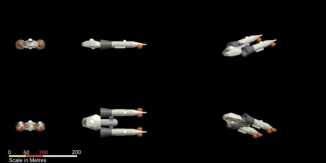
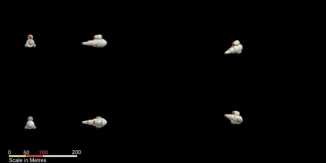
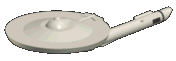
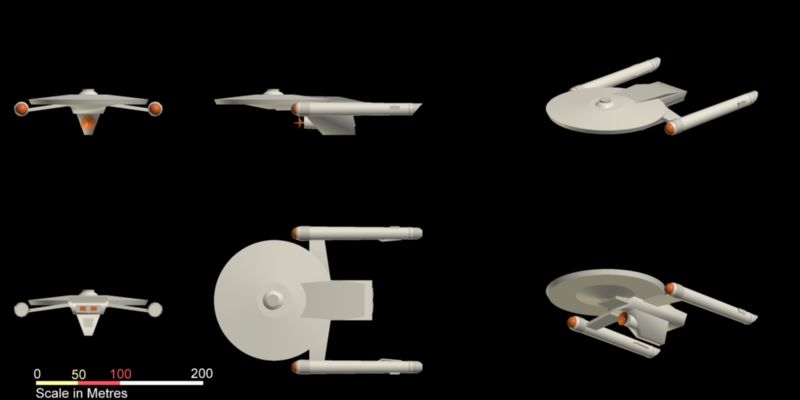
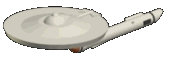
The Bode Class entered Starfleet service in 2236. This large (for its time) scout was one of the last major warship classes built without the benefit of dilithium moderated warp drives.  The Bode class was designed to act as a Battlefleet Scout, and quite often was deployed in task forces alongside a Baton Rouge Class Cruiser. The Baton Rouge Class ship being the flagship of the force, and the Bode it’s eyes and ears.  

The Mk1 Bode class featured protected warp nacelle bussards, on an engine that in terms of design owed much to the design used on the Mann class cruiser. Initially the protective ring only enclosed half of the bussard, but later this ring was extended around the whole circumference of the bussard scoop to try to boost efficiency.   The Bode was popular with its crews, as although only lightly armed with lasers, it did include a single FAC2 accelerator cannon, which meant that the Bode could easily damage then evade a more powerful opponent. The ample power of the engines and excellent maneuverability of the design allowed the Bode to choose its combats.

The Class was later supplanted in its fleet role by Hermes, Monoceros and Nelson class scouts, but it was retained in use supporting second line fleets. With the outbreak of the Four Years War, many Bode class vessels were pressed into service scouting ahead of convoys.   The failure of the diminutive Hale class in service, and its withdrawal from operational use in early 2253, meant that the Bode assumed greater importance. The other common scout class, the Sawyer, was deemed to be too small for the role, and production of Hermes and Nelson class vessels was being deferred in favour of Destroyers of the Larson and Saladin classes instead.  

Accordingly 20 Bodes were quickly re-equipped with Dilithium moderated warp drive, which gave a maximum speed of warp 8, however this was at the expense of a 20% loss of installed power. To compensate for this loss of available power, the shields were upgraded to the FSD binary system, which more than made up for the loss. As part of the upgrade the L14 computer replaced the old L3, but uniquely the class retained the old FNSP-5B impulse drive as it was felt that the operational profile of the class did not suffer from the lower maximum speed (0.25c) of the engine compared to the newer generation of impulse drives (0.5c).  Following the withdrawal of the Sawyer Class scout from service in late 2253 the Bode was for a short time the main fleet scout. When sufficient numbers of Nelson and Hermes class scouts became available in 2254 the Bode was withdrawn from operational service, as although it was a capable vessel problems with maintenance meant that the class was very man power intensive to maintain in service.  

Additionally, as with the experience with the Sawyer and Hale classes, Starfleet was uncomfortable with the level of losses that these light scouts were suffering given the crew shortages that Starfleet was suffering as a result of the war.  Most surviving Bodes were mothballed at the Morena Yards, and would have been recalled to service if the strategic  situation had deteriorated further, but in the event this was not required. Four Bode class ships remained in limited service attached to the Academy.  A proposal to refit the Bodes with Phasers, Photon Torpedoes and new impulse drives was made after the end of the war to allow a return to service, but it was felt that refitting newer classes was far more cost effective.  The Bodes attached to the Academy survived in service until 2262.  Most of the Bodes that had been stored at Morena were later expended in trials of the new FP4 torpedo system

  • Class:V
  • Year:2236
  • Ship Source:Space Flight Chronology
  • Ship Datasheet:Download PDF
bode_large


2233 – Hale

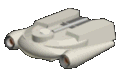
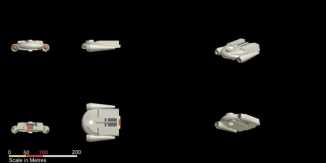
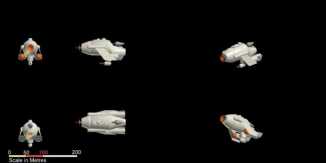
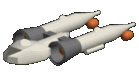
The Hale was first commissioned in Mark 1 form in 2233, and was intended to act as a light scout for Galaxy Exploration Command, a heavier Mark 2 version followed two years later to suit the needs of Military Operations
Command. The design was intended to produce a compact ship with minimal surface area to reduce observability. GEC planned to use the vessels for covert surveillance of worlds subject to the prime directive which had not yet made contact with the outside universe. MOC also planned to use the vessels for covert surveillance, but of less benign targets.

The result of the low observability requirement was to produce an unconventional ship with nacelles mounted close to the side of ship, the nacelles were also shielded against sensors with hull plating. This gave the class an appearance of being armoured, but this was far from the case. The design was studied with great interest by many designers as it was hoped that the close in engine mounting would give major benefits.

In service the ships proved reliable, and were quite well liked by their crews, despite the cramped accommodation they offered to the 65 crew they carried. The crews also appreciated the distinctiveness of the design, which made them stand out from the more conventional designs used in Starfleet.

In 2242, the Hale Class USS Pace, while engaged in surveillance operations near the Triangle obtained sensor readings on a new Klingon Design, this is now known to BE the first time a UFP ship scanned a D7A class cruiser. The USS Pace managed to scan the D7A for 15 minutes without being detected, before warping back to its base.

The Commissioning of newer scouts such as the Bode, Sawyer and Nelson classes gradually reduced the importance of the Hale to MOC, and by 2249 all remaining ships had been transferred to GEC or assigned to the Academy as Trainers. The Hale Class continued in active service until 2253 when it was decided that given the tactical situation of the Four Years War, continued operation of such a small lightly protected scout was reckless even in ‘safe’ areas. The ships assigned to the Academy survived in service until 2256.

Production of the Hale totalled 60 Mk 1s, and 70 Mk 2s between 2233 and 2239, no ships were modified between marks. The Class was produced at Morena Shipyards. Remarkably the class was never refitted. A refit program was considered in 2246, but a gradual change in emphasis towards larger scouts (such as the Nelson and Hermes classes) meant that it was rejected as uneconomical and unnecessary, as such the ships retained their non-dilithium engines until they left service.

Class: II Year: 2233
Ship Source: Space Flight Chronology Ship Datasheet: Download PDF

hale_large

2247 – Modified Hermes

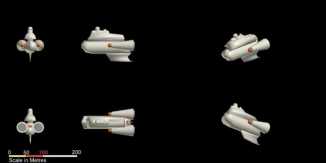
The Hermes class scout was based on the same design as the Saladin class destroyer. As it was more powerful and than the earlier Nelson class it was generally assigned as a scout for battle fleets.

A number of vessels of this class were built in an experimental configuration with a neck mounted deflector dish, instead of the original that was mounted below the primary hull. This modification improved reliability of the deflector system, but did not affect combat performance.

  • Class:VI
  • Year:2247
  • Ship Source:Starfleet Technical Manual
  • Ship Datasheet:Download PDF

MASAO-saladin-100


2243 – Nelson

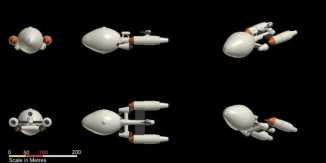
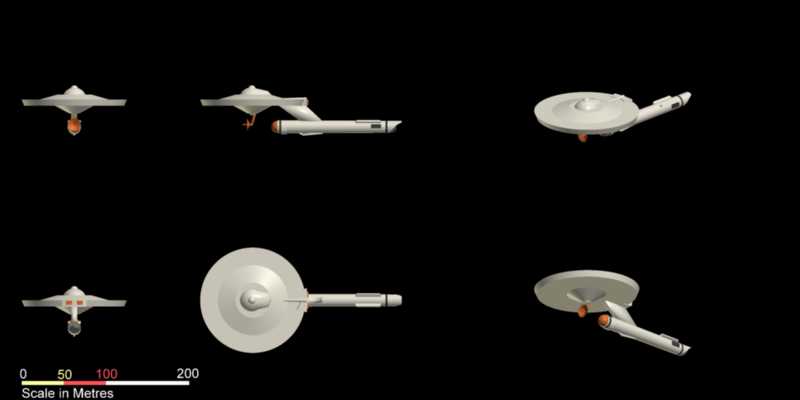
The Nelson class scout was primarily designed to act as a scout for Galaxy Exploration command, it had much in common with the Constitution class Cruisers and the other ships of the period. The class can be distinguished from the similar Hermes class scout by the V formation of the warp nacelle supports

Class: VI Year: 2243
Ship Source: FASA Ship Datasheet: Download PDF


nelson_large

2255 – Detroyat

Detroyat by VintageStarships on Sketchfab

The Detroyat class Heavy destroyer holds the distinction of being the Largest destroyer type built in the 22nd or 23rd centuries. One of the most powerful ships in known space when commissioned, the class remained in a frontline role for 50 years, although the class was reclassified as a long range scout in 2255. The class has an enviable reputation for surviving no matter what the odds. Only one ship of the class was lost in all those years of service.

Class: XI Year: 2255 (Reclassification)
Ship Source: USS Detroyat Class Heavy Destroyer Blueprints Ship Datasheet: Download PDF

detroyat_mod_100