The Doppler class scout introduced matter/antimatter power into scout ships.
| Class: | II | Year: | 2156 | |
| Ship Source: | Space Flight Chronology | Ship Datasheet: | Download PDF | |
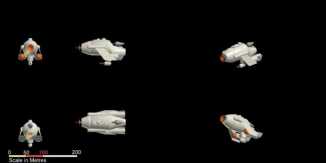
Scouts, like Cruisers, are one of the oldest designation in Federation nomenclature. Scouts are designed to conduct a number or information gathering missions, including exploration, first contact, research, and intelligence gathering. Scouts are usually smaller and lighter than other front line exploration vessels. Most are also less heavily armed, using the space for labs and research equipment. Scouts have extremely comfortable, although somewhat cramped, crew spaces, due to their extended patrols. Most scouts are used along the expanding boarder to explore and catalogue planets, stars and other space phenomenon.
No other single category of vessel can claim as many discoveries as Scouts.
Scouts are also designed to be easily repaired, and many have extensive self-repair capabilities, needing only time and raw materials to repair nearly any onboard system. Scouts have both passive and active sensor systems, often rivalling those of Heavy Cruisers. Scouts have a number of computer redundancies, used to store and transmit newly acquired information. But the focused nature of Scouts does put them at a disadvantage when compared to cruisers.
Most scouts have only moderate medical facilities, reducing their effectiveness in medical situations. Scouts also lack the large crew associated with other exploration classes. None the less, their speed and excellent detection equipment make them the ideal choice for expanding the boarders of the Federation.
Light Scouts are the smallest scout vessels in use by the Federation. Unlike standard Scouts, which have an extensive multi-target research base, Light Scouts, like Research Cruisers, are designed to concentrate several different science system on the study of a single phenomenon. Light scouts are often no larger than a cutter or large gunboat, but have extensive recreation and meeting spaces available.
Light Scouts also have a larger than average passenger compliment, with many on board crew actually civilians. Light Scouts often have only rudimentary defences, and are never sent beyond the boundaries of Federation Space.
Fast Scouts are usually known for their inability to conduct research missions, rather than their high speed. Considered some of the fastest vessels within most navies, Fast Scouts use much of their internal space to accommodate oversized engines and impulse drives, sacrificing much of their science base capability.
Most Fast Scouts do retain extremely sensitive scanning equipment, and can gather data nearly as detailed as a Survey vessel. None the less, most have half the number of labs associated with a typical scout vessel.
This give most Fast Scouts a more military mission profile. Due to their small size and usually light weapons, Fast Scouts are not know for their battle capabilities.
Battle Scouts, a Klingon term, describe vessels more commonly known as Raiders and occasionally confused with Blockade Runners. Battle Scouts, the most famous of which is the Bird of Prey design, has only a limited science capability, usually having only one or two actual labs aboard.
Many Battle Scouts are equipped with extensive ECM devices which allow them to operate closer to most enemy facilities. Battle Scouts are known for their light beam weapons and usually are equipped with a single, heavy firepower torpedo weapon.
Although unable to successfully engage large capital ships, Battle Scouts are able to use their stealth and attack Destroyers, Escorts, and on rare occasions, Cruisers. Battle part of most combat plans.
The most sought after scout assignment, the Science Scout is perhaps the most common image of scouting vessels among most navies. Science Scouts trade weapons for labs, often having more actual on-board laboratories than vessels twice their size. Science Scouts have extremely precise sensors to make extensive studies of both space-born and ground phenomenon. Science Scouts bring to bear all the science and research capabilities of a Heavy Cruiser in a platform often one quarter of the size. Science Scouts can conduct experiments and research on up to 10 or more projects simultaneously, and are credited with more discoveries than any other single class of vessel.
Science Scouts are none the less vulnerable. Because of their reduced internal volume, many are only lightly armed and moderately shielded. Most Science Scouts are assigned to relatively “safe” areas of study, having a military escort when operating near dangerous areas. Science Scouts are usually quite easy to detect, despite their small size. Their active sensor systems make them easy to spot great distances away. Truly non-military vessels, Science Scouts have large Passenger Facilities and recreation capability. Although armed, most Science Scouts would quickly run when faced with an adversary. Although not deigned for it, most Science Scouts can conduct first contact missions when necessary. Many in Star Fleet seek at least a single tour aboard a Science Scout, as do many Romulans.
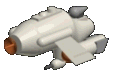
The Doppler class scout introduced matter/antimatter power into scout ships.
| Class: | II | Year: | 2156 | |
| Ship Source: | Space Flight Chronology | Ship Datasheet: | Download PDF | |
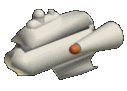
A Diminutive early scout vessel with Fusion power. These little ships saw combat in the Romulan war, and many survived to be transferred to the Federation Starfleet when it was established in 2161.
| Class: | II | Year: | 2151 | |
| Ship Source: | Space Flight Chronology | Ship Datasheet: | Download PDF |
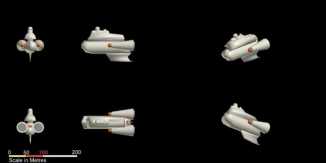
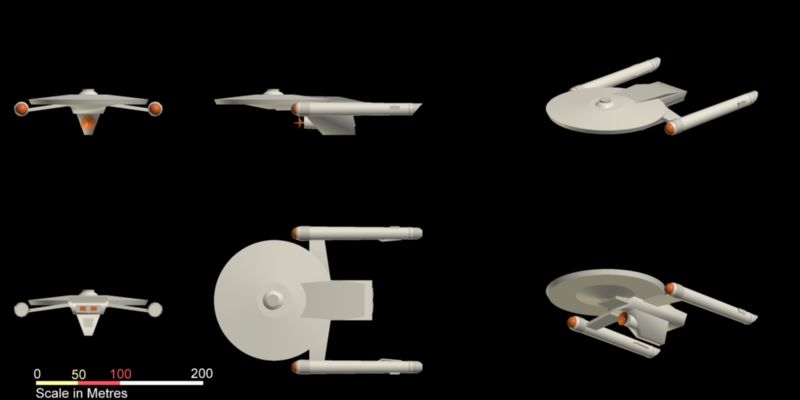
The Hermes class scout was based on the same design as the Saladin class destroyer. As it was more powerful and than the earlier Nelson class it was generally assigned as a scout for battle fleets.
A number of vessels of this class were built in an experimental configuration with a neck mounted deflector dish, instead of the original that was mounted below the primary hull. This modification improved reliability of the deflector system, but did not affect combat performance.

The Hermes class scout was based on the same design as the Saladin class destroyer. As it was more powerful and than the earlier Nelson class it was generally assigned as a scout for battle fleets.
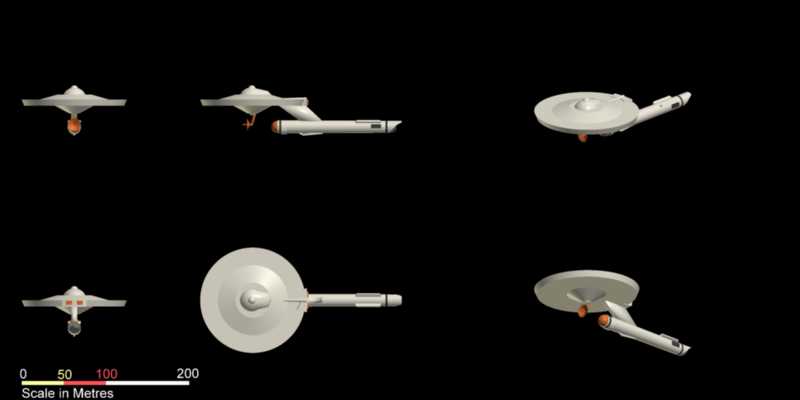
The Nelson class scout was primarily designed to act as a scout for Galaxy Exploration command, it had much in common with the Constitution class Cruisers and the other ships of the period. The class can be distinguished from the similar Hermes class scout by the V formation of the warp nacelle supports
| Class: | VI | Year: | 2243 | |
| Ship Source: | FASA | Ship Datasheet: | Download PDF | |
|
|
||||


Detroyat by VintageStarships on Sketchfab
The Detroyat class Heavy destroyer holds the distinction of being the Largest destroyer type built in the 22nd or 23rd centuries. One of the most powerful ships in known space when commissioned, the class remained in a frontline role for 50 years, although the class was reclassified as a long range scout in 2255. The class has an enviable reputation for surviving no matter what the odds. Only one ship of the class was lost in all those years of service.
| Class: | XI | Year: | 2255 (Reclassification) | |
| Ship Source: | USS Detroyat Class Heavy Destroyer Blueprints | Ship Datasheet: | Download PDF | |
|
|
||||
The Monoceros class scout was designed to provide Starfleet with a light scout which was cheap and easy to build. First commissioned in 2246 (1/89), further ship production was delayed after a design flaw in the warp field balance coil was discovered. At high warp speeds, the ship tended to “rise” out of its own warp field, causing the ship to violently exit warp. The problem was corrected by reconfiguring the control computer software.
The Monoceros II was also designed to act as a demonstrator for the improved generation of linear warp drives then in development. The SCNN nacelle and reactor arrangement adopted for the single FWB-1 warp engine was lighter than the equivalent PB series installation. Fitment of a full-blown linear drive assembly with hull mounted warp core was dismissed in this design on safety grounds. It would be a further 10 years before work began on a class mounting such a system.
The experience gained in operating the SCNN equipped Monoceros II class paved the way directly for later SCNN engined vessels (such as the Endeavour class) and also demonstrated the benefits that ships equipped with linear drives had compared to those with circumferential warp drives. Of the 16 ships commissioned, not a single vessel was lost to warp drive related problems, but some nine vessels were lost to enemy action. The decommissioning of the class in 2257 (1/99) was the result of the need to continue the testing of the new engines on the few surviving ships of the class. Accordingly all seven survivors continued to be operated as test-beds by both the engine manufacturers and the Starfleet Corps of Engineers, the last not being retired until 2282 ((2/27).
The Monoceros did see action in the Four Years War, albeit limited. In 2253 (1/95), the USS Vulpecula was responsible for inflicting minor damage on several unescorted Klingon G-4 transports. The captain and crew of the Vulpecula received Starfleet’s highest commendations for this action. Most ships of this class, however, served as sentry ships for assembled fleets.
An interesting footnote to the ship’s history is the origin of the class name. It has been told that Commodore Charles Tatum, who was overseeing the design of the proposed scout, was studying the ship schematics at home when his seven year old daughter became curious as to her father’s work. The commodore light-heartedly asked his daughter what the ship should be called, and she promptly answered, “Unicorn!” Impressed, the commodore (after changing the name to its Latin derivative) submitted the name and it was eventually approved.
| Class: | IV | Year: | 2246 | |
| Ship Source: | Starfleet Technical Manual/Lee Wood | Ship Datasheet: | Download PDF |
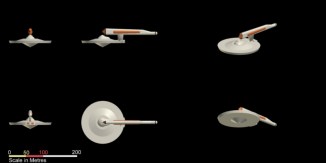

The Monoceros class scout was designed to provide Starfleet with a light scout which was cheap and easy to build. First commissioned in 2246 (1/89), further ship production was delayed after a design flaw in the warp field balance coil was discovered. At high warp speeds, the ship tended to “rise” out of its own warp field, causing the ship to violently exit warp. The problem was corrected by reconfiguring the control computer software.
The Monoceros II was also designed to act as a demonstrator for the improved generation of linear warp drives then in development. The SCNN nacelle and reactor arrangement adopted for the single FWB-1 warp engine was lighter than the equivalent PB series installation. Fitment of a full-blown linear drive assembly with hull mounted warp core was dismissed in this design on safety grounds. It would be a further 10 years before work began on a class mounting such a system.
The experience gained in operating the SCNN equipped Monoceros II class paved the way directly for later SCNN engined vessels (such as the Endeavour class) and also demonstrated the benefits that ships equipped with linear drives had compared to those with circumferential warp drives. Of the 16 ships commissioned, not a single vessel was lost to warp drive related problems, but some nine vessels were lost to enemy action. The decommissioning of the class in 2257 (1/99) was the result of the need to continue the testing of the new engines on the few surviving ships of the class. Accordingly all seven survivors continued to be operated as test-beds by both the engine manufacturers and the Starfleet Corps of Engineers, the last not being retired until 2272 (2/17).
The Monoceros did see action in the Four Years War, albeit limited. In 2253 (1/95), the USS Vulpecula was responsible for inflicting minor damage on several unescorted Klingon G-4 transports. The captain and crew of the Vulpecula received Starfleet’s highest commendations for this action. Most ships of this class, however, served as sentry ships for assembled fleets.
An interesting footnote to the ship’s history is the origin of the class name. It has been told that Commodore Charles Tatum, who was overseeing the design of the proposed scout, was studying the ship schematics at home when his seven year old daughter became curious as to her father’s work. The commodore light-heartedly asked his daughter what the ship should be called, and she promptly answered, “Unicorn!” Impressed, the commodore (after changing the name to its Latin derivative) submitted the name and it was eventually approved.
| Class: | IV | Year: | 2246 | |
| Ship Source: | Starfleet Technical Manual/Lee Wood | Ship Datasheet: | Download PDF |

 Vintage Starships
You must be logged in to post a comment.