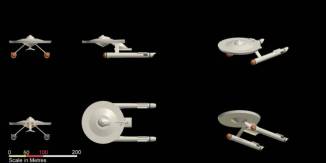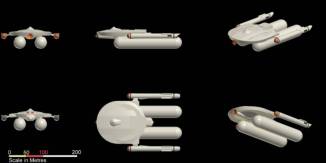

2242 – Ptolemy (Modified)

The Ptolemy class transport was the first in a line of successful high-load warp transports used by the Federation. Equipped with specially designed warp engines suitable for towing mass never before realized, the vessels were a boon to infrastructure building outside the core of the Federation. Initially, production contracts called for 30 ships of this class to be constructed. However, due to the fleet-wide ship build-up at the time it was commissioned, limited appropriations permitted the construction of only 15 of the class.

The Ptolemy class was designed for easy and efficient transporting of cargo within outboard cargo containers. The cargo containers were easily attached and detached via a specially designed coupling unit fitted to the neck of the primary hull of the starship. Depending upon total mass, up to two containers could be towed by the Ptolemy at one time. These containers were mass-produced and supplied to both Starfleet and private shipping concerns (at a reduced rate) to promote the use of these standardized containers. Practically a ship unto themselves, these containers were a break-through in shipping technology just as the high-load warp engines mounted on the Ptolemy were.

The containers came in five basic types:

  • Mk I Liquids
  • Mk II Dry Bulk Goods
  • Mk III Refrigerated/Thermal Goods
  • Mk IV People (starliners, mass transport)
  • Mk V Products (non-food stuffs and misc.)

The Mk I-III and V containers had their own cargo transporters (up to six), turbolifts for carrying goods to various levels and self-contained environmental machinery. The Mk IV containers also included 6 personal transporters and could accommodate 800 passengers. This container also had its own sensors array, was capable of sub-light speed and could sustain its passengers in case of an emergency for up to 18 years.
During the Four Years War, an urgent need arose for military cargo transports. Because of their slow speeds, the Ptolemy was not a viable candidate. However, the need was so great that all Ptolemys in service at the time were converted to Mk IIs. The Mk II mounted the FWB-1 engine which improved the speed of the transport, but at the cost of limited cargo capacity. The Mk II could only carry approximately 121,000 mt of cargo in smaller outboard cargo containers. However, this was sufficient in its role as a military transport.

After the Four Years War, surviving Ptolemys were retrofitted with the FHLWA-1 and returned to their pre-war roles. Many of the Mk IV containers were converted to starliners, with luxurious accommodations for up to 500 passengers. These starliners contained a park promenade, numerous recreation lounges, 2 full theaters, a gymnasium, pool and hydroponic gardens.

This modified version was first built in 2242 alongside the standard version, it featured more discreet hull mounted deflectors as opposed to the large dish of the standard ships. Post war most of the class were converted to this standard, which gave no performance benefits, but considerably improved reliability.

Class: VII Year: 2242
Ship Source: Starfleet Technical Manual/The Starfleet Museum Ship Datasheet: Download PDF

masao-ptolemy-pod-70masao-ptolemy-nopod-70

2258 – Pyotr Velilkiy

Ordered as an alternative in case of the failure of the Constitution Class. The delays to Constitution Class and poor performance of the Ranger II meant that the Pyotr Velilkiy served as an interim Heavy Cruiser, and was ordered in quantity in response to Klingon aggression in 2244.

The eventual entry of the Constitution Class to service in large numbers meant that the Pyotr Velikiy was relegated to less glamorous duties, and some were converted to serve as tugs. The Cruiser version was phased out by 2312.

The Pyotr Veliky class was conceived as fall back design in case of delays to the Constitution Class Program. The Protoype, USS Pyotr Veliky named for the Tsar who created Russia’s Imperial Fleet, entered service in 2241. The ship mounted the ultimate non dilithium warp drive to enter service, the FFTL-7B and was the only class fitted with this engine. The other technology of this design was also well proven, in direct contrast to the advanced systems chosen for the Constitution Class. The class was designed and built at Andorian shipyards in an effort to disperse the strategically important role of building heavy cruisers away from Earth, additionally much of Earth’s ship building and design capacity was tied up in the Constitution class program.

Delays to the Constitution Class led to the ordering of 5 Mk 2 ships, the first of which entered service in 2244. The Mk 2 featured improved laser weaponry and improvements to cargo handling systems. The Pyotr Veliky class, despite it’s old technology warp reactor did have the same nacelle design as would be used on the Constitution, and many minor improvements made to the nacelles on these ships found their way into the Constitution class nacelles.

As the Mk2 ships entered service, increased Klingon aggression prompted an order to be placed for 14 Mk3 ships. The Mk3, which entered service in 2245 mounted the brand new FAC-4 accelerator cannon, but the main advance was with shielding. The New unary shields were now coming into service, and the FSG was selected to replace the inefficient system mounted on earlier ships. The FSG required the addition of a new style M series computer, and the M3 was accordingly fitted.

With the Constitution class beginning to be available in quantity by 2250, steps were taken to refit the 20 Pyotr Veliky ships for further service. 14 Ships were refitted to MkIV standards for service with Military Operations Command, and 6 to MkV for service with Galaxy Exploration Command.

The MkIV adopted the FWD-1 warp drive, this drive at half the weight of the FFTL-7B meant that the ship’s mass dropped by almost a 100,000mt. The resultant ships, although less powerful, were more efficient in movement and had a higher maximum speed, useful for patrol duties. The only old technology system retained aboard the ships was the dependable FNSP-X impulse system, as no newer style engines could yet power ships of Class XI. The refits were all complete at the outbreak of the Four Years War, where this class served distinction.

The MkV adopted the even lighter FWE-1 Warp drive, and had a major physical change with the removal of the secondary hull. These ships had been intended for use in an exploration role, but the Four Years War saw them serve as Frigates until the Surya and Coventry classes entered full service. The MkV mounted the same weapons as the MkIV and the FIC-3 impulse engine meant that it had the same amount of power as its larger sibling, but the lighter structure could absorb less damage.

Postwar surviving vessels were used in second line roles, some for exploration (Mk6) and some as cargo tugs(Mk7) or transports (mk8), although a small number did remain in defence roles with the Blue Fleet (Mk9).

The last Pyotr Veliky was not retired from service until 2312, that vessel, the USS Salah Ad-Din is now on display in the Starfleet Museum.

  • Class: IX
  • Year: 2250 (Mk V)
  • Ship Source: Starfleet Museum
  • Ship Datasheet: Download PDF

pv-tug-70

Commissioned Ships

USS Pyotr Velikiy NCC-1670

USS Shrelev II NCC-1671

USS Yi Sun-Shin NCC-1672

USS John Paul Jones NCC-1673

USS Tav NCC-1674

USS Elizabeth I NCC-1675

USS Etrox NCC-1676

USS Togo NCC-1677

USS Rommel NCC-1678

USS Friedrich Barbarossa NCC-1679 USS Goyathlay NCC-1680

USS Washington NCC-1681

USS Niakenchiis NCC-1682

USS Salah Ad-Din NCC-1683

USS Giap NCC-1684

USS Hannibal NCC-1685

USS Zerisshebi NCC-1686

USS De Grasse NCC-1687

USS Rexx NCC-1688

USS Gantu NCC-1689