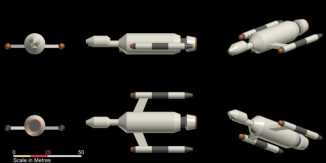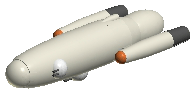
2253 – Solar

NOTES:

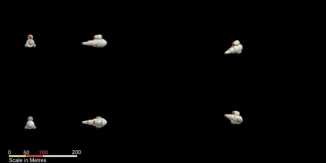
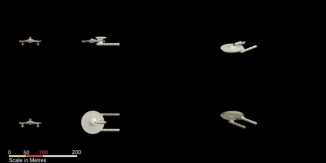
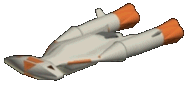
The Solar class was a sought after posting for young officers looking to make a name for themselves or to gain first experience of command. With a crew of 23 and 10 marines, the ships had a justifiable reputation for being ‘hot rods’ due to their speed and manoeuvrability, and also made many planetfalls as they were used to ‘fly the flag’ in many lightly defended areas. Indeed the only Starfleet vessel that many colonies only ever saw a Solar class cutter.

As of 2270 of the 588 Mk 1 Solar Class cutters built, 196 Mk Is remain in reserve fleets.  79 Mk Is have been destroyed and 2 Mk Is are listed as missing; 16 Mk Is have been scrapped and 81 Mk I have been sold to civilian commercial concerns.

Of the remaining 214 Mk1s, 120 are employed in second line duties across the UFP, and 70 have been sold planetary defence forces or allies. 24 Mk1s were converted to Mk2 standards during the 4 Years war, and gained a heavier weapons fit for use in a high speed precision strike role, only 1 Mk2 (The USS Kane) survived the war in UFP service, and it was retired to the Fleet museum, 9 were lost following combat , 5 scrapped owing to damage, one is listed as missing and the remaining 8 were sold to the AOFW where they remain in service alongside a number of Mk1s.

The Solar class cutters were manufactured at the Salazaar and Alpha Centauri shipyards at a combined rate of 26 per year

Class: III Year: 2253
Ship Source: FASA Ship Datasheet: Coming Soon

Continue reading

2155 – Fireball

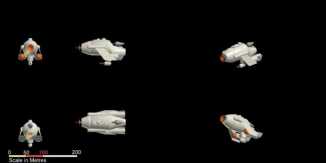
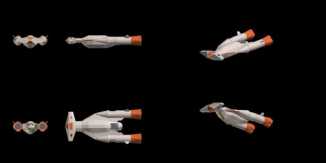
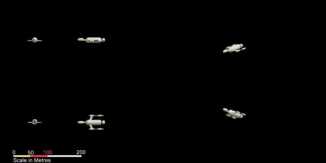
The Fireball class was created as an experimental cruiser type that was intended to test new technologies and new warp field configurations. In early Engineers speculated that dividing a spacecraft’s enveloping warp field into a smaller forward “penetrating” lobe and a larger trailing lobe would decrease subspace resistance and increase warp efficiency. The Fireball class was designed with the innovative feature of a small command hull separated by a thin neck from the larger engineering hull to test this theory. Another change from most recent designs of the era was that the Warp nacelles were raised above the hull, this was again in an effort to boost warp efficiency.

The Fireball class used the new FFTL-2A warp drive system. This drive as much power as the old EFTL-5, but at less than half the mass, this allowed the Fireball class to be far smaller than the previous generation of cruisers. The Fireball and her sister ship Rocket had originally been planned to just be technology demonstrators, but the design was to successful that an armed variant was ordered in late 2158, this became the Comet class.

These two ships continued to be as test beds in the development of the second-generation of M/AM-powered ships. In 2165, at the conclusion of their research careers they were allocated to Starfleet and served as couriers until 2193.

USS Fireball is now on display at the Starfleet Museum.

The Experimental NG (New Generation) engines and shield systems were redesignated as part of the Federation Designation System in 2161.

comet_side_large


2158 – Torsk

The Torsk class destroyers were designed as multi role vessels. The first intended role was to gather intelligence along border areas, and return that information to the fleet. The Second designed role was to act in a hunter killer role against enemy scout ships. Accordingly the Torsk class was designed to be faster than the Krechet class, but more lightly armed as it was intended for fleet actions.Torsk class ships were the first to carry the improved EFTL-6 warp reactor, which was 30% smaller but only 10% less powerful than the EFTL-5 carried by the Krechet class ships.

Because of the narrowly defined roles that the Torsk class ships were designed to play, they were much less expensive to build and operate than the Krechet class cruisers. They carried fewer weapons, had a 35% smaller crew, and were 25% lighter. Fourteen TORSK-class destroyers entered service from February through December 2158. However, they saw little action in their intended roles as Romulan forces withdraw and consolidated in anticipation of an UE Alliance offensive. They were, however, used as radar pickets and scouts when UE Alliance task forces pushed into Romulan territories in the final 2 years of the war, and five were lost in the course of these actions. Torsk ships did well in these limited roles, but were eventually superseded by the significantly more capable and versatile Powhatan class.

The TORSK-class Destroyer UES STINGRAY (CEM-6) is now on display at the Starfleet Museum.


Class: VII Year: 2158
Ship Source: The Starfleet Museum Ship Datasheet: Download PDF

Commissioned Ships:

UES Torsk CEM-1
UES Nautilus CEM-2
UES Holland CEM-3
UES Dolphin CEM-4
UES Navaga CEM-5
UES Stingray CEM-6
UES Porpoise CEM-7
UES Seawolf CEM-8
UES Han CEM-9
UES Rickover CEM-10
UES Shalki CEM-11
UES Borei CEM-12
UES Haifa CEM-13
UES Hai Lung CEM-14
 

2154 – Marshall

“The ambush and loss of the UES Patton began the Romulan War. The Marshall class was the Earth’s staunchest line of defence, and these ships’ superior performance and firepower provided a crucial tactical edge. In fact, the class supposed to succeed it could not better its specifications and so was never built, the reason why the Marshall class had the longest commissioned lifespan in interstellar history (at that time).”

The Marshall class destroyer was produced in vast numbers during the Romulan War. It was not the most powerful ship of its type, but it was easy and quick to produce at a time when every ship that could be built was a valuable addition to the Fleet. It was generally used as a convoy escort and patrol vessel. The USS Patton of this class has the dubious distinction of being the first ship destroyed in the Romulan War

Class: III Year: 2154
Ship Source: Space Flight Chronology Ship Datasheet: Download PDF

marshall_sharp

2160 – Scimater

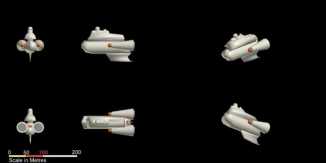
The Scimater class was the ultimate development of the Battle Cruiser concept during the Romulan War. The collapse of Romulan resistance in 2159 led to the decision to cancel the construction of the Scimater class, and the related Elephant class in 2160. The incomplete hull of the UES Scimater was scrapped in 2161.

scimater