2155 – Fireball

The Fireball class was created as an experimental cruiser type that was intended to test new technologies and new warp field configurations. In early Engineers speculated that dividing a spacecraft’s enveloping warp field into a smaller forward “penetrating” lobe and a larger trailing lobe would decrease subspace resistance and increase warp efficiency. The Fireball class was designed with the innovative feature of a small command hull separated by a thin neck from the larger engineering hull to test this theory. Another change from most recent designs of the era was that the Warp nacelles were raised above the hull, this was again in an effort to boost warp efficiency.

The Fireball class used the new FFTL-2A warp drive system. This drive as much power as the old EFTL-5, but at less than half the mass, this allowed the Fireball class to be far smaller than the previous generation of cruisers. The Fireball and her sister ship Rocket had originally been planned to just be technology demonstrators, but the design was to successful that an armed variant was ordered in late 2158, this became the Comet class.

These two ships continued to be as test beds in the development of the second-generation of M/AM-powered ships. In 2165, at the conclusion of their research careers they were allocated to Starfleet and served as couriers until 2193.

USS Fireball is now on display at the Starfleet Museum.

The Experimental NG (New Generation) engines and shield systems were redesignated as part of the Federation Designation System in 2161.

comet_side_large


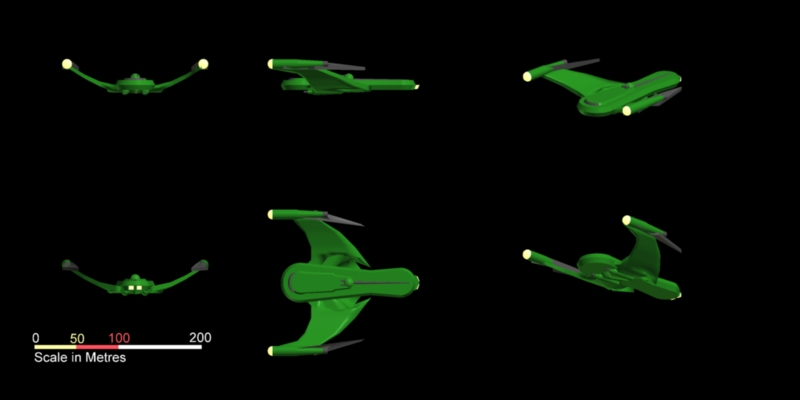
2155 – U21 stelal’deletham (Defender of Stars) Class

The U-21 entered service in 2155 and saw action in almost all of the battles of the Romulan War. The ship combined the highly effective power plant and wings of the U-19, with the light and simple to manufacture hull of the U-15.

The main delay in building the U-19 came from the building of the primary hull, as it incorporated a number of stealth features (even after the deletion of the cloak) and required the use of the latest computer for control purposes. An additional problem was that the hull relied on tritanium, a strategic resource the Romulans could only obtain in small quantities (usually by piracy). The wings of the U-19 on the other hand used duranium, as all other Romulan Starships designs did. A single U-19C with a duranium primary hull was built, but the increased amount of hull material required to give structural strength resulted in a 25% weight growth that the engines could not handle.

The simpler U-15 hull offered a simple solution. Even accounting for the heavier, less strong material, a U-15 hull weighed 10% less than a U-21 hull, and the appeal of combining the two was unquestionable. A U-15C hull was mated to the U-19C’s wings to produce the prototype U-21A. The ship was as fast as a U-19, and only slightly less manoeuvrable. Most importantly it only cost 75% more than the cost of a standard U-15, and took only 50% longer to build, and gave a 150% improvement in Combat Efficiency over the U-15.

45 U-15Cs were converted to produce the U-21A, and a further 143 new build ships were produced as U-21Bs. The U-21A mounted only cluster missiles, but the U-21B added a plasma cannon. Both variants carried drill beams and a pair of star bombs.

One notable action in 2155 saw a U-21 apparently destroy the UES Merlin, compelling evidence now suggest that both of these ships were somehow thrown forward in time by some 129 years, where both vessels were encountered by the Brenton class cruiser USS Hatton. The USS Hatton was forced to destroy the U-21-029, effectively making that ship the last vessel destroyed in the Romulan War.

The U-21 was the match of most Earth and Allied vessels until 2157 when the balance of power shifted with commissioning of the Earth’s new Battle Cruiser classes.

U-21s persisted in the post war fleet until around 2200.

Class: IX Year: 2155
Ship Source: Steve Bacon Ship Datasheet: Coming Soon

u21-100