

The Moskva class originated from the 2169 design competition to provide a replacement for the Daedalus class. That competition was won in 2171by the Wasp class, the Moskva losing out. By 2173 doubts emerged over the capability of the Wasp class to meet its designed specification, and a requirement was issued for a second class of cruiser. This was awarded in 2175 to a revised Moskva class, 31 of which were ordered.
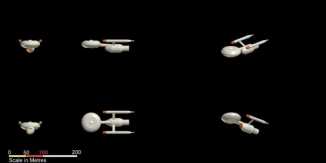
The class was recognized as an advance in starship design. The most important feature was the reversion to a discoid primary hull (as used in the NX class of 30 years earlier). Most earlier designs used a spherical primary hull for reasons of cost (geometry dictates that a spherical hull has the smallest surface area for a given volume – therefore, construction costs are lower and shields are more efficient) and institutional inertia (most exploratory cruisers originating until that time from the United Earth Space Probe Agency, and its successor organizations had spherical hulls).
As the Wasp class had shown, warp field geometry is problematic when a spherical hull with its relatively large frontal area is used. The discoid hull was also found to have a channeling effect on the warp field flow towards the Bussard ram scoops of the warp nacelles, this improved field efficiency at all power levels and speeds. As the understanding of warp field mechanics improved, the reversion to saucer-shaped primary hulls would intensify on later vessels Starfleet produced.
The first ship of the new class, USS Moskva, entered service with Starfleet in April 2179. An additional 30 ships commissioned between 2179 and 2183.
The class had an excellent safety record, with no ships lost to mechanical failures. However, in 2186 an incident occurred aboard USS Johannesburg when a faulty monitor indicated a runaway overload within the plasma flow governor.With a warp core breach apparently imminent the warp nacelles and warp bustle were separated. Although unnecessary the seperation caused the warp core to initiate its automatic shut-down routine. The seperated sections of the ship were successfully re-mated at a Starbase 29.
Although most of the class had left front-line service by 2215, some served on as auxiliaries and training vessels until the 2240s, others were used as testbeds for new technologies. Additionally, the Taurus class tugs (2182) and Sanford class repair tenders ( 2185) were derived from the Moskva class design.
USS Aurora, a participant of the Battle of Eohippus IV, is on display at the Starfleet Museum.
- Class:VI
- Year:2179
- Ship Source:Starfleet Museum
- Ship Datasheet:Download PDF
Commissioned Ships:
| USS Moskva NCC-374 USS Orion NCC-375 USS Callisto NCC-376 USS Aurora NCC-377 USS Pallas NCC-378 USS Africa NCC-379 USS Thresher NCC-380 USS Osaka NCC-381 USS Johannesburg NCC-382 USS Titan NCC-383 USS Theiss NCC-384 USS Nostromo NCC-385 USS San Francisco NCC-386 USS Gato NCC-387 USS Vincennes NCC-388 USS America NCC-389 |
USS Von Braun NCC-390 USS Susan Calvin NCC-391 USS Tyrell NCC-392 USS Ganymede NCC-393 USS Metropolis NCC-394 USS Apollo NCC-395 USS Barsoom NCC-396 USS Thunder Child NCC-397 USS Seymour Cray NCC-398 USS McManus NCC-399 USS Wah Chang NCC-400 USS Ingraham NCC-401 USS Vostok NCC-402 USS Shanghai NCC-403 USS Trumbull NCC-404 |
 Vintage Starships
You must be logged in to post a comment.