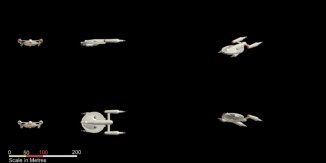
The Einstein class entered service in small numbers in 2196, unlike most single nacelle designs the Einstein had a secondary hull mounted atop the primary hull, with the single warp nacelle mounted ventrally. The secondary hull was based on the design used on the Horizon class of Heavy Cruiser of 2190.
The selection of a single engine design for long range independent exploration and survey work was controversial, but the proponents of the class felt that the greater efficiency and resultant increase in range that the use of a single nacelle gave was a compelling reason for the construction of the class. The ships of the class were rebuilt between 2205 and 2210 with improved drive systems and the addition of an enlarged hangar deck at the rear of the secondary hull.
Compared to its contemporaries, the use of the single nacelle was rare, but the class did demonstrate many of the benefits anticipated with the addition of improved manoeuvrability. However the class did suffer from some instances of stranding following engine failure, fortunately never on any long range missions. The overall success of the design led to the single engine Destroyer and Scout designs of the mid 23rd Century.
All 16 ships of the class were decommissioned or retired by 2233, the last in service the USS Kelvin NCC-514 was retired to the Starfleet Museum after a successful long range exploration mission under the legendary Captain Robau, and his first officer George Kirk.
Unusually after the retirement of the class their registry range was reused for the similar Saladin design – it is believed that this was done in part to make it appear the new Saladin class destroyers were actually rebuilt explorers.
|
| Class: |
IX |
|
Year: |
2196 |
| Ship Source: |
Based on design from Star Trek (2009) |
|
Ship Datasheet: |
Coming Soon |
Original Configuration: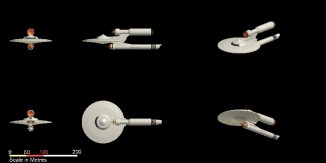
Refit Configuration: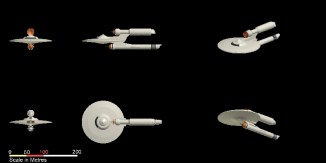


 Commissioned Ships: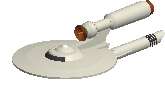
 Vintage Starships
You must be logged in to post a comment.