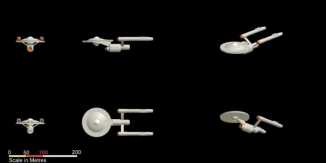
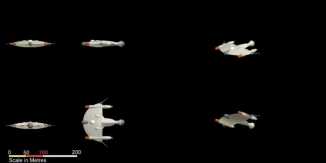
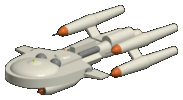
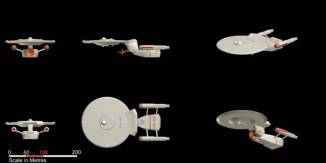
2201 – Modified Tritium

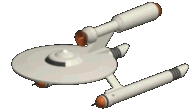
The first great experiment, and the first great failure.

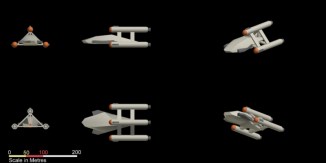
The design drew from the supposed strengths of the three engine version of the Wasp class, unfortunately the designers failed to take account of the very different warp dynamics of the Tritium design compared to the eariler vessel. The designers also did not pay heed to the difficulties suffered by the Wasp programme.

The failure of the triple engine design of the Tritium was one of the most costly failures in the History of Starfleet. Although the design showed the promise of the three engine layout to boost power, it would be another 15 years before computer advances allowed the three engine warp field to be successfully balanced in the Quetzalcoatl class.

On paper a powerful ship, under impulse power the design performed superbly, with power to spare. At warp the design was shown to be far slower than designed for, and the fuel consumption meant the range was half of that predicted, additionally the warp drive system required five times more maintenance than an equivalent twin engine system.

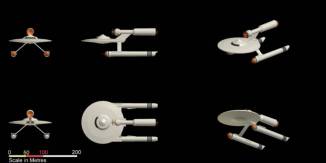
Compared to the original, the Modified Tritiums have lengthened warp nacelles and shorter outlet cones in an attempt to improve warp dynamics, it made no difference to the problems of the design.

“The Tritium class has the dubious distinction of being the worst major ship ever built by the UFP. Insurmountable design flaws surfaced during its validation phase, and though six Tritium class ships were constructed in a vain attempt to overcome glaring shortcomings, the Federation finally cut its losses and cancelled the series. As a costly reminder to future generations, the Tritium may also be viewed as the Spaceflight museum on Memory Alpha.”


Class: V Year: 2201
Ship Source: Spaceflight Chronology Ship Datasheet: Download PDF

tritium2_large_SIDE

2217 – Bennett

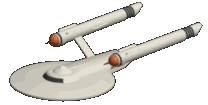
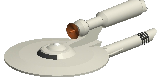
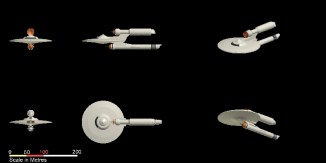
The Bennett Class cruiser entered service in 2217, and served in both exploration and military roles.

Notable amongst the ships of this class is one that was in fact not built. The fifteenth unit of the class was scheduled to be named USS Enterprise, but was renamed USS Meyer prior to launching.

Class: VII Year: 2217
Ship Source: Based on Design for Star Trek: Star Fleet Academy movie Ship Datasheet: Coming Soon

bennett_70

2210 – Hyperion II

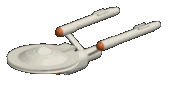
By the mid-2190s, transtator based subspace transmitters were compact enough to be suitable for fitment to Starfleet vessels other than specialized communications ships. The first ships to carry the new compact transmitters were the Hyperion Class Cruisers launched in 2194. The class had initially been designed as a exploratory follow-up to the Moskva class of 2179. However, when the Mercury subspace communication and sensor system became available, the Hyperion class was seen as an ideal platform. The Mercury system was mounted in a specially shielded housing on the primary hull. The Mark 2 features new more efficient and faster warp engines.

Class: VI Year: 2210
Ship Source: The Starfleet Museum Ship Datasheet: Mk2 Coming soon

hyperion2_large


2222 – Aryabhatta

The Aryabhatta class, an Andorian design, entered service in 2222 to replace the large numbers of ageing cruisers that were employed in the research role.

The Andorian ship-building industry was in a poor condition by 2218. During the Earth- Romulan War, Andorian naval ship yards in orbit had built ships of local design totaling many millions tons’ displacement. However, after 2161 few Andorian designs found favor with the new Starfleet as it preferred ships with separate primary and secondary hulls were preferred for reasons of safety and flexibility. Andorian ships placed all ship’s equipment into a single hull with integrated nacelles. The first ship in many years to be adopted by the fleet based on Andorian designs was the Aryabhatta class Cruiser which began trials in 2221.

Work had begun in 2218 after Exploration Command had convinced the Federation Council that a class of dedicated explorers would be more effective and less expensive to build, operate, and maintain than the current fleet of converted, obsolete cruisers. The only stipulation was that construction of this new class would in no way interfere with the introduction of the projected new Valley Forge cruiser class. Ten exploratory cruisers of the Aryabhatta class were authorized. Generally free of interference from Military Operations Command and the Federation Council, the design stage of the project proceeded extremely smoothly.

The new exploratory cruiser was to displace some 70,000 tons. The primary hull was a thick, rounded crescent, which housed most crew spaces, computer core, life-support machinery, scientific equipment, and deuterium tanks. The upper and lower surfaces of this hull supported sensor panels and antennae. The short secondary hull housed the shuttle bay, the M/AM reactor, additional scientific equipment and a long-range, omnidirectional scanner. Weaponry was fitted purely for self defense.

Delivery was delayed by the procurement of the Kestel Class cruiser version of the design, but in compensation five additional ships were ordered. USS Aryabhatta commissioned in March 2222, and the other fourteen followed through to June 2225. The new class fulfilled all Exploration Command’s needs as a medium-range exploratory cruiser. Because of their relatively short endurance, they were primarily used to survey areas within Federation territory, following up surveys done previously. In their more than 30 years of service, the class was credited with mapping and exploring more than 500 star systems and establishing contact with 31 civilizations. Although they served almost exclusively within areas under Federation control, their missions were not without danger. In 2234 USS OmarKhayyam was severely damaged after being fired upon during a first contact attempt that went tragically wrong.

USS Prince Henry of this class is now on display at the Starfleet Museum.


Class: V Year: 2222
Ship Source: Stafleet Museum Ship Datasheet: Download PDF

arabyhatta_large


2206 – Horizon

The 2206 Horizon class explorer  was amongst the first Starfleet ships designed for extended range science missions in uncharted space. At the time of commissioning the ships were dismissed as an  idealistic extravagance’, the Horizon can be seen as the forerunner of Starfleet’s later exploration ships.


Prior to 2200 Galaxy Exploration Command’s ship performance and their value for scientific research were limited. The longest-range starshipsin service were the Hyperion class of 2194, which had an unrefuelled range of 34 light years and carried sufficient stores for 20 months of operations. However, the majority of exploratory vessels in service at the time (such as the Daedalus and Moskva classes) were only able to visit 3 or 4 star systems before needing resupply. In addition, many Starfleet ships were not fully equipped for extensive scientific research, only those dedicated to survey missions had sensors that were optimized for research and stellar mapping.  The other limitation (at least until the Hyperion class entered service) was that subspace-based sensors were generally passive, because the size of subspace transmitters precluded their installation on most starships.


What Galaxy Exploration Command required was a starship which combined the range, speed, and endurance of a heavy cruiser with the scientific facilities of a surveyor. It was not until the late 22nd century that the technology to build such a ship became available, but even then such a ship was likely to be extremely expensive to build and operate.

Commodore Matías Tolbert, who became commander of Galaxy Exploration Command  in 2199, was an idealistic and adventurous officer. He had served as an ensign aboard the survey cruiser UES Ericson (CX-19, Republic class), which made Earth’s first contact with the Altair system in 2155. As captain of USS Blériot (NCC-539, Gagarin class), he made the Federation’s first contact with 8 races, including the Saurians. He believed that Starfleet’s future lay in exploration missions rather than as a purely military force.

Ambassador Skon of Vulcan led a vocal minority faction of Federation Council members who felt that the Federation was expanding too quickly and too far, and that Starfleet emphasising military force to drive the expansion. After the dual role Paris class was deployed in a military role only, Skon realised that if he could not restrain Starfleet’s military operations command, he would instead encourage a greater emphasis on exploration.

Working with Commodore Tolbert, Skon requested funding for a new “explorer class” starship in April 2200. The request was controversial, because this explorer would be as expensive to build as a heavy cruiser, and more expensive to maintain and operate.Amongst other concerns, the issue of the expense of the project led to the proposal’s rejection.

In October 2200, the Federation Council began debate on the funding for the new  Lancaster class heavy cruiser. Skon threatened to block funding for the Lancaster unless funding was also approved for the explorer. After much debate and argument funding was authorized for 12 explorers (now named Horizon after the UES Horizon class and the lost USS Horizon), and 50 Lancasters.

The specifications called for a cruising speed greater than warp 5 and an unrefuelled range of at least 100 light years. The ship was to have 10 science labs, with a crew of 300 (30% of these being scientists and laboratory technicians). It was also to carry enough stores to allow for an unprecedented 5 years of independent operations.

The primary hull contained the bridge, crew facilities, computer and sensors, as well as defensive weaponry. The primary hull was elongated to accommodate a large shuttlebay, impulse drives, and rotating outboard ultra long range sensor panels. The secondary hull containing the warp drive reactor was aft of the primary hull on a 43-meter neck. Up to 6 external modules were mounted externally around the neck to carry additional  fuel, stores, cargo, or specialized mission modules.

The design board also specified the mounting of 4 warp nacelles, making this the first class to use this configuration since the Yorktowns of 2158. The 4 nacelles allowed the power to be spread across a larger number of warp coils, thereby increasing their longevity. Also, in the event of a failure the ship could still return to base, or even continue its mission, with only 2 or 3 nacelles.

To facilitate long-range exploration and enable communication with base, Horizon carried a large navigational deflector and subspace transmitter module below the primary hull in a tertiary hull. Due to extended mission profile, the resultant supplies, crew facilities, and redundant equipment meant that at 203,000 tons Horizon would be Starfleet’s largest starship since the Conqueror class of 2159.

USS Horizon was launched in July 2206, and was followed by the other 11 ships of the class  over the following 4 years. As a shakedown, Horizon completed  a 9-month survey of star systems in the Hyralan sector. Following the successful completion of the shakedown, Horizon commenced a 3-year mission beyond the Groma Hollow. During this mission the Horizon travelled more than 150 light years, surveyed more than 7,000 cubic light years of space, and made first contact with 4 spacefaring races.

As the other Horizons entered service they too started to expand the knowledge of the Federation.  In 2207 USS Venture was the first starship to encounter a complex space-dwelling life form (the Kento). The following year, USS V’Shon-Pal  was the first starship to survey the Mutara Nebula, and in 2210 USS Yinghuo discovered ancient ruins left by the Preservers.

The  range and endurance of the class enabled Starfleet to launch its first 5-year missions.  Starting in March 2209, Captain Fabiola Kalani commanded the USS Odyssey on a 62 month mission exploring spinward of the Rigel system. During this mission the Odyssey made first contact with 12 spacefaring races, including the Edosian

Despite the success of the Horizon class, funding for Galaxy Exploratorion Command became more limited following Skon’s death in 2208, as resources were gradually directed back to Military operations command. As a result no further explorer starships entered Starfleet service until 2222 with the commissioning of the smaller and less expensive Aryabhatta class.

Horizon-class ships were at times diverted to border patrol and long-range observation missions as Horizon’s unparalleled sensor suite made it useful asset for surveillance.  Such missions were not common as the the Horizon needed a sizeable escort in hostile areas.

The Horizon class remained in service until 2254, and during this time only a single ship of the class was lost. USS Victoria  was destroyed in 2235 while surveying a particle fountain in the Moab sector.

The Horizon-class explorer USS Odyssey, which completed four 5-year missions, is on display at the Starfleet Museum.

Class: XII Year: 2206
Ship Source: The Starfleet Museum Ship Datasheet: Coming Soon

sfm-horizonCommissioned Ships

USS Horizon NCC-1197
USS Odyssey NCC-1198
USS Venture NCC-1199
USS V’Shon-Pal NCC-1200
USS Kumari NCC-1201
USS Beagle NCC-1202
USS Yinghuo NCC-1203
USS Endurance NCC-1204
USS Nadezhda NCC-1205
USS Victoria NCC-1206
USS T’Plana-Hath NCC-1207
USS São Gabriel NCC-1208


2222 – Valiant

The Valiant-class starship was a type of Federation heavy cruiser created by Starfleet. The prototype, USS Valiant was launched in 2222.

Six of these were built, weighing in Class XII they were larger than their contemporaries, each with a crew of 440. The vessels measured 21 decks in height, 303 meters in length, had a maximum cruising speed of warp 5.6 and were armed with two torpedo launchers and 4 phaser emitters

The Ships were refitted in 2253 to increase their combat capabilities during the Four Years War, after this refit they were deployed as part of the defensive fleet protecting the Core worlds. After the war all surviving units were continued in Service, Beagle was lost in action.

Two ships (Adamant and Valiant) received Linear warp drives in 2279, but their sister ships retained the older style drives until they were decommissioned in 2281. Adamant was lost in action in 2284, while Valiant finally decommissioned in 2287.

valiant_100

Commissioned Ships

  • USS Valiant NX-1288
  • USS Delphi NCC-1295
  • USS Yamato NCC-1305
  • USS Adamant NCC-1315
  • USS Expedient NCC-1307
  • USS Beagle NCC-1291


2225 – Baton Rouge

“The USS Moscow and the other ships of this class were the one of the last major classes without dilithium. The immediate predecessor to the Constitution class, the Baton Rouge class exhibited the distinct separated living disc and engine modules so familiar now. Up-rated in the 2240s, these ships have only recently completed their commissioned usefulness as interstellar carriers.”

The Mark 1 Baton Rouge class entered UFP service in 2225 and were the last major cruiser class built with non dilithium energised engines, in total an impressive 86 Mk1 ships was built over 18 years. A modification program in the 2240’s saw 40 of these ships re-equipped with new M- 1 computers, enhanced weaponry and unary shield generators to become Mk2s, a further 14 ships were built as new to compensate for delays in the Constitution programme. This modification meant that the ships remained a useful element of the fleet despite their low top speed compared to newer designs.

Some unmodified Mk2 ships also served throughout the four years war as convoy escorts, it being felt that their low speed was not an issue when escorting slow moving freighters, indeed the additional power was seen as an asset. In one famous incident, a trio of 30-year-old Baton Rouges fought off a squadron of D7As without a single ship being lost in the convoy they were escorting.

12 Mk2s survived the war, and 6 of these were later converted to Mk5 standards.

A number of Baton Rouge class ships are preserved at various sites around the Federation, as well as a single vessel preserved in the AOFW, but the ships that are still in service some 60 years after the design was conceived are the most telling proof of the excellence of the design and memorial to those who have gone before.

Class: VII Year: 2225
Ship Source: Space Flight Chronology/ Rick Sternbach Ship Datasheet: Download PDF

br-new-01-70

2217 – Ranger

The Ranger class entered service in 2217, and despite some shortcomings served as Starfleet’s premier heavy cruiser for almost 30 years until the introduction of the Constitution class.


  • Class: IX
  • Year: 2217
  • Ship Source: Based on image by Last Unicorn Games
  • Ship Datasheet: Download PDF

ranger_1_70

2205 – Modified Einstein

The Einstein class entered service in small numbers in 2196, unlike most single nacelle designs the Einstein had a secondary hull mounted atop the primary hull, with the single warp nacelle mounted ventrally. The secondary hull was based on the design used on the Horizon class of Heavy Cruiser of 2190.

The selection of a single engine design for long range independent exploration and survey work was controversial, but the proponents of the class felt that the greater efficiency and resultant increase in range that the use of a single nacelle gave was a compelling reason for the construction of the class. The ships of the class were rebuilt between 2205 and 2210 with improved drive systems and the addition of an enlarged hangar deck at the rear of the secondary hull.

Compared to its contemporaries, the use of the single nacelle was rare, but the class did demonstrate many of the benefits anticipated with the addition of improved manoeuvrability. However the class did suffer from some instances of stranding following engine failure, fortunately never on any long range missions. The overall success of the design led to the single engine Destroyer and Scout designs of the mid 23rd Century.

All 16 ships of the class were decommissioned or retired by 2233, the last in service the USS Kelvin NCC-514 was retired to the Starfleet Museum after a successful long range exploration mission under the legendary Captain Robau, and his first officer George Kirk.

Unusually after the retirement of the class their registry range was reused for the similar Saladin design – it is believed that this was done in part to make it appear the new Saladin class destroyers were actually rebuilt explorers.


Class: IX Year: 2205 (Modified Version)
Ship Source: Based on design from Star Trek (2009) Ship Datasheet: Coming Soon

Refit Configuration:kelvin1a