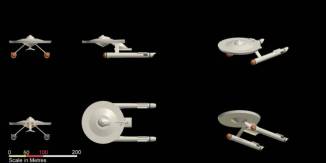
2242 – Ptolemy (Modified)

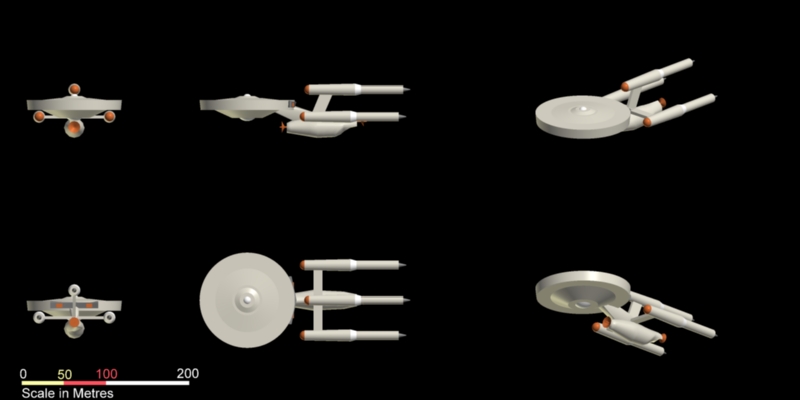
The Ptolemy class transport was the first in a line of successful high-load warp transports used by the Federation. Equipped with specially designed warp engines suitable for towing mass never before realized, the vessels were a boon to infrastructure building outside the core of the Federation. Initially, production contracts called for 30 ships of this class to be constructed. However, due to the fleet-wide ship build-up at the time it was commissioned, limited appropriations permitted the construction of only 15 of the class.

The Ptolemy class was designed for easy and efficient transporting of cargo within outboard cargo containers. The cargo containers were easily attached and detached via a specially designed coupling unit fitted to the neck of the primary hull of the starship. Depending upon total mass, up to two containers could be towed by the Ptolemy at one time. These containers were mass-produced and supplied to both Starfleet and private shipping concerns (at a reduced rate) to promote the use of these standardized containers. Practically a ship unto themselves, these containers were a break-through in shipping technology just as the high-load warp engines mounted on the Ptolemy were.

The containers came in five basic types:

  • Mk I Liquids
  • Mk II Dry Bulk Goods
  • Mk III Refrigerated/Thermal Goods
  • Mk IV People (starliners, mass transport)
  • Mk V Products (non-food stuffs and misc.)

The Mk I-III and V containers had their own cargo transporters (up to six), turbolifts for carrying goods to various levels and self-contained environmental machinery. The Mk IV containers also included 6 personal transporters and could accommodate 800 passengers. This container also had its own sensors array, was capable of sub-light speed and could sustain its passengers in case of an emergency for up to 18 years.
During the Four Years War, an urgent need arose for military cargo transports. Because of their slow speeds, the Ptolemy was not a viable candidate. However, the need was so great that all Ptolemys in service at the time were converted to Mk IIs. The Mk II mounted the FWB-1 engine which improved the speed of the transport, but at the cost of limited cargo capacity. The Mk II could only carry approximately 121,000 mt of cargo in smaller outboard cargo containers. However, this was sufficient in its role as a military transport.

After the Four Years War, surviving Ptolemys were retrofitted with the FHLWA-1 and returned to their pre-war roles. Many of the Mk IV containers were converted to starliners, with luxurious accommodations for up to 500 passengers. These starliners contained a park promenade, numerous recreation lounges, 2 full theaters, a gymnasium, pool and hydroponic gardens.

This modified version was first built in 2242 alongside the standard version, it featured more discreet hull mounted deflectors as opposed to the large dish of the standard ships. Post war most of the class were converted to this standard, which gave no performance benefits, but considerably improved reliability.

Class: VII Year: 2242
Ship Source: Starfleet Technical Manual/The Starfleet Museum Ship Datasheet: Download PDF

masao-ptolemy-pod-70masao-ptolemy-nopod-70

2248 – Mission X

The Mission-X was ordered by Starfleet Intelligence Command in 2248. Externally identical to the standard Mission Class scout/courier, the Mission-X had a combat capability greater than many destroyers and cruisers. The major drawback of the design was the high cost of fitting such components into a small hull. Additionally the design compromised the crew facilites and fuel storage, making missions of more than seven days duration impossible.

Prior to the Four Years war the ships were primarily used in Intelligence gathering duties along the border away from the glare of publicity. But war changed that, as some of these ships were stationed at what became known as ‘Malta Station’ which was beseiged by Klingon Forces for much of the war. The ships assigned to that station earned Federation wide fame for their brave actions supporting the defence of the station. These four ships ‘Faith’, ‘Hope’, ‘Charity’ and ‘Desperation’ collectively destroyed 34 Klingon Vessels, and crippled a further 46. Starfleet refuses to confirm whether the original four ships survived the war, or whether they were secretly replaced during the war after being destroyed.
30 Mark 1 ships were built, and 20 new build Mark 2s. The 18 Surviving Mark 1 vessels were uprated to Mark 2 standards, the only difference being the FWA-2 engine installation.

2256 saw the testing of an enhanced Phaser and Photon Torpedo armed Mark 3 version. This ship was marginally less combat effective than the Mark 2 and more expensive to build. Only the prototype vessel was built of this mark as it was clear that the earlier ships were still highly effective. The Mission-X class was finally withdrawn from service in the 2280’s, it was the last FL/FAC Armed ship on the active service list. Rumours do persist though of special variants still serving with Intelligence command, but these cannot substantiated.

Class: III Year: 2248
Ship Source: FASA/Steve Bacon Ship Datasheet: Download PDF

100mission_large4xmission

2248 – Mission

When most citizens of the Federation think of the ships of Starfleet, their thoughts may soar with the mighty designs of the Constitution ,Enterprise and Excelsior classes. However, one of the most successful and influential designs in the history of the Federation is the modest Mission class. This versatile little ship will forever be linked to the success of the Federation in many ways.

Class: II Year: 2248
Ship Source: FASA Ship Datasheet: Download PDF

100mission_large4xmission

2242 – Sawyer

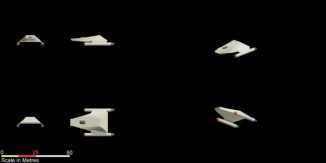
The Sawyer class Scout entered service in 2242. Designed as a fast scout for use in non combat areas, a total of 69 were built.

On paper, the Sawyer was an excellent vessel, being both efficient and fast.  The class was however always mistrusted by crews as it had earned an unenviable reputation as a result of a number of ships being lost. The USS Gulliver, destroyed at Axanar earned the class another unwanted footnote in history as being the first ship to be destroyed in the Four Years War in 2252.

The growing area of hostilities meant that few areas could really be deemed as being ‘non combat’ and during 2253 losses of the Sawyer Class mounted to an alarming extent. The situation came to a head in November 2253 when three of the surviving 40 ships of the class were lost with all hands. Starfleet Command immediately ordered that the ships be withdrawn from active service.

The reason for the failure of the class is hard to pinpoint, for their time they were not too badly armed or shielded, and they had a fair turn of speed and good manoeuvrability. In all 36 ships survived to be withdrawn from service, but they were soon pressed back into service as Trainers for Starfleet Academy . It was while serving in this role that a potential cause of the losses was found. It was discovered that the warp nacelle assembly, although rated for landing operations was in fact susceptible to stress damage, examination of the service history of the lost vessels showed that many were among the fleet leaders for number of landings.

As a result of this discovery all Sawyer class ships were withdrawn from any use in 2261, and were subsequently sold for scrap.

The lessons learned from the Sawyer debacle were implemented on all subsequent designs that had landing capability, and were retrofitted to existing designs. Chief among these improvements was an early type of structural reinforcement field that was used during take off and landing, as well during atmospheric operations to reduce stress on the hull and warp nacelle assembly.

Class: III Year: 2242
Ship Source: Space Flight Chronology Ship Datasheet: Download PDF

100sawyer_large

2242 – Nightingale

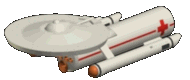
Based on the ubiquitous Ptolemy Class Transport Hull, the Nightingale entered service in 2242 replacing the obsolete Mercy class. Compared to a standard Ptolemy, the class has improved shielding and internal modifications to make the class more suitable for the medical role. Due to these modifications Nightingale class ships are rarely used in standard transport duties, and are virtually permanently attached to their medical pod. The two Mk 1 Nightingales are based on the Ptolemy hull and systems, the single Mk 2 is based on a Keppler hull.

With the outbreak of the four years war, five Ptolemy’s taken up from mercantile service were also modified to Nightingale standards, as Mk 3s. The other three ships were also modified to this common standard.


Class: VII Year: 2242
Ship Source: Based on Ptolemy class from Star Fleet Technical Manual Ship Datasheet: Coming Soon

nightingale-70

Siegfried (II)

2242 – Siegfried Refit

The Siegfried class was the first true dreadnought to enter service. As originally completed the class mounted the extremely powerful FLM-1 Cannon, this weapon was limited in terms of arcs of fire and recharge time, but used well was an extremely effective weapon. In 2242 some of the class were refitted to a more standard configuration due to delays in the Constitution class program, and were refitted with the new Unary shielding systems. In this revised configuration these ships gave valuable service for a number of years, although later on only in supporting roles

Class: XII Year: 2242
Ship Source: The Starfleet Museum Ship Datasheet: Download PDF

Siegfried (II).