2243 – Pompey

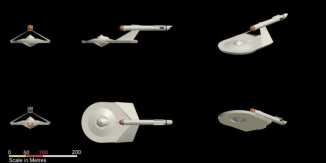
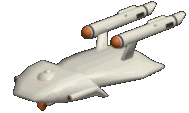
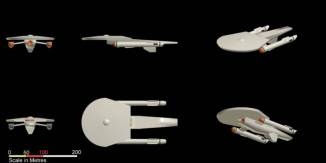
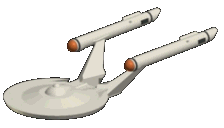
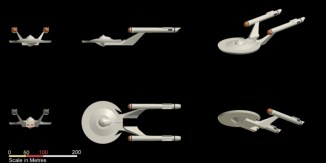
The Pompey Class was conceived as a light twin engine Destroyer variant of the successful Hermes Class Scout. The change to a twin engine layout improved the available power and manoeuvrability, however compromises in the Tactical system made the initial variant not wholly satisfactory, and an improved Mk 2 was soon introduced.

The Pompey never gained wide acceptance in service, and the later Saladin variant of the Hermes class displaced it from front line service. The Pompey continued to be used in longer duration missions in remote regions as the twin engine design was felt to be more robust than the single engined Saladin.

Class: VI Year: 2243
Ship Source: Mastercom Data Center (Corrected schematics supplied by Aridas Sofia) Ship Datasheet: Download PDF

pompey_b_100

2243 – Nelson

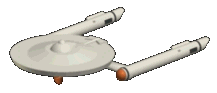
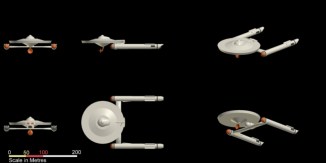
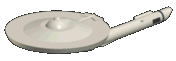
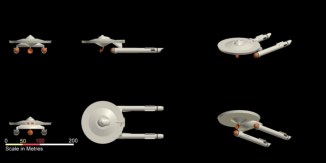
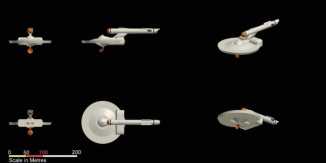
The Nelson class scout was primarily designed to act as a scout for Galaxy Exploration command, it had much in common with the Constitution class Cruisers and the other ships of the period. The class can be distinguished from the similar Hermes class scout by the V formation of the warp nacelle supports

Class: VI Year: 2243
Ship Source: FASA Ship Datasheet: Download PDF


nelson_large

2243 – Apache

Historically, Starfleet had only ever fielded one heavy Destroyer class, the Detroyat class of 2224. In 2243, Starfleet Tactical suggested the development of a new tactic for Destroyer operations, the use of leaders. New sensor technology, such as that fitted to the Constitution class offered massive range improvements, but it was felt that the sensor suite and associated systems were too large to be fitted to standard Destroyers. As a result the 10 Detroyat class ships were refitted with modern warp drives, and with the new sensor systems, it was also decided to order 26 vessels to supplement the Detroyats. The total of 36 Heavy Destroyers was felt to be sufficient to allocate one to each group of 6 standard destroyers operating along the Klingon and Romulan borders. The Heavy Destroyer would act as the command ship for the group, and also provide long range sensors.

The design, later to be named Apache, started off as a modified Detroyat design. During the design process the class evolved, the saucer was modified to feature an elongated rear edge and the secondary hull was massively enlarged compared to that of the Detroyat. It was intended that the Apache would be allocated to Destroyer groups allocated to more remote areas, and as a result the secondary hull was enlarged to enable it to carry spares and supplies to support its assigned group.

In service the Apache proved to be as dependable as its illustrious ancestor. Destroyer groups led by Apaches served with distinction throughout the Four Years War, and a group led by the USS Tartar was instrumental in the Attack of Convoy Y-16Z in 2253, the first significant Federation fleet victory of the war. So effective was the Leader concept, that a number of Cygnus class command couriers were rearmed and modified to act as Leaders to supplement the insufficient numbers of Detroyats and Apaches.

Postwar the fortunes of the Apache, and the leaders in general waned. The progress in miniaturisation meant that conventional destroyers could now mount the long range sensors far more economically. As a result the Detroyats were reclassified as long range scouts and assigned to exploration duties, and the new leader class, the Derf, was modified to become a tender. The 18 surviving Apaches were retained in service, but were grouped together to form three heavy destroyer groups, which were assigned to the defence of Terra, Vulcan and Alpha Centauri. In 2258 the ships were rearmed with phasers and photon torpedoes.

Heightened tensions leading up to the Organia conflict led to the Apaches being refitted again, and recalled to the Klingon Border. This time they served as sector command ships, supplementing the Perimeter Action Ships of the Kiaga and Agilis classes. The success of the ships in this role led to them being reclassified as Strike Cruisers (interim) in 2268, and they served in this capacity until the Belknap class entered full service.

The Apaches were progressively retired to reserve from 2280 onwards as the Belknap class ships assumed their role.

The Apache class was named by Admiral Wood, commander of Military Operations Command in commeration of his first command, the Mann class Cruiser USS Apache.

  • Class:TBC
  • Year:2243
  • Ship Source:Starship Size Comparison Chart
  • Ship Datasheet:Coming Soon

apache_2_final_70

2243 – Cassard

The Cassard class Missile Destroyer was designed in 2242 to provide the fleet with accelerator cannon support.

The USS Cassard commissioned in mid 2243, and made use of the recently introduced M-1 control computer.

The Cassard served well in the skirmishes and conflicts with the Klingon Empire over the from 2243 until 2288. The first time they were really tried in combat was in 2248. In this encounter near Federation Outpost 1 a Klingon task force of three D-7A’s and six D-16’s  attacked six ships from the 6th fleet. Four Cassard class ships led a counter attack by eight other ships of the 6th fleet, making full use of their accelerator cannons. The Klingon flagship was destroyers by the opening volleys, and the Cassards then continued to attack the other ships in turn. The battle ended 30 minutes later with the loss of three Federation vessels, while the Klingons all but three of the D-16’s. The Cassards  continued to perform well in fleet actions when used in concert with other starships providing beam weapon suppor, but when used without such support they were found to be extremely vulnerable. As a result the Cassard class was redeployed  from independent patrol duties and mainly assigned to fleet support duties..

In 2258 the MK II version was introduced, this version mounted the new Photon Torpedoes, but the beam weapons remained weak. It was not until 2268 when the MK III version entered service that the beam weapons were finally upgraded. Until the class left service it retained the ‘classic’ design and PB series circumferential warp nacelles.

Starfleet decommissioned the last units of the Cassard class in 2288, when the remaining ships where mothballed.  26  of these ships were sold to the Affiliation of Outer Free Worlds in 2304. The USS Cassard was placed into the Starfleet museum in 2305.

Class: VI Year: 2243
Ship Source: Bill Colley Ship Datasheet: Available at tacticalstarshipcombat.com

cassard_side

2243 – Loknar

The Loknar Class frigates were built during “The Great Awakening”, a period of expansion by the Federation. During this time, many research and exploration vessels were designed and built to aid in the efforts to solidify an enlarged and growing United Federation of Planets. Also during this period, a smaller number of warships were built. The Loknar, the most noted of these warships, is still in service to this day, a tribute to the quality of the Andorian design.

Soon after the Federation Appropriations Committee granted Starfleet the funds necessary to construct fleets to expand and patrol the limits of the UFP, Andorian factions began pushing for warship construction. The basic Andorian philosophy was that, in expanding, the Federation might come upon races as hostile as the Romulans and Klingons, leading to another protracted war for which the Federation and Starfleet were unprepared. The Andorians argued that, were this to happen or were the Klingons or Romulans to escalate hostilities, Starfleet needed to be better prepared and would need ships to protect the new borders and colonies. The Andorian arguments were successful, and Starfleet began a limited build- up of warships. Several ship building facilities were constructed by Andorian firms to design and manufacture these warships, the most notable of these on Sol IV and Salazaar, the largest and most productive in the Federation.

Introduced in October of 2247 (1/90), the Loknar class frigate mounted the new, but already proven, FWE-1 warp drive, in Starfleet’s inventory for only two years. The FIC-2 impulse engine was introduced on the Loknar and has since proven itself to be one of the most reliable of all production. The Loknar Mk I was considered a ‘muscle’ ship because of its four heavy lasers and single accelerator cannon, making it equal to all but the largest Klingon vessels and more powerful than any ship in the Romulan navy. In addition, the Loknar mounted FSH shield generators, more efficient than any used by the enemies of the Federation.

During the Four Years War, the Loknar saw more action than any other vessel in Starfleet. As the war dragged on however, Starfleet realized the need for vessels with more firepower. When they could be spared, Loknars began being refitted at forward supply and repair stations. The Mk Ib Loknar mounted two additional laser cannons and an aft accelerator cannon. The lasers were banked to provide more flexibility in combat. Late in the war, the Mk Ic was introduced. This version of the Loknar mounted a curious blend of old and new technologies; it retained the lasers of its predecessors, but replaced the accelerator cannons with FP-1 photon torpedoes.

Although it was considered to be successful, the Andorian designers felt a need to improve the Loknar. The FWE-2 warp drive systems, still being tested, would produce 60% more power than the FWE-1 and would increase the ship’s overall performance. The Mk II was commissioned into service in January of 2256 (1/98) mounting the FWE-2, even though this engine was not officially adopted by Starfleet until February of 2259 (2/00).

The most significant advance in starship technology came with the phaser and photon torpedo. The phaser delivered more firepower at longer ranges, weighed less, and required less structural reinforcing than the laser. The newly developed photon torpedo delivered the same explosive power at 75% less power requirement, was considerably lighter and required less structural reinforcement than the accelerator cannon. Eight FH-5 phasers and new photon torpedo technology were incorporated into the Mk II, making it more powerful than anything in the Klingon fleet with the exception of the D-10. The Mk II also mounted an upgraded binary shield generator, the FSK, giving 33% more protection at the same output level as the earlier system. The Mk IIa Loknars were refits from surviving Mk Ic’s- no new builds occurred of this version. The Mk IIb mounted 3 FP-3 photon torpedoes forward and 1 aft (the FP-3 was experimental when first mounted to the Loknar). This arrangement favored redundancy: during the Four Years War, several Loknars were placed at a severe disadvantage when their single forward missile weapon was damaged during combat. The Mk IIa’s were refitted to Mk IIb standard by 2260 (2/03). Both versions saw limited action in the Four Years War.

The next major change in the Loknar’s design came with the introduction of the FWD-2 warp drive to the Mk IV. Along with the FIC-3 impulse drive, this increased the power output and overall performance by 40%. Furthermore, this model replaced the 4 FP-3 photon launchers with the FP-1. The Mk V is the latest model of the Loknar class and is armed with FP-6 torpedoes.

Loknar class frigates have served Starfleet faithfully for over 40 years and will remain in the inventory for many years to come. A major push was begun by the Andorians to create the next generation of Loknar- the Mk VI. However, with four newer frigate designs already being produced, Starfleet Appropriations did not accept the proposal. The final Loknar was constructed in May of 2288 (2/24). Loknars were produced at the Salazaar and Sol IV facilities at a rate of 2 ships per year, including refits. At the behest of the Andorian government, all Loknars are to be refitted to Mk V standard and retained in active service.

Historical Notes:

The Loknar class frigates are named after cities and provinces of the Federation. More than half of these vessels are crewed by Andorians and the majority of these are assigned to the ‘Blue Fleet’, ships whose officer contingent and crew are entirely Andorian. The USS Loknar was the first ship commissioned into the Blue Fleet, serving as the flagship for many years.

The infamous IKSV Staav’e Mara (Slave Of Justice), was originally the USS Morgan City, a Loknar Class frigate captured by Admiral Kamato’s forces during the Four Years War and later used in Kamato’s abortive coup attempt on the Klingon throne. After failing, Kamato retreated into the Triangle, taking the Loknar class frigate with him. From their location in the Triangle, the Klingon rebels began attacking unprotected convoys and merchant vessels by using the Staav’e Mara to lure them in. This ruse lasted for several years, then a general recall of all Loknar class vessels made it difficult for the Klingon vessel to operate as though it were from Starfleet. The IKS Admiralty then decided to have the vessel painted in the standard steel-gray color of their Navy. The Staav’e Mara still operates with the IKS Navy and has been seen as recently as January 2287 (2/23).


Class: VIII Year: 2243
Ship Source: FASA Ship Datasheet: Download PDF

loknar_side

2243 – Siva (William Howe)

The Siva class destroyer mounted the best in Federation technology for its size at the time it was built. First commissioned in 2243, it mounted the M-1 computer, FWB-1 warp engine, FIC-1 impulse engine and FSA shield generator. A controversial military design due to its accelerator cannon arrangement, the Siva was unique in that it possessed only one laser cannon mounted aft purely for defensive purposes.

The Siva was assigned to Military Operations as a light missile destroyer to be used offensively with fleet support. The ships were designed to work together in groups of three. In these squadrons, they were to attack an enemy vessel while it was engaged in combat with a larger friendly vessel.

Until the Four Years War, the Siva class did not see any combat action. However, at the outbreak of the war, Sivas were some of the first vessels deployed in combat. Starfleet was conscious of the limited combat mission the Siva could perform and did not dispatch Sivas alone. Starfleet deployed them as designed when suitable capital vessels could be mustered (which proved quite a chore in the early days of the war).

As the war stabilized and the urgency of ship allocation lessened, the Siva class came into its own. Working mainly with Coventry class frigates and Heston class cruisers, a squadron of Sivas would be assigned to a single larger vessel. After a space battle had occurred in which a Klingon task force had been splintered or largely destroyed, a single Heston or Coventry would engage any lone, surviving Klingon capital ships. Staying well away from the larger Starfleet vessel so as not to be detected, the Sivas would lie in wait until the capital vessels engaged in combat. The Sivas would fly in a perpendicular path to the enemy vessel, avoiding any hostile forward weapons. The Sivas would fire their forward accelerator cannons at optimum range and then fly-by their target. Then, they would release their aft cannons and keep on going until out of range of the enemy vessel. Here they would turn around and line up for another attack. It took great skill and power management to perform the maneuver safely and effectively.

Usually captained by young Lieutenant Commanders, these ships and their crews were especially noted for their “e’sprit de corp”. This was especially the case with the Siva crews, since the entire complement of ten vessels were always assigned to the same fleet. Since their combat duties were limited by their design, they often served as scouts, pairing up with one another for safety.

It was no secret that the Siva was severely under-powered. Due to the limitations of its design and the technology of the era, no additional models of the ship were constructed and no other builds took place. The power limitations also left Sivas vulnerable, especially to Klingon gunboats and escorts that protected capital ships. Of the ten Siva class destroyers built, four were destroyed in the Four Years War. Two were damaged beyond repair and scrapped. The surviving four were assigned to Starfleet Training Command after the war where they served until being scrapped in 2269. One vessel, the USS William Howe, NCC 3216, participated in the evacuation of the Alerian homeworld in 2268 (2/11).

The USS Siva was amongst amongst those severely damaged, and the hulk was used as the prototype for the more conventional Siva subclass of the Saladin class in 2248. Upon the recommissioning of the Siva in this new configuration the former class was renamed the William Howe class.

  • Class: V
  • Year: 2243
  • Ship Source: FASA
  • Ship Datasheet: Download PDF

apache_large

2243 – Miranda

What eventually became one of the most common and longest lived Starship designs started with this vessel.

USS Miranda (NCC-1833) was launched on 10/1/2243, and was the precursor to a range of classes (Anton, Surya, Coventry).

The Miranda class eventually numbered 15 vessels, which served well in the conventional cruiser role, unlike the majority of ships of this configuration which filled the Frigate role.

The Miranda was refitted to become a Cruiser variant of what was then known as the Avenger (Frigate) or Reliant (Research cruiser) in 2283. However a change in Starfleet policy following the Khitomer accords and the reductions in the military role focussed frigate fleet saw the Avenger class frigates redesignated as being a Cruiser as part of the Miranda class. Over the following decades as refit programs progressed the Avengers (and indeed the Reliants) all became full members of the Miranda class as each refit program covered ships from the various predecessor classes.

  • Class:X
  • Year:2243
  • Ship Source: Class Name CBS/Paramount, USS Bombay from ST:Vanguard, Miranda Registry Alex Rosenzweig
  • Ship Datasheet:Coming Soon

anton_large

Commissioned Ships of this class included:

Bombay, Achilles, Equinox, Miranda, Rutherford, Lantree

2243 – Larson

The Larson Class was one of the large numbers of Destroyers that commissioned in the 2240s. Although not as powerful as the Saladin class it was still built in large numbers. It was generally employed as an escort vessel for larger fleets.

Designed at the same time as the Nelson class scouts and the Constitution class cruisers, Larson class destroyers shared many of the same physical features of these ships. An efficient ship that served well, it was intended to perform the same tasks as other dual-function vessels, namely both research and defense. Even so, most of the existing Larsons in service were employed by Starfleet’s Military Operations Command, with several serving in the Galaxy Exploration Command.

Destroyers such as the Larson frequently were employed on patrol duty along the frontier areas. In time of war or other military emergencies, such destroyers were assigned to escort convoys or used as scouts by squadrons or small fleets. This methodology is still practiced today with Starfleet’s modern destroyers. With its array of weapons, the Larson was a fine combat vessel, though not as powerful as a cruiser or larger ship.

As can be seen by reviewing the statistics, the Larson Mk I was introduced into service in January 2245 (1/8801), remaining unchanged until the outbreak of the Four Years War in 2253 (1/95). After several fierce battles with Klingon forces, it was evident that the Larson was weaker than their Klingon counterparts. As quickly as possible, all Larsons were scheduled to be upgraded to Mk Ib standard. This provided the Larson with more efficient shielding, allowing more power for its new FL-3 lasers and existing FAC-1 accelerator cannons.

Finally in early 2256 (1/98), the first Mk II Larsons were produced. The production schedule was split into two lines: the Mk IIa and the Mk IIb. All Mk Ia Larsons upgraded during the conflict were upgraded to Mk IIa standard and all Mk Ibs became Mk IIbs. This helped speed up the turn around time for upgrades because only the weaponry and single warp engine, now upgraded to the FWC-2, changed on the vessels.

The Mk IIa mounted the FP-2 photon torpedo system, still in its prototype stage. The Mk IIb mounted the powerful FP-1 system. Starfleet was split on this issue, however: Larsons were seeing heavy action, but they were vulnerable ships. If mounted with the FP-1, the Larson’s firepower would increase, but at the sake of exposing the FP-1 photon technology to the Klingons if a Larson were captured in battle. In addition and unforeseen in static tests, the superstructure of the relatively light Larson was not strong enough to absorb the shock of repeated firings of the two FP-1 launchers. In rare cases, some firings caused structural damage to the starship. This problem was never fully resolved and in the later Mks, all Larsons mounted the smaller FP-2. All Mk I vessels were refitted with new weapons by September of 2258 (2/0109). Several small interior changes were also made, but these did not affect the combat performance of the vessel until the introduction of the Mk VI.

The Mk VI mounted improved phaser weapons and the more efficient FSD shield generators. The Mk VII, introduced in March of 2269 (2/1403), mounted the newer style engine nacelle and a more powerful impulse drive system. This increased the overall power output by 25% and extended the service life of the Larson class by several years. By May 2285 (2/2205), all Larsons in active service at that time had been upgraded to the Mk VI, and several had been modified to
Mk VIIs.

Production of the Larson class was halted in August of 2281 (2/1808) with the commissioning of the USS Juno. In October 2291 (2/2710), the last Larson class destroyer in service, the USS Tana Re, returned from its duty station and moored at Starbase 24. With this, the end of the Larson class era fell upon Starfleet Destroyer Command and all Larsons were placed in reserve fleets. As a part of Starfleet’s reserve fleet budget, a project has been underway since 2293 (2/29) to slowly upgrade all remaining Mk VI Larsons to Mk VII standard.

No ships sold to the private sector have been refit, and most retain the characteristics they had at the time of sale. All vessels sold were disarmed by Starfleet, though the weapon-mounting hardpoints usually were left intact.

Larsons were named for military leaders and battles of Terran origin. The class vessel is named for Admiral William G. Larson, hero of the battle at Gamma Hydra during the Romulan War. The only exception to this naming convention is NCC 4305, the USS Thelenth, which is named after an Andorian admiral who defeated the Klingons in a pitched battle at Donovan’s Star at the cost of his own ship and crew.
Historical Notes:

The ships Hammurabi and Troy were both destroyed while escorting a convoy of merchant ships bound for a frontier area. During this battle, seventeen freighters were destroyed and an additional four were taken as prizes by the Klingons. Of the five ships that survived the encounter, all reported that the Hammurabi destroyed two Klingon D-7 cruisers and crippled two others before being destroyed itself. The Troy apparently was disabled in the initial exchange of fire and left for dead. When a Klingon cruiser ventured too close to the derelict, however, it opened fire and destroyed the enemy vessel in a single volley. Of course, without maneuvering power, the Troy was later easily dispatched.

In August 2259 (2/0208), the Bolivar led a small detachment consisting of the Normandy, Alesia, Babur, and Tecumseh into an uncontrolled area near the Romulan Neutral Zone. The task force maintained radio silence and failed to report back at its scheduled time. When extensive communications attempts were made unsuccessfully, a rescue group was dispatched to the last reported position of the task force. Upon arrival, nothing was to be found, and an extensive search was begun, ultimately discovering the engine nacelle of the Alesia adrift in an unknown asteroid cluster. At the time no determination was made as to what had caused the loss of the ships, but it was suspected by many that the Romulans had ambushed the group and successfully destroyed them before they were able to send a call for aid. This theory was never proved, and no action was ever taken against the Romulans, largely because it was felt that the Romulans could not have crossed the Neutral Zone unnoticed. Since the discovery of the Romulan cloaking capability, the theory has been given new weight.

In February 2270 (2/1502), the USS Richtofen was recalled for an engine refit and scheduled maintenance to shipboard systems. As the ship’s refit and maintenance checks neared completion, spirited Ensigns and sympathetic workers painted it bright red in honor of its namesake. Starfleet Command decided to leave the ship this color despite the breach of regulations, though all Ensigns were mildly disciplined. The vessel was assigned to the Klingon sector.

On its maiden flight, the USS Sheridan experienced a critical overload in its warp drive system. All backup systems failed to correct the problem. It was decided to jettison the engine pod because an uncontrolled matter anti-matter mix was underway and could not be stopped. The systems used to eject the engine also failed, and the ship was totally destroyed in the subsequent explosion. Three crewmembers who had taken refuge in a shuttle survived.

The Larson class destroyers were produced at the Sol V and Proxima shipyards.

Class: VII Year: 2243
Ship Source: FASA Ship Datasheet: Download PDF

larson_large