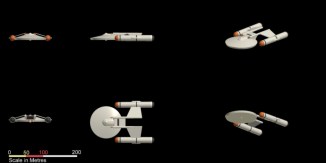
2246 T2 Vastagor Lattam (Death Talon)

Introduced about Stardate 1/8905 and assigned as groups to various fleets in the Romulan navy, the T-2s were designed for escort and patrol duties.  Though they had no room to spare for leisure, and though the quarters and work areas were quite cramped, the class is considered to be roomy and comfortable by early standards.

After Stardate 1/9902, vessels appeared in which the hull had been modified to hold a plasma weapon.  After Stardate 2/0001, the first Type 3s appeared, with increased length, weight, and crew complement.  The firepower of the new type was more than double its original configuration, and the newer shields gave a combat efficiency three times greater than the Type 1.  After several years of service, the destroyers began undergoing minor changes to the hull configuration and interior layout, and, beginning with the Type 6, the weapons mountings were increased from four to six.

The Type 7, with this new weapons arrangement, a more powerful impulse engine, and more efficient shields, made its appearance about Stardate 2/0803.  A cloaking device also was installed on the Type 7.  Reports from the Klingons indicate these were useful in escort duties.  Many times, Klingon long-range sensor scans of Romulan convoys would show few escort vessels, but actual contact would reveal five to ten T-2s materializing from nowhere, making the supposed easy Klingon victory and prize a mere dream.
Of the approximately 250 T-2s built, about 150 are in reserve fleets and another 20 are being used as training vessels.  Only five of these ships have been sold to the civil sector, all of which operate in the the Triangle or along Federation borders; it is not known if any of these are armed.
The class is named from the Romulan vastagor lattam (death talon), a reference to the Mogari, a large carnivorous bird native to Romulus.  These man-sized birds are reported to swoop down on their prey at speeds up to 120 mph and inflict fatal blows with their long talons.

2246 – Monoceros I

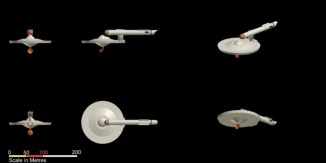
The Monoceros class scout was designed to provide Starfleet with a light scout which was cheap and easy to build. First commissioned in 2246 (1/89), further ship production was delayed after a design flaw in the warp field balance coil was discovered. At high warp speeds, the ship tended to “rise” out of its own warp field, causing the ship to violently exit warp. The problem was corrected by reconfiguring the control computer software.

The Monoceros II was also designed to act as a demonstrator for the improved generation of linear warp drives then in development. The SCNN nacelle and reactor arrangement adopted for the single FWB-1 warp engine was lighter than the equivalent PB series installation. Fitment of a full-blown linear drive assembly with hull mounted warp core was dismissed in this design on safety grounds. It would be a further 10 years before work began on a class mounting such a system.

The experience gained in operating the SCNN equipped Monoceros II class paved the way directly for later SCNN engined vessels (such as the Endeavour class) and also demonstrated the benefits that ships equipped with linear drives had compared to those with circumferential warp drives. Of the 16 ships commissioned, not a single vessel was lost to warp drive related problems, but some nine vessels were lost to enemy action. The decommissioning of the class in 2257 (1/99) was the result of the need to continue the testing of the new engines on the few surviving ships of the class. Accordingly all seven survivors continued to be operated as test-beds by both the engine manufacturers and the Starfleet Corps of Engineers, the last not being retired until 2272 (2/17).

The Monoceros did see action in the Four Years War, albeit limited. In 2253 (1/95), the USS Vulpecula was responsible for inflicting minor damage on several unescorted Klingon G-4 transports. The captain and crew of the Vulpecula received Starfleet’s highest commendations for this action. Most ships of this class, however, served as sentry ships for assembled fleets.

An interesting footnote to the ship’s history is the origin of the class name. It has been told that Commodore Charles Tatum, who was overseeing the design of the proposed scout, was studying the ship schematics at home when his seven year old daughter became curious as to her father’s work. The commodore light-heartedly asked his daughter what the ship should be called, and she promptly answered, “Unicorn!” Impressed, the commodore (after changing the name to its Latin derivative) submitted the name and it was eventually approved.

Class: IV Year: 2246
Ship Source: Starfleet Technical Manual/Lee Wood Ship Datasheet: Download PDF

new_monoceros-pb-100

2246 – Gorgon

The Gorgon (PKA-810) Class was the first Perimeter Action class to commission in Starfleet, and in many ways was used to prove the concept, unlike the later Agilis and Kiaga classes the Gorgon was based on more traditional design concepts. The Gorgon was designed by a joint Terran-Andorian team, and as such shares some basic concepts (the twin boom design) with the Loknar class frigate, but the execution on the Gorgon was somewhat different. After the introduction of the smaller newer Agilis and Kiaga classes, the Gorgon class was reclassified as a Large Perimeter Action Ship (PKA).

The Gorgon class was designed to have a good all round coverage of firing arcs with lasers (although the weaker FL4 was mounted aft while the FL5 was mounted fore), this was complements by two forward, and one aft firing, accelerator cannons. 10 Gorgon class vessels were constructed, and all saw service in the Four years war. Upgrades to the shielding system were deemed essential in 2253 following the loss of two vessels, the FSD just could not produce enough power. Accordingly the FSH was fitted, but as weight was at a premium in the class, it was at the expense of two of the aft firing lasers, but it was judged that this was a price worth paying. Post war the five survivors were rearmed with modern phasers and photon torpedoes, as well as upgraded warp drives and shields, they continued in service until 2275, and no further refits were undertaken as the number of ships surviving in service was not deemed economic to devise a refit program for.

The Gorgon class was a useful stepping stone in the evolution of the PA, and the lessons learnt in the class demonstrated that a smaller platform was the best option for a definitive PA.

Class: X Year: 2246
Ship Source: Steve Bacon, Inspired by Paramount’s Norway Class Ship Datasheet: Download PDF

gorgon_100