| Class: | TBC | Year: | 2250 | |
| Ship Source: | Based on Starfleet Battles NCL+ | Ship Datasheet: | Coming Soon | |
|
|
||||


| Class: | TBC | Year: | 2250 | |
| Ship Source: | Based on Starfleet Battles NCL+ | Ship Datasheet: | Coming Soon | |
|
|
||||

The Cygnus Class entered service in 2248 as a Command Courier version of the highly successful Saladin/Hermes class. The Intention was that an Admiral could use the ship as a sector command post. To this end the design was given the FWC-1 warp drive, giving it more power than its half sisters, the weapons were entirely laser based to make more room for the Admiral’s facilities and command centre.
In 2250, the USS Columbia was converted to a more heavily armed configuration as an experiment to evaluate the benefits of an FWC-1 powered heavy destroyer type. These trials amounted to nothing, but the Columbia was left in this configuration, and was assigned as a Destroyer Leader to a flotilla of Saladins in the Klingon Border Area.
Compared to the Mk1, the Mk2 mounted a pair of rear firing Lasers and also added a pair of FAC-2 accelerator cannons at the expense of the Flag Cabins. The extensive Combat Information Centre initially fitted for the use of an Admirial was retained for suadron level operation command.
The outbreak of the Four Years War saw a major change in Starfleer Operational Procedure, a number of the Cygnus class ships were involved in near disasters in 2252, as operating independently without escorts as they had been designed to do made them tempting targets. In a fleet role the additional speed of the Cygnus was wasted, so it was ordered to convert the other 8 mk1 vessels to mk2 standards.
The nine Cygnus class ships performed valiantly throughout the war, and in many ways paved the way for the later Strike Cruisers which adopted the role of command ship for a Destroyer squadron. Post war the future of these ships was uncertain, as the fleet backed away from a purely military posture, it was eventually decided to convert all of the ships to Hermes specifications to make good the losses suffered by that class.
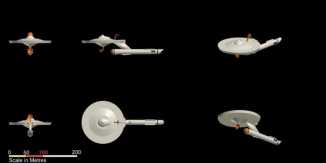
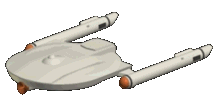
Ordered as an alternative in case of the failure of the Constitution Class. The delays to Constitution Class and poor performance of the Ranger II meant that the Pyotr Velilkiy served as an interim Heavy Cruiser, and was ordered in quantity in response to Klingon aggression in 2244.
The eventual entry of the Constitution Class to service in large numbers meant that the Pyotr Velikiy was relegated to less glamorous duties, and some were converted to serve as tugs. The Cruiser version was phased out by 2312.
The Pyotr Veliky class was conceived as fall back design in case of delays to the Constitution Class Program. The Protoype, USS Pyotr Veliky named for the Tsar who created Russia’s Imperial Fleet, entered service in 2241. The ship mounted the ultimate non dilithium warp drive to enter service, the FFTL-7B and was the only class fitted with this engine. The other technology of this design was also well proven, in direct contrast to the advanced systems chosen for the Constitution Class. The class was designed and built at Andorian shipyards in an effort to disperse the strategically important role of building heavy cruisers away from Earth, additionally much of Earth’s ship building and design capacity was tied up in the Constitution class program.
Delays to the Constitution Class led to the ordering of 5 Mk 2 ships, the first of which entered service in 2244. The Mk 2 featured improved laser weaponry and improvements to cargo handling systems. The Pyotr Veliky class, despite it’s old technology warp reactor did have the same nacelle design as would be used on the Constitution, and many minor improvements made to the nacelles on these ships found their way into the Constitution class nacelles.
As the Mk2 ships entered service, increased Klingon aggression prompted an order to be placed for 14 Mk3 ships. The Mk3, which entered service in 2245 mounted the brand new FAC-4 accelerator cannon, but the main advance was with shielding. The New unary shields were now coming into service, and the FSG was selected to replace the inefficient system mounted on earlier ships. The FSG required the addition of a new style M series computer, and the M3 was accordingly fitted.
With the Constitution class beginning to be available in quantity by 2250, steps were taken to refit the 20 Pyotr Veliky ships for further service. 14 Ships were refitted to MkIV standards for service with Military Operations Command, and 6 to MkV for service with Galaxy Exploration Command.
The MkIV adopted the FWD-1 warp drive, this drive at half the weight of the FFTL-7B meant that the ship’s mass dropped by almost a 100,000mt. The resultant ships, although less powerful, were more efficient in movement and had a higher maximum speed, useful for patrol duties. The only old technology system retained aboard the ships was the dependable FNSP-X impulse system, as no newer style engines could yet power ships of Class XI. The refits were all complete at the outbreak of the Four Years War, where this class served distinction.
The MkV adopted the even lighter FWE-1 Warp drive, and had a major physical change with the removal of the secondary hull. These ships had been intended for use in an exploration role, but the Four Years War saw them serve as Frigates until the Surya and Coventry classes entered full service. The MkV mounted the same weapons as the MkIV and the FIC-3 impulse engine meant that it had the same amount of power as its larger sibling, but the lighter structure could absorb less damage.
Postwar surviving vessels were used in second line roles, some for exploration (Mk6) and some as cargo tugs(Mk7) or transports (mk8), although a small number did remain in defence roles with the Blue Fleet (Mk9).
The last Pyotr Veliky was not retired from service until 2312, that vessel, the USS Salah Ad-Din is now on display in the Starfleet Museum.
Commissioned Ships
USS Pyotr Velikiy NCC-1670
USS Shrelev II NCC-1671
USS Yi Sun-Shin NCC-1672
USS John Paul Jones NCC-1673
USS Tav NCC-1674
USS Elizabeth I NCC-1675
USS Etrox NCC-1676
USS Togo NCC-1677
USS Rommel NCC-1678
USS Friedrich Barbarossa NCC-1679 USS Goyathlay NCC-1680
USS Washington NCC-1681
USS Niakenchiis NCC-1682
USS Salah Ad-Din NCC-1683
USS Giap NCC-1684
USS Hannibal NCC-1685
USS Zerisshebi NCC-1686
USS De Grasse NCC-1687
USS Rexx NCC-1688
USS Gantu NCC-1689

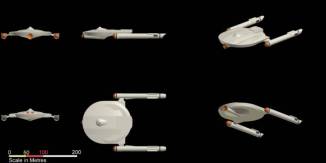
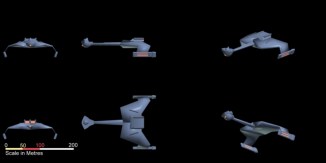
The Heavy Cruiser variant of the D7, the D7B was produced for some of the more militant of the Klingon houses. Compared to the standard D7 the ship was far more effective in combat efficiency terms, although more costly and time consuming to build. Some 280 ships were built between 2250 and 2252, when production was switched to the more capable still D10 class.
Although highly capable and successful, production of the ‘ugh (heavy) version of the D7 was limited as it was viewed as an interim counter to the Federation Heavy Cruisers program prior to the D10 entering service in large numbers.
| Class: | X | Year: | 2250 | |
| Ship Source: | Paramount Pictures/ The Starfleet Museum | Ship Datasheet: | Download PDF | |
 Vintage Starships
You must be logged in to post a comment.