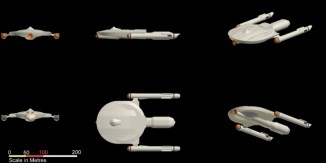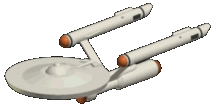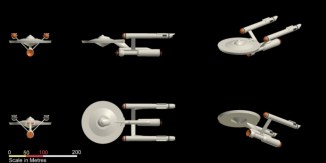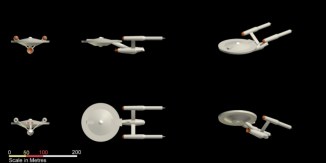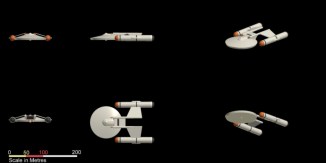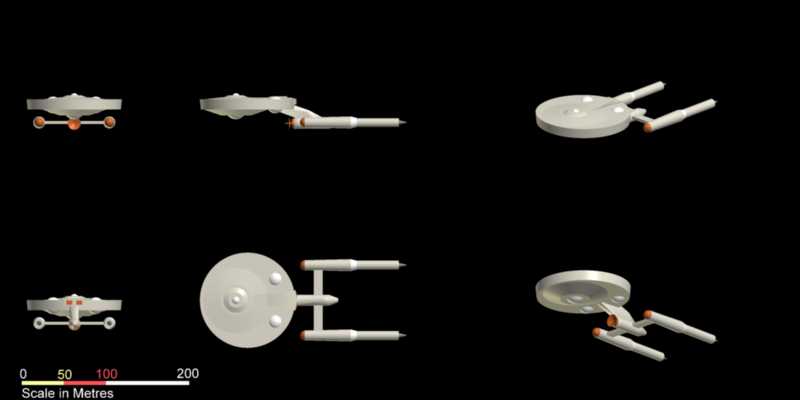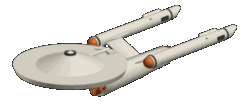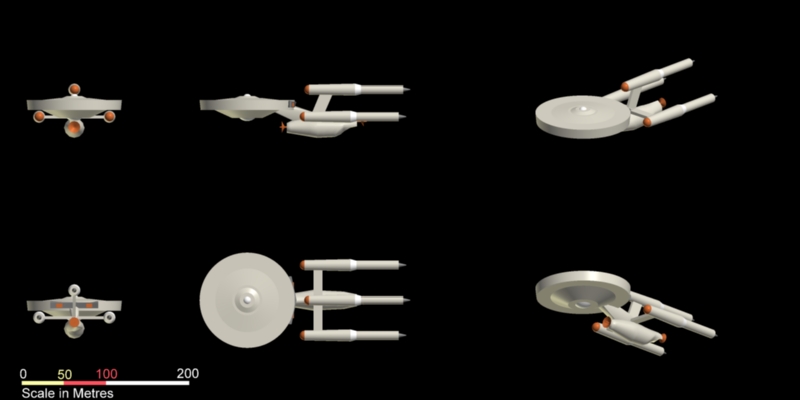
2241 – Pyotr Velilkiy

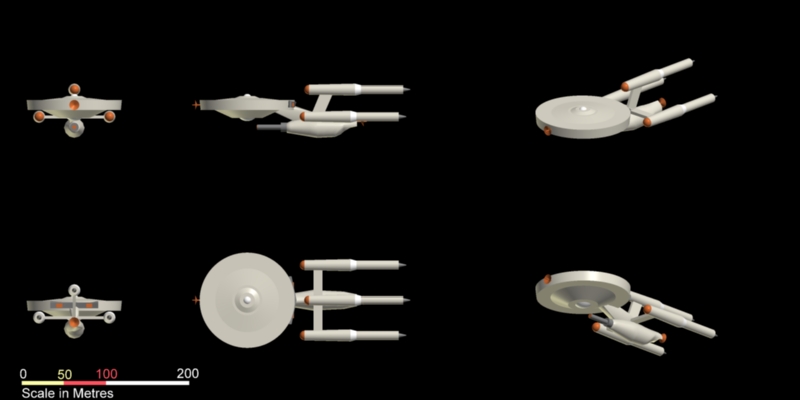
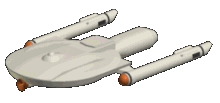
Ordered as an alternative in case of the failure of the Constitution Class. The delays to Constitution Class and poor performance of the Ranger II meant that the Pyotr Velilkiy served as an interim Heavy Cruiser, and was ordered in quantity in response to Klingon aggression in 2244.

The eventual entry of the Constitution Class to service in large numbers meant that the Pyotr Velikiy was relegated to less glamorous duties, and some were converted to serve as tugs. The Cruiser version was phased out by 2312.

The Pyotr Veliky class was conceived as fall back design in case of delays to the Constitution Class Program. The Protoype, USS Pyotr Veliky named for the Tsar who created Russia’s Imperial Fleet, entered service in 2241. The ship mounted the ultimate non dilithium warp drive to enter service, the FFTL-7B and was the only class fitted with this engine. The other technology of this design was also well proven, in direct contrast to the advanced systems chosen for the Constitution Class. The class was designed and built at Andorian shipyards in an effort to disperse the strategically important role of building heavy cruisers away from Earth, additionally much of Earth’s ship building and design capacity was tied up in the Constitution class program.

Delays to the Constitution Class led to the ordering of 5 Mk 2 ships, the first of which entered service in 2244. The Mk 2 featured improved laser weaponry and improvements to cargo handling systems. The Pyotr Veliky class, despite it’s old technology warp reactor did have the same nacelle design as would be used on the Constitution, and many minor improvements made to the nacelles on these ships found their way into the Constitution class nacelles.

As the Mk2 ships entered service, increased Klingon aggression prompted an order to be placed for 14 Mk3 ships. The Mk3, which entered service in 2245 mounted the brand new FAC-4 accelerator cannon, but the main advance was with shielding. The New unary shields were now coming into service, and the FSG was selected to replace the inefficient system mounted on earlier ships. The FSG required the addition of a new style M series computer, and the M3 was accordingly fitted.

With the Constitution class beginning to be available in quantity by 2250, steps were taken to refit the 20 Pyotr Veliky ships for further service. 14 Ships were refitted to MkIV standards for service with Military Operations Command, and 6 to MkV for service with Galaxy Exploration Command.

The MkIV adopted the FWD-1 warp drive, this drive at half the weight of the FFTL-7B meant that the ship’s mass dropped by almost a 100,000mt. The resultant ships, although less powerful, were more efficient in movement and had a higher maximum speed, useful for patrol duties. The only old technology system retained aboard the ships was the dependable FNSP-X impulse system, as no newer style engines could yet power ships of Class XI. The refits were all complete at the outbreak of the Four Years War, where this class served distinction.

The MkV adopted the even lighter FWE-1 Warp drive, and had a major physical change with the removal of the secondary hull. These ships had been intended for use in an exploration role, but the Four Years War saw them serve as Frigates until the Surya and Coventry classes entered full service. The MkV mounted the same weapons as the MkIV and the FIC-3 impulse engine meant that it had the same amount of power as its larger sibling, but the lighter structure could absorb less damage.

Postwar surviving vessels were used in second line roles, some for exploration (Mk6) and some as cargo tugs(Mk7) or transports (mk8), although a small number did remain in defence roles with the Blue Fleet (Mk9).

The last Pyotr Veliky was not retired from service until 2312, that vessel, the USS Salah Ad-Din is now on display in the Starfleet Museum.

  • Class: XII-XIV
  • Year: 2241
  • Ship Source: Starfleet Museum
  • Ship Datasheet: Download PDF

pv1

Commissioned Ships
USS Pyotr Velikiy NCC-1670
USS Shrelev II NCC-1671
USS Yi Sun-Shin NCC-1672
USS John Paul Jones NCC-1673
USS Tav NCC-1674
USS Elizabeth I NCC-1675
USS Etrox NCC-1676
USS Togo NCC-1677
USS Rommel NCC-1678
USS Friedrich Barbarossa NCC-1679 USS Goyathlay NCC-1680
USS Washington NCC-1681
USS Niakenchiis NCC-1682
USS Salah Ad-Din NCC-1683
USS Giap NCC-1684
USS Hannibal NCC-1685
USS Zerisshebi NCC-1686
USS De Grasse NCC-1687
USS Rexx NCC-1688
USS Gantu NCC-1689

2240 – Ranger Refit

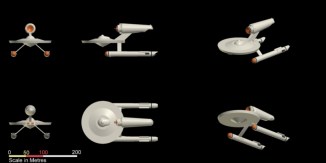
The Ranger class originally entered service in 2217, and despite some shortcomings served as Starfleet’s premier heavy cruiser for almost 30 years until the introduction of the Constitution class.

The 2240 Ranger Refit utilised the new secondary hull design for the Constitution class, as well as the upgraded warp drive intended for that class.

Performance of the Ranger Refit was a disappointment as the refit was limited in scope, and further upgrades were cancelled in favour of additional orders for other new build heavy cruisers.

  • Class: IX
  • Year: 2240
  • Ship Source: Last Unicorn Games
  • Ship Datasheet: Coming Soon

ranger_2_sidelarge

2232 – Republic

The Republic was a modified Horizon class cruiser. This configuration was an interim step that was used to evaluate the design elements of the Constitution class. USS Republic was later upgraded to the Full Constitution class specification.

  • Class: X
  • Year: 2232
  • Ship Source: Concept from Heavy Cruiser Evolution Chart
  • Ship Datasheet: Download PDF

republic_largeside

Commissioned Ships

USS Republic NCC-1371

2227 – Valley Forge

In 2220 many members of the Federation Council, and Starfleet itself, recognized that the present borders of the Federation could not be adequately defended without a major investment in Ships and Starbases. The council decided that some of the marginal outlying colonies would be abandoned, and a new defensive perimeter established around the core colonies. This change of Policy required smaller Cruisers and Destroyers to be stationed at the colonies, rather than the patrolling Heavy Cruisers and Dreadnoughts previously procured.

The Lancaster Class of 2205 had proven successful, but was expensive in terms of construction, maintenance and manpower. The plan was to procure a smaller ship, using proven technologies at a lower unit cost. The design was to be evolutionary, not revolutionary. It was also to be a stand against the ever increasing growth in Starship size and cost. All construction of the class was to be carried out in Starfleet Division Shipyards. The lead ship of the class, USS Valley Forge, launched in November 2226, and commissioned in August 2227. The class was slimmer than the previous Lancaster class, but the design still followed the concepts from the Daedalus class of 2160.

More frequent border incursions by the Klingons started soon after the first Valley Forge class ships joint the fleet in 2227. The first major engagement was fought by these ships in 20 August 2242, when the USS Cougar engaged a squadron of 12 Klingon D6 cruisers attacking the Cicatrix IV colony. She destroyed two ships in combat, and a third by ramming, although the Cougar was also lost.

The Valley Forge class was also extensively used in Police Actions, especially in anti Orion priracy operations, as their greater maneuverability was better suited to engaging small targets compared to the larger cruiser classes, which were designed to engage other cruisers and capital ships. As newer ships entered service the Valley Forge class ships gradually assumed lesser roles, although they continued in service until the 2280s. The class also formed the basis for the Belleau Wood class assault transports and Siegfried class dreadnoughts (of 2232 and 2235 respectively).

USS RATTLESNAKE (NCC-1493), a participant of the Battle of Donatu V and numerous other engagements, is on display at the Starfleet Museum.

  • Class: IX
  • Year: 2227
  • Ship Source: The Starfleet Museum
  • Ship Datasheet: Download PDF

100Valley_forge_large

Commissioned Ships

USS Valley Forge NCC-1463
USS Aldrin NCC-1464
USS Tigress NCC-1465
USS California NCC-1466
USS St. Petersburg NCC-1467
USS Cougar NCC-1468
USS Independence NCC-1469
USS Diana NCC-1470
USS Arizona NCC-1471
USS O’Bannon NCC-1472
USS Tokyo NCC-1473
USS Bonderenko NCC-1474
USS Europa NCC-1475
USS Normandy NCC-1476
USS Clarke NCC-1477
USS Proteus NCC-1478
USS Los Angeles NCC-1479
USS Aelita NCC-1480
USS Elvgren NCC-1481
USS Hong Kong NCC-1482
USS Ishtar NCC-1483
USS LaFayette NCC-1484
USS Yamato NCC-1485
USS Vesta NCC-1486
USS Masaryk NCC-1487
USS Cherenkov NCC-1488
USS Oriskany NCC-1489
USS Clavius NCC-1490
USS Sheridan NCC-1491
USS Toklas NCC-1492
USS Rattlesnake NCC-1493
USS Asaph Hall NCC-1494
USS Ripley NCC-1495
USS Dallas NCC-1496
USS Canberra NCC-1497
USS Boxer NCC-1498
USS Cheetah NCC-1499
USS Artemis NCC-1500
USS Scorpion NCC-1501
USS Narcissus NCC-1502
USS Ganesa NCC-1503
USS Dolphin NCC-1504
USS Vargas NCC-1505
USS Anaconda NCC-1506

2249 – Kiaga

The Kiaga (PA-820) Class was the first specialist Perimeter action class to commission in Starfleet. Building on the lessons learnt from the interim Gorgon class, the Kiaga was a smaller vessel, with a very flat side profile which was intended to increase the stealthiness of the design.

Unlike the larger Gorgon, the Kiaga was designed to optimise forward firepower, mounting four smaller accelerator cannons, all firing forward in specially designed twin launchers each side of the primary hull. The FL5 lasers were arranged with banks covering f/p, f/s and aft arcs of fire, it was realised that this left the aft vulnerable, so an additional FL4 was crammed in firing aft.

Weight was always an issue on the Kiaga, and the theoretical weapons load could have been almost double, but the engines would not permit the carriage of such a mass of weaponry. 35 Kiagas were produced, and all saw active combat, a number being lost in the Four Years war. The class was not modified until Photon Torpedoes and Phasers became available, and the Kiaga was the last PA class to begin refitting (well after the war had ended).

In Mk1 form the Kiaga had always been outperformed by its smaller sibling, the Agilis, but the Mk2 Kiaga could finally carry the maximum weapons fit that the M1 allowed, and as a result of this, and the upgraded FWB2 warp drive, the class finally outperformed the Agilis, even the new Mk2. For this reason additional construction was ordered to make up the vessels lost during the war. The Kiaga continued in service, but was always in the shadow of the later Agilis Class, despite this they were preferred by PA crews in peacetime as they were far roomier, but in wartime the Agilis was still the class of choice due to its far tougher construction.

Class: VI Year: 2249
Ship Source: Aridas Sofias/ Ships of the Starfleet Vol 1 Ship Datasheet: Download PDF
Please note that this PDF requires updating in terms of images, the stats are correct


2246 – Gorgon

The Gorgon (PKA-810) Class was the first Perimeter Action class to commission in Starfleet, and in many ways was used to prove the concept, unlike the later Agilis and Kiaga classes the Gorgon was based on more traditional design concepts. The Gorgon was designed by a joint Terran-Andorian team, and as such shares some basic concepts (the twin boom design) with the Loknar class frigate, but the execution on the Gorgon was somewhat different. After the introduction of the smaller newer Agilis and Kiaga classes, the Gorgon class was reclassified as a Large Perimeter Action Ship (PKA).

The Gorgon class was designed to have a good all round coverage of firing arcs with lasers (although the weaker FL4 was mounted aft while the FL5 was mounted fore), this was complements by two forward, and one aft firing, accelerator cannons. 10 Gorgon class vessels were constructed, and all saw service in the Four years war. Upgrades to the shielding system were deemed essential in 2253 following the loss of two vessels, the FSD just could not produce enough power. Accordingly the FSH was fitted, but as weight was at a premium in the class, it was at the expense of two of the aft firing lasers, but it was judged that this was a price worth paying. Post war the five survivors were rearmed with modern phasers and photon torpedoes, as well as upgraded warp drives and shields, they continued in service until 2275, and no further refits were undertaken as the number of ships surviving in service was not deemed economic to devise a refit program for.

The Gorgon class was a useful stepping stone in the evolution of the PA, and the lessons learnt in the class demonstrated that a smaller platform was the best option for a definitive PA.

Class: X Year: 2246
Ship Source: Steve Bacon, Inspired by Paramount’s Norway Class Ship Datasheet: Download PDF

gorgon_100

2249 – Heston

The Heston class, although now largely forgotten, was the leading Cruiser type in the four years war. Although not as powerful as the Constitution in terms of engines, it made up for that with its greater firepower and overlapping arcs of fire.

Advances in Klingon Ship design and weaponry capability led to concerns amongst some elements of Starfleet in the early 2240s. It was planned that the Constitution class would form the vanguard of Starfleet’s strength after they began commissioning in 2245, but the dual role nature of the design led to the military capabilities being reduced to allow for science and exploration capability. Additionally the advanced sensors and science instrumentation fitted meant that the class was prohibitively expensive to procure in quantity.

To counter this problem Military Operations Command pushed for a cheaper military roled heavy cruiser, which would dispense with th e extensive science equipment of the Constitution class, this ship became the Heston class. The first Heston class ship commissioned in 2249; it was in many ways a more heavily armed variant of the Constitution class design. Superficially, the ships looked similar, but externally, and internally there were a number of changes.

The Heston mounted the FWD-1 warp drive, as opposed to the FWC-1 of the Constitution. The only way to fit the required weapon load in the class was use the lighter warp drive which additionally was 20% cheaper than the FWC-1. of the ship. The cost of this change was that the Heston class was always short of power, but to remedy this the class was fitted with the revolutionary FSI shield generator, the first trinary shield generator. Because of leaving out the science facilities of the Constitution class, the ships had the capability to carry 200 marines as well as fighter craft and assault shuttles. It had been planned to make the ship larger, but suitable impulse drives were not available to power ships of more than class XI until 2256.

The Mark 2 Heston of 2253 was perhaps the ultimate laser equipped warship to serve in Starfleet. She adopted the new FWE-2 warp drive, which allowed additional structural reinforcing due to its lower weight, as well as being both more efficient and more powerful. All 7 surviving Mk 1s were upgraded to this standard. The Mark 2 was designed purely to counter the D10 class Cruiser.

Postwar the ships were deemed obsolete due to their reliance on lasers, and the lower power of the warp drives. Additionally the single role nature of the vessels meant that they could not be redeployed on exploration duties, which made them less attractive for refits than the Constitution class ships.

In another blow to the future of the Heston class, the Federation Class usurped the military role of the class, the Federation class was essentially a Heston class hull with the addition of a third nacelle. A limited refit was carried out in 2257, when three ships gained FWD-2 warp drives, but this was only a temporary reprieve, as the lasers and accelerator cannons were not replaced. USS Heston became flagship of the Federation reserve fleet in 2258, just 9 years after commissioning. Subsequently it was decided that the Heston class spaceframes could be most effectively used if refitted to Federation Class Dreadnought specifications.

To this end, all 13 surviving vessels were mothballed or in reserve by 2260. From 2266 onwards 12 of the 13 survivors were stripped back to their spaceframes with the intention of being be rebuilt to Federation class specifications, however when the Federation class production was halted early these hull were scrapped or expended as targets.

The USS Heston (NCC-1685) was the only ship not scrapped, and was later allocated for display purposes. She is still in the Starfleet Museum today.

  • Class: XI
  • Year: 2249
  • Ship Source: Based on Federation Class From Starfleet Technical Manual, Name Reference FASA
  • Ship Datasheet: Download PDF

heston_large

Siegfried (II)

2242 – Siegfried Refit

The Siegfried class was the first true dreadnought to enter service. As originally completed the class mounted the extremely powerful FLM-1 Cannon, this weapon was limited in terms of arcs of fire and recharge time, but used well was an extremely effective weapon. In 2242 some of the class were refitted to a more standard configuration due to delays in the Constitution class program, and were refitted with the new Unary shielding systems. In this revised configuration these ships gave valuable service for a number of years, although later on only in supporting roles

Class: XII Year: 2242
Ship Source: The Starfleet Museum Ship Datasheet: Download PDF

Siegfried (II).

Siegfried (I)

2235 – Siegfried

The Siegfried class was the first true dreadnought to enter service. As originally completed the class mounted the extremely powerful FLM-1 Cannon, this weapon was limited in terms of arcs of fire and recharge time, but used well was an extremely effective weapon. In 2242 some of the class were refitted to a more standard configuration due to delays in the Constitution class program, and were refitted with the new Unary shielding systems. In this revised configuration these ships gave valuable service for a number of years, although later on only in supporting roles.

Class: XII Year: 2235
Ship Source: The Starfleet Museum Ship Datasheet: Download PDF

Siegfried (i)