2257 – Bakker

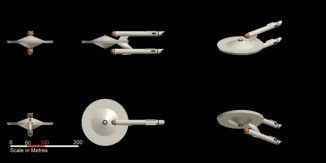
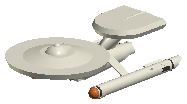
The Bakker Class Command Cruiser entered service the year after the Four Years War. Originally planned as a class of twelve ships, only six were commissioned.

As with many ships of her era she is a rearrangement of the highly successful Constitution Class design, the secondary hull being the same as the conventional design although with a shorter neck. The low mounted warp nacelles allowed the addition of a tertiary hull in the Dorsal position atop the secondary hull. This tertiary hull housed a full fleet command suite, with separate computer and life support systems. It was capable of being swapped for a multi mission pod, but the the only other pod procured was a transport one, proposed carrier and weapon pods were not forthcoming.

In service the Bakker concept worked well to a degree, but the large tertiary hull limited speed and reduced efficiency compared to more conventional Cruisers.

The USS Bakker (NCC 1996) was lost in 2270. She was stolen by a crew of Klingon renegades aided by the commanding officer of Starbase 6 (Commander Baines) while docked for refit.

Commander Spock of the Enterprise established that the Klingons were not acting on behalf of the empire, and contacted the Klingon Commander Kor to warn him that the ship was entering Klingon space. A battle group led by Kor destroyed the Bakker, however the incursion and destruction of the ship did not impact negatively on Klingon-Federation relations due to the nature of the incident – indeed it did lead to a greater level of understanding.


bakker

2257 – Mary & John

The Mary & John class Battle Destroyer was designed as a destroyer counterpart to the Heston class Battle cruiser and Federation class Dreadnought, utilising the same saucer design as those classes, with the upper nacelle mount from the Federation. Owing to wartime prioritising of existing designs, the USS Mary & John finally began trials in November 2257.

In common with the Twin Saladin and the Warhawk designs, the twin engine configuration was a reaction to the lessons of the four years war.

This class, however, fell victim to another lesson from the war Starfleet realised that a rationalisation of destroyer designs was required. Only the Warhawk class entered service, the USS Mary and John saw only limited service as the Heston/Federation class primary hull lacked the science facilities of the Constitution derived saucer of the Warhawk class, and as such was ill suited to the peacetime Starfleet.

mary&john1

2257 – V7 Aye Mosaram (Whitewind)

Like their counterparts in the V-6 Class, the V-7s were designed for multiple roles, with spacious in- teriors and complete onboard research facilities.

The Type 1 entered service about Stardate 2/12 and is still being produced as a support ship, even though it is not as efficient in combat as later models.  Mounting the RPL-2 plasma weapon and a cloaking device, the Type 1 is capable of operating alone.

The Type 3, introduced about Stardate 2/17, is the preferred model of the class.  It mounts two additional disruptors and three photon torpedoes, and it has more efficient shields.

Of the approximately 80 V-7s built, nearly all remain in active service.  Current production of the Whitewind is estimated at six per year.

The aft weaponry of the V-7s has set the standard for the Romulan Navy, as exemplified by this Project Grey Ghost report of an incident between two V-7s and two Klingon L-9 class frigates. The V-7s, investigating asteroid clusters, detected the Klingons as they approached.  Both V-7s cloaked and deployed.  As the unsuspecting Klingons began surveying the asteroids, the V-7s de-cloaked and opened fire, only to have the Klingons disappear from view and sensor, obviously taking advantage of cloaking capabilities acquired in the technological exchange.  In the waiting game that followed, all four ships remained cloaked and invisible to sensors for several hours.  Finally, one of the Klingon commanders became impatient and attempted to warp away from the area.  Unfortunately, his path of departure resulted in a collision and catastrophic explosion.  The remaining ships immediately de-cloaked, only to find themselves lying aft to aft, which put the Klingon at a disadvantage because of its lack of torpedoes to the rear.  It suffered serious damage and surrendered to the Romulan commander, who allowed the Klingon to leave after surrendering the cloaking device.

The class is named for a meteorological disturbance peculiar to Remus.  As described in The Eridam Papers, twice per Remus year, a hot wind blows across the northern hemisphere for as long as five days.  Mineral particles from the western cliffs are borne aloft by the winds, and, at night, their phosphorescense causes the hemisphere-wide nightglow that gives the weather phenomenon its name aye mosaram (white wind).

Again, to make this class fit in the right position I’ve bought it forwards, this can be attributed to an error in Project Grey Ghost’s data.

2257 – V8 Vas Hatham (Bird of Prey) (“Cricket”)

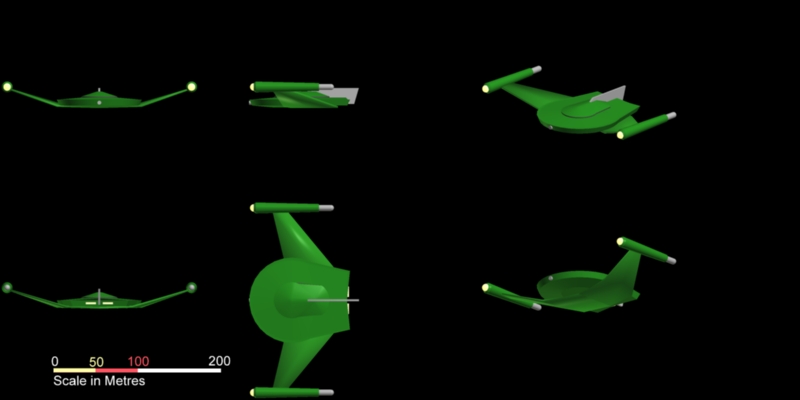
On Stardate 2/0710 (2266), a V-8 was encountered by a Star Fleet cruiser patrolling the Neutral Zone, the first such contact in over 100 years and the very first visual contact with a Romulan war vessel.  The incursion into Federation space obviously was intended to test UFP defenses, and the V-8 destroyed several listening posts and bases before being heavily damaged by the Federation vessel and self-destructing to avoid capture.  Because of this incident, and because these ships were encountered in increasing numbers afterward, this vessel, more than any other, has been identified with Romulan military actions.  For many years, these vessels were believed to be the mainstay of the Romulan fleet, but improved intelligence reveals that this was a misconception.

The vessel was designed to carry the RPL-2 plasma weapon; because of its size and bulk, the Type 1 ships–136 meters long–actually were built around the 110-foot-Iong weapon.  The other major feature of the Type 1 was the use of new shielding technology.  The Type 4, with upgraded disruptors, was introduced to overcome the inadequate firepower of earlier models.

Of the approximately 100 ships built, about 40 are assigned to reserve fleets.  Six have been modified and sold to the civil sector, including two Type 1s, one each of Type 2 and Type 3, and two Type 4s, all of which operate in and out of the Triangle.

The class is named for the Romulan vas hatham (bird of prey), in reference to a huge, flying predator reportedly native to Romulus, but so revered that they have been transplanted to several of the conquered worlds in the empire.  Living for nearly 100 years, these avians can reach nearly giant proportions, some having wingspans as wide as 50 feet and weighing as much as 400 pounds.

Class: IX Year: 2257
Ship Source: The Starfleet Museum FASA Ship Datasheet: Coming Soon

v8-100

Federation

2257 – Federation

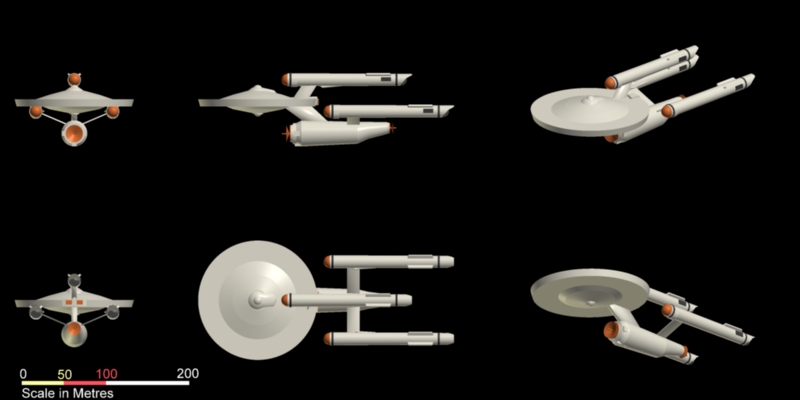
The Federation Class Dreadnought was initially conceived prior to the Four Years as a variant of the Heston class Battle Cruiser (which was itself a Military role variant of the Constitution). The design was shelved as the new dilithium energised engines were not yet available to power such a large vessel. After the war the design was modified to take account of the lessons of the War and put into production using the new FWF-1 engine. The class was refitted in 2274, and was the most powerful Starfleet vessel until the introduction of the Excelsior class some twenty years later.

Class: XIV Year: 2257
Ship Source: Starfleet Technical Manual Ship Datasheet: Download PDF

Federation