2261 – Vindicator

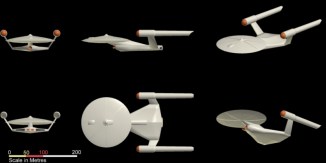
The Vindicator class of 2261 was a development of the Anton/Miranda Class Cruiser and Surya/Coventry Class Frigate platform. A more compact looking vessel than its earlier forebears the Vindicator mounted its warp drives closer to the primary hull on much more substantial mounts. This modification of the design was based upon after action feedback from various vessels of the family that had been engaged in the Four years war.

The Vindicator class was the last twin engine version of this basic design platform produced before the adoption of the Linear Warp Drive (the later Durrett prototype being single engined).

Like many of the other ships of this overall design family, many of the Vindicator class ships were extensively rebuilt to form part of the refitted Miranda class in the 2270s and 2280s. However, the 20 newest ships of the class were rebuilt much like the Endeavour refit of the Constitution class with Vickers SCNN Linear Warp Nacelles to form the Voyager Class which continued in service until the early 2300s.

Class: XI Year: 2261
Ship Source: Jackills Starship Data Sheet Ship Datasheet: Coming Soon

vindicator_100

2261 – Blade

The Blade class entered service in 2261 addressing concerns around the Signal intelligence (SIGINT) capabilities of the fleet, the name derived from the bladeship nickname that the design earned.

Bladeships are fully equipped with sensors and receivers for use in reconnaissance and surveillance, the huge blade housing massive arrays for monitoring communications and providing SIGINT.

Although the Bladeship design had some weaponry, the design as drafted was meant to fight running away (unusually it had two torpedo tubes firing aft but only one firing forward).

The designer of the bladeship, Commander Deitrick (unusually an operational intelligence office) based the design on his own experience of what was required in the role. After submitting the design to his superiors as part of a post mission debrief he was soon informed that a prototype would be built.

The first ship, USS Dagger, was built by Chandley Works and commissioned in 2261. The speed and intelligence gathering capabilities of the design impressed Intelligence command and series production was ordered.

The Mk1 mounted standard Starfleet systems and was intended for use on the UFP side of border areas.

The Mk2 swapped standard systems for an exotic blend of Orion and federation technology, partly for the cover story that those ships were not UFP, and partly for the opportunity to use the Orion systems that were well talilored for small craft. Use of an Orion computer system   was controversial, but it worked well. Also questioned was the choice of the higher efficiency but lower powered OSI shield generator compared to the FSH of the Mk1, however given the limited power of the single FWC-1 it and the intention of the class to use speed as it’s main defence this was deemed a sensible tradeoff.

For its size the Blade was the fastest ship in known space (indeed it was unmatched until the Enterprise class entered service), but couldn’t take a whole lot of damage the best defence the class had was that sheer speed – and its parting gift of twin torpedoed!

The Mk2 Blade also had stealth-shields that were the closest thing Starfleet had to a cloaking device. The Mk3 which entered service in2271 continued the mixed technology from the Mk2, while mounting three of the more potent FP-7 torpedoes to replace the earlier FP-2.


Although not meant for combat, the Blade when handled well can be deadly. In 2265 the USS Claymore was intercepted in disputed space by three IKS cruisers. The Claymore’s captain, realising that his direct escape route was cut off by IKS space, chose to engage his opponents by reversing into combat at full reverse speed with only shields covering those arcs raised. The manoeuvre surprised his opponents, and the Claymore managed to score direct hits on the warp drives of two of the IKS ships. Then taking advantage of the confusion the Claymore warped to safety.

Class: VI
Year: 2261
Ship Source: FASA Starfleet Intelligence Manual
Ship Datasheet: Download PDF

blade_sf

The Blade write up is based on the background provided on David Deitrick’s (the ship’s designer) blog.

2261 – K’Kmarak

The K’Kmarak class was developed as a research ship only. It was never intended for combat and only carries weapons for defense. When the Mk I was commissioned, the need for a research vessel in the rimward areas of the Federation was greatest. As each ship in this class was completed, it was sent to this area to aid in the expansion of the territory. The K’Kmarak was instrumental in mapping this great expanse of space and in establishing contact with heretofore unknown races.

All ships in this class are designed for extended stays and therefore have large living quarters and working areas. Also, ships of this type have some of the most extensive laboratory facilities aboard any Starfleet ship. They are capable of performing the most intricate of planetary studies and have monitored and recorded several novas. It was during one of these investigations that a K’Kmarak class vessel the USS T’Pool (NCC 24307) was engulfed by a stellar explosion that covered 1200 A.U.s in 20 hours. Luckily for the crew aboard, their ship was caught up in a solar wind of phenomenal proportions which pushed away the T’Pool from the main thrust of the radiation. When all had settled, the T’Pool was still intact and flight worthy. The crew, however, had begun to suffer from radiation poisoning within a few days. The ship wandered about for several weeks until it was discovered by the USS Agincourt (NCC 4314), a Larson class destroyer. The crew was beamed aboard the Agincourt and the T’Pool was left adrift with marker beacons on, warning any approaching vessels to stay away. When ships were dispatched to recover the hull, the T’Pool was no where to be found and has not been seen or heard from since.

The Mk II version of this ship mounted the more powerful FWC-2, although maximum warp speed was slightly decreased. The Mk III version has improved firing arcs for its defensive FH-2 phasers. This upgrade was in response to the destruction of the research vessel USS Grissom in 2285 (2/22). After the Grissoms’ destruction, Starfleet reevaluated its research fleet and began a program to upgrade their defensive capabilities.

The K’Kmarak vessels were not built in substantial numbers, but the class is a capable one. All in all, the K’Kmarak class has served its purpose well and is still in service today. It should be noted that all K’Kmarak class ships are crewed by Vulcans.

Of the 14 K’Kmaraks built, 11 remain in active service. One Mk I is listed as missing. One Mk I and 1 Mk II have been scrapped. All remaining vessels have been upgraded to Mk IIIs. The K’Kmarak is no longer in production.

The K’Kmarak class has been named in honor of an early Vulcan scientist and explorer. K’Kmarak vessels carry on in the tradition of their namesake.

Class: VI Year: 2261
Ship Source: FASA/Lee Wood Ship Datasheet: Download PDF

kk

2261 – Concorde

Few ships have had such a chequered career as the Concorde Class. Laid down in 2255, the USS Concorde was intended to be the first of a new class of heavy cruiser. The design was built around the new FWF-1 warp drive and featured a number of revolutionary new features; it was intended to be the pathfinder for a whole new style of starship design.

The ships twin forward firing photon torpedoes (FP1 in the original design) were mounted in a bulge on the top of the saucer. The saucer itself was designed with 8 separate segments which were intended to be swappable to allow mission customising. As a result, the FH5 phasers were mounted in the broad secondary hull to allow maximum fields of fire fore and aft. The secondary hull itself was a revolutionary delta shape to increase warp efficiency, and also incorporated two huge hanger bays, as well accommodation for 100 marines.

The Concorde was finally launched in 2261, by this time 11 sister ships had also been laid down. It took another three years to get Concorde into service, and when it finally entered service, after many teething problems, it featured uprated weapons and shields to those originally intended for the design.

The second vessel, Callisto entered service in 2266, some 10 years after being laid down. Compared to Concorde, Callisto mounted a more powerful impulse drive, but was otherwise identical to her sister ship. The delays in getting the class into service meant that they were outclassed by many other newer types, and the unconventional firing arcs made the ships unpopular in military circles.

The third vessel, Comet, commissioned in 2268. This ship had uprated phasers in the form of FH-11, but was also outfitted as a long range explorer to suit its new mission. In initial trials for this role the design was found to be ideal, and the decision was taken to modify the two existing ships, as well as the three that were still to commission.

The problems and escalating costs faced by the class led to a decision to halve the order in 2267. Five of the ships, those that were least advanced, were cancelled, and a sixth, Cornelius, was reallocated for use as an experimental trials ship. The five cancelled ships were Charybdis, Columbia, Constellation, Challenger and Cochrane. Cornelius entered service in 2269, but lacked any permanent weaponry however she was to play a key role in the testing of many new weapon, shield and propulsion systems over the next 25 years, The next standard ship due to commission, Comet, was chosen to be reprieved as another potential role had been suggested for a small number of ships of this design. Galaxy Exploration Command needed a small number of large ships for long duration missions to the galactic core area, and the Concorde design, a failure in its military role, was the prime candidate due to its long range and duration.

Both Concorde and Callisto were soon modified for this new role, and along with the Comet set out on long range exploration missions. A fourth ship, Corsair commissioned in 2270, and for the first time the class was receiving positive attention. This was sadly to change in 2271, when Callisto was lost, presumed destroyed, on a mission to investigate the great barrier.

The loss of Callisto cast a shadow over the class, and delayed the commissioning of the fifth ship, Centaur. Investigation into the loss cleared the design of blame, and resulted in a ban on crewed missions to the great barrier. Centaur, which finally commissioned in 2274 was also a Mk 3 ship, and was again assigned to the long range exploration role.

The sixth ship to be completed , and the only new build Mk4, Commanche, commissioned in 2276, some 17 years after the hull was first laid down. The Mk4 was a major evolution in the class, as it mounted the new FWG-1 warp drive, coupled to a pair of M-6 computers and FSP shields the Commanche had a superb turn of speed and excellent defences to add to the already impressive range of the class. Another change in the Mk4 was that the segmented primary hull sections were fused together permanently, which greatly reinforced the strength of the primary hull. The Commanche was almost immediately despatched on a planned 10 year mission, deep into unknown space. She returned from the mission in 2288, six months behind schedule, but with a wealth of data and knowledge.

Concorde herself was upgraded to Mk4 standards in 2278, and was also despatched on a long range mission, which she returned from in 2288. Refits to a Mk5 configuration, with FWG-2 warp drive and FIG impulse drives, were considered for the other three ships, but the perceived complexity and limitations of the design led to the decision being made to phase the class out of service prematurely. Comet was placed in reserve in 2284, Corsair in 2286 and Centaur in 2287 as they returned from their missions.

Upon its return to Federation space in 2288, Commanche was spared decommissioning, instead she was used as part of a Starfleet goodwill mission, trying to recruit new recruits into the fleet. Concorde, on the other hand, was decommissioned as soon as she returned from her mission in 2288, and the Commanche finally followed in 2291.

The fate of the class seemed sealed in 2295 when the Centaur was scrapped, as newer classes such as Excelsior were in the ascendancy. The following year the Commanche was taken out of storage, and was due to be dismantled. Fate intervened though as the old trials ship Cornelius had been used as a testbed for the new FWL-2 warp drive, was producing stunning results. In 2297, following successful completion of the engine trials aboard Cornelius, a surprisingly bold decision was made to reactivate the four surviving ships of the class and refit them for further service, and a decision was also made to evaluate the possibility of refitting the Corneliius for active service.

Indeed, so successful has the class now become, it is suggested that the basic design could one day be used as the basis for even larger exploration vessels. Although the oldest ship in the class was laid down almost 50 years ago, she has only seen service for about 20 years, so it is likely that this class could survive in service until the mid 24th century. Upon reflection it is evident that the design was sound, but was too advanced for the technology of the time, as a result it took too long to commission, and was too expensive and complex for extensive production. Once technology had caught up with the concept, the class was able to prove its worth.

Class: XII Year: 2261
Ship Source: Paramount Pictures Ship Datasheet: Download PDF

phase2-seg-100

Commissioned Ships:

  • NCC-6051 – CONCORDE
  • NCC-6052 – CALLISTO
  • NCC-6053 – COMET
  • NCC-6054 – CHARYBDIS
  • NCC-6055 – COLUMBIA
  • NCC-6056 – CORSAIR
  • NCC-6057 – CONSTELLATION
  • NCC-6058 – CENTAUR
  • NCC-6059 – CHALLENGER
  • NCC-6060 – COMMANCHE
  • NCC-6061 – COCHRANE
  • NX-6062 – CORNELIUS