2257 – Mary & John

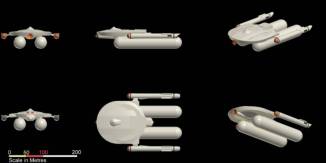
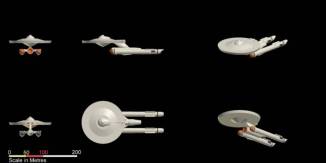
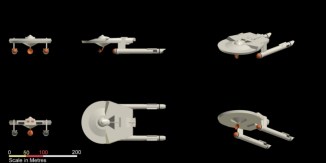
The Mary & John class Battle Destroyer was designed as a destroyer counterpart to the Heston class Battle cruiser and Federation class Dreadnought, utilising the same saucer design as those classes, with the upper nacelle mount from the Federation. Owing to wartime prioritising of existing designs, the USS Mary & John finally began trials in November 2257.

In common with the Twin Saladin and the Warhawk designs, the twin engine configuration was a reaction to the lessons of the four years war.

This class, however, fell victim to another lesson from the war Starfleet realised that a rationalisation of destroyer designs was required. Only the Warhawk class entered service, the USS Mary and John saw only limited service as the Heston/Federation class primary hull lacked the science facilities of the Constitution derived saucer of the Warhawk class, and as such was ill suited to the peacetime Starfleet.

mary&john1

2251 – Palomar

In 2250 the de-commisioned Caracal Class Command Cruisers USS Palomar (NCC-760), USS. Long Beach (NCC-761), USS Tayi (NCC-762), USS Dominium (NCC-763), and USS R’Sah-Dan (NCC-764)  vessels were taken out of reserve to make up for a short term shortfall in heavy Cruiser numbers. The ships were initially only minimally refitted. The ships were removed from service in 2251 when more modern ships became available, but the build up of hostilities leading to the advent of the Four Years War (in 2252) saw these ships modified instead of being scrapped as planned.

This second modification saw the ships refitted with modern warp drives and weapons  to act as Command Ships for Destroyer groups and Convoys, and they recomissioned in this form from 2251 onwards

Class: IX Year: 2251
Ship Source: Starstation Aurora Ship Datasheet: Coming Soon

palomar_100

2253 – Shanks

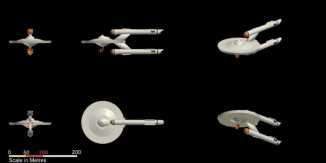
The Shanks class light cruiser was an emergency design created during the four years war, the design was the simplest possible using a Class I primary hull coupled to a pair of warp nacelles.

Despite it’s rushed beginnings, the class was very successful and many of the ships were later refitted with Linear warp drives and served into the 24th Century.

Class: TBC Year: 2253
Ship Source: Chris Cornelius/Jackills Ship Datasheet: Coming Soon

shanks_100

2258 – Twin Saladin

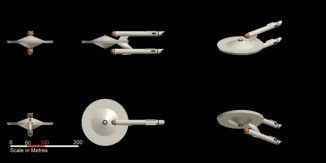
As part of the lesson learnt from the Four Years War, Starfleet realised that the sheer multitude of destroyer classes in service (around 15 different classes) and in production (10) was wholly impractical. The usefulness of twin engine destroyer has been demonstrated during the war, offering extra power for movement and weapons (although at the expense of range and cost). The simple solution proposed to meet the need for twin engine destroyers was to utilise existing single engine designs with a ‘minimum change’ addition of a second engine.

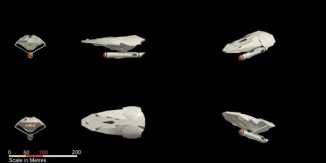
The ‘Twin Saladin’  class was one example of this approach, the design basically added a second warp nacelle to a Saladin Class Destroyer. Unlike the Warhawk class (which added a ventral nacelle), this design added a small secondary hull, upon which warp nacelles were mounted. As with the Warhawk the additional nacelle connected directly into the existing power systems of the Saladin design with no major modification to the design other than some uprating of components to handle the additional power.

After evaluation the decision was made that the Warhawk class would be adopted as it was a more simple design to build. However the promise shown by the ‘Twin Saladin’ meant that it was instead chosen to be intoduced in a new role, as a medium cruiser.

  • Class:TBC
  • Year:2258
  • Ship Source:Based on refit kitbash in ST:DS9 Technical manual.
  • Ship Datasheet:Coming Soon

saladin-twin

2258 – Warhawk

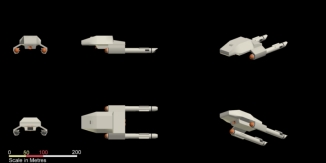
As part of the lesson learnt from the Four Years War, Starfleet realised that the sheer multitude of destroyer classes in service (around 15 different classes) and in production (10) was wholly impractical. The usefulness of twin engine destroyer has been demonstrated during the war, offering extra power for movement and weapons (although at the expense of range and cost). The simple solution proposed to meet the need for twin engine destroyers was to utilise existing single engine designs with a ‘minimum change’ addition of a second engine.

The Warhawk class was one example of this approach, the design basically added a second warp nacelle to a Saladin Class Destroyer. As such this second dorsal nacelle could be mounted to feed directly into the existing power systems of the Saladin design with no major modification to the design other than some uprating of components to handle the additional power.

The large numbers of destroyers in service meant that production of the Warhawk was limited to only 24 ships. However this general configuration was later reused on other destroyer types, most notably the Wilkerson class.

  • Class:TBC
  • Year:2258
  • Ship Source: Based on designs from Starfleet Prototype & Starfleet Technical Manual
  • Ship Datasheet:Coming Soon

warhawk_large

2251 – Aaken

The Aakenn Class transport entered service in large quantities during the Four Years War, during which the class was used to move men and materiel to the front and supplies to the rear to keep the Federation’s wartime production at high levels.

Class: VI Year: 2251
Ship Source: FASA Ship Datasheet: Coming Soon

aaken_large

2258 – Pyotr Velilkiy

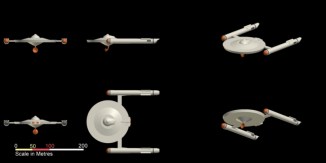
Ordered as an alternative in case of the failure of the Constitution Class. The delays to Constitution Class and poor performance of the Ranger II meant that the Pyotr Velilkiy served as an interim Heavy Cruiser, and was ordered in quantity in response to Klingon aggression in 2244.

The eventual entry of the Constitution Class to service in large numbers meant that the Pyotr Velikiy was relegated to less glamorous duties, and some were converted to serve as tugs. The Cruiser version was phased out by 2312.

The Pyotr Veliky class was conceived as fall back design in case of delays to the Constitution Class Program. The Protoype, USS Pyotr Veliky named for the Tsar who created Russia’s Imperial Fleet, entered service in 2241. The ship mounted the ultimate non dilithium warp drive to enter service, the FFTL-7B and was the only class fitted with this engine. The other technology of this design was also well proven, in direct contrast to the advanced systems chosen for the Constitution Class. The class was designed and built at Andorian shipyards in an effort to disperse the strategically important role of building heavy cruisers away from Earth, additionally much of Earth’s ship building and design capacity was tied up in the Constitution class program.

Delays to the Constitution Class led to the ordering of 5 Mk 2 ships, the first of which entered service in 2244. The Mk 2 featured improved laser weaponry and improvements to cargo handling systems. The Pyotr Veliky class, despite it’s old technology warp reactor did have the same nacelle design as would be used on the Constitution, and many minor improvements made to the nacelles on these ships found their way into the Constitution class nacelles.

As the Mk2 ships entered service, increased Klingon aggression prompted an order to be placed for 14 Mk3 ships. The Mk3, which entered service in 2245 mounted the brand new FAC-4 accelerator cannon, but the main advance was with shielding. The New unary shields were now coming into service, and the FSG was selected to replace the inefficient system mounted on earlier ships. The FSG required the addition of a new style M series computer, and the M3 was accordingly fitted.

With the Constitution class beginning to be available in quantity by 2250, steps were taken to refit the 20 Pyotr Veliky ships for further service. 14 Ships were refitted to MkIV standards for service with Military Operations Command, and 6 to MkV for service with Galaxy Exploration Command.

The MkIV adopted the FWD-1 warp drive, this drive at half the weight of the FFTL-7B meant that the ship’s mass dropped by almost a 100,000mt. The resultant ships, although less powerful, were more efficient in movement and had a higher maximum speed, useful for patrol duties. The only old technology system retained aboard the ships was the dependable FNSP-X impulse system, as no newer style engines could yet power ships of Class XI. The refits were all complete at the outbreak of the Four Years War, where this class served distinction.

The MkV adopted the even lighter FWE-1 Warp drive, and had a major physical change with the removal of the secondary hull. These ships had been intended for use in an exploration role, but the Four Years War saw them serve as Frigates until the Surya and Coventry classes entered full service. The MkV mounted the same weapons as the MkIV and the FIC-3 impulse engine meant that it had the same amount of power as its larger sibling, but the lighter structure could absorb less damage.

Postwar surviving vessels were used in second line roles, some for exploration (Mk6) and some as cargo tugs(Mk7) or transports (mk8), although a small number did remain in defence roles with the Blue Fleet (Mk9).

The last Pyotr Veliky was not retired from service until 2312, that vessel, the USS Salah Ad-Din is now on display in the Starfleet Museum.

  • Class: IX
  • Year: 2250 (Mk V)
  • Ship Source: Starfleet Museum
  • Ship Datasheet: Download PDF

pv-tug-70

Commissioned Ships

USS Pyotr Velikiy NCC-1670

USS Shrelev II NCC-1671

USS Yi Sun-Shin NCC-1672

USS John Paul Jones NCC-1673

USS Tav NCC-1674

USS Elizabeth I NCC-1675

USS Etrox NCC-1676

USS Togo NCC-1677

USS Rommel NCC-1678

USS Friedrich Barbarossa NCC-1679 USS Goyathlay NCC-1680

USS Washington NCC-1681

USS Niakenchiis NCC-1682

USS Salah Ad-Din NCC-1683

USS Giap NCC-1684

USS Hannibal NCC-1685

USS Zerisshebi NCC-1686

USS De Grasse NCC-1687

USS Rexx NCC-1688

USS Gantu NCC-1689

2251 – Coventry

The Coventry differed from the Surya by having an extended rear edge to the primary hull to house extended hangar decks. These hangars often carried Attack ships as well as the more usual shuttles. Some ships of this class served 50 years in the fleet.

Class: X Year: 2251
Ship Source: Ships of the Starfleet Volume 1 Ship Datasheet: Download PDF

coventry_side

2266 – Sheffield

The Sheffield Class was built in very small numbers as it was a victim of technical progress.

Intended to supplement the Surya and Coventry class Frigates, the USS Sheffield Commissioned in October 2266, and a class of 30 ships was envisaged to allow the replacement of the remaining Asia class ships. However while the Sheffield was being tested Starfleet started to bring Linear warp drives into the inventory. The Sheffield’s design was assessed and it was found that the changes from the standard Coventry class design made the ship less suitable for use with the linear drive nacelles and warp core.

As a result only 7 further Sheffields were completed, the remaining 22 were cancelled in favour of additional ships of the new Babcock class.

Class: X Year: 2266
Ship Source: Based on Early Paramount design for Miranda Class Ship Datasheet: Coming Soon

ff-01-100