| Class: | X | Year: | 2268 | |
| Ship Source: | FASA | Ship Datasheet: | Coming Soon | |
| Class: | X | Year: | 2268 | |
| Ship Source: | FASA | Ship Datasheet: | Coming Soon | |

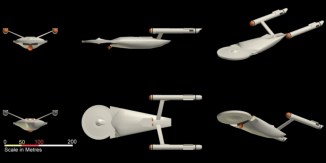
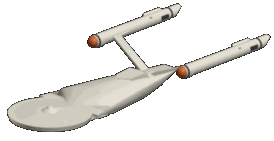
The Chandley Class prototypes were ordered in the aftermath of the Four Years War to provide an effective fleet combatant that could also deliver a sizeable marine force.
Genesis of the Chandley Class – The FFT-X programme
After the conclusion of the Four Years War, Star Fleet Command initiated the Strategic Forces Survey to evaluate every major operation of the war, from its conception to its final outcome. All aspects of these operations, starting with the initial planning stages, to the deployment of forces, their use during the operation, and the after-action requirements of those forces, were evaluated. The results of this survey have directly influenced plans made by Star Fleet Command ever since.
One of the weaknesses identified by the survey was that Star Fleet needed combat vessels carrying boarding parties or prize crews so that it could follow up a successful campaign with rapid and decisive blows against a retreating or routed enemy. Star Fleet warships did not carry marine assault teams, and, therefore, they were unable to board and capture enemy vessels or outposts. In many operations, Star Fleet vessels were held back so that their combined boarding groups could take control of disabled enemy vessels or outposts; this caused lengthy delays in follow-up operations and allowed the enemy to recover. To take enemy outposts, assault ships were called in, frequently a poor choice because they were slow, vulnerable, and usually carried too many troops for small operations. To solve this problem, Star Fleet began developing the frigate class of ships to carry marines trained to board hostile vessels and complexes.
The story of the Chandley Class actually predates the commissioning of the USS Chandley (NCC 2301) by some eleven years. In 2258, in direct response to the Strategic Forces Survey, Chandley Works proposed the ‘Fleet Frigate – Troop’ (FFT). The design was a radical move away from the compact Frigates of the Loknar Class, and was more closely related to the Heavy Frigates of the Surya and Coventry Classes.
The Sketch Design proposed to Star Fleet Command featured the new phaser and photon torpedo weapons, coupled to the FWC-1 warp drive and FSO shields. Elements within Starfleet Command were sceptical that the design could combine both the combat mission of a Frigate and the required troop carrying mission, however the design was supported by the Commandant of the Star Fleet Marines and the influence he bought to bear was considerable, and resulted in an experimental program being written around the design. Such was the uncertainty about the final design was that ships were considered ranging between classes XI and XIV.
The experimental program was dubbed FFT-X (Fleet Frigate – Troop Experimental), and as a result it was decided that all the ships would be given names beginning with ‘T’ . As an experimental program, the plan was to evaluate a number of ships of similar basic design, but that each stressed different possible permutations of the Frigate design, one would maximise troops (Tempest), another would maximise speed (Trident), a third would maximise firepower (Tiger) and the fourth would be a compromise solution (Trafalgar). The plan was to order eight ships in total, altough initially it was felt that the mix would favour the Tiger class, as that was seen to be the best solution by Military Operations Command.
The Starfleet Corps of Engineers, and the designers at Chandley Works, felt that the balance of the Tiger class was problematic, the increase in firepower was bought at the expense of speed and troop capacity, they argued that the design’s slow speed would be a major liability, tragically they were later proved correct. As such they argued for just two of each design to be built.
The FFT-X ships are ordered
Eight ships were ordered in 2258, consisting of two each of four slightly different variations on the basic design theme. The baseline design supported by the Star Fleet Marines was ordered as the Tempest sub class, the ship was viewed as the optimal mix between combat and troop carrying capability, in that it could carry 250 troops, and was still more combat efficient and as fast as a Loknar Class Frigate.
The second version was named the Trafalgar sub class, this version was the version originally designed by Chandley Works, compared to the Tempest sub class, it sacrificed billets for 50 marines, along with two combat transporters in order to allow the fitment of three aft firing phasers in single mounts. The designers favoured this option to maximise combat persistence, given the finite number of photon torpedo warheads that a ship could carry.
The third version was intended to mount a far heavier armanent, reflect the more traditional Frigate role; this sub class, named Tiger mounted the lighter and more powerful FWD-2 warp drive system. This version of the design was supported by Military Operations Command for use as a Picket Ship in border areas. The intention was to have a ship that could carry a force of Marines, yet still have one on one superiority over any ship it encountered. The price paid for this greater weapon load and power was two fold, the marine contingent was cut back to 150, as a result of the need to install the three twin mount rear firing phasers, and also as a result of the need to incorporate a second M-4 computer in the design to provide fire control. The most significant impact was on speed though, maximum speed fell to warp 6.56 compared to warp 9 in the Tempest (or 8.91 in the Trafalgar). In lightspeed terms the ship could achieve only 38% of the speed that the Tempest could (282.14c compared to 730.14c).
The Star Fleet Corps of Engineers, having recognised the likely shortcomings of the Tiger sub class, proposed the fourth variation, Trident. Trident reverted to the FWC-1 warp drive, but added a third nacelle to the design. The third nacelle reduced range by 50%, making the design unsuitable for use on patrol duties, but increased maximum speed to warp 10.04, (1012.8c) making the ship one of the fastest in known space. The twin M-4 installation of the Tiger was retained, as was the enhanced weapons fit. The net result of this, coupled with the power conduits for the third engine, was to further reduce the number of marines carried to just 100, and cut the number of shuttles carried in half to just six.
The second ship of the Trident sub class, USS Triad was experimentally modified, at the request of the Starfleet Marines, while under construction to carry the weapons fit of the Tempest sub class. This modification was made to increase the number of marines that could be carried up to 150, this also had the side effect of a marginal speed increase. However, it was felt that the ship that resulted offered only speed as an improvement on the basic Tempest design, and as such the USS Triad was modified to the standard Trident design in 2265.
The first FFT-X ships commision
The first four ships commissioned in late 2258, a superb achievement seeing as they had been ordered only 10 months previously. This was made possible by the reuse of primary hulls originally intended for Ptolemy class ships. This four consisted of one ship of each of the four sub classes.
All four ships were allocated to the Klingon Frontier in order to gain experience of the concept in action in an area that was still hostile. Initially the ships saw little serious action as the Klingons were still licking their wounds. The larger troop capacity of the Tempest sub class had proved to be valuable on a number of occasions when boarding and inspecting Orion cargo ships travelling in groups, but Military Operations Command felt that the greater firepower of the Tiger sub class was still the preferred solution.
The FFT-X Ships in service
In early 2260 the utility of the Trident design was proven, the USS Trident answered a distress signal from the newly refitted Larson Class Destroyer, USS Justinian (NCC 4362). The Justinian had experienced a complete failure of its power systems, and was in a decaying orbit, The Trident, responding to the signal managed to maintain speeds in excess of warp 10 for two hours and reached the crippled Larson class ship in time to save it from burning up in the atmosphere. Damage to the Trident was remarkably minor, any other class of ship in the fleet would have been severely damaged by travel at such a speed for a prolonged period.
2262 saw the worst fears of many confirmed, the USS Tiger was on solo patrol when she was ambushed by 6 D-10 Cruisers. Normally the best course of action in such an ambush would be to flee as the odds against surviving such an engagement would be slim in the extreme. The Tiger attempted to flee the combat, but the superior speed of the Klingon vessels meant that the Tiger was outclassed. Forced to fight, Tiger fought valiantly, despatching two of the Cruisers before she succumbed. When a relief force, led by the USS Triad, reached the scene no survivors were found from the over 500 souls aboard the ship. The responsible ships were disclaimed as renegades by the Klingon Empire, but most in Star Fleet doubted this, and tensions on the Frontier rose accordingly.
In 2263, The USS Tempest fell into a similar ambush, this time against four D-10s (the four which survived the attack on Tiger) and a pair of D-7s. This time Tempest made use of her superior speed to evade combat, and made use of the rear torpedos to harass the enemy while they pursued her, these torpedoes destroyed one of the D-7s and crippled a D-10. The Tempest’s commander then lured the Klingons straight into a Federation trap, knowing that Klingons would not give up a chase he lured them straight into the arms of a battle group of perimeter action ships and Loknar Class frigates. All four remaining Klingon ships were destroyed, for the loss of no Federation vessels. The Tempest then returned to the crippled D-10 and used her marine force to board her, they found the crew consisted of a mixture of Klingons and Orions, the ships were indeed renegades. This discovery led to a temporary reduction in tension on the Klingon Border.
The success of the Tempest led to the ordering of a third vessel of the sub class (USS Tornado) to replace the lost Tiger. The failure of the Tiger, also led to the refitting of the Talon to Trident specification in 2263. Since that time no ship of the Chandley family has been powered by an engine other than the FWC-1. The failure of the Tiger sub class meant that the competition was down to a three horse race between the Tempest, Trafalgar and Trident designs. The Triad variation already been eliminated, as it offered too small an improvement in combat efficiency over the Tempest design, and the ship was refitted to Trident configuration in 2265.
Choosing the winner
The performance of the remaining designs was assessed in 2265. It was felt that although the additional firepower provided by the Trafalgar and Trident subclasses was welcome (and the speed of the Trident), the price paid in Marine complement was a problem, and that the twin computer arrangement was a potential weak point in the design, as a result it was decided to use the Tempest design as a basis for a production class
Finalising the Chandley Design
The design created in 2266, was known as Chandley 2265, and featured the engines and computers of the Tempest coupled to the new FP-6 torpedo and FH-9 phasers, however the decision was made, given the progress in linear warp drives to delay production pending the introduction of new technologies.
The Chandley 2266 design added the FIF-2 impulse drive to the notional design, and the next version Chandley 2267 adopted the experimental M-5 computer. The Chandley 2268 design changed the phasers to the FH-11 phasers. The USS Chandley, NCC 2301, was laid down in 2268 and was intended to be fitted with the M-5 as per the 2268 design, the failure of that computer meant that the construction had to be delayed while an alternative was sought. The alternative adopted was the M-6 in 2269, in the final version of the Mk-1 design, which was codenamed Chandley 2269.
In 2269, the USS Chandley, the first production ship of this prestigious line of vessels, was commissioned. The Chandley not only met the requirements of being a deep-space fighting vessel but also could beam its 250 marines in less than four minutes. With this vessel, Star Fleet had the ability to follow up combat more efficiently. The large, wing-like assembly houses the company of marines, their equipment, training areas, shuttlebay, and the combat transporters needed. The marines are billeted by platoons, with each platoon having its own spacious training, mess, dormitory, and recreation areas. The training areas, located in the central core of the wing structures, are made up of modules that may be positioned to resemble the interior of enemy ships and installations, allowing assault teams to familiarize themselves with their intended operation area; this training technique is largely responsible for the high success rate in boarding actions. The training areas are also used for physical training and firing ranges. Each platoon has a recreation area containing a swimming pool, gymnasium, gravball chamber, and complete health facilities; these facilities are largely responsible for the notable successes enjoyed by marine sports teams.
Fate of the FFT-X ships
The entry of the definitive Chandley class into service meant that the days of the Tempest and Trafalgar subclasses were numbered, Tempest was decomissioned in 2272 and put on display in the Starfleet museum; Typhoon, Trafalgar and Tally Ho were refitted to Chandley Mk1 configuration; Tornado became the Marines training ship in 2270 in support of the Chandley class deployment. The three ships of the Trident subclass remained in service unchanged until 2280, when they were taken in hand for a major refit to become the Trident II class.
On reflection the importance of the FFT-X ships in the evolution of the modern Star Fleet Frigate in general, and the Chandley class in particular cannot be overstated. These nine ships were instrumental in refining the concept and defining the requirements for all troop carrying frigates.
|
|
||||
| Class: | XI | Year: | 2258 | |
| Ship Source: | Based on FASA Design | Ship Datasheet: | Download PDF | |
|
|
||||

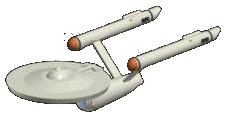
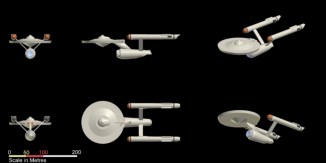
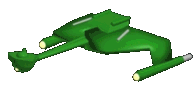
Because of the Romulan-Klingon technological exchange treaties, the Klingons agreed to exchange their D-7A Class cruisers for Romulan plasma weapons and several old-style cloaking devices. These vessels, delivered Stardate 2/09, 2/12, and 2/17 became the V-11 Class.
The 80 vessels in the initial shipment were stripped of their weapons, but the Klingon engines were retained to form the Type 1. The 42 in the second shipment were delivered without engines, shields, or weapons; these were fitted as the Type 2 with a plasma weapon and more efficient shielding. The 50 vessels in the final shipment also were delivered completely stripped, and these were fitted as the Type 5, with fore and aft-mounted photon torpedoes reminiscent of the Klingon D- 7M Class. Types 3 and 4 are modified Type 1s.
Although 172 of these ships have entered Romulan service, they are not liked by their commanders or crews, many of whom consider them to be enemy vessels. In recent years, the Romulans have begun deploying many of the approximately 160 remaining in active service along the Klingon borders in direct violation of the signed accords. The class is named for thevas’kalabam (bird of storms), a small, flying predator of Remus. These nocturnal avians are often seen gliding on the rising winds before a storm and it is said they are capable of traveling hundreds of miles in the vanguard of a storm.
| Class: | VIII | Year: | 2269 | |
| Ship Source: | FASA/Paramount Pictures | Ship Datasheet: | Coming Soon | |
|
|
||||
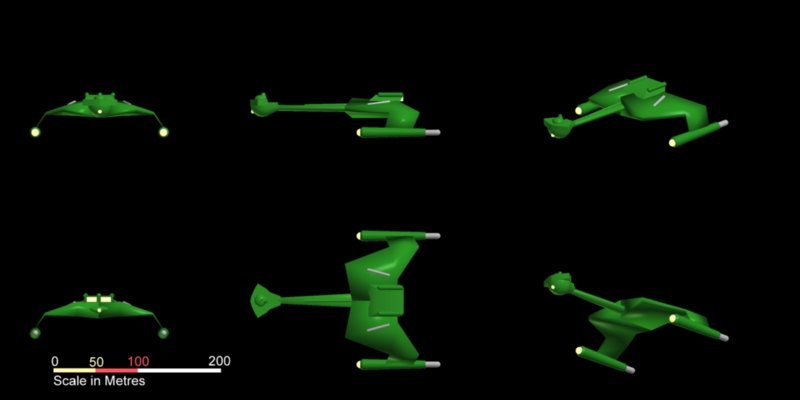
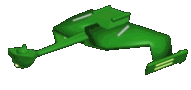
Because of the Romulan-Klingon technological exchange treaties, the Klingons agreed to exchange their D-7A Class cruisers for Romulan plasma weapons and several old-style cloaking devices. These vessels, delivered Stardate 2/09, 2/12, and 2/17 became the V-11 Class.
The 80 vessels in the initial shipment were stripped of their weapons, but the Klingon engines were retained to form the Type 1. The 42 in the second shipment were delivered without engines, shields, or weapons; these were fitted as the Type 2 with a plasma weapon and more efficient shielding. The 50 vessels in the final shipment also were delivered completely stripped, and these were fitted as the Type 5, with fore and aft-mounted photon torpedoes reminiscent of the Klingon D- 7M Class. Types 3 and 4 are modified Type 1s.
Although 172 of these ships have entered Romulan service, they are not liked by their commanders or crews, many of whom consider them to be enemy vessels. In recent years, the Romulans have begun deploying many of the approximately 160 remaining in active service along the Klingon borders in direct violation of the signed accords. The class is named for thevas’kalabam (bird of storms), a small, flying predator of Remus. These nocturnal avians are often seen gliding on the rising winds before a storm and it is said they are capable of traveling hundreds of miles in the vanguard of a storm.
| Class: | VIII | Year: | 2266 | |
| Ship Source: | FASA/Paramount Pictures | Ship Datasheet: | Coming Soon | |
|
|
||||

The V-9 Class, created from plans for the older V-8 (Bird Of Prey) Class, was constructed in response to the need for increased firepower and speed. Its similarity to the V-8 on casual inspection is responsible for the prolonged myth that the V-8 was the mainstay of the Romulan Navy.
The Type 1 was introduced about Stardate 2/0805. It was the first vessel in the Romulan fleet to carry two plasma weapons, and it had an impressive array of disruptors and a cloaking device. This vessel reportedly became extremely popular with front line commanders, because of its ability to deliver multiple plasma weapon strikes. It did not, however, address the speed problem still seen in the concurrent Type 4 V-8, and several power plant changes resulted in the successful Type 6.
Of the approximately 180 V-9s constructed, about 160 remain in active service; of these, some are known to be assigned to Romulan Intelligence as training vessels. There are reports of these vessels operating within the Triangle.
The class is named from the RomuIan temar vastaram (night flyer), in reference to a small, nocturnal, flying predator native to Remus. The Eridam Papers state that they were the source of many ancient legends and myths about invisible predators from another dimension.
Like their counterparts in the V-6 Class, the V-7s were designed for multiple roles, with spacious in- teriors and complete onboard research facilities.
The Type 1 entered service about Stardate 2/12 and is still being produced as a support ship, even though it is not as efficient in combat as later models. Mounting the RPL-2 plasma weapon and a cloaking device, the Type 1 is capable of operating alone.
The Type 3, introduced about Stardate 2/17, is the preferred model of the class. It mounts two additional disruptors and three photon torpedoes, and it has more efficient shields.
Of the approximately 80 V-7s built, nearly all remain in active service. Current production of the Whitewind is estimated at six per year.
The aft weaponry of the V-7s has set the standard for the Romulan Navy, as exemplified by this Project Grey Ghost report of an incident between two V-7s and two Klingon L-9 class frigates. The V-7s, investigating asteroid clusters, detected the Klingons as they approached. Both V-7s cloaked and deployed. As the unsuspecting Klingons began surveying the asteroids, the V-7s de-cloaked and opened fire, only to have the Klingons disappear from view and sensor, obviously taking advantage of cloaking capabilities acquired in the technological exchange. In the waiting game that followed, all four ships remained cloaked and invisible to sensors for several hours. Finally, one of the Klingon commanders became impatient and attempted to warp away from the area. Unfortunately, his path of departure resulted in a collision and catastrophic explosion. The remaining ships immediately de-cloaked, only to find themselves lying aft to aft, which put the Klingon at a disadvantage because of its lack of torpedoes to the rear. It suffered serious damage and surrendered to the Romulan commander, who allowed the Klingon to leave after surrendering the cloaking device.
The class is named for a meteorological disturbance peculiar to Remus. As described in The Eridam Papers, twice per Remus year, a hot wind blows across the northern hemisphere for as long as five days. Mineral particles from the western cliffs are borne aloft by the winds, and, at night, their phosphorescense causes the hemisphere-wide nightglow that gives the weather phenomenon its name aye mosaram (white wind).
Again, to make this class fit in the right position I’ve bought it forwards, this can be attributed to an error in Project Grey Ghost’s data.

On Stardate 2/0710 (2266), a V-8 was encountered by a Star Fleet cruiser patrolling the Neutral Zone, the first such contact in over 100 years and the very first visual contact with a Romulan war vessel. The incursion into Federation space obviously was intended to test UFP defenses, and the V-8 destroyed several listening posts and bases before being heavily damaged by the Federation vessel and self-destructing to avoid capture. Because of this incident, and because these ships were encountered in increasing numbers afterward, this vessel, more than any other, has been identified with Romulan military actions. For many years, these vessels were believed to be the mainstay of the Romulan fleet, but improved intelligence reveals that this was a misconception.
The vessel was designed to carry the RPL-2 plasma weapon; because of its size and bulk, the Type 1 ships–136 meters long–actually were built around the 110-foot-Iong weapon. The other major feature of the Type 1 was the use of new shielding technology. The Type 4, with upgraded disruptors, was introduced to overcome the inadequate firepower of earlier models.
Of the approximately 100 ships built, about 40 are assigned to reserve fleets. Six have been modified and sold to the civil sector, including two Type 1s, one each of Type 2 and Type 3, and two Type 4s, all of which operate in and out of the Triangle.
The class is named for the Romulan vas hatham (bird of prey), in reference to a huge, flying predator reportedly native to Romulus, but so revered that they have been transplanted to several of the conquered worlds in the empire. Living for nearly 100 years, these avians can reach nearly giant proportions, some having wingspans as wide as 50 feet and weighing as much as 400 pounds.
| Class: | IX | Year: | 2257 | |
| Ship Source: | The Starfleet Museum FASA | Ship Datasheet: | Coming Soon | |
|
|
||||
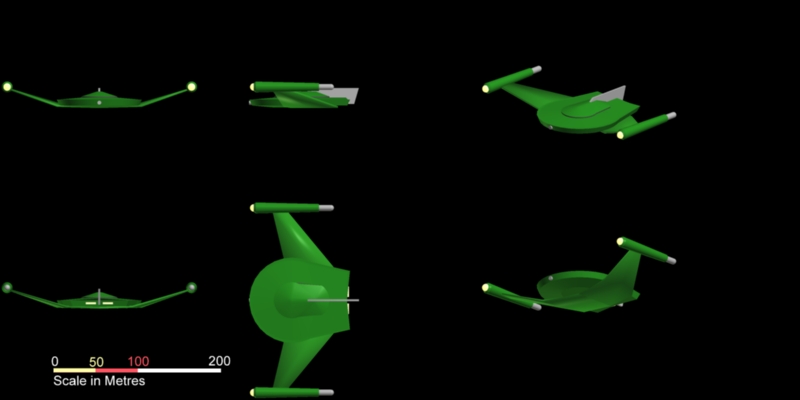
The V-6 class was considered to be the ultimate replacement to fill the need for both a military vessel and a research vessel. Designed much like Star Fleet research cruisers, they are well equipped for research duties and for combat.
At the time of their introduction about Stardate 2/09, they were the most powerful ships in the fleet. The Type 1 mounted six of the most powerful disruptors available and the RPL-2 plasma weapon. Although these vessels never saw combat with any Federation ships, it is speculated that this model would have been an even match for a Constitution Class cruiser.
With the Type 5, introduced about Stardate 2/11, the combat efficiency improved because its more powerful disruptors, more efficient shields, and stronger superstructure. At this time, all Type 1s were recalled for refitting to the new configuration, and, by Stardate 2/13, this process had been completed. The Type 5 remained in service until about Stardate 2/22, when all had been converted to the Type 7.
The Type 7, introduced on Stardate 211607, mounted improved engines and was structurally improved. Vessels of this type are expected to remain a mainstay of the active Navy.
Of the approximately 100 V-6s built, nearly all remain in active service. One operates as a private research vessel, appearing infrequently in the Triangle.
The class is named from the RomuIan s’ten vastam (gallant wing).
NB To fit in I’ve decided that this class was actually commissioned 10 years prior to the converted FASA date
The V-5 Class, apparently brought into service to supplement the V-2 Class, combines the need for a military vessel with that of a research vessel. Though it reportedly is quite capable for combat roles in which the V-2 is a failure, it fills its research roles less well. The Type 1 mounted an impressive array of disruptors with very good fields of fire. The Type 2, introduced about Stardate 2/00, saw the removal of the forward firing disruptors in favor of a bow-mounted plasma weapon, but this version did not prove to be as combat efficient as the earlier model and has not been reported in any great numbers.
Of the approximately 80 built, about 50 are assigned to reserve fleets. Several are used as training vessels, and eight are reported to be in use as private research vessels or cruisers.
The class is named from the RomuIan ralaaram ocala (fire from the sky), in reference to its military capabilities.
 Vintage Starships
You must be logged in to post a comment.