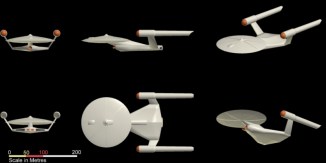
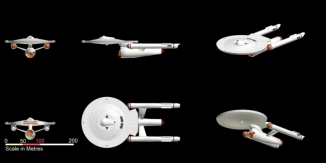
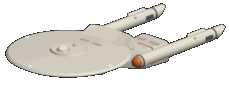
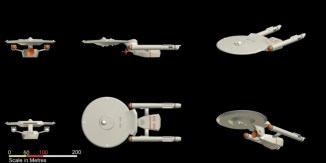
2254 – Tikopai

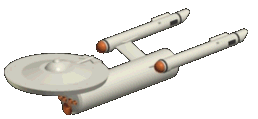
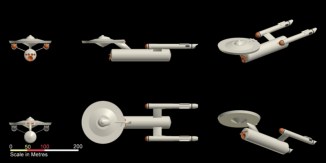
The Four Years War saw the need for large number of escort cruisers to be quickly commissioned. The Achernar and Tikopai classes of supplemental cruisers met this need. The Achernar class was adapted from the mark two versions of the standard Ptolemy (Achernar Mark 1) and Keppler (Achernar Mark 2) classes of Transport Tug. The Tikopai class was adapted from the mark two versions of the Dollond (Tikopai Mark 1) and Doppler (Tikopai Mark 2) classes. All four of these tug classes were in both Starfleet and Civilian service, and ships originally destined for civilian lines were diverted to this program.

The supplemental cruisers were created by the addition of a specialist pod with a hanger, enhanced sensors and weapons. The mother ship itself was unchanged, except for the impulse drive if it required upgrading and retained its own light weapons fit. This solution meant large numbers of the supplemental cruisers could be built quickly, as the Tugs were already mass produced in civil yards, and the weapons hull could be easily built by the smaller warship builders. These ships, although underpowered, were an invaluable asset in convoy escort duties throughout the war. Post-war these ships were all swiftly de-commisioned and converted to standard tug configuration, and then either sold off for commercial transport use, or used to replace wartime tug losses in the fleet.

The weapon pod contained 8 FL-4 Lasers in 4 banks, with 2 banks covering each arc of fire, a pair of FAC-3 accelerator cannons was positioned on the sides of the pod to fire forward. These ships provided a valuable role escorting convoys, often hiding amongst innocent looking standard configuration tugs to lure attackers in. The main criticism that could be levelled at both of the classes was the weak shielding systems, but the adoption of more advanced shielding systems would have prevented the construction of the ships in civilian yards.

Class: V-VI Year: 2253
Ship Source: Franz Joseph Designs/FASA Ship Datasheet: Download PDF
 The design is based on the FJ tugs, the name is from FASA to provide a way for these classes to serve in the four years war prior to the commissioning of the heavy cruisers.

tikopai_ii_100

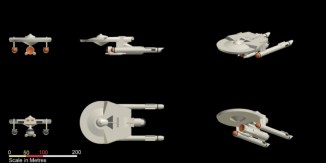
2253 – Achernar

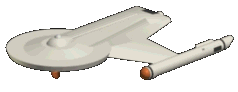
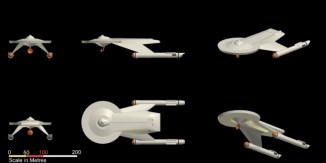
The Four Years War saw the need for large number of escort cruisers to be quickly commissioned. The Achernar and Tikopai classes of supplemental cruisers met this need. The Achernar class was adapted from the mark two versions of the standard Ptolemy (Achernar Mark 1) and Keppler (Achernar Mark 2) classes of Transport Tug. The Tikopai class was adapted from the mark two versions of the Dollond (Tikopai Mark 1) and Doppler (Tikopai Mark 2) classes. All four of these tug classes were in both Starfleet and Civilian service, and ships originally destined for civilian lines were diverted to this program.

The supplemental cruisers were created by the addition of a specialist pod with a hanger, enhanced sensors and weapons. The mother ship itself was unchanged, except for the impulse drive if it required upgrading and retained its own light weapons fit. This solution meant large numbers of the supplemental cruisers could be built quickly, as the Tugs were already mass produced in civil yards, and the weapons hull could be easily built by the smaller warship builders. These ships, although underpowered, were an invaluable asset in convoy escort duties throughout the war. Post-war these ships were all swiftly de-commisioned and converted to standard tug configuration, and then either sold off for commercial transport use, or used to replace wartime tug losses in the fleet.

The weapon pod contained 8 FL-4 Lasers in 4 banks, with 2 banks covering each arc of fire, a pair of FAC-3 accelerator cannons was positioned on the sides of the pod to fire forward. These ships provided a valuable role escorting convoys, often hiding amongst innocent looking standard configuration tugs to lure attackers in. The main criticism that could be levelled at both of the classes was the weak shielding systems, but the adoption of more advanced shielding systems would have prevented the construction of the ships in civilian yards.

Class: V-VI Year: 2253
Ship Source: Franz Joseph Designs/FASA Ship Datasheet: Download PDF
 The design is based on the FJ tugs, the name is from FASA to provide a way for these classes to serve in the four years war prior to the commissioning of the heavy cruisers.

achernar_ii_100

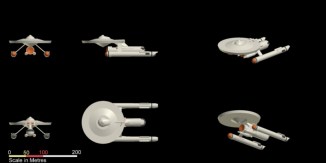
2255 – Copperhead

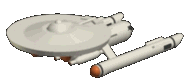
The Copperhead was a one off command cruiser, created from a Class I primary hull, coupled to a specially converted shipping container coupled to warp drives.

The design was conceived to meet an urgent need for a command ship capable of controlling operations across a broad battlefield. The single Copperhead, with a strategic operations crew of almost 400 could easily coordinate hundreds of ships across the entire battle space.

The end of the war in 2256 meant the Copperhead was left with a mission, as the peacetime Starfleet could ill afford the level of resources required. The sensor and communications equipment was still of use, so the ship was redeployed to fill a role providing intelligence around the Romulan Neutral zone.

copperhead_100

2267 – Baker

The Baker Class is a notable ‘what if’ in the history of Starfleet’s cruisers. The requirement that the Baker was built for, was for a smaller stablemate for the Constitution Class to replace the earlier Antares class, and to allow the diversion of the smaller exploration cruisers to more localised duties.

The class would have been notable in being the first major new cruiser class designed and built since the end of the four years war. However, in the event though the decision was made that existing Cruiser classes would be sufficient to meet requirements and that the Baker class design was better suited for use as a Destroyer, a role it has proved very suitable for. Only the USS Baker was ever completed as a Cruiser using circumferential warp drive, as part of the refit to Destroyer standards the Baker was refitted with linear warp engines.


lass: VIII Year: 2267
Ship Source: FASA Ship Datasheet: Coming Soon

baker_100


2261 – K’Kmarak

The K’Kmarak class was developed as a research ship only. It was never intended for combat and only carries weapons for defense. When the Mk I was commissioned, the need for a research vessel in the rimward areas of the Federation was greatest. As each ship in this class was completed, it was sent to this area to aid in the expansion of the territory. The K’Kmarak was instrumental in mapping this great expanse of space and in establishing contact with heretofore unknown races.

All ships in this class are designed for extended stays and therefore have large living quarters and working areas. Also, ships of this type have some of the most extensive laboratory facilities aboard any Starfleet ship. They are capable of performing the most intricate of planetary studies and have monitored and recorded several novas. It was during one of these investigations that a K’Kmarak class vessel the USS T’Pool (NCC 24307) was engulfed by a stellar explosion that covered 1200 A.U.s in 20 hours. Luckily for the crew aboard, their ship was caught up in a solar wind of phenomenal proportions which pushed away the T’Pool from the main thrust of the radiation. When all had settled, the T’Pool was still intact and flight worthy. The crew, however, had begun to suffer from radiation poisoning within a few days. The ship wandered about for several weeks until it was discovered by the USS Agincourt (NCC 4314), a Larson class destroyer. The crew was beamed aboard the Agincourt and the T’Pool was left adrift with marker beacons on, warning any approaching vessels to stay away. When ships were dispatched to recover the hull, the T’Pool was no where to be found and has not been seen or heard from since.

The Mk II version of this ship mounted the more powerful FWC-2, although maximum warp speed was slightly decreased. The Mk III version has improved firing arcs for its defensive FH-2 phasers. This upgrade was in response to the destruction of the research vessel USS Grissom in 2285 (2/22). After the Grissoms’ destruction, Starfleet reevaluated its research fleet and began a program to upgrade their defensive capabilities.

The K’Kmarak vessels were not built in substantial numbers, but the class is a capable one. All in all, the K’Kmarak class has served its purpose well and is still in service today. It should be noted that all K’Kmarak class ships are crewed by Vulcans.

Of the 14 K’Kmaraks built, 11 remain in active service. One Mk I is listed as missing. One Mk I and 1 Mk II have been scrapped. All remaining vessels have been upgraded to Mk IIIs. The K’Kmarak is no longer in production.

The K’Kmarak class has been named in honor of an early Vulcan scientist and explorer. K’Kmarak vessels carry on in the tradition of their namesake.

Class: VI Year: 2261
Ship Source: FASA/Lee Wood Ship Datasheet: Download PDF

kk

2261 – Concorde

Few ships have had such a chequered career as the Concorde Class. Laid down in 2255, the USS Concorde was intended to be the first of a new class of heavy cruiser. The design was built around the new FWF-1 warp drive and featured a number of revolutionary new features; it was intended to be the pathfinder for a whole new style of starship design.

The ships twin forward firing photon torpedoes (FP1 in the original design) were mounted in a bulge on the top of the saucer. The saucer itself was designed with 8 separate segments which were intended to be swappable to allow mission customising. As a result, the FH5 phasers were mounted in the broad secondary hull to allow maximum fields of fire fore and aft. The secondary hull itself was a revolutionary delta shape to increase warp efficiency, and also incorporated two huge hanger bays, as well accommodation for 100 marines.

The Concorde was finally launched in 2261, by this time 11 sister ships had also been laid down. It took another three years to get Concorde into service, and when it finally entered service, after many teething problems, it featured uprated weapons and shields to those originally intended for the design.

The second vessel, Callisto entered service in 2266, some 10 years after being laid down. Compared to Concorde, Callisto mounted a more powerful impulse drive, but was otherwise identical to her sister ship. The delays in getting the class into service meant that they were outclassed by many other newer types, and the unconventional firing arcs made the ships unpopular in military circles.

The third vessel, Comet, commissioned in 2268. This ship had uprated phasers in the form of FH-11, but was also outfitted as a long range explorer to suit its new mission. In initial trials for this role the design was found to be ideal, and the decision was taken to modify the two existing ships, as well as the three that were still to commission.

The problems and escalating costs faced by the class led to a decision to halve the order in 2267. Five of the ships, those that were least advanced, were cancelled, and a sixth, Cornelius, was reallocated for use as an experimental trials ship. The five cancelled ships were Charybdis, Columbia, Constellation, Challenger and Cochrane. Cornelius entered service in 2269, but lacked any permanent weaponry however she was to play a key role in the testing of many new weapon, shield and propulsion systems over the next 25 years, The next standard ship due to commission, Comet, was chosen to be reprieved as another potential role had been suggested for a small number of ships of this design. Galaxy Exploration Command needed a small number of large ships for long duration missions to the galactic core area, and the Concorde design, a failure in its military role, was the prime candidate due to its long range and duration.

Both Concorde and Callisto were soon modified for this new role, and along with the Comet set out on long range exploration missions. A fourth ship, Corsair commissioned in 2270, and for the first time the class was receiving positive attention. This was sadly to change in 2271, when Callisto was lost, presumed destroyed, on a mission to investigate the great barrier.

The loss of Callisto cast a shadow over the class, and delayed the commissioning of the fifth ship, Centaur. Investigation into the loss cleared the design of blame, and resulted in a ban on crewed missions to the great barrier. Centaur, which finally commissioned in 2274 was also a Mk 3 ship, and was again assigned to the long range exploration role.

The sixth ship to be completed , and the only new build Mk4, Commanche, commissioned in 2276, some 17 years after the hull was first laid down. The Mk4 was a major evolution in the class, as it mounted the new FWG-1 warp drive, coupled to a pair of M-6 computers and FSP shields the Commanche had a superb turn of speed and excellent defences to add to the already impressive range of the class. Another change in the Mk4 was that the segmented primary hull sections were fused together permanently, which greatly reinforced the strength of the primary hull. The Commanche was almost immediately despatched on a planned 10 year mission, deep into unknown space. She returned from the mission in 2288, six months behind schedule, but with a wealth of data and knowledge.

Concorde herself was upgraded to Mk4 standards in 2278, and was also despatched on a long range mission, which she returned from in 2288. Refits to a Mk5 configuration, with FWG-2 warp drive and FIG impulse drives, were considered for the other three ships, but the perceived complexity and limitations of the design led to the decision being made to phase the class out of service prematurely. Comet was placed in reserve in 2284, Corsair in 2286 and Centaur in 2287 as they returned from their missions.

Upon its return to Federation space in 2288, Commanche was spared decommissioning, instead she was used as part of a Starfleet goodwill mission, trying to recruit new recruits into the fleet. Concorde, on the other hand, was decommissioned as soon as she returned from her mission in 2288, and the Commanche finally followed in 2291.

The fate of the class seemed sealed in 2295 when the Centaur was scrapped, as newer classes such as Excelsior were in the ascendancy. The following year the Commanche was taken out of storage, and was due to be dismantled. Fate intervened though as the old trials ship Cornelius had been used as a testbed for the new FWL-2 warp drive, was producing stunning results. In 2297, following successful completion of the engine trials aboard Cornelius, a surprisingly bold decision was made to reactivate the four surviving ships of the class and refit them for further service, and a decision was also made to evaluate the possibility of refitting the Corneliius for active service.

Indeed, so successful has the class now become, it is suggested that the basic design could one day be used as the basis for even larger exploration vessels. Although the oldest ship in the class was laid down almost 50 years ago, she has only seen service for about 20 years, so it is likely that this class could survive in service until the mid 24th century. Upon reflection it is evident that the design was sound, but was too advanced for the technology of the time, as a result it took too long to commission, and was too expensive and complex for extensive production. Once technology had caught up with the concept, the class was able to prove its worth.

Class: XII Year: 2261
Ship Source: Paramount Pictures Ship Datasheet: Download PDF

phase2-seg-100

Commissioned Ships:

  • NCC-6051 – CONCORDE
  • NCC-6052 – CALLISTO
  • NCC-6053 – COMET
  • NCC-6054 – CHARYBDIS
  • NCC-6055 – COLUMBIA
  • NCC-6056 – CORSAIR
  • NCC-6057 – CONSTELLATION
  • NCC-6058 – CENTAUR
  • NCC-6059 – CHALLENGER
  • NCC-6060 – COMMANCHE
  • NCC-6061 – COCHRANE
  • NX-6062 – CORNELIUS
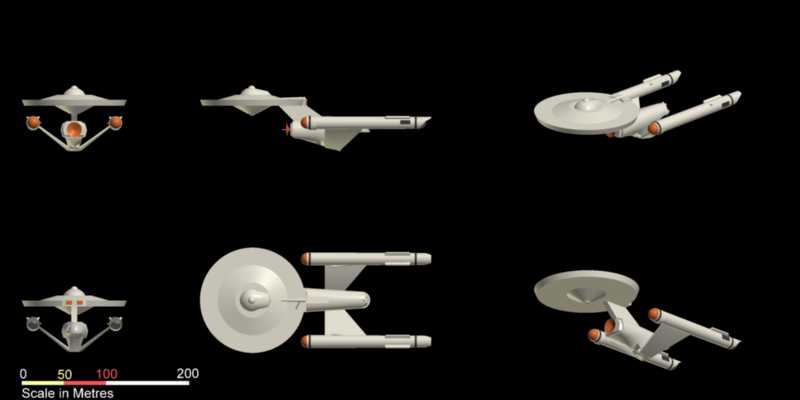
2254 – Ares

From Star Trek Expanded Universe:

The USS Ares (NCC-1650) was the prototype of the Ares-class. It was commanded by Garth of Izar during the Four Years War. (Star Trek: Axanar)

During the first two years of the four years war, Starfleet was experiencing near constant defeat at the hands of the Imperial Klingon Navy’s D-6 battlecruiser. Whole systems were being seized, with the populations slaughtered at their hands. Changes needed to be made to save the Federation. The Starfleet Commander in Chief, Admiral Conrad Slater, was replaced by Admiral Marcus Ramirez. Ramirez’s first action was ordering the design and production of the Ares-class. The simulations showed promise, but its first real test would be on the battlefield. The Vulcans restricted their involvement to environmental, propulsion, and defensive sytems, though there were voices that demanded Vulcan remove their participation completely. In the words of Admiral Samuel Trask, “A Vulcan’s gonna do what a Vulcan’s gonna do. But the Andorians… they were happy to supply us the phasers.” The first ship in the class, the USS Ares, would be assigned to the Captain of the Destroyer Xenophon: Captain Kelvar Garth. There were over a dozen other member worlds waiting on the Ares class. Operation Pegasus would be the proving ground.

On stardate 2244.1, the Ares took part in its first combat engagement near the planet Cygnus III during Operation Pegasus. (“Prelude to Axanar”). In the words of the Supreme Warlord of the Imperial Klingon Navy (“Kharn the Undying”), “The new class Starfleet vessels were… unexpected.” Kelvar Garth, pushing his vessel’s capabilities to the maximum, surprised the Klingons and delivered a victory to Starfleet at Cygnus III. Following those events, Starfleet would go on to regain much of their lost territory. The USS Ares was faster, more agile, more heavily-armed than any operation Klingon vessel. With the new Ares-class and with the hard-won experience of their battle-tested commanders, three systems were retaken within 30 days. The Klingon ship captains began to give the Federation their due as a worthy adversary, primarily taking notice of Garth of Izar. The Captain of the USS Hercules, Samuel Trask, was quoted as saying, “That mad Izarian son of a bitch – that was his day.” Captain Sonya Alexander of the USS Ajax added, “Garth likes to play down what he did. Don’t you believe it. What he did that day no Starfleet Captain had ever done.”

In total 12 Ares class ships were built, production was curtailed in favour of additional ships of the Constitution class and related designs. The Constitution class was marginally cheaper and quicker to build,  was more combat efficient, and it was recognised it would be a more a versatile design to retain postwar.

9 of the Ares class ships survived the war, and post war they served as guard ships for key installations before being mothballed in 2262. All were recalled for service in 2267 when the fleet was put on a war footing prior to the Organian conflict, after the imposition of the treaty the ships returned to reserve.

Class: IX Year: 2254
Ship Source: Star Trek Axanar Ship Datasheet: Coming Soon
NB The write up of the Ares creates an issue in that it clearly states that the design is a product of the four years war, but at the same time places the first Constitution class ships under construction (which is 9 years too late). I have chosen to keep the wartime date and ignore the Constitution reference.

ares

2254 – Britannia

“The USS Moscow and the other ships of this class were the one of the last major classes without dilithium. The immediate predecessor to the Constitution class, the Baton Rouge class exhibited the distinct separated living disc and engine modules so familiar now. Up-rated in the 2250s, these ships have only recently completed their commissioned usefulness as interstellar carriers.”

The uprating was due to delays in the Constitution program, and introduced new warp engines, impulse engines, weapons and shields. In this configuration the ships gave valuable service in the four years war.

The Mark 1 Baton Rouge class entered UFP service in 2225 and were the last major cruiser class built with non dilithium energised engines, in total an impressive 86 Mk1 ships was built over 18 years. A modification program in the 2240’s saw 40 of these ships re-equipped with new M- 1 computers, enhanced weaponry and unary shield generators to become Mk2s, a further 14 ships were built as new to compensate for delays in the Constitution programme. This modification meant that the ships remained a useful element of the fleet despite their low top speed compared to newer design.

In 2254 the damaged Mk2 USS Britannia was refitted to Mk4* standards at Utopia Planitia. The secondary hull of the Britannia was damaged beyond repair, and it was decided to use a secondary hull from a written off Heston Class Cruiser. The refit was based on the standard Mk4 for spares support reasons, except the heavy FAC-4 replaced the FAC-3, one pair of these were mounted in the traditional location on the saucer below the bridge, and a second pair atop the secondary hull. The resulting ship was designated a special type and entered service providing heavy support to the 35th Cruiser Squadron (which consisted of Mk3/4 Baton Rouges). Further production of the Mk4* was not authorised as the type’s range was reduced compared to that of the standard Baton Rouge, and the cost of the refit in time and resources was deemed prohibitive compared to the Mark3/4 refits.

In 2256 the Britannia was ambushed while protecting a convoy of troopships in supposedly safe territory. She single handledly managed to hold off three D-10 cruisers while the convoy escaped to safety escorted by another pair of ships from the 35th CS. In total the convoy was carrying over 100,000 troops and Captain Kelsey of the Britannia felt that it was more important for the two other cruisers to safeguard the convoy then to help hold off the D-10s. Miraculously 150 of the Britannia’s crew, including Captain Kelsey, managed to survive the battle, and all three D-10s were crippled or rendered ineffective.

Britannia’s battle was not yet over though, a trio of Orion Pirate vessels attracted by the potential for booty and salvage moved into attack. The crew aboard the damaged Britannia managed to get their accelerator cannons online, and when the lead Orion vessel, a captured D7, moved into the arc of fire they hit it with all four cannons destroying the Orion Vessel, the resultant explosion damaged the second Orion cruiser, but also mortally damaged the unshielded Britannia. The third Orion vessel was destroyed when the command pod of one of the D-10s separated and rammed it’s warp nacelle. The crew of Britannia were forced to abandon their ship as the damage sustained in this final battle caused a catastrophic impulse reactor explosion. The surviving crew members being rescued by the Klingons who they had been fighting just an hour earlier. Aboard the Klingon vessels the survivors were welcomed as warriors with honour, it was not lost on the Klingon commander, Gorkon, that the Britannia could have evaded combat and left the Klingons at the mercy of the Orions.

Class: X Year: 2254
Ship Source: Space Flight Chronology/ FASA Ship Datasheet: Download PDF

britannia-100t

2253 – Baton Rouge Refit

“The USS Moscow and the other ships of this class were the one of the last major classes without dilithium. The immediate predecessor to the Constitution class, the Baton Rouge class exhibited the distinct separated living disc and engine modules so familiar now. Up-rated in the 2250s, these ships have only recently completed their commissioned usefulness as interstellar carriers.”

The uprating was due to delays in the Constitution program, and introduced new warp engines, impulse engines, weapons and shields. In this configuration the ships gave valuable service in the four years war.

The Mark 1 Baton Rouge class entered UFP service in 2225 and were the last major cruiser class built with non dilithium energised engines, in total an impressive 86 Mk1 ships was built over 18 years. A modification program in the 2240’s saw 40 of these ships re-equipped with new M- 1 computers, enhanced weaponry and unary shield generators to become Mk2s, a further 14 ships were built as new to compensate for delays in the Constitution programme. This modification meant that the ships remained a useful element of the fleet despite their low top speed compared to newer designs

In 2249 the availability of suitable dilithium based engines in the form of FWE-1 meant that these ships could again be modified to Mk3 standards. This refit was controversial as although speed increased from Warp 4.2 to Warp 8.7, available power dropped by more than 33%. At the outbreak of the four years war in 2253 the New New Aberdeen shipyards in the AOFW were contracted to refit existing UFP Baton Rouge class ships with these new systems due to the Yard’s recent experience with the class (it had license built ships for the AOFW). The refit they designed was based upon the Mk3, but made use of the new FWE-2 warp drive, this however required a change of main computer. The desperate need for ships meant that refits to both Mk3 and Mk4 were carried out during the war . The Mark 4 being a more capable vessel, but the refit took six months compared to three for the Mk3. Mk 3 production totalled 26 ships (12 converted Mk2s and 14 Converted Mk1s), while Mk4 production totalled 25 ships (9 converted Mk2s and 16 Converted Mk1s).

Some unmodified Mk2 ships also served throughout the war as convoy escorts, it being felt that their low speed was not an issue when escorting slow moving freighters, indeed the additional power was seen as an asset. In one famous incident, a trio of 30-year-old Baton Rouges fought off a squadron of D7As without a single ship being lost in the convoy they were escorting.

12 Mk2s survived the war, and 6 of these were later converted to Mk5 standards, along with 12 each of the Mk3 and Mk4 ships making 30 in total. Mk5 introduced photon torpedoes and phasers to the venerable design, the first ship commissioned in 2260, and it is intended that these ships will serve in some capacity until the 2280s.

21 ships of various marks have been donated to, or purchased by friendly powers. Chief amongst these is the AOFW which has acquired 10 ships over the years, and built under license an additional four ships in the shipyard at New New Aberdeen. Currently the AOFW retains 6 ships in operation, in a version corresponding to the UFP Mk5. The former USS Aberdeen is currently being refitted to a more advanced standard with FP4 torpedoes in an installation based upon that on the late USS Britannia.

A number of Baton Rouge class ships are preserved at various sites around the Federation, as well as a single vessel preserved in the AOFW, but the ships that are still in service some 60 years after the design was conceived are the most telling proof of the excellence of the design and memorial to those who have gone before.

Class: IX Year: 2253
Ship Source: Space Flight Chronology/ FASA Ship Datasheet: Download PDF

br-new-02-100