2254 – Ares

From Star Trek Expanded Universe:

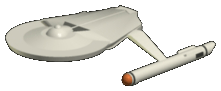
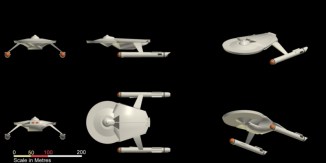
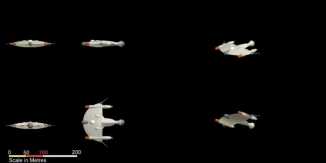
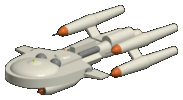
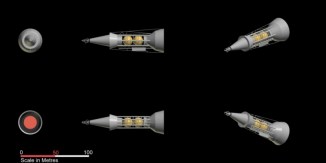
The USS Ares (NCC-1650) was the prototype of the Ares-class. It was commanded by Garth of Izar during the Four Years War. (Star Trek: Axanar)

During the first two years of the four years war, Starfleet was experiencing near constant defeat at the hands of the Imperial Klingon Navy’s D-6 battlecruiser. Whole systems were being seized, with the populations slaughtered at their hands. Changes needed to be made to save the Federation. The Starfleet Commander in Chief, Admiral Conrad Slater, was replaced by Admiral Marcus Ramirez. Ramirez’s first action was ordering the design and production of the Ares-class. The simulations showed promise, but its first real test would be on the battlefield. The Vulcans restricted their involvement to environmental, propulsion, and defensive sytems, though there were voices that demanded Vulcan remove their participation completely. In the words of Admiral Samuel Trask, “A Vulcan’s gonna do what a Vulcan’s gonna do. But the Andorians… they were happy to supply us the phasers.” The first ship in the class, the USS Ares, would be assigned to the Captain of the Destroyer Xenophon: Captain Kelvar Garth. There were over a dozen other member worlds waiting on the Ares class. Operation Pegasus would be the proving ground.

On stardate 2244.1, the Ares took part in its first combat engagement near the planet Cygnus III during Operation Pegasus. (“Prelude to Axanar”). In the words of the Supreme Warlord of the Imperial Klingon Navy (“Kharn the Undying”), “The new class Starfleet vessels were… unexpected.” Kelvar Garth, pushing his vessel’s capabilities to the maximum, surprised the Klingons and delivered a victory to Starfleet at Cygnus III. Following those events, Starfleet would go on to regain much of their lost territory. The USS Ares was faster, more agile, more heavily-armed than any operation Klingon vessel. With the new Ares-class and with the hard-won experience of their battle-tested commanders, three systems were retaken within 30 days. The Klingon ship captains began to give the Federation their due as a worthy adversary, primarily taking notice of Garth of Izar. The Captain of the USS Hercules, Samuel Trask, was quoted as saying, “That mad Izarian son of a bitch – that was his day.” Captain Sonya Alexander of the USS Ajax added, “Garth likes to play down what he did. Don’t you believe it. What he did that day no Starfleet Captain had ever done.”

In total 12 Ares class ships were built, production was curtailed in favour of additional ships of the Constitution class and related designs. The Constitution class was marginally cheaper and quicker to build,  was more combat efficient, and it was recognised it would be a more a versatile design to retain postwar.

9 of the Ares class ships survived the war, and post war they served as guard ships for key installations before being mothballed in 2262. All were recalled for service in 2267 when the fleet was put on a war footing prior to the Organian conflict, after the imposition of the treaty the ships returned to reserve.

Class: IX Year: 2254
Ship Source: Star Trek Axanar Ship Datasheet: Coming Soon
NB The write up of the Ares creates an issue in that it clearly states that the design is a product of the four years war, but at the same time places the first Constitution class ships under construction (which is 9 years too late). I have chosen to keep the wartime date and ignore the Constitution reference.

ares

2243 – Miranda

What eventually became one of the most common and longest lived Starship designs started with this vessel.

USS Miranda (NCC-1833) was launched on 10/1/2243, and was the precursor to a range of classes (Anton, Surya, Coventry).

The Miranda class eventually numbered 15 vessels, which served well in the conventional cruiser role, unlike the majority of ships of this configuration which filled the Frigate role.

The Miranda was refitted to become a Cruiser variant of what was then known as the Avenger (Frigate) or Reliant (Research cruiser) in 2283. However a change in Starfleet policy following the Khitomer accords and the reductions in the military role focussed frigate fleet saw the Avenger class frigates redesignated as being a Cruiser as part of the Miranda class. Over the following decades as refit programs progressed the Avengers (and indeed the Reliants) all became full members of the Miranda class as each refit program covered ships from the various predecessor classes.

  • Class:X
  • Year:2243
  • Ship Source: Class Name CBS/Paramount, USS Bombay from ST:Vanguard, Miranda Registry Alex Rosenzweig
  • Ship Datasheet:Coming Soon

anton_large

Commissioned Ships of this class included:

Bombay, Achilles, Equinox, Miranda, Rutherford, Lantree

2244 – Anton

The Anton Class shared its basic design concept with the Coventry class frigate, but in terms of equipment there were major differences as the Anton was equipped as a Research Cruiser with roughly half the weapons capability of the Coventry class. The Anton class having an enhanced science fit instead as befitted its role as a research cruiser.

First commissioned in 2244 during the period known as “The Great Awakening”, the Anton Class cruiser was in the forefront of that expansion effort. At the time, Star Fleet itself was expanding in response to the changing and expanding economic and political goals of the UFP. To meet the demand of a larger navy, the Military Appropriations Committee authorized the development and testing of hundreds of vessel types, the Anton among them.

During this same period, the concepts of ship design were rapidly evolving and becoming more sophisticated, and the technology to build and operate starships was going through an industrial revolution. Advances in all facets of the technology required to construct, maintain, and operate a starship was changing so rapidly that some ships were obsolete before they were completed. The Anton design was changed no fewer than 12 times before the tooling and machining was begun. Even so, the ship required some alterations during its trials and was to see many more changes after its commissioning, the last of which was the refitting to the Reliant Class.

When these new cruisers were launched, they were only capable of performing 3-year missions with re-supply at 1-year intervals. This made their dual-purpose role of research cruiser harder to perform. With the great distances that had to be traveled, they could not get more than 6-months travel time from a friendly outpost. This meant they could only advance as fast as the frontier was expanding.

Class: X Year: 2244
Ship Source: Based on FASA Anton Ship Datasheet: Download PDF

fasa_anton_100

2230 – Antares

The Antares class survey cruiser was designed for longer range duties than her recent predecessors, the relatively large secondary hull giving greater storage capacity for consumables and fuel, as well as an ample supply of survey drones. The class gained a reputation for toughness and reliability as the simple no frills design served well for almost 60 years despite the loss of the class ship.

The USS Antares,  lead-ship of this class was lost with all hands on March 30th 2239. The name was next given to a freighter which was lost with all hands in 2266.

Class: TBC Year: 2230
Ship Source: Star Trek Concordance Ship Datasheet: Coming Soon

antares_70


2226 – Kremlin

The Kremlin Class was based on the primary hull of the earlier Asia class to reduce development time. Although well equipped with sensors the weapons fit was not sufficient for the ship to protect itself in a unfriendly area, and four of the class were lost in the 2260s, and the remainder were pulled back to safer areas

Class: V Year: 2226
Ship Source: Ex Astris Scientia/ Bernd Schnieder Ship Datasheet: Download PDF

kremlin_large_side

Commissioned Ships

  • USS Kremlin NCC-1433
  • USS Topaz NCC-1437
  • USS Courageous NCC-1438
  • USS Montana NCC-1510
  • USS Rio Grande NCC-1511
  • USS Bordeaux NCC-1512
  • USS Wolf NCC-1513
  • USS Nemesis NCC-1543
  • USS Kronstadt NCC-1544
  • USS Dauphin NCC-1545
  • USS Mesopotamia NCC-1638
  • USS Potomac NCC-1639
  • USS New Berlin NCC-1640
  • USS Archanis NCC-1641
  • USS Zulu NCC-1686
  • USS Dragon NCC-1687

2222 – Aryabhatta

The Aryabhatta class, an Andorian design, entered service in 2222 to replace the large numbers of ageing cruisers that were employed in the research role.

The Andorian ship-building industry was in a poor condition by 2218. During the Earth- Romulan War, Andorian naval ship yards in orbit had built ships of local design totaling many millions tons’ displacement. However, after 2161 few Andorian designs found favor with the new Starfleet as it preferred ships with separate primary and secondary hulls were preferred for reasons of safety and flexibility. Andorian ships placed all ship’s equipment into a single hull with integrated nacelles. The first ship in many years to be adopted by the fleet based on Andorian designs was the Aryabhatta class Cruiser which began trials in 2221.

Work had begun in 2218 after Exploration Command had convinced the Federation Council that a class of dedicated explorers would be more effective and less expensive to build, operate, and maintain than the current fleet of converted, obsolete cruisers. The only stipulation was that construction of this new class would in no way interfere with the introduction of the projected new Valley Forge cruiser class. Ten exploratory cruisers of the Aryabhatta class were authorized. Generally free of interference from Military Operations Command and the Federation Council, the design stage of the project proceeded extremely smoothly.

The new exploratory cruiser was to displace some 70,000 tons. The primary hull was a thick, rounded crescent, which housed most crew spaces, computer core, life-support machinery, scientific equipment, and deuterium tanks. The upper and lower surfaces of this hull supported sensor panels and antennae. The short secondary hull housed the shuttle bay, the M/AM reactor, additional scientific equipment and a long-range, omnidirectional scanner. Weaponry was fitted purely for self defense.

Delivery was delayed by the procurement of the Kestel Class cruiser version of the design, but in compensation five additional ships were ordered. USS Aryabhatta commissioned in March 2222, and the other fourteen followed through to June 2225. The new class fulfilled all Exploration Command’s needs as a medium-range exploratory cruiser. Because of their relatively short endurance, they were primarily used to survey areas within Federation territory, following up surveys done previously. In their more than 30 years of service, the class was credited with mapping and exploring more than 500 star systems and establishing contact with 31 civilizations. Although they served almost exclusively within areas under Federation control, their missions were not without danger. In 2234 USS OmarKhayyam was severely damaged after being fired upon during a first contact attempt that went tragically wrong.

USS Prince Henry of this class is now on display at the Starfleet Museum.


Class: V Year: 2222
Ship Source: Stafleet Museum Ship Datasheet: Download PDF

arabyhatta_large


2206 – Horizon

The 2206 Horizon class explorer  was amongst the first Starfleet ships designed for extended range science missions in uncharted space. At the time of commissioning the ships were dismissed as an  idealistic extravagance’, the Horizon can be seen as the forerunner of Starfleet’s later exploration ships.


Prior to 2200 Galaxy Exploration Command’s ship performance and their value for scientific research were limited. The longest-range starshipsin service were the Hyperion class of 2194, which had an unrefuelled range of 34 light years and carried sufficient stores for 20 months of operations. However, the majority of exploratory vessels in service at the time (such as the Daedalus and Moskva classes) were only able to visit 3 or 4 star systems before needing resupply. In addition, many Starfleet ships were not fully equipped for extensive scientific research, only those dedicated to survey missions had sensors that were optimized for research and stellar mapping.  The other limitation (at least until the Hyperion class entered service) was that subspace-based sensors were generally passive, because the size of subspace transmitters precluded their installation on most starships.


What Galaxy Exploration Command required was a starship which combined the range, speed, and endurance of a heavy cruiser with the scientific facilities of a surveyor. It was not until the late 22nd century that the technology to build such a ship became available, but even then such a ship was likely to be extremely expensive to build and operate.

Commodore Matías Tolbert, who became commander of Galaxy Exploration Command  in 2199, was an idealistic and adventurous officer. He had served as an ensign aboard the survey cruiser UES Ericson (CX-19, Republic class), which made Earth’s first contact with the Altair system in 2155. As captain of USS Blériot (NCC-539, Gagarin class), he made the Federation’s first contact with 8 races, including the Saurians. He believed that Starfleet’s future lay in exploration missions rather than as a purely military force.

Ambassador Skon of Vulcan led a vocal minority faction of Federation Council members who felt that the Federation was expanding too quickly and too far, and that Starfleet emphasising military force to drive the expansion. After the dual role Paris class was deployed in a military role only, Skon realised that if he could not restrain Starfleet’s military operations command, he would instead encourage a greater emphasis on exploration.

Working with Commodore Tolbert, Skon requested funding for a new “explorer class” starship in April 2200. The request was controversial, because this explorer would be as expensive to build as a heavy cruiser, and more expensive to maintain and operate.Amongst other concerns, the issue of the expense of the project led to the proposal’s rejection.

In October 2200, the Federation Council began debate on the funding for the new  Lancaster class heavy cruiser. Skon threatened to block funding for the Lancaster unless funding was also approved for the explorer. After much debate and argument funding was authorized for 12 explorers (now named Horizon after the UES Horizon class and the lost USS Horizon), and 50 Lancasters.

The specifications called for a cruising speed greater than warp 5 and an unrefuelled range of at least 100 light years. The ship was to have 10 science labs, with a crew of 300 (30% of these being scientists and laboratory technicians). It was also to carry enough stores to allow for an unprecedented 5 years of independent operations.

The primary hull contained the bridge, crew facilities, computer and sensors, as well as defensive weaponry. The primary hull was elongated to accommodate a large shuttlebay, impulse drives, and rotating outboard ultra long range sensor panels. The secondary hull containing the warp drive reactor was aft of the primary hull on a 43-meter neck. Up to 6 external modules were mounted externally around the neck to carry additional  fuel, stores, cargo, or specialized mission modules.

The design board also specified the mounting of 4 warp nacelles, making this the first class to use this configuration since the Yorktowns of 2158. The 4 nacelles allowed the power to be spread across a larger number of warp coils, thereby increasing their longevity. Also, in the event of a failure the ship could still return to base, or even continue its mission, with only 2 or 3 nacelles.

To facilitate long-range exploration and enable communication with base, Horizon carried a large navigational deflector and subspace transmitter module below the primary hull in a tertiary hull. Due to extended mission profile, the resultant supplies, crew facilities, and redundant equipment meant that at 203,000 tons Horizon would be Starfleet’s largest starship since the Conqueror class of 2159.

USS Horizon was launched in July 2206, and was followed by the other 11 ships of the class  over the following 4 years. As a shakedown, Horizon completed  a 9-month survey of star systems in the Hyralan sector. Following the successful completion of the shakedown, Horizon commenced a 3-year mission beyond the Groma Hollow. During this mission the Horizon travelled more than 150 light years, surveyed more than 7,000 cubic light years of space, and made first contact with 4 spacefaring races.

As the other Horizons entered service they too started to expand the knowledge of the Federation.  In 2207 USS Venture was the first starship to encounter a complex space-dwelling life form (the Kento). The following year, USS V’Shon-Pal  was the first starship to survey the Mutara Nebula, and in 2210 USS Yinghuo discovered ancient ruins left by the Preservers.

The  range and endurance of the class enabled Starfleet to launch its first 5-year missions.  Starting in March 2209, Captain Fabiola Kalani commanded the USS Odyssey on a 62 month mission exploring spinward of the Rigel system. During this mission the Odyssey made first contact with 12 spacefaring races, including the Edosian

Despite the success of the Horizon class, funding for Galaxy Exploratorion Command became more limited following Skon’s death in 2208, as resources were gradually directed back to Military operations command. As a result no further explorer starships entered Starfleet service until 2222 with the commissioning of the smaller and less expensive Aryabhatta class.

Horizon-class ships were at times diverted to border patrol and long-range observation missions as Horizon’s unparalleled sensor suite made it useful asset for surveillance.  Such missions were not common as the the Horizon needed a sizeable escort in hostile areas.

The Horizon class remained in service until 2254, and during this time only a single ship of the class was lost. USS Victoria  was destroyed in 2235 while surveying a particle fountain in the Moab sector.

The Horizon-class explorer USS Odyssey, which completed four 5-year missions, is on display at the Starfleet Museum.

Class: XII Year: 2206
Ship Source: The Starfleet Museum Ship Datasheet: Coming Soon

sfm-horizonCommissioned Ships

USS Horizon NCC-1197
USS Odyssey NCC-1198
USS Venture NCC-1199
USS V’Shon-Pal NCC-1200
USS Kumari NCC-1201
USS Beagle NCC-1202
USS Yinghuo NCC-1203
USS Endurance NCC-1204
USS Nadezhda NCC-1205
USS Victoria NCC-1206
USS T’Plana-Hath NCC-1207
USS São Gabriel NCC-1208