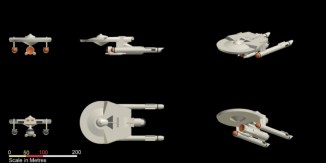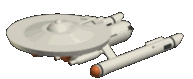
2254 – Tikopai

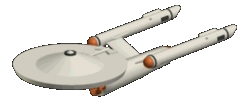
The Four Years War saw the need for large number of escort cruisers to be quickly commissioned. The Achernar and Tikopai classes of supplemental cruisers met this need. The Achernar class was adapted from the mark two versions of the standard Ptolemy (Achernar Mark 1) and Keppler (Achernar Mark 2) classes of Transport Tug. The Tikopai class was adapted from the mark two versions of the Dollond (Tikopai Mark 1) and Doppler (Tikopai Mark 2) classes. All four of these tug classes were in both Starfleet and Civilian service, and ships originally destined for civilian lines were diverted to this program.

The supplemental cruisers were created by the addition of a specialist pod with a hanger, enhanced sensors and weapons. The mother ship itself was unchanged, except for the impulse drive if it required upgrading and retained its own light weapons fit. This solution meant large numbers of the supplemental cruisers could be built quickly, as the Tugs were already mass produced in civil yards, and the weapons hull could be easily built by the smaller warship builders. These ships, although underpowered, were an invaluable asset in convoy escort duties throughout the war. Post-war these ships were all swiftly de-commisioned and converted to standard tug configuration, and then either sold off for commercial transport use, or used to replace wartime tug losses in the fleet.

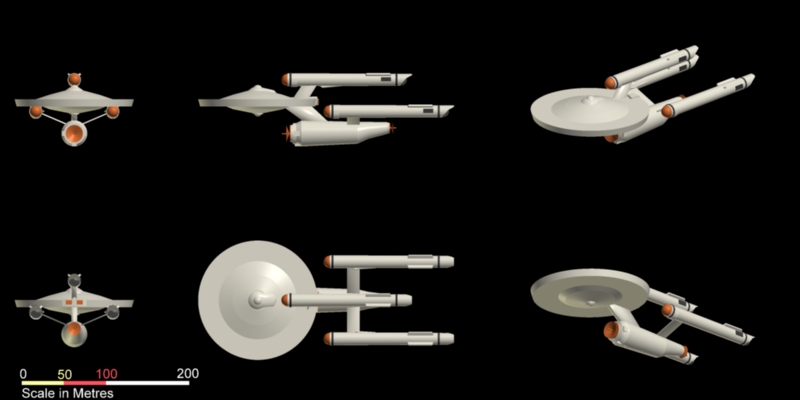
The weapon pod contained 8 FL-4 Lasers in 4 banks, with 2 banks covering each arc of fire, a pair of FAC-3 accelerator cannons was positioned on the sides of the pod to fire forward. These ships provided a valuable role escorting convoys, often hiding amongst innocent looking standard configuration tugs to lure attackers in. The main criticism that could be levelled at both of the classes was the weak shielding systems, but the adoption of more advanced shielding systems would have prevented the construction of the ships in civilian yards.

Class: V-VI Year: 2253
Ship Source: Franz Joseph Designs/FASA Ship Datasheet: Download PDF
 The design is based on the FJ tugs, the name is from FASA to provide a way for these classes to serve in the four years war prior to the commissioning of the heavy cruisers.

tikopai_ii_100

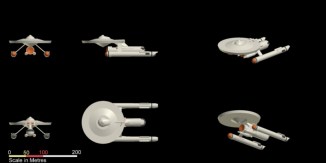
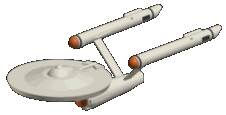
2253 – Achernar

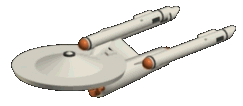
The Four Years War saw the need for large number of escort cruisers to be quickly commissioned. The Achernar and Tikopai classes of supplemental cruisers met this need. The Achernar class was adapted from the mark two versions of the standard Ptolemy (Achernar Mark 1) and Keppler (Achernar Mark 2) classes of Transport Tug. The Tikopai class was adapted from the mark two versions of the Dollond (Tikopai Mark 1) and Doppler (Tikopai Mark 2) classes. All four of these tug classes were in both Starfleet and Civilian service, and ships originally destined for civilian lines were diverted to this program.

The supplemental cruisers were created by the addition of a specialist pod with a hanger, enhanced sensors and weapons. The mother ship itself was unchanged, except for the impulse drive if it required upgrading and retained its own light weapons fit. This solution meant large numbers of the supplemental cruisers could be built quickly, as the Tugs were already mass produced in civil yards, and the weapons hull could be easily built by the smaller warship builders. These ships, although underpowered, were an invaluable asset in convoy escort duties throughout the war. Post-war these ships were all swiftly de-commisioned and converted to standard tug configuration, and then either sold off for commercial transport use, or used to replace wartime tug losses in the fleet.

The weapon pod contained 8 FL-4 Lasers in 4 banks, with 2 banks covering each arc of fire, a pair of FAC-3 accelerator cannons was positioned on the sides of the pod to fire forward. These ships provided a valuable role escorting convoys, often hiding amongst innocent looking standard configuration tugs to lure attackers in. The main criticism that could be levelled at both of the classes was the weak shielding systems, but the adoption of more advanced shielding systems would have prevented the construction of the ships in civilian yards.

Class: V-VI Year: 2253
Ship Source: Franz Joseph Designs/FASA Ship Datasheet: Download PDF
 The design is based on the FJ tugs, the name is from FASA to provide a way for these classes to serve in the four years war prior to the commissioning of the heavy cruisers.

achernar_ii_100

2245 – Constitution


The Legendary Constitution class needs no real introduction. However the class did not become the dominant force it later was until the introduction of the Phaser equipped Mark 2. The earlier Mark 1 was lightly armed compared to the best ships of the Klingon empire largely as a result of mass constraints. As such the Mark 1 was incrementally upgraded as new technology became available in an effort to make the class as capable as possible.

The Constitution class cruisers are the most renowned vessels of their time. Serving as both a research vessel and a cruiser, these ships have performed their duties to perfection for the last 50 years. The Constitution class ships were an integral part of the buildup during “The Great Awakening,” from the outset the most versatile of all ships built for the expansion efforts.

The original construction contract called for 13 vessels to be built that would serve as cruisers, have complete research facilities, and be capable of operating on 5-year research and exploration missions. In January of 2245 (1/8801), the first of these vessels, the USS Constitution, was commissioned, followed by one more each month for five months. As soon as these vessels were completed and commissioned, they were sent on 2-year shakedown cruises. Over the next five years, the remaining 7 cruisers were built. As scheduling allowed, the ships were upgraded with new technology, particularly with binary shield generators, which led to the Mk Ib and Ic. The construction program came to a halt with the commissioning of the USS Defiant.

When the Four Years War broke out, Starfleet decided to produce warships instead of the dual-purpose cruisers that devoted large areas of their space to research and laboratories. Even though the Constitution class was not put into production for the war effort, four of the ships- in the form of the Mk Id- saw action. Each distinguished itself in battle time and again, soon gaining the nickname “The Queens of Starfleet.” After-action reports continued to show the combat ability of this ship to be superior to any other ship in the fleets, save for the combat-dedicated Heston class, and so the decision to produce more of them was finally issued in November of 2254 (1/9611).

The ship that would be produced was the Mk II version, mounting the new phaser weaponry and photon torpedoes. Because of these modifications to the original design, construction did not begin until September of 2255 (1/9709) and the first ship did not come off the line until January of 2257 (1/9901), 7 months after the end of the war. Starfleet decided to continue the production of the Constitution class cruisers and expanded the proposed total number to 42 vessels.

In April of 2258 (2/0104), the FWF-1 warp drive engine was brought into the inventory and all Constitution class ships were recalled to be refit as Mk IIIs. By October of 2263 (2/0510), the refitting was complete and the Constitution class remained the most advanced starship of its time. One Mk III, the USS Ark Royal, still serves in Starfleet, exploring the rimward areas and acting as ongoing proof of this class’ successful record. Duty on the Ark Royal is awarded as a special training tour to Starfleet cadets. It is the only Constitution class vessel still in active service.

After the first successful test firing of the FP-5 photon torpedo, Starfleet ordered that 12 Constitution class ships be modified to fire it. In February of 2269 (2/1202), the USS Discovery, USS Saratoga, USS El Dorado and USS Kitty Hawk were sent into service as Mk IVs, mounting not only the new torpedo system, but also more powerful impulse engine and shield generators.

The Mk IV was the last version of the Constitution class to be built, but not the last to use that particular hull style. The Enterprise class cruiser was originally built from older Constitution hulls and retains its general appearance. Constitution class ships were constructed at the Sol IV shipyards.

Class: XI Year: 2245
Ship Source: Paramount Pictures Ship Datasheet: Download PDF

constitution_large

Commissioned Ships (FASA)

  •  Constellation NCC-1017
  •  Republic NCC-1371
  •  Intrepid NCC-1631
  •  Farragut NCC-1647
  •  Excalibur NCC-1664
  •  Exeter NCC-1672
  •  Constitution NCC-1700
  •  Enterprise NCC-1701
  •  Potemkin NCC-1702
  •  Hood NCC-1703
  •  Bismark NCC-1704
  •  Yamato NCC-1705
  •  Lexington NCC-1709
  •  Valiant NCC-1709
  •  Kongo NCC-1710
  •  Challenger NCC-1715
  •  Yorktown NCC-1717
  •  Valiant NCC-1718
  •  Essex NCC-1719
  •  Saratoga NCC-1720
  •  El Dorado NCC-1724
  •  Kent  NCC-1725
  •  Littorio NCC-1727
  •  Ticonderoga  NCC-1736
  •  Eagle NCC-1738
  •  Santissima Trinidad NCC-1742
  •  Marseille NCC-1744
  •  Langley NCC-1749
  •  Richelieu NCC-1750
  •  Forrestal NCC-1751
  •  Kitty Hawk NCC-1754
  •  Chikuma NCC-1759
  •  Victory NCC-1760
  •  Defiant NCC-1764
  •  Rivoli NCC-1765
  •  Bonhomme Richard NCC-1776
  •  Endeavour NCC-1777
  •  Hornet NCC-1778
  •  Akagi NCC-1779
  •  Kaga NCC-1780
  •  Ark Royal NCC-1791
  •  Radetsky NCC-1792
  •  Discovery NCC-1798

Commissioned Ships (Starfleet Museum)

USS Constitution NCC-1700
USS Enterprise NCC-1701
USS Potemkin NCC-1702
USS Hood NCC-1703
USS Yorktown NCC-1704
USS Excalibur NCC-1705
USS Exeter NCC-1706
USS Valiant NCC-1707
USS Intrepid NCC-1708
USS Lexington NCC-1709
USS Constellation NCC-1710
USS Farragut NCC-1711
USS Bonhomme Richard NCC-1712
USS Monitor NCC-1713
USS Hornet NCC-1714
USS Virginia NCC-1715
USS Kongo NCC-1716
USS Defiant NCC-1717
USS Endeavour NCC-1718
USS Eagle NCC-1719
USS LaFayette NCC-1720
USS Wasp NCC-1721
USS El Dorado NCC-1722
USS Ari NCC-1723
USS Saratoga NCC-1724 USS Tori NCC-1725
USS Krieger NCC-1726
USS Essex NCC-1727
USS Ranger NCC-1728
USS Bunker Hill NCC-1729
USS Lion NCC-1730
USS Implacable NCC-1731
USS Glory NCC-1732
USS Theseus NCC-1733
USS Triumph NCC-1734
USS Ark Royal NCC-1735
USS Warrior NCC-1736
USS Magnificent NCC-1737
USS Argus NCC-1738
USS Bonaventure NCC-1739
USS Clemenceau NCC-1740
USS De Gaulle NCC-1741
USS Foch NCC-1742
USS Arromanches NCC-1743
USS Jeanne D’Arc NCC-1744
USS Vikrant NCC-1745
USS Zuikaku NCC-1746
USS Shokaku NCC-1747
USS Kiev NCC-1748
USS Minsk NCC-1749

2249 – Heston

The Heston class, although now largely forgotten, was the leading Cruiser type in the four years war. Although not as powerful as the Constitution in terms of engines, it made up for that with its greater firepower and overlapping arcs of fire.

Advances in Klingon Ship design and weaponry capability led to concerns amongst some elements of Starfleet in the early 2240s. It was planned that the Constitution class would form the vanguard of Starfleet’s strength after they began commissioning in 2245, but the dual role nature of the design led to the military capabilities being reduced to allow for science and exploration capability. Additionally the advanced sensors and science instrumentation fitted meant that the class was prohibitively expensive to procure in quantity.

To counter this problem Military Operations Command pushed for a cheaper military roled heavy cruiser, which would dispense with th e extensive science equipment of the Constitution class, this ship became the Heston class. The first Heston class ship commissioned in 2249; it was in many ways a more heavily armed variant of the Constitution class design. Superficially, the ships looked similar, but externally, and internally there were a number of changes.

The Heston mounted the FWD-1 warp drive, as opposed to the FWC-1 of the Constitution. The only way to fit the required weapon load in the class was use the lighter warp drive which additionally was 20% cheaper than the FWC-1. of the ship. The cost of this change was that the Heston class was always short of power, but to remedy this the class was fitted with the revolutionary FSI shield generator, the first trinary shield generator. Because of leaving out the science facilities of the Constitution class, the ships had the capability to carry 200 marines as well as fighter craft and assault shuttles. It had been planned to make the ship larger, but suitable impulse drives were not available to power ships of more than class XI until 2256.

The Mark 2 Heston of 2253 was perhaps the ultimate laser equipped warship to serve in Starfleet. She adopted the new FWE-2 warp drive, which allowed additional structural reinforcing due to its lower weight, as well as being both more efficient and more powerful. All 7 surviving Mk 1s were upgraded to this standard. The Mark 2 was designed purely to counter the D10 class Cruiser.

Postwar the ships were deemed obsolete due to their reliance on lasers, and the lower power of the warp drives. Additionally the single role nature of the vessels meant that they could not be redeployed on exploration duties, which made them less attractive for refits than the Constitution class ships.

In another blow to the future of the Heston class, the Federation Class usurped the military role of the class, the Federation class was essentially a Heston class hull with the addition of a third nacelle. A limited refit was carried out in 2257, when three ships gained FWD-2 warp drives, but this was only a temporary reprieve, as the lasers and accelerator cannons were not replaced. USS Heston became flagship of the Federation reserve fleet in 2258, just 9 years after commissioning. Subsequently it was decided that the Heston class spaceframes could be most effectively used if refitted to Federation Class Dreadnought specifications.

To this end, all 13 surviving vessels were mothballed or in reserve by 2260. From 2266 onwards 12 of the 13 survivors were stripped back to their spaceframes with the intention of being be rebuilt to Federation class specifications, however when the Federation class production was halted early these hull were scrapped or expended as targets.

The USS Heston (NCC-1685) was the only ship not scrapped, and was later allocated for display purposes. She is still in the Starfleet Museum today.

  • Class: XI
  • Year: 2249
  • Ship Source: Based on Federation Class From Starfleet Technical Manual, Name Reference FASA
  • Ship Datasheet: Download PDF

heston_large

Federation

2257 – Federation

The Federation Class Dreadnought was initially conceived prior to the Four Years as a variant of the Heston class Battle Cruiser (which was itself a Military role variant of the Constitution). The design was shelved as the new dilithium energised engines were not yet available to power such a large vessel. After the war the design was modified to take account of the lessons of the War and put into production using the new FWF-1 engine. The class was refitted in 2274, and was the most powerful Starfleet vessel until the introduction of the Excelsior class some twenty years later.

Class: XIV Year: 2257
Ship Source: Starfleet Technical Manual Ship Datasheet: Download PDF

Federation