
After 30 years of service, with no replacement in sight, the Marshall class was refitted for further service.
| Class: | III | Year: | 2185 | |
| Ship Source: | Space Flight Chronology | Ship Datasheet: | Coming Soon | |
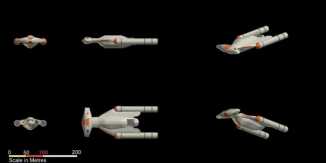

After 30 years of service, with no replacement in sight, the Marshall class was refitted for further service.
| Class: | III | Year: | 2185 | |
| Ship Source: | Space Flight Chronology | Ship Datasheet: | Coming Soon | |
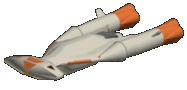
“The ambush and loss of the UES Patton began the Romulan War. The Marshall class was the Earth’s staunchest line of defence, and these ships’ superior performance and firepower provided a crucial tactical edge. In fact, the class supposed to succeed it could not better its specifications and so was never built, the reason why the Marshall class had the longest commissioned lifespan in interstellar history (at that time).”
The Marshall class destroyer was produced in vast numbers during the Romulan War. It was not the most powerful ship of its type, but it was easy and quick to produce at a time when every ship that could be built was a valuable addition to the Fleet. It was generally used as a convoy escort and patrol vessel. The USS Patton of this class has the dubious distinction of being the first ship destroyed in the Romulan War
| Class: | III | Year: | 2154 | |
| Ship Source: | Space Flight Chronology | Ship Datasheet: | Download PDF | |
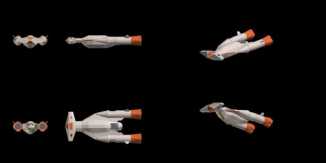

“The Portsmith class was a small cheap destroyer designed for mass production. During the four years war vast numbers were built to act in numerous roles. Despite its size and low cost, the class was amongst the more powerful destroyers in service during the war. Post war the class was not fitted with phasers as the cost of conversion would have exceeded the cost of construction.”
The Mk1 Portsmith Class entered service in 2246 as a cheap simple customs cutter, and was produced at numerous merchant and military shipyards throughout the Federation. The design had no weapons save for four lasers, and was powered by the heavy but effective FWH-1 warp drive system, In all some 300 were built between 2246 and 2252.
The growing hostilities prior to the advent of the Four Years war in 2252 found the Federation desperately short of effective escorts. A program was instituted to design a new escort destroyer class for mass production. It was realised that designing a new class from scratch would take a number of years. It was suggested that the existing Portsmith class could form the basis for a very capable Light Destroyer.
The FWH-1 engines of the Mk1 were replaced by the new FWA-2, and the ship had three accelerator cannons crammed into the former cargo hold. The resultant ship was a revelation to Starfleet Commanders, the more efficient Warp Drive, coupled to the heavy weapon load (for the size of vessel) meant that the Mk2 had a combat efficiency better than full size destroyers, and indeed better than some cruisers.
The price paid for this efficiency was two fold, the range of the Portsmith could not compare to that of the larger destroyers, and the superstructure, although reinforced compared to the Mk1 was not as resilient as that of the larger destroyers. However when deployed in groups escorting convoys the capabilities of the Portsmith meant that they were a force to be reckoned with. Some 360 Mk2s were built, and a large number of Mk1s were upgraded.
Postwar, the Portsmith class had no real role, although a large number were retained in reserve fleets until the 2270’s. A large number of these ships were sold onto planetary defence forces, or onto the civil sector after being disarmed.
| Class: | IV | Year: | 2252 | |
| Ship Source: | Spaceflight Chronology | Ship Datasheet: | Download PDF | |


“The Mann class was employed primarily for strategic purposes by the Star fleet command, providing defence and security within the ever growing Federation jurisdiction. Using advanced third generation propulsion, these ships used pure matter/antimatter annihilation and were amongst the fastest to warp. The USS Endurance (of this class) supervised the largest spacelift in Federation history, where the over ten million inhabitants of Bayard’s planet were successfully evacuated.”
The design restored much confidence in the light cruiser program after the Tritium debacle, and the ships were sought after postings due to their modern looking design and ample interior space.
The class remained in active service until 2250, when it was deemed uneconomical to further refit them as the once radical design was deemed obsolete. Two ships were sold onto the AOFW and were refitted with modern warp drives and remained in use until 2290.
| Class: | V | Year: | 2208 | |
| Ship Source: | Spaceflight Chronology | Ship Datasheet: | Download PDF |


The first great experiment, and the first great failure.
The design drew from the supposed strengths of the three engine version of the Wasp class, unfortunately the designers failed to take account of the very different warp dynamics of the Tritium design compared to the eariler vessel. The designers also did not pay heed to the difficulties suffered by the Wasp programme.
The failure of the triple engine design of the Tritium was one of the most costly failures in the History of Starfleet. Although the design showed the promise of the three engine layout to boost power, it would be another 15 years before computer advances allowed the three engine warp field to be successfully balanced in the Quetzalcoatl class.
On paper a powerful ship, under impulse power the design performed superbly, with power to spare. At warp the design was shown to be far slower than designed for, and the fuel consumption meant the range was half of that predicted, additionally the warp drive system required five times more maintenance than an equivalent twin engine system.
Compared to the original, the Modified Tritiums have lengthened warp nacelles and shorter outlet cones in an attempt to improve warp dynamics, it made no difference to the problems of the design.
“The Tritium class has the dubious distinction of being the worst major ship ever built by the UFP. Insurmountable design flaws surfaced during its validation phase, and though six Tritium class ships were constructed in a vain attempt to overcome glaring shortcomings, the Federation finally cut its losses and cancelled the series. As a costly reminder to future generations, the Tritium may also be viewed as the Spaceflight museum on Memory Alpha.”
|
|
||||
| Class: | V | Year: | 2201 | |
| Ship Source: | Spaceflight Chronology | Ship Datasheet: | Download PDF | |
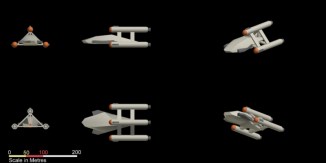

The first great experiment, and the first great failure.
The design drew from the supposed strengths of the three engine version of the Wasp class, unfortunately the designers failed to take account of the very different warp dynamics of the Tritium design compared to the eariler vessel. The designers also did not pay heed to the difficulties suffered by the Wasp programme.
The failure of the triple engine design of the Tritium was one of the most costly failures in the History of Starfleet. Although the design showed the promise of the three engine layout to boost power, it would be another 15 years before computer advances allowed the three engine warp field to be successfully balanced in the Quetzalcoatl class.
On paper a powerful ship, under impulse power the design performed superbly, with power to spare. At warp the design was shown to be far slower than designed for, and the fuel consumption meant the range was half of that predicted, additionally the warp drive system required five times more maintenance than an equivalent twin engine system.
“The Tritium class has the dubious distinction of being the worst major ship ever built by the UFP. Insurmountable design flaws surfaced during its validation phase, and though six Tritium class ships were constructed in a vain attempt to overcome glaring shortcomings, the Federation finally cut its losses and cancelled the series. As a costly reminder to future generations, the Tritium may also be viewed as the Spaceflight museum on Memory Alpha.”
|
|
||||
| Class: | V | Year: | 2200 | |
| Ship Source: | Spaceflight Chronology | Ship Datasheet: | Download PDF | |
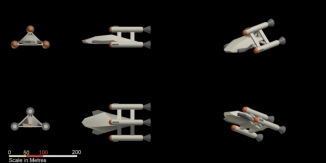

“The Horizon was one of the most important ships and classes in spaceflight history. The flagship for early Earth space exploration, the UES Horizon journeyed to the edge of the galaxy, encountering many new worlds in its numerous voyages. At the end of its commissioned life it was retired to Star Fleet’s spaceflight museum on Memory Alpha.”
| Class: | IV | Year: | 2134 | |
| Ship Source: | Spaceflight Chronology | Ship Datasheet: | Download PDF | |
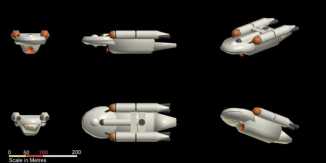

“.. the Pollux and its fellow Messier class ships were ..refitted for military use. The Pollux saw considerable action during the Romulan War.”
The Messier class cruisers were built in two distinct different variations, when the Messier specification was issued two different shipyards submitted design and built bids. To satisfy competing political interests the order was split between the two yards (one terran and one martian). Both yards used identical equipment, and broadly similar dimensions, but the execution of the design was considerably different. Although the approach met political needs and also served to drive down costs to a degree by encouraging competition, it did lead to a duplication of parts and components which led to overall increased costs.
| Class: | IV | Year: | 2106 | |
| Ship Source: | Spaceflight Chronology | Ship Datasheet: | Download PDF NB Dates incorrect |
|

| Class: | IV | Year: | 2080 | |
| Ship Source: | Spaceflight Chronology | Ship Datasheet: | Coming Soon | |
|
|
||||


| Class: | III | Year: | 2070 | |
| Ship Source: | Spaceflight Chronology | Ship Datasheet: | Coming Soon | |
|
|
||||
 Vintage Starships
You must be logged in to post a comment.