
2249 – Canopus

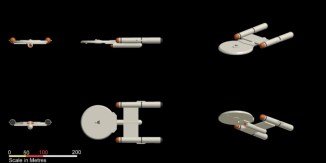
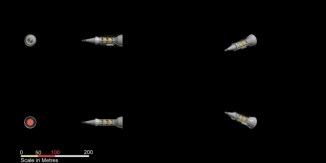
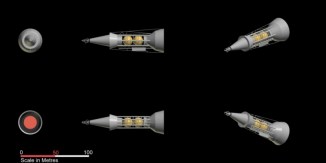
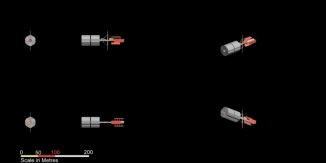
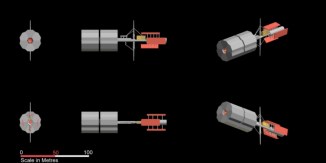
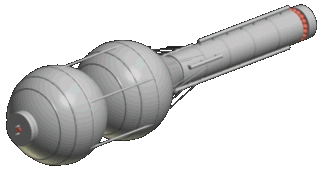
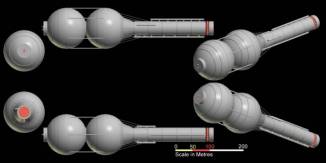
The Canopus Class Research Cruisers were designed to carry out the first detailed survey work on the Sagittarian arm of the Galaxy. 24 Ships of the class were proposed, the design was lightly armed, but to compensate was equipped with state of the art FSI trinary shielding.

15 Ships were produced in this initial configuration, but only 12 actually entered full service with Galaxy Exploration Command, the final three ships were refitted while working up to the new Mk3 configuration. The Mk 1 served until 2258 when the last vessel was refitted and upgraded. Two ships of this mark are known to have been destroyed, while a third USS Capricornus vanished without trace in December 2255.

The intention had been to introduce the Mk2 in 2253, with upgraded FWE-2 Warp drives, but no additional weapons. However, events were to cause Starfleet to require a very different type of cruiser. The outbreak of the four years war led to the modification of the design to produce the Mk3, which mounted more powerful lasers in more mounts, as well as accelerator cannon. The high speed, and excellent shielding of the Canopus design making it an ideal long range reconnaissance cruiser. The prototype Mk2 was renamed USS Centurion, and entered service in 2253 as the first Mk3, and was followed by a further 5 new build ships. Three recently completed Mk1s were pulled back from working up and upgraded to the new standard. Three additional Mk1s were upgraded as they returned from their missions.

Mark 3 Canopus class vessels frequently operated on their own, deep inside enemy territory, the small profile of the design linked to classified ECM systems making them virtually impossible for the inferior Klingon sensors to detect. As a result of this high risk mission, 5 Mk3 ships of the 12 built or converted were lost during the war.

The 22nd and last production vessel USS Cavalier was completed as a Mk4 with Phasers and a single photon torpedo launcher. The ship commissioned just in time to catch the end of the war. All of the 13 surviving Mk1 and Mk3 ships were refitted to the Mk4 standard between 2257 and 2263, but 8 proposed new build Mk4s were cancelled as production of additional Constitution class ships was deemed preferable. Post war the class returned to its scientific mission profile, but the enhanced weapons were retained.

The class continued in service until 2286, although numbers were steadily reduced from 2275 onwards by a intense program of scrapping and sales. The reasons for this was a combination of the craft being too small to operate effectively in a long range exploration role or to be equipped with modern sensors, conversely they were too large and crew intensive to operate in a short range exploration role in a military configuration. Despite this, civilian research groups now own a number of Mk4s, as the removal of the weapons upon sale permitted a major reduction in crew complement and released the space for the fitment of modern sensors.

In 2290 it was realized that not a single ship had been retained for the Starfleet museum, as a result the former USS Canopus was repurchased at scrap prices in a very poor condition, and is now being restored to its former glory.

Class: VIII Year: 2249
Ship Source: Space Flight Chronology Ship Datasheet: Download PDF

canopus_side_large

Commissioned Ships

B1 – Built as Mk1, B3 – Built as Mk3, B4 – Built as Mk4, R3 – Refit to Mk3, R4 – Refit to Mk4, D – Destroyed, Sc – Scrapped, M – Missing

1570 Canopus

B1-2249, R4 2256, SOLD 2277

1580 Coriolanus

B1-2253, R4 2261, SC 2277

1590 Cambria

B3-2256, D2257

1571 Castor

B1-2249, R3 2253, R4 2257, SC 2275

1581 Corsair

B1-2253, R4 2257, SC 2280

1591 Cavalier

B4-2256, SOLD 2286

1572 Capella

B1-2250, R3 2253, D2255

1582 Ceres

B1-2253, R3 2253, R4 2257, SC 2278

1592 Camilla

CANCELLED 2256

1573 Capricornus

B1-2250, M 2255

1583 Centaurus

B1-2254, R3 2253, R4 2257, SC 2279

1593 Corinna

CANCELLED 2256

1574 Caledonia

B1-2251, R3 2253, D 2256

1584 Cambria

B1-2254, R3 2253, D 2256

1594 Calpurnia

CANCELLED 2256

1575 Cassiopeia

B1-2251, R4 2261 SC 2275

1585 Centurion

B3-2254, R4 2261, SOLD 2283

1595 Cameronian

CANCELLED 2256

1576 Calypso

B1-2251, D 2255

1586 Caledonia

B3-2255, R4 2263, SC 2285

1596 Cathay

CANCELLED 2256

1577 Catalina

B1-2252, R4 2258 SC 2275

1587 Cleopatra

B3-2255, D 2255

1597 Cabot

CANCELLED 2256

1578 Caribou

B1-2252, R4 2257 SC 2276

1588 Circe

B3-2255, R4 2262, SC 2280

1598 Courtier

CANCELLED 2256

1579 Clipper

B1-2252, D 2254

1589 Challenger

B3-2256, R4 2258, SOLD 2285

1599 Columbia

CANCELLED 2256


2254 – Britannia

“The USS Moscow and the other ships of this class were the one of the last major classes without dilithium. The immediate predecessor to the Constitution class, the Baton Rouge class exhibited the distinct separated living disc and engine modules so familiar now. Up-rated in the 2250s, these ships have only recently completed their commissioned usefulness as interstellar carriers.”

The uprating was due to delays in the Constitution program, and introduced new warp engines, impulse engines, weapons and shields. In this configuration the ships gave valuable service in the four years war.

The Mark 1 Baton Rouge class entered UFP service in 2225 and were the last major cruiser class built with non dilithium energised engines, in total an impressive 86 Mk1 ships was built over 18 years. A modification program in the 2240’s saw 40 of these ships re-equipped with new M- 1 computers, enhanced weaponry and unary shield generators to become Mk2s, a further 14 ships were built as new to compensate for delays in the Constitution programme. This modification meant that the ships remained a useful element of the fleet despite their low top speed compared to newer design.

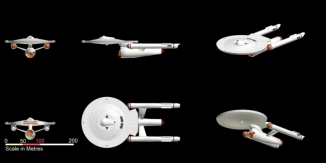
In 2254 the damaged Mk2 USS Britannia was refitted to Mk4* standards at Utopia Planitia. The secondary hull of the Britannia was damaged beyond repair, and it was decided to use a secondary hull from a written off Heston Class Cruiser. The refit was based on the standard Mk4 for spares support reasons, except the heavy FAC-4 replaced the FAC-3, one pair of these were mounted in the traditional location on the saucer below the bridge, and a second pair atop the secondary hull. The resulting ship was designated a special type and entered service providing heavy support to the 35th Cruiser Squadron (which consisted of Mk3/4 Baton Rouges). Further production of the Mk4* was not authorised as the type’s range was reduced compared to that of the standard Baton Rouge, and the cost of the refit in time and resources was deemed prohibitive compared to the Mark3/4 refits.

In 2256 the Britannia was ambushed while protecting a convoy of troopships in supposedly safe territory. She single handledly managed to hold off three D-10 cruisers while the convoy escaped to safety escorted by another pair of ships from the 35th CS. In total the convoy was carrying over 100,000 troops and Captain Kelsey of the Britannia felt that it was more important for the two other cruisers to safeguard the convoy then to help hold off the D-10s. Miraculously 150 of the Britannia’s crew, including Captain Kelsey, managed to survive the battle, and all three D-10s were crippled or rendered ineffective.

Britannia’s battle was not yet over though, a trio of Orion Pirate vessels attracted by the potential for booty and salvage moved into attack. The crew aboard the damaged Britannia managed to get their accelerator cannons online, and when the lead Orion vessel, a captured D7, moved into the arc of fire they hit it with all four cannons destroying the Orion Vessel, the resultant explosion damaged the second Orion cruiser, but also mortally damaged the unshielded Britannia. The third Orion vessel was destroyed when the command pod of one of the D-10s separated and rammed it’s warp nacelle. The crew of Britannia were forced to abandon their ship as the damage sustained in this final battle caused a catastrophic impulse reactor explosion. The surviving crew members being rescued by the Klingons who they had been fighting just an hour earlier. Aboard the Klingon vessels the survivors were welcomed as warriors with honour, it was not lost on the Klingon commander, Gorkon, that the Britannia could have evaded combat and left the Klingons at the mercy of the Orions.

Class: X Year: 2254
Ship Source: Space Flight Chronology/ FASA Ship Datasheet: Download PDF

britannia-100t

2253 – Baton Rouge Refit

“The USS Moscow and the other ships of this class were the one of the last major classes without dilithium. The immediate predecessor to the Constitution class, the Baton Rouge class exhibited the distinct separated living disc and engine modules so familiar now. Up-rated in the 2250s, these ships have only recently completed their commissioned usefulness as interstellar carriers.”

The uprating was due to delays in the Constitution program, and introduced new warp engines, impulse engines, weapons and shields. In this configuration the ships gave valuable service in the four years war.

The Mark 1 Baton Rouge class entered UFP service in 2225 and were the last major cruiser class built with non dilithium energised engines, in total an impressive 86 Mk1 ships was built over 18 years. A modification program in the 2240’s saw 40 of these ships re-equipped with new M- 1 computers, enhanced weaponry and unary shield generators to become Mk2s, a further 14 ships were built as new to compensate for delays in the Constitution programme. This modification meant that the ships remained a useful element of the fleet despite their low top speed compared to newer designs

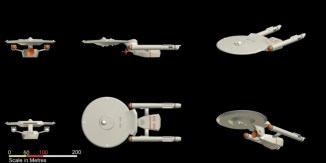
In 2249 the availability of suitable dilithium based engines in the form of FWE-1 meant that these ships could again be modified to Mk3 standards. This refit was controversial as although speed increased from Warp 4.2 to Warp 8.7, available power dropped by more than 33%. At the outbreak of the four years war in 2253 the New New Aberdeen shipyards in the AOFW were contracted to refit existing UFP Baton Rouge class ships with these new systems due to the Yard’s recent experience with the class (it had license built ships for the AOFW). The refit they designed was based upon the Mk3, but made use of the new FWE-2 warp drive, this however required a change of main computer. The desperate need for ships meant that refits to both Mk3 and Mk4 were carried out during the war . The Mark 4 being a more capable vessel, but the refit took six months compared to three for the Mk3. Mk 3 production totalled 26 ships (12 converted Mk2s and 14 Converted Mk1s), while Mk4 production totalled 25 ships (9 converted Mk2s and 16 Converted Mk1s).

Some unmodified Mk2 ships also served throughout the war as convoy escorts, it being felt that their low speed was not an issue when escorting slow moving freighters, indeed the additional power was seen as an asset. In one famous incident, a trio of 30-year-old Baton Rouges fought off a squadron of D7As without a single ship being lost in the convoy they were escorting.

12 Mk2s survived the war, and 6 of these were later converted to Mk5 standards, along with 12 each of the Mk3 and Mk4 ships making 30 in total. Mk5 introduced photon torpedoes and phasers to the venerable design, the first ship commissioned in 2260, and it is intended that these ships will serve in some capacity until the 2280s.

21 ships of various marks have been donated to, or purchased by friendly powers. Chief amongst these is the AOFW which has acquired 10 ships over the years, and built under license an additional four ships in the shipyard at New New Aberdeen. Currently the AOFW retains 6 ships in operation, in a version corresponding to the UFP Mk5. The former USS Aberdeen is currently being refitted to a more advanced standard with FP4 torpedoes in an installation based upon that on the late USS Britannia.

A number of Baton Rouge class ships are preserved at various sites around the Federation, as well as a single vessel preserved in the AOFW, but the ships that are still in service some 60 years after the design was conceived are the most telling proof of the excellence of the design and memorial to those who have gone before.

Class: IX Year: 2253
Ship Source: Space Flight Chronology/ FASA Ship Datasheet: Download PDF

br-new-02-100

2225 – Baton Rouge

“The USS Moscow and the other ships of this class were the one of the last major classes without dilithium. The immediate predecessor to the Constitution class, the Baton Rouge class exhibited the distinct separated living disc and engine modules so familiar now. Up-rated in the 2240s, these ships have only recently completed their commissioned usefulness as interstellar carriers.”

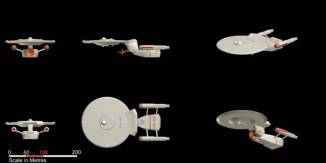
The Mark 1 Baton Rouge class entered UFP service in 2225 and were the last major cruiser class built with non dilithium energised engines, in total an impressive 86 Mk1 ships was built over 18 years. A modification program in the 2240’s saw 40 of these ships re-equipped with new M- 1 computers, enhanced weaponry and unary shield generators to become Mk2s, a further 14 ships were built as new to compensate for delays in the Constitution programme. This modification meant that the ships remained a useful element of the fleet despite their low top speed compared to newer designs.

Some unmodified Mk2 ships also served throughout the four years war as convoy escorts, it being felt that their low speed was not an issue when escorting slow moving freighters, indeed the additional power was seen as an asset. In one famous incident, a trio of 30-year-old Baton Rouges fought off a squadron of D7As without a single ship being lost in the convoy they were escorting.

12 Mk2s survived the war, and 6 of these were later converted to Mk5 standards.

A number of Baton Rouge class ships are preserved at various sites around the Federation, as well as a single vessel preserved in the AOFW, but the ships that are still in service some 60 years after the design was conceived are the most telling proof of the excellence of the design and memorial to those who have gone before.

Class: VII Year: 2225
Ship Source: Space Flight Chronology/ Rick Sternbach Ship Datasheet: Download PDF

br-new-01-70