2158 – Mercy

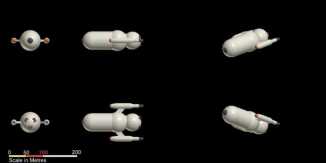
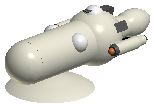
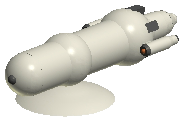
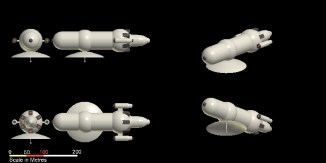
The Olympus Mons family of ships was developed from the Bison class. The Olympus Mons class was an armed Assault transport, The Reid Fleming class was a Deuterium Tanker, and the Mercy class was Starfleet’s primary Medical ship type for many years.

Class: XVII Year: 2158
Ship Source: The Starfleet Museum Ship Datasheet: Download PDF

mercy_large

Commissioned Ships

  • UES Mercy AHM-4
  • UES Solace AHM-5
  • UES Comfort AHM-6
  • UES Sanctuary AHM-7
  • UES Consolation AHM-8
  • UES Refuge AHM-9
  • UES Hope AHM-10
  • UES Tranquility AHM-11

.


2210 – Hyperion II

By the mid-2190s, transtator based subspace transmitters were compact enough to be suitable for fitment to Starfleet vessels other than specialized communications ships. The first ships to carry the new compact transmitters were the Hyperion Class Cruisers launched in 2194. The class had initially been designed as a exploratory follow-up to the Moskva class of 2179. However, when the Mercury subspace communication and sensor system became available, the Hyperion class was seen as an ideal platform. The Mercury system was mounted in a specially shielded housing on the primary hull. The Mark 2 features new more efficient and faster warp engines.

Class: VI Year: 2210
Ship Source: The Starfleet Museum Ship Datasheet: Mk2 Coming soon

hyperion2_large


2158 – Powhatan

The Powhatan class ships were intended to serve as escorts for Yorktown class carriers on strike missions. Since the carriers carried only short-range area defense missiles, they were considered vulnerable to attack by smaller, more maneuverable vessels. If a carrier was accompanied by one or more smaller, heavily armed ships, the mission could be performed with a much lower risk of interference by enemy ships. Even before the launch of the EFTL-5 powered UES Krechet, engineers had begun developing a series of compact reactors for smaller ships. The first to enter service was the EFTL-6 in the Torsk class. Although smaller and lighter than it was also slightly less powerful. This was considered acceptable for border patrol ships, which were expected to operate in a limited geographic area. However, escorts for carriers had to be capable of sustained operations at high speeds for month-long missions into enemy territory.

The EFTL-8 was smaller and lighter but provided higher peak output levels for longer periods of time. Compared to earlier cruisers, Powhatan could be considerably smaller than earlier cruisers but have significantly improved performance, also the sleek lines were also strikingly different, she was long and thin where Krechet had been fat and round. Powhatan mounted a four nacelle system to improve maneuverability, and also used the new J-4A computer, which was a special version of the J-4 for smaller ships.
No carriers under their protection were lost to enemy action in the last 15 months of the war.

The long range, high speeds, and heavy weaponry of the class also made it useful in a wide range of other roles. By early 2159, Powhatans had largely superseded all other small cruisers in the roles of escorts, destroyers, scouts, and cruisers. Several ships were modified to perform intelligence missions deep within enemy territory. Even after the introduction of the Comet class in October 2158, the superior firepower of the Powhatans ensured that they continued in front line service. However, when peace came, a lack of space for scientific facilities meant that Powhatans had only limited use in the new Starfleet. They were replaced in 2185 by the more versatile Moskva class cruisers.

The POWHATAN-class escort USS PHAETON (CEM-18) is now on display at the Starfleet Museum.


Class: VI Year: 2158
Ship Source: The Starfleet Museum Ship Datasheet: Download PDF

powhatan_large


2222 – Aryabhatta

The Aryabhatta class, an Andorian design, entered service in 2222 to replace the large numbers of ageing cruisers that were employed in the research role.

The Andorian ship-building industry was in a poor condition by 2218. During the Earth- Romulan War, Andorian naval ship yards in orbit had built ships of local design totaling many millions tons’ displacement. However, after 2161 few Andorian designs found favor with the new Starfleet as it preferred ships with separate primary and secondary hulls were preferred for reasons of safety and flexibility. Andorian ships placed all ship’s equipment into a single hull with integrated nacelles. The first ship in many years to be adopted by the fleet based on Andorian designs was the Aryabhatta class Cruiser which began trials in 2221.

Work had begun in 2218 after Exploration Command had convinced the Federation Council that a class of dedicated explorers would be more effective and less expensive to build, operate, and maintain than the current fleet of converted, obsolete cruisers. The only stipulation was that construction of this new class would in no way interfere with the introduction of the projected new Valley Forge cruiser class. Ten exploratory cruisers of the Aryabhatta class were authorized. Generally free of interference from Military Operations Command and the Federation Council, the design stage of the project proceeded extremely smoothly.

The new exploratory cruiser was to displace some 70,000 tons. The primary hull was a thick, rounded crescent, which housed most crew spaces, computer core, life-support machinery, scientific equipment, and deuterium tanks. The upper and lower surfaces of this hull supported sensor panels and antennae. The short secondary hull housed the shuttle bay, the M/AM reactor, additional scientific equipment and a long-range, omnidirectional scanner. Weaponry was fitted purely for self defense.

Delivery was delayed by the procurement of the Kestel Class cruiser version of the design, but in compensation five additional ships were ordered. USS Aryabhatta commissioned in March 2222, and the other fourteen followed through to June 2225. The new class fulfilled all Exploration Command’s needs as a medium-range exploratory cruiser. Because of their relatively short endurance, they were primarily used to survey areas within Federation territory, following up surveys done previously. In their more than 30 years of service, the class was credited with mapping and exploring more than 500 star systems and establishing contact with 31 civilizations. Although they served almost exclusively within areas under Federation control, their missions were not without danger. In 2234 USS OmarKhayyam was severely damaged after being fired upon during a first contact attempt that went tragically wrong.

USS Prince Henry of this class is now on display at the Starfleet Museum.


Class: V Year: 2222
Ship Source: Stafleet Museum Ship Datasheet: Download PDF

arabyhatta_large


2206 – Horizon

The 2206 Horizon class explorer  was amongst the first Starfleet ships designed for extended range science missions in uncharted space. At the time of commissioning the ships were dismissed as an  idealistic extravagance’, the Horizon can be seen as the forerunner of Starfleet’s later exploration ships.


Prior to 2200 Galaxy Exploration Command’s ship performance and their value for scientific research were limited. The longest-range starshipsin service were the Hyperion class of 2194, which had an unrefuelled range of 34 light years and carried sufficient stores for 20 months of operations. However, the majority of exploratory vessels in service at the time (such as the Daedalus and Moskva classes) were only able to visit 3 or 4 star systems before needing resupply. In addition, many Starfleet ships were not fully equipped for extensive scientific research, only those dedicated to survey missions had sensors that were optimized for research and stellar mapping.  The other limitation (at least until the Hyperion class entered service) was that subspace-based sensors were generally passive, because the size of subspace transmitters precluded their installation on most starships.


What Galaxy Exploration Command required was a starship which combined the range, speed, and endurance of a heavy cruiser with the scientific facilities of a surveyor. It was not until the late 22nd century that the technology to build such a ship became available, but even then such a ship was likely to be extremely expensive to build and operate.

Commodore Matías Tolbert, who became commander of Galaxy Exploration Command  in 2199, was an idealistic and adventurous officer. He had served as an ensign aboard the survey cruiser UES Ericson (CX-19, Republic class), which made Earth’s first contact with the Altair system in 2155. As captain of USS Blériot (NCC-539, Gagarin class), he made the Federation’s first contact with 8 races, including the Saurians. He believed that Starfleet’s future lay in exploration missions rather than as a purely military force.

Ambassador Skon of Vulcan led a vocal minority faction of Federation Council members who felt that the Federation was expanding too quickly and too far, and that Starfleet emphasising military force to drive the expansion. After the dual role Paris class was deployed in a military role only, Skon realised that if he could not restrain Starfleet’s military operations command, he would instead encourage a greater emphasis on exploration.

Working with Commodore Tolbert, Skon requested funding for a new “explorer class” starship in April 2200. The request was controversial, because this explorer would be as expensive to build as a heavy cruiser, and more expensive to maintain and operate.Amongst other concerns, the issue of the expense of the project led to the proposal’s rejection.

In October 2200, the Federation Council began debate on the funding for the new  Lancaster class heavy cruiser. Skon threatened to block funding for the Lancaster unless funding was also approved for the explorer. After much debate and argument funding was authorized for 12 explorers (now named Horizon after the UES Horizon class and the lost USS Horizon), and 50 Lancasters.

The specifications called for a cruising speed greater than warp 5 and an unrefuelled range of at least 100 light years. The ship was to have 10 science labs, with a crew of 300 (30% of these being scientists and laboratory technicians). It was also to carry enough stores to allow for an unprecedented 5 years of independent operations.

The primary hull contained the bridge, crew facilities, computer and sensors, as well as defensive weaponry. The primary hull was elongated to accommodate a large shuttlebay, impulse drives, and rotating outboard ultra long range sensor panels. The secondary hull containing the warp drive reactor was aft of the primary hull on a 43-meter neck. Up to 6 external modules were mounted externally around the neck to carry additional  fuel, stores, cargo, or specialized mission modules.

The design board also specified the mounting of 4 warp nacelles, making this the first class to use this configuration since the Yorktowns of 2158. The 4 nacelles allowed the power to be spread across a larger number of warp coils, thereby increasing their longevity. Also, in the event of a failure the ship could still return to base, or even continue its mission, with only 2 or 3 nacelles.

To facilitate long-range exploration and enable communication with base, Horizon carried a large navigational deflector and subspace transmitter module below the primary hull in a tertiary hull. Due to extended mission profile, the resultant supplies, crew facilities, and redundant equipment meant that at 203,000 tons Horizon would be Starfleet’s largest starship since the Conqueror class of 2159.

USS Horizon was launched in July 2206, and was followed by the other 11 ships of the class  over the following 4 years. As a shakedown, Horizon completed  a 9-month survey of star systems in the Hyralan sector. Following the successful completion of the shakedown, Horizon commenced a 3-year mission beyond the Groma Hollow. During this mission the Horizon travelled more than 150 light years, surveyed more than 7,000 cubic light years of space, and made first contact with 4 spacefaring races.

As the other Horizons entered service they too started to expand the knowledge of the Federation.  In 2207 USS Venture was the first starship to encounter a complex space-dwelling life form (the Kento). The following year, USS V’Shon-Pal  was the first starship to survey the Mutara Nebula, and in 2210 USS Yinghuo discovered ancient ruins left by the Preservers.

The  range and endurance of the class enabled Starfleet to launch its first 5-year missions.  Starting in March 2209, Captain Fabiola Kalani commanded the USS Odyssey on a 62 month mission exploring spinward of the Rigel system. During this mission the Odyssey made first contact with 12 spacefaring races, including the Edosian

Despite the success of the Horizon class, funding for Galaxy Exploratorion Command became more limited following Skon’s death in 2208, as resources were gradually directed back to Military operations command. As a result no further explorer starships entered Starfleet service until 2222 with the commissioning of the smaller and less expensive Aryabhatta class.

Horizon-class ships were at times diverted to border patrol and long-range observation missions as Horizon’s unparalleled sensor suite made it useful asset for surveillance.  Such missions were not common as the the Horizon needed a sizeable escort in hostile areas.

The Horizon class remained in service until 2254, and during this time only a single ship of the class was lost. USS Victoria  was destroyed in 2235 while surveying a particle fountain in the Moab sector.

The Horizon-class explorer USS Odyssey, which completed four 5-year missions, is on display at the Starfleet Museum.

Class: XII Year: 2206
Ship Source: The Starfleet Museum Ship Datasheet: Coming Soon

sfm-horizonCommissioned Ships

USS Horizon NCC-1197
USS Odyssey NCC-1198
USS Venture NCC-1199
USS V’Shon-Pal NCC-1200
USS Kumari NCC-1201
USS Beagle NCC-1202
USS Yinghuo NCC-1203
USS Endurance NCC-1204
USS Nadezhda NCC-1205
USS Victoria NCC-1206
USS T’Plana-Hath NCC-1207
USS São Gabriel NCC-1208


2245 – Constitution


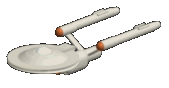
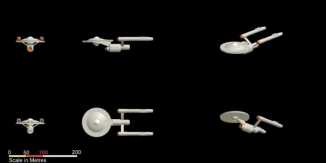
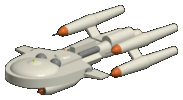
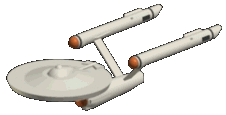
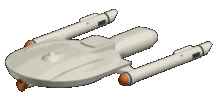
The Legendary Constitution class needs no real introduction. However the class did not become the dominant force it later was until the introduction of the Phaser equipped Mark 2. The earlier Mark 1 was lightly armed compared to the best ships of the Klingon empire largely as a result of mass constraints. As such the Mark 1 was incrementally upgraded as new technology became available in an effort to make the class as capable as possible.

The Constitution class cruisers are the most renowned vessels of their time. Serving as both a research vessel and a cruiser, these ships have performed their duties to perfection for the last 50 years. The Constitution class ships were an integral part of the buildup during “The Great Awakening,” from the outset the most versatile of all ships built for the expansion efforts.

The original construction contract called for 13 vessels to be built that would serve as cruisers, have complete research facilities, and be capable of operating on 5-year research and exploration missions. In January of 2245 (1/8801), the first of these vessels, the USS Constitution, was commissioned, followed by one more each month for five months. As soon as these vessels were completed and commissioned, they were sent on 2-year shakedown cruises. Over the next five years, the remaining 7 cruisers were built. As scheduling allowed, the ships were upgraded with new technology, particularly with binary shield generators, which led to the Mk Ib and Ic. The construction program came to a halt with the commissioning of the USS Defiant.

When the Four Years War broke out, Starfleet decided to produce warships instead of the dual-purpose cruisers that devoted large areas of their space to research and laboratories. Even though the Constitution class was not put into production for the war effort, four of the ships- in the form of the Mk Id- saw action. Each distinguished itself in battle time and again, soon gaining the nickname “The Queens of Starfleet.” After-action reports continued to show the combat ability of this ship to be superior to any other ship in the fleets, save for the combat-dedicated Heston class, and so the decision to produce more of them was finally issued in November of 2254 (1/9611).

The ship that would be produced was the Mk II version, mounting the new phaser weaponry and photon torpedoes. Because of these modifications to the original design, construction did not begin until September of 2255 (1/9709) and the first ship did not come off the line until January of 2257 (1/9901), 7 months after the end of the war. Starfleet decided to continue the production of the Constitution class cruisers and expanded the proposed total number to 42 vessels.

In April of 2258 (2/0104), the FWF-1 warp drive engine was brought into the inventory and all Constitution class ships were recalled to be refit as Mk IIIs. By October of 2263 (2/0510), the refitting was complete and the Constitution class remained the most advanced starship of its time. One Mk III, the USS Ark Royal, still serves in Starfleet, exploring the rimward areas and acting as ongoing proof of this class’ successful record. Duty on the Ark Royal is awarded as a special training tour to Starfleet cadets. It is the only Constitution class vessel still in active service.

After the first successful test firing of the FP-5 photon torpedo, Starfleet ordered that 12 Constitution class ships be modified to fire it. In February of 2269 (2/1202), the USS Discovery, USS Saratoga, USS El Dorado and USS Kitty Hawk were sent into service as Mk IVs, mounting not only the new torpedo system, but also more powerful impulse engine and shield generators.

The Mk IV was the last version of the Constitution class to be built, but not the last to use that particular hull style. The Enterprise class cruiser was originally built from older Constitution hulls and retains its general appearance. Constitution class ships were constructed at the Sol IV shipyards.

Class: XI Year: 2245
Ship Source: Paramount Pictures Ship Datasheet: Download PDF

constitution_large

Commissioned Ships (FASA)

  •  Constellation NCC-1017
  •  Republic NCC-1371
  •  Intrepid NCC-1631
  •  Farragut NCC-1647
  •  Excalibur NCC-1664
  •  Exeter NCC-1672
  •  Constitution NCC-1700
  •  Enterprise NCC-1701
  •  Potemkin NCC-1702
  •  Hood NCC-1703
  •  Bismark NCC-1704
  •  Yamato NCC-1705
  •  Lexington NCC-1709
  •  Valiant NCC-1709
  •  Kongo NCC-1710
  •  Challenger NCC-1715
  •  Yorktown NCC-1717
  •  Valiant NCC-1718
  •  Essex NCC-1719
  •  Saratoga NCC-1720
  •  El Dorado NCC-1724
  •  Kent  NCC-1725
  •  Littorio NCC-1727
  •  Ticonderoga  NCC-1736
  •  Eagle NCC-1738
  •  Santissima Trinidad NCC-1742
  •  Marseille NCC-1744
  •  Langley NCC-1749
  •  Richelieu NCC-1750
  •  Forrestal NCC-1751
  •  Kitty Hawk NCC-1754
  •  Chikuma NCC-1759
  •  Victory NCC-1760
  •  Defiant NCC-1764
  •  Rivoli NCC-1765
  •  Bonhomme Richard NCC-1776
  •  Endeavour NCC-1777
  •  Hornet NCC-1778
  •  Akagi NCC-1779
  •  Kaga NCC-1780
  •  Ark Royal NCC-1791
  •  Radetsky NCC-1792
  •  Discovery NCC-1798

Commissioned Ships (Starfleet Museum)

USS Constitution NCC-1700
USS Enterprise NCC-1701
USS Potemkin NCC-1702
USS Hood NCC-1703
USS Yorktown NCC-1704
USS Excalibur NCC-1705
USS Exeter NCC-1706
USS Valiant NCC-1707
USS Intrepid NCC-1708
USS Lexington NCC-1709
USS Constellation NCC-1710
USS Farragut NCC-1711
USS Bonhomme Richard NCC-1712
USS Monitor NCC-1713
USS Hornet NCC-1714
USS Virginia NCC-1715
USS Kongo NCC-1716
USS Defiant NCC-1717
USS Endeavour NCC-1718
USS Eagle NCC-1719
USS LaFayette NCC-1720
USS Wasp NCC-1721
USS El Dorado NCC-1722
USS Ari NCC-1723
USS Saratoga NCC-1724 USS Tori NCC-1725
USS Krieger NCC-1726
USS Essex NCC-1727
USS Ranger NCC-1728
USS Bunker Hill NCC-1729
USS Lion NCC-1730
USS Implacable NCC-1731
USS Glory NCC-1732
USS Theseus NCC-1733
USS Triumph NCC-1734
USS Ark Royal NCC-1735
USS Warrior NCC-1736
USS Magnificent NCC-1737
USS Argus NCC-1738
USS Bonaventure NCC-1739
USS Clemenceau NCC-1740
USS De Gaulle NCC-1741
USS Foch NCC-1742
USS Arromanches NCC-1743
USS Jeanne D’Arc NCC-1744
USS Vikrant NCC-1745
USS Zuikaku NCC-1746
USS Shokaku NCC-1747
USS Kiev NCC-1748
USS Minsk NCC-1749

2241 – Pyotr Velilkiy

Ordered as an alternative in case of the failure of the Constitution Class. The delays to Constitution Class and poor performance of the Ranger II meant that the Pyotr Velilkiy served as an interim Heavy Cruiser, and was ordered in quantity in response to Klingon aggression in 2244.

The eventual entry of the Constitution Class to service in large numbers meant that the Pyotr Velikiy was relegated to less glamorous duties, and some were converted to serve as tugs. The Cruiser version was phased out by 2312.

The Pyotr Veliky class was conceived as fall back design in case of delays to the Constitution Class Program. The Protoype, USS Pyotr Veliky named for the Tsar who created Russia’s Imperial Fleet, entered service in 2241. The ship mounted the ultimate non dilithium warp drive to enter service, the FFTL-7B and was the only class fitted with this engine. The other technology of this design was also well proven, in direct contrast to the advanced systems chosen for the Constitution Class. The class was designed and built at Andorian shipyards in an effort to disperse the strategically important role of building heavy cruisers away from Earth, additionally much of Earth’s ship building and design capacity was tied up in the Constitution class program.

Delays to the Constitution Class led to the ordering of 5 Mk 2 ships, the first of which entered service in 2244. The Mk 2 featured improved laser weaponry and improvements to cargo handling systems. The Pyotr Veliky class, despite it’s old technology warp reactor did have the same nacelle design as would be used on the Constitution, and many minor improvements made to the nacelles on these ships found their way into the Constitution class nacelles.

As the Mk2 ships entered service, increased Klingon aggression prompted an order to be placed for 14 Mk3 ships. The Mk3, which entered service in 2245 mounted the brand new FAC-4 accelerator cannon, but the main advance was with shielding. The New unary shields were now coming into service, and the FSG was selected to replace the inefficient system mounted on earlier ships. The FSG required the addition of a new style M series computer, and the M3 was accordingly fitted.

With the Constitution class beginning to be available in quantity by 2250, steps were taken to refit the 20 Pyotr Veliky ships for further service. 14 Ships were refitted to MkIV standards for service with Military Operations Command, and 6 to MkV for service with Galaxy Exploration Command.

The MkIV adopted the FWD-1 warp drive, this drive at half the weight of the FFTL-7B meant that the ship’s mass dropped by almost a 100,000mt. The resultant ships, although less powerful, were more efficient in movement and had a higher maximum speed, useful for patrol duties. The only old technology system retained aboard the ships was the dependable FNSP-X impulse system, as no newer style engines could yet power ships of Class XI. The refits were all complete at the outbreak of the Four Years War, where this class served distinction.

The MkV adopted the even lighter FWE-1 Warp drive, and had a major physical change with the removal of the secondary hull. These ships had been intended for use in an exploration role, but the Four Years War saw them serve as Frigates until the Surya and Coventry classes entered full service. The MkV mounted the same weapons as the MkIV and the FIC-3 impulse engine meant that it had the same amount of power as its larger sibling, but the lighter structure could absorb less damage.

Postwar surviving vessels were used in second line roles, some for exploration (Mk6) and some as cargo tugs(Mk7) or transports (mk8), although a small number did remain in defence roles with the Blue Fleet (Mk9).

The last Pyotr Veliky was not retired from service until 2312, that vessel, the USS Salah Ad-Din is now on display in the Starfleet Museum.

  • Class: XII-XIV
  • Year: 2241
  • Ship Source: Starfleet Museum
  • Ship Datasheet: Download PDF

pv1

Commissioned Ships
USS Pyotr Velikiy NCC-1670
USS Shrelev II NCC-1671
USS Yi Sun-Shin NCC-1672
USS John Paul Jones NCC-1673
USS Tav NCC-1674
USS Elizabeth I NCC-1675
USS Etrox NCC-1676
USS Togo NCC-1677
USS Rommel NCC-1678
USS Friedrich Barbarossa NCC-1679 USS Goyathlay NCC-1680
USS Washington NCC-1681
USS Niakenchiis NCC-1682
USS Salah Ad-Din NCC-1683
USS Giap NCC-1684
USS Hannibal NCC-1685
USS Zerisshebi NCC-1686
USS De Grasse NCC-1687
USS Rexx NCC-1688
USS Gantu NCC-1689

2227 – Valley Forge

In 2220 many members of the Federation Council, and Starfleet itself, recognized that the present borders of the Federation could not be adequately defended without a major investment in Ships and Starbases. The council decided that some of the marginal outlying colonies would be abandoned, and a new defensive perimeter established around the core colonies. This change of Policy required smaller Cruisers and Destroyers to be stationed at the colonies, rather than the patrolling Heavy Cruisers and Dreadnoughts previously procured.

The Lancaster Class of 2205 had proven successful, but was expensive in terms of construction, maintenance and manpower. The plan was to procure a smaller ship, using proven technologies at a lower unit cost. The design was to be evolutionary, not revolutionary. It was also to be a stand against the ever increasing growth in Starship size and cost. All construction of the class was to be carried out in Starfleet Division Shipyards. The lead ship of the class, USS Valley Forge, launched in November 2226, and commissioned in August 2227. The class was slimmer than the previous Lancaster class, but the design still followed the concepts from the Daedalus class of 2160.

More frequent border incursions by the Klingons started soon after the first Valley Forge class ships joint the fleet in 2227. The first major engagement was fought by these ships in 20 August 2242, when the USS Cougar engaged a squadron of 12 Klingon D6 cruisers attacking the Cicatrix IV colony. She destroyed two ships in combat, and a third by ramming, although the Cougar was also lost.

The Valley Forge class was also extensively used in Police Actions, especially in anti Orion priracy operations, as their greater maneuverability was better suited to engaging small targets compared to the larger cruiser classes, which were designed to engage other cruisers and capital ships. As newer ships entered service the Valley Forge class ships gradually assumed lesser roles, although they continued in service until the 2280s. The class also formed the basis for the Belleau Wood class assault transports and Siegfried class dreadnoughts (of 2232 and 2235 respectively).

USS RATTLESNAKE (NCC-1493), a participant of the Battle of Donatu V and numerous other engagements, is on display at the Starfleet Museum.

  • Class: IX
  • Year: 2227
  • Ship Source: The Starfleet Museum
  • Ship Datasheet: Download PDF

100Valley_forge_large

Commissioned Ships

USS Valley Forge NCC-1463
USS Aldrin NCC-1464
USS Tigress NCC-1465
USS California NCC-1466
USS St. Petersburg NCC-1467
USS Cougar NCC-1468
USS Independence NCC-1469
USS Diana NCC-1470
USS Arizona NCC-1471
USS O’Bannon NCC-1472
USS Tokyo NCC-1473
USS Bonderenko NCC-1474
USS Europa NCC-1475
USS Normandy NCC-1476
USS Clarke NCC-1477
USS Proteus NCC-1478
USS Los Angeles NCC-1479
USS Aelita NCC-1480
USS Elvgren NCC-1481
USS Hong Kong NCC-1482
USS Ishtar NCC-1483
USS LaFayette NCC-1484
USS Yamato NCC-1485
USS Vesta NCC-1486
USS Masaryk NCC-1487
USS Cherenkov NCC-1488
USS Oriskany NCC-1489
USS Clavius NCC-1490
USS Sheridan NCC-1491
USS Toklas NCC-1492
USS Rattlesnake NCC-1493
USS Asaph Hall NCC-1494
USS Ripley NCC-1495
USS Dallas NCC-1496
USS Canberra NCC-1497
USS Boxer NCC-1498
USS Cheetah NCC-1499
USS Artemis NCC-1500
USS Scorpion NCC-1501
USS Narcissus NCC-1502
USS Ganesa NCC-1503
USS Dolphin NCC-1504
USS Vargas NCC-1505
USS Anaconda NCC-1506