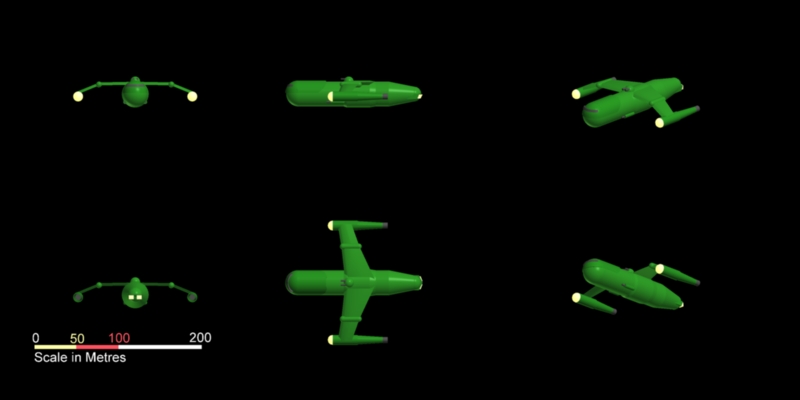
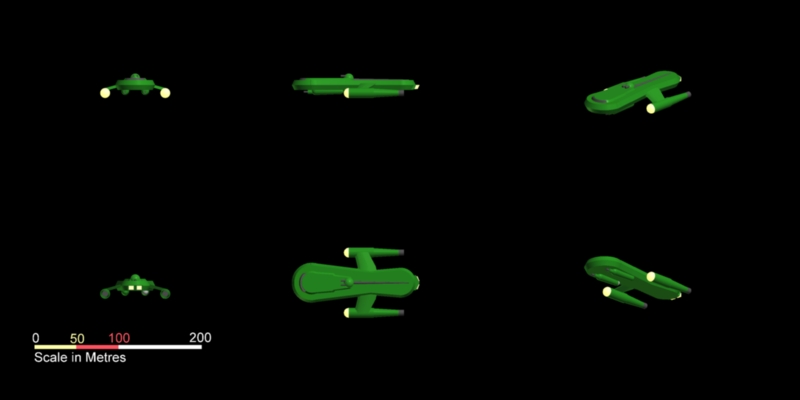
2159 – U26 Juggernaut

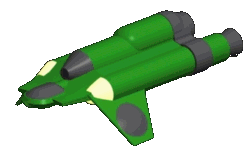
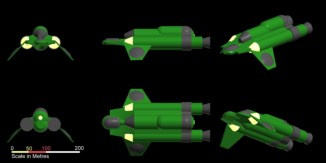
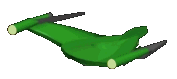
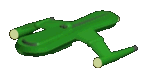
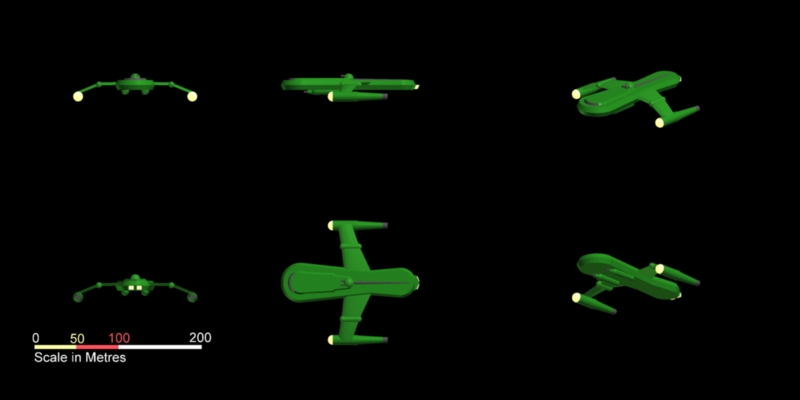
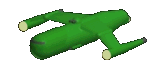
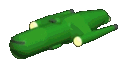
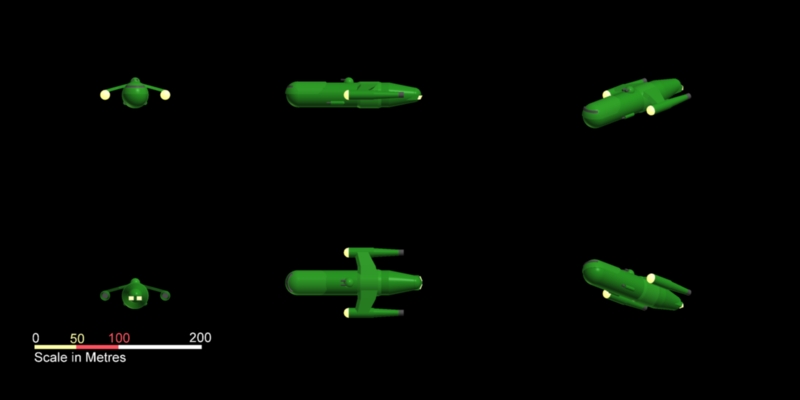
Construction of the Juggernaut class Battle cruiser began in 2152. By late 2159, the ship was finally ready to begin trials, but on 30 November 2159 , a daring combined Earth/Andorian raid snatched the vessel from its dock.

The second Juggernaut class ship was still incomplete at the time of the truce.

The Juggernaut had the potential to be the most powerful ship in known space, and the design called for it to carry up to 50 star bombs, which would have made it capable of destroying whole fleets on its own.

The second and last Juggernaut class ship finally entered service in 2169, and was destroyed in a border skirmish with the Klingons, but not until it had destroyed nine Klingon cruisers in 2185.

Class: XIV Year: 2159
Ship Source: Steve Bacon/FASA Ship Datasheet: Coming Soon

u20100

2155 – U21 stelal’deletham (Defender of Stars) Class

The U-21 entered service in 2155 and saw action in almost all of the battles of the Romulan War. The ship combined the highly effective power plant and wings of the U-19, with the light and simple to manufacture hull of the U-15.

The main delay in building the U-19 came from the building of the primary hull, as it incorporated a number of stealth features (even after the deletion of the cloak) and required the use of the latest computer for control purposes. An additional problem was that the hull relied on tritanium, a strategic resource the Romulans could only obtain in small quantities (usually by piracy). The wings of the U-19 on the other hand used duranium, as all other Romulan Starships designs did. A single U-19C with a duranium primary hull was built, but the increased amount of hull material required to give structural strength resulted in a 25% weight growth that the engines could not handle.

The simpler U-15 hull offered a simple solution. Even accounting for the heavier, less strong material, a U-15 hull weighed 10% less than a U-21 hull, and the appeal of combining the two was unquestionable. A U-15C hull was mated to the U-19C’s wings to produce the prototype U-21A. The ship was as fast as a U-19, and only slightly less manoeuvrable. Most importantly it only cost 75% more than the cost of a standard U-15, and took only 50% longer to build, and gave a 150% improvement in Combat Efficiency over the U-15.

45 U-15Cs were converted to produce the U-21A, and a further 143 new build ships were produced as U-21Bs. The U-21A mounted only cluster missiles, but the U-21B added a plasma cannon. Both variants carried drill beams and a pair of star bombs.

One notable action in 2155 saw a U-21 apparently destroy the UES Merlin, compelling evidence now suggest that both of these ships were somehow thrown forward in time by some 129 years, where both vessels were encountered by the Brenton class cruiser USS Hatton. The USS Hatton was forced to destroy the U-21-029, effectively making that ship the last vessel destroyed in the Romulan War.

The U-21 was the match of most Earth and Allied vessels until 2157 when the balance of power shifted with commissioning of the Earth’s new Battle Cruiser classes.

U-21s persisted in the post war fleet until around 2200.

Class: IX Year: 2155
Ship Source: Steve Bacon Ship Datasheet: Coming Soon

u21-100

2155 – U22 Sabinus (“Cabbage”)

The U-22 (codenamed ‘Cabbage’ by the UESN) entered service in 2155, and was one of the most commonly encountered Romulan Cruisers during the war. The design was created to allow fleet advances across interstellar distance. They were equipped with a formidable arsenal of cluster missiles and Star Bombs, and also mounted the most powerful plasma weapon yet produced, and this could be carried for distances further than any other Romulan Cruiser save for the U-13A.

However, this massive capability came at a price; the amount of deuterium fuel required by the fusion reactors to give the required range meant that the ships weighed an estimated 500,000mt. Plans to use the twin-engine system developed for the U-20 were abandoned due to delays in that program, and a modified version of the long serving RFTL-3 was adopted in a triple nacelle arrangement. The massive mass of this class badly affected its manoeuvrability and performance at warp (2.5 maximum speeds).

Early in the War the U-22 was used to great effect, the firepower overwhelming many Earth Alliance ships, and the sheer size of the vessel meant that the damage inflicted on the U-22 was easily absorbed. Later in the war as newer designs entered service with Earth and its allies, the slow ponderous U-22s became easy prey.

The vulnerability of the U-22 was demonstrated very clearly at the battle of Hell’s Gate on 21-23 October 2157. This battle saw the Earth Alliance forces crush a massive Romulan Invasion attempt. 27 U-22 Cruisers were committed to this battle, and not even one survived, it is estimated that the Romulan loss of life in this battle was in excess of 30,000 crew and troops.

The cruiser was designated as the U-22A, at the start of the war some 75 U-22As were in service, and these were joint by a further 30 built during the war. Numerous variants of the U-22 also served during the war, despite the change in roles they were all classified as part of the same series and retained the U-22 designation. The U-22B (Codename ‘Tonsil’) was a tanker built to support long-range U-22A operations, production totalled 15. Armament was reduced to just the defensive cluster missiles.

U-22C (Codename ‘Rodent’) was used as a subspace sensor/communications ship, often deployed on long intelligence gathering sorties. This class retained the plasma cannon and cluster missile, but dispensed with the star bombs to allow for the fitment of advanced sensor equipment. Only 10 of these specialist intelligence ships were built. U-22D (Codename ‘Syrup’) was a specialist troop transport/assault ship; it could carry some 2000 troops. The weapons fit dispensed with plasma weapon, but retained a full missile arsenal for self-defence and planetary assault. The U-22D was the second most common variant, with some 35 seeing service.

The U-22 suffered from the compromise made in its design, Romulan fusion engine technology meant that the only way to gain a long range was to carry massive amounts of deuterium fuel, this fuel meant that the ship’s power efficiency and speed would always be inferior to ships built for speed and manoeuvrability, especially when those ships also used matter/antimatter propulsion.

Class: XVIII Year: 2155
Ship Source: The Starfleet Museum Ship Datasheet: Download PDF

u22-100

2151 – U19 “Warbird” Class

The U-19B entered service in 2154. If it had been available in large numbers, it is possible that this ship would have won the war for the Romulan Empire.

The original U-19A began testing and evaluation in 2151, the trials proved it to be a superb vessel; it far outclassed any Earth ship, and was not far behind Klingon or Vulcan technology.

The U-19A prototypes were assigned to the Tal’shiar for testing. The Tal’shiar had obtained a number of Suliban cloaking devices, and installed them on these ships intending to use them as surveillance or covert operation ships. One of the ships was used to obtain close in scans of the Earth’s NX-01 UES Enterprise in 2152 after that vessel strayed into a minefield.

In November 2152, the three ships, in company with three U-13As, were deployed on an intelligence-gathering mission in what is now known to be Tholian space. The U-13s, acting as support ships were trailing behind the U-19s when they vanished from sensors. When the U-13s caught up, they found the U-19s caught in some kind of subspace flux. No other ships were in the vicinity or had been detected on sensors, and it was concluded that the cloaking devices were to blame. As the only people with real knowledge of the cloaking device technology were aboard the ships, the cloak programme suffered a setback from which it would take almost a century to recover. Additionally, only three cloaks had been procured from the Suliban, and an increase in tension following Suliban incursions precluded negotiations for further units.

The fourth prototype U-19 was completed to the same design, but without the cloak. Concerns existed about the cost and time required to build the ships, the U-19 cost 8 times more than a U-15, and took over four years to build each unit. The U-19A design was modified to simpler hull and nacelle design to become the U-19B. The U-19B still cost 6 times more than and requires three years to build, compared to 8 months for one of the simpler U-15s. This was largely due to the use of the immensely light and strong, but scarce and expensive metal Tritanium in the primary hull structure and plating. The wing assembly used duranium as all other Romulan ships did.

As a result, only 24 U-19Bs were completed before the end of the war (and a further 12 post war), and most of these were deployed along the Klingon Frontier to stop a much-feared invasion while the Fleet was occupied elsewhere. A single U-19C was completed to evaluate the use of duranium for the primary hull, but was deemed a failure, and was cannibalised to produce the U-21 prototype.

There is no doubt that had mass production of the U-19 been practical the outcome of the war would have been less certain, and were it not for the intervention of what is now called the Tholian (or Defiant) rift the cloaking ability of the U-19A could have caused havoc

Class: X Year: 2154
Ship Source: Star Trek Enterprise Ship Datasheet: Coming Soon

u19-100

2150 – U15 stelal’deletham (Defender of Stars) Class

The U-15A entered service in 2150 and the U-15B in 2151. In appearance, it was combination of the sleek hull of the U-9 and the wide wing of the U-13. Powered by the latest RFTL-4 warp nacelles it was the fastest ship in the fleet when it commissioned.

The ship was produced in two variants, the U-15A mounted twin plasma cannons, and the U-15B mounted cluster missiles instead. Both variants could carry a single star bomb for additional anti-ship punch. Generally, the ships were deployed in threes, with two U-15Bs to each U-15A.

On 14 October 2157 , a U-15 fired the first shot of the declared war, when it fired a single SB-2 star bomb into the UES Patton near Eta Leonis VI. The Patton had been assigned to await the response to the ultimatum delivered four months previously to the Romulan Star Empire by Admiral Gunther. Three U-15s closed in on the Patton, and it got only one message off before it was destroyed, but that message was War!

Most Romulan fleet actions in the war used U-15s as the main ship; on 17 March 2158 , two squadrons of U-15s fought an earth Alliance force of similar numbers to a tactical draw at Prantares, the Romulan fleet had been headed to Rigel to trade for urgently needed technical supplies.

U-15s made up a large part of the fleet that engaged the Earth forces near Gamma Hydra, which then engaged further forces under Admiral Larson on 02 May 2159 .

In all some 575 U-15s were built, 160 U-15As and, 340 U-15Bs, and 75 U-15Cs.

The U-15C first entered service in 2155. It was a squadron command ship, which mounted a smaller missile system to allow more room for command and control facilities. It was not successful in service, and was generally used as a standard cruiser instead as the flag bridge was too small to carry a coordinating staff of sufficient size.

A number of U-15s were later converted to U-21 configuration.

Class: VII Year: 2150
Ship Source: Steve Bacon/FASA Ship Datasheet: Coming Soon

u15-100

2146 – U13 vastagor vastarum (Death Flyer) Class

The U-13, which entered fleet service in 2146, was one of the heaviest designs to see service in the Romulan fleet. It mated a hull based on that of the early U-7 class to a new wing structure mounting the new RFTL-3 warp nacelle. The U-13 was designed for a specific purpose; it was intended as a long-range patrol cruiser. The re-adoption of the large hull form allowed a bay to be fitted that carried one of the immense SB-2 star bombs and sufficient fuel for an extended individual patrol. 120 of the U-13As were built, and it performed sterling work in this role. Additionally, these ships carried out deep penetration raids with some success. While on patrol near Eta Leonis VI on 16 June 2156 , a U-13A received the ultimatum calling for the Romulan Government to stop the piratical attacks from Admiral Gunther.

The success of these penetration missions prompted the adoption of the U-13B. The U-13B (60 built) first commissioned in 2148. It carried three SB-2 star bombs in the weapons bay, but carried only half the fuel of the U-13A. These ships were employed as strike cruisers and as heavy weapon platforms alongside more conventionally armed lighter cruisers.

Desperate for a way to strike back at the Earth Forces the U-13C and U-13D were conceived in 2157. The U-13C carried no star bombs (but retained conventional weapons); the U-13D carried five star bombs, at the expense of a reduced range. The plan was to employ the U-13Cs as tankers to allow the U-13D to reach deep inside Allied territory. It was planned that two U-13Cs would support each U-13D. In total 50 U-13Cs and 24 U-13Ds were converted (40 U-13Cs and 6 U-13Ds were converted from U-13As, 10 U-13Cs and 18 U-13Ds were converted from U-13Bs).

The first mission of the U-13C/D combination saw 48 U-13Cs stage the fleet to a safe distance from Alpha Omega B. The 24 U-13Ds and 24 escorting U-13As proceeded to that planet and attacked on 25 July 2159 . The ensuing raid saw the fleet bombard the planet with 120 star bombs from the U-13Ds (and a further 24 from the U-13As in a diversionary attack). The Diversionary U-13As went in first and were wiped out by local defences, but the U-13Ds went into the gap left in the defences and struck. Over 20,000 military and civilian personnel were killed, and the planet was rendered uninhabitable. This proved to be the deepest incursion into Allied space.

The raiding force suffered a major loss while returning to base, during an in flight  refuelling operation one of the U-13Ds exploded, destroying the U-13C it was linked to, and taking a further 12 U-13Cs with it in the explosion that resulted. Fortunately, all but one of these had already dispensed their fuel loads, allowing the surviving ships to return to base. A raid on Earth was in preparation, when on 25 November 2159 an Allied force raided the Romulan shipyards at Manaraam, this was the deepest Allied incursion of the war, and was in response to the attack on Alpha Omega B. Ironically 18 of the ships destroyed in the raid were U-13Ds. This attack and the loss of the 13 tankers in one accident was effectively the death knell for the program, as insufficient numbers of U-13s remained to convert to U-13C or D standards. The remaining U-13Cs were later modified to carry two externally mounted Star bombs as U-13Es, but the war ended before they could be perfected.

Class: IX Year: 2146
Ship Source: Steve Bacon Ship Datasheet: Coming Soon

u13-100

2144 – U11 “Greater Bird” Class

The first U-11 commissioned in 2144. It was a standard U-9 with a stretched hull. The hull extension allowed the fitment of weapon bay that allowed the internal storage of two star-bomb missiles.

Internally the U-11A mounted the same systems as the U-9A, and the warp drive system was the same as the earlier vessel (RFTL-2). The additional weight of the star-bomb missile launch system meant that the U-11A was slower and less efficient than its smaller cousin was.

Production of the U-11A was limited, as the U-13B introduced in 2148 did the same role much more effectively. In all just 40 ships were built. In 2157, the surviving 21 ships were fitted with RFTL-5 engines and became U-11B in a program that ran alongside the U-9B program.

The U-11 was employed mainly to interdict Allied Capital ships on penetration raids. The firepower given by the Starbombs made it devastating for a single salvo, but woefully under armed as soon as the two missiles had been fired if the target was not crippled or destroyed. Operation experience led to the ships being deployed in packs of three of four vessels to ensure a killer blow could be swiftly struck. Against individual targets this worked, but if engaging a capital ship with escorts, the end result was normally the loss of the pack.

The U-11B is notable for being the first ship class to use the then experimental R2L-1, a year before it’s formal acceptance into service.

Class: VII Year: 2144
Ship Source: Steve Bacon Ship Datasheet: Download PDF

u11-100

2142 – U9 vas’rosvlai (Silver Bird) Class

The U-9 class started to commission in 2142 the ship soon gained a fearsome reputation, but despite this the Earth crews dubbed it the flying peanut.

The first confirmed action involving U-9s against an Earth ship came on 18 October 2144, when two U-9s attacked the SS Amaretto within Earth controlled space. The U-9s broke off when a patrol of four Cavalry class destroyers appeared on the scene.

09 June 2148 saw a major reversal of fortune for the Romulan fleet, when the Earth’s Twenty Fourth Tactical Anti-Piracy Group cornered a U-9. This group consisted of eight Messier class cruisers and a Cavalry class destroyer. The U-9 exchanged fire with the ships, damaging the UES Oort. After sustaining substantial damage from a missile strike from the UES Hubbell the U-9, following standard Romulan policy, self-destructed to avoid capture.

On 04 May 2150, three U-9 class cruisers attacked a liner as part of the ongoing series of ‘pirate’ attacks. Almost 600 crew and passengers lost their lives in the raid, and the removal of the cargo completed the impression of piracy. The Romulans retained only the strategic materials and equipment from the cargo; they simply destroyed the remainder of it, as they had no need for it. The liner in question was the SS Diana.

The U-9 was also involved on 21 November 2151 when a mixed squadron of U-7s and U-9s destroyed eleven ships at Outer System Defence Outpost 4. The same squadron, still with U-9s in service scored a further triumph on 02 November 2154, when it attacked and destroyed Outer Sector Defence Outpost One.

Two U-9s attacked and destroyed a series of mining outposts near Sigma Canori on 16 August 2155, these ships then confronted two Horizon class cruisers of the Earth Starfleet. The U-9s managed to damage severely the UES Matador, but the UES Excelsior (commanded by Captain William Gustavus Larson) destroyed one of the U-9s and managed to drive away the other one.

The loss of the U-9 to the inferior Horizon class ship prompted an upgrade to U-9B standards. 96 ships were upgraded to U-9B standards (of 120 U-9s built). The basic U-9 had mounted the same engine system as the U-7 (RFTL-2), the lighter hull structure giving increased speed and enhanced manoeuvrability. The U-9B adopted the new RFTL-4 as used on the U-15. This engine gave the same power levels and performance, but was 20% lighter, carrying an enhanced weapons load. By January 2157, only the U-9B was in service following completion of the upgrade program. The U-9 adopted a destroyer role, acting as escorts to the larger cruisers then entering service.

Class: VI Year: 2142
Ship Source: Steve Bacon Ship Datasheet: Download PDF

u9-100

2140 – U7 vastari sanalam (Wing of Doom) Class

The first known combat between the U-7 and Earth forces came in July 2150; when two U-7As ambushed a convoy of a dozen Vanguard class Transports and an escort of five destroyers and corvettes. The first cruiser (U-07-101) destroyed two destroyers from the escort force with a combination of cluster missiles and drill beams; the second cruiser (U-07-133) destroyed a corvette and five transports. The remaining escorts managed to damage 133, and the two U-7s withdrew.

The U-7 class cruiser was involved in one of the most notorious incidents of the pre-war era. On 21 November 2151, a mixed squadron of five U-7 and two U-9 class cruisers attacked an Allied base. The base in question was Outer System Defence Outpost 4; the crews of the 155th Combat Squadron were enjoying rest and recreation at the incomplete base, knowing that the long-range sensors of the base would give sufficient warning of any raid to allow them to return to their vessels. Unfortunately, for the Allied crews, and fortunately for the Romulans, a circuit overload caused a failure of lights and other non-essential systems. Although repaired quickly, it was not realised that the overload had damaged the sensors and rendered them inoperative. The Romulan squadron struck, destroying four Taholsin class cruisers, three Thofsin class destroyers, two Cavalry class destroyers, an Assist class warp tender and a G’buqoff class armed transport. The Romulan fleet did not attack the base, mistaking storage bins outside the incomplete base for anti ship missile emplacements. The crews survived the initial attack, but almost all were dead when reinforcements arrived two weeks later, as the base’s life support system was unable to support that many people for a prolonged period.

The mission was a complete success, with the destruction of the allied ships for no losses and the subsequent loss of life at the base. However, the Tal’shiar checked the sensor logs as normal after the raid, and noticed the cocky exchanges between the ships after the raid, which breached strict communications protocols. They also noticed something the commander had not noticed. At extreme sensor range, the UES Carronade, a Cavalry class destroyer from the 155th, had monitored the transmissions between the ships after the raid. This intelligence provided the allies with valuable information, including the name of their enemy, the Rom’lnz.  The execution of the squadron’s Commander followed immediately.

The same squadron (albeit with a new commander) continued to operate, and scored another notable triumph on 02 November 2154, when it attacked and destroyed Outer Sector Defence Outpost One without loss on its part. After this, the newer Allied ships started to outclass the U-7, but it remained in service until the end of the war, although often in peripheral areas. Physically the U-7 was an enlarged U-4 hull mated to a new wing structure, which gave far better warp dynamics and fuel efficiency; this wing mounted the improved RFTL-2 warp nacelle system. Production of the U-7 totalled 140 ships, composed of 105 U-7As with Cluster Missiles, and 35 of the U-7Bs, the first Romulan ship to mount a plasma weapon. In 2158, because of lessons learnt in the conflict the 30 ships were refitted to U-7C standards, with upgraded shields, and t mixed armament of RPC-3 Plasma cannon and cluster missiles, it was intended to refit more vessels, but the shortage of frontline ships prevented this.  Only 32 ships, of all marks survived the war in a serviceable condition, and all were soon retired.

Class: VI Year: 2140
Ship Source: Paramount Pictures Ship Datasheet: Download PDF

u7-100

2130 – U4 vas’maklaram (Shrieking Bird) Class

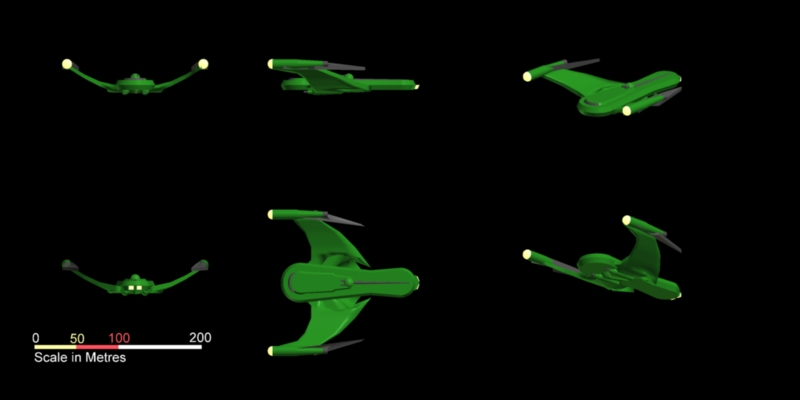
First commissioned in 2130, the U-4 class was the first successful Romulan Warp engine Cruiser design. Although primitive by modern standards, the design was superior to any ship in the Earth Starfleet at that time.

Powered by a Fusion Reactor, linked to twin RFTL-1 warp nacelles, the design exhibited many of the traits of later Romulan designs. It had a bird wing like shape to the nacelle supports, and stressed manoeuvrability over power generation.  In all 30 U-4 class cruisers were built between 2130 and 2137. The 28 of these still in service were upgraded to U-4B standards from 2144 onwards, with enhanced RM-C2 cluster missiles and RDB-2 Drill beams.

The U-4 was one of the first designs positively identified by the Allies, when on 01 January 2152 U-04-026 engaged the ACS Runemark near Canis Minoris 12. The Runemark (an Alpha Centaurian Zoenamy class Corvette) was destroyed in the long running skirmish, and the U-4 escaped with minor damage.

Three U-4Bs attacked an escorted Convoy of Tellarite G’buqoff class transports in sector 10E on 10 September 2153. Three U-4s (013,020,025) attacked the convoy and inflicted some losses before retreating after the destruction of 020. On 08 January 2157 U-04-005 (the oldest still in service, known as ‘Lucky Lucius’) entered into combat with the Thara, an Andorian Tanathooef class Cruiser near the Pretoric system. Despite the experience of her crew, 005 was destroyed in the battle, although it did destroy the Thara in a battle to the death.

The loss of 005, against a far smaller vessel, prompted the Romulan high command to withdraw the 18 surviving U-4Bs from frontline service in February 2157 and redeploy the ships on training duties and lower risk tasks. On 30 July 2158, three U-4Bs on a low risk mission destroying Earth sensor probes encountered two Tellarite Dagbaxis class Frigates. The three U-4s crippled one frigate, and forced the other to retreat, showing that the old ship still had life in it., although one U-4 was lost in the encounter.

The desperate shortage of ships in September 2159 prompted the return of the15 surviving ships to frontline service, after being modified to U-4C standards with RM-C4 Cluster missiles replacing the C-2s. However, six of these vessels (008,009,016,019,025,028) were lost almost immediately in the raid by Earth Alliance forces against the fleet base at Manaraam on 25 November 2159, this raid destroyed over 30 cruisers and gunboats before they could fire a shot in return.

A further 5 ships were lost in the Cheron campaign (008,011,017,026,021), and after other losses only 4 U-4C class cruisers survived to the truce in September 2160 (007,013,022,030). Ship 013, preserved in orbit around Romulus, serves as a monument to the sacrifice of her class.

The class, despite the appalling losses suffered, was highly successful; it suffered from the problem of continuing in service in a fleet role when it had been outclassed. The U-4’s return to service in 2159 was a desperate measure forced by the turning tides of the war

Class: VI Year: 2130
Ship Source: Paramount Pictures Ship Datasheet: Download PDF

u4-100