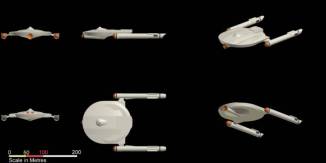
2223 – Kestrel


The Andorian ship-building industry was in a poor condition by 2218. During the Earth- Romulan War, Andorian naval ship yards in orbit had built ships of local design totaling many millions tons’ displacement. However, after 2161 few Andorian designs found favor with the new Starfleet as it preferred ships with separate primary and secondary hulls were preferred for reasons of safety and flexibility. Andorian ships placed all ship’s equipment into a single hull with integrated nacelles.

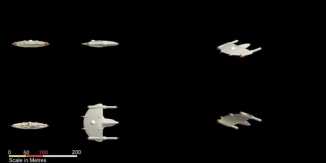
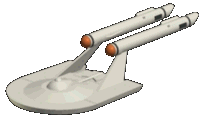
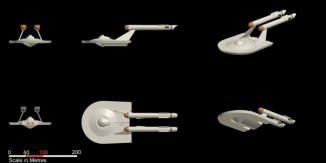
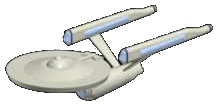
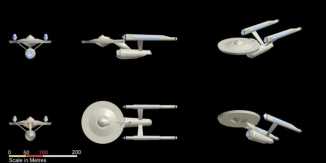
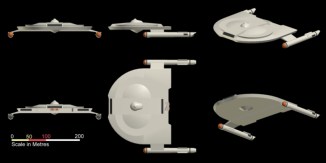
The first ship in many years to be adopted by the fleet based on Andorian designs was the Aryabhatta class Cruiser which began trials in 2221. Hovever, as this ship began testing an urgent need emerged for additional Light Cruisers for Military Operation Command. The Kestrel emerged from this requirement as an upgraded variant of the basic exploration cruiser design. Weaponry included laser cannons and torpedoes. Most science facilities were removed to increase space for fuel, weapons, better damage control facilities, and a larger sickbay. The exploratory bridge module was replaced with a combat bridge with high capacity links to weapons-control processors and target acquisition sensors. The low draft typical of Andorian designs and the countermeasures suite contributed to Kestrel’s small sensor profile. Long-range passive sensors allowed Kestrel to quietly scan extensive areas of the frontier for enemy raiders and scoutships. USS Kestrel, the first ship of the class, commissioned in February 2223.

An engagement in April 2226 with Kzinti raiders in the Little Crescent sector is typical of the actions along the Federation frontier. After an automated station reported a sensor contact with a small group of unidentified ships, USS Caudiptyrex and USS Goshawk were sent to investigate. They discovered six Kzinti heavy cruisers heading to the Federation colony on Slavin H-3. By hcarrying out alternating attack and suppression runs, the two Kestrels inflicted considerable damage on the Kzinti. These actions held the Kzinti for some 5 hours until heavier reinforcements arrived from Starbase 55 to engage the Kzinti. Five of the already weakened invaders were destroyed, and the sixth ship surrendered and was tractored back to Starbase 55.

During their courageous action, the Kestrels were struck at least 25 times each by enemy fire; however, serious casualties were avoided because of the ships robust design and powerful shields. Both ships returned to Starstation Nike under their own power, where they underwent repairs in drydock before returning to duty.

USS Shrike (NCC-1434) of the Kestrel Class is now on display at the Starfleet Museum.

Class: VI Year: 2223
Ship Source: Starfleet Museum Ship Datasheet: Download PDF

kestrel_large

Commissioned Ships

USS Kestrel NCC-1406
USS Falcon NCC-1407
USS Aquila NCC-1408
USS Warhawk NCC-1409
USS Kingfisher NCC-1410
USS Caudiptyrex NCC-1411
USS Osprey NCC-1412
USS Vulture NCC-1413
USS Pelecyornis NCC-1414
USS Harrier NCC-1415
USS Roc NCC-1416
USS Diornis NCC-1417
USS Harpy NCC-1418
USS Condor NCC-1419
USS Krechet NCC-1420 
USS Deinonychus NCC-1421
USS Kite NCC-1422
USS Goshawk NCC-1423
USS Accipiter NCC-1429
USS Pterodactyl NCC-1430
USS Rhamphorhynchus NCC-1431
USS Mononykus NCC-1432
USS Shrike NCC-1434
USS Owl NCC-1435
USS Peregrine NCC-1436
USS Merlin NCC-1439
USS Velociraptor NCC-1442
USS Skua NCC-1443
USS Hobby NCC-1444
USS Sparrowhawk NCC-1445

2222 – Detroit

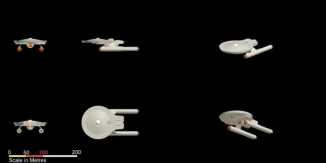
The Detroit Class was produced as the light Cruiser counterpart to the Asia class, although it did not enter service until some 20 years after the Asia class. They were intended to supplement the earlier Eclipse class cruiser, but they were found to be not as versatile.

The class had some notable firsts, including the first shuttlebays on the aft edge of the primary hull, either side of the impulse drive.

The roles intended for the class were mainly exploration and transport, and although relatively lightly armed the class could hold its own in combat.

The class was relegated to second line roles in the late 2240s when the Anton and Tyrannus class commissioned, and the surviving ships were finally withdrawn in the 2260s as they were judged to be unsuitable for upgrading


Class: VIII Year: 2222
Ship Source: Ex Astris Scientia /Bernd Schnieder Ship Datasheet: Download PDF

detroit_large_side

Commissioned Ships:

  • USS Detroit NCC-1396
  • USS Columbia NCC-1401
  • USS Lion NCC-1402
  • USS Maine NCC-1403
  • USS Forrestal NCC-1404
  • USS Mexico NCC-1405

2250 – Pyotr Velilkiy

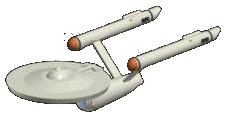
Ordered as an alternative in case of the failure of the Constitution Class. The delays to Constitution Class and poor performance of the Ranger II meant that the Pyotr Velilkiy served as an interim Heavy Cruiser, and was ordered in quantity in response to Klingon aggression in 2244.

The eventual entry of the Constitution Class to service in large numbers meant that the Pyotr Velikiy was relegated to less glamorous duties, and some were converted to serve as tugs. The Cruiser version was phased out by 2312.

The Pyotr Veliky class was conceived as fall back design in case of delays to the Constitution Class Program. The Protoype, USS Pyotr Veliky named for the Tsar who created Russia’s Imperial Fleet, entered service in 2241. The ship mounted the ultimate non dilithium warp drive to enter service, the FFTL-7B and was the only class fitted with this engine. The other technology of this design was also well proven, in direct contrast to the advanced systems chosen for the Constitution Class. The class was designed and built at Andorian shipyards in an effort to disperse the strategically important role of building heavy cruisers away from Earth, additionally much of Earth’s ship building and design capacity was tied up in the Constitution class program.

Delays to the Constitution Class led to the ordering of 5 Mk 2 ships, the first of which entered service in 2244. The Mk 2 featured improved laser weaponry and improvements to cargo handling systems. The Pyotr Veliky class, despite it’s old technology warp reactor did have the same nacelle design as would be used on the Constitution, and many minor improvements made to the nacelles on these ships found their way into the Constitution class nacelles.

As the Mk2 ships entered service, increased Klingon aggression prompted an order to be placed for 14 Mk3 ships. The Mk3, which entered service in 2245 mounted the brand new FAC-4 accelerator cannon, but the main advance was with shielding. The New unary shields were now coming into service, and the FSG was selected to replace the inefficient system mounted on earlier ships. The FSG required the addition of a new style M series computer, and the M3 was accordingly fitted.

With the Constitution class beginning to be available in quantity by 2250, steps were taken to refit the 20 Pyotr Veliky ships for further service. 14 Ships were refitted to MkIV standards for service with Military Operations Command, and 6 to MkV for service with Galaxy Exploration Command.

The MkIV adopted the FWD-1 warp drive, this drive at half the weight of the FFTL-7B meant that the ship’s mass dropped by almost a 100,000mt. The resultant ships, although less powerful, were more efficient in movement and had a higher maximum speed, useful for patrol duties. The only old technology system retained aboard the ships was the dependable FNSP-X impulse system, as no newer style engines could yet power ships of Class XI. The refits were all complete at the outbreak of the Four Years War, where this class served distinction.

The MkV adopted the even lighter FWE-1 Warp drive, and had a major physical change with the removal of the secondary hull. These ships had been intended for use in an exploration role, but the Four Years War saw them serve as Frigates until the Surya and Coventry classes entered full service. The MkV mounted the same weapons as the MkIV and the FIC-3 impulse engine meant that it had the same amount of power as its larger sibling, but the lighter structure could absorb less damage.

Postwar surviving vessels were used in second line roles, some for exploration (Mk6) and some as cargo tugs(Mk7) or transports (mk8), although a small number did remain in defence roles with the Blue Fleet (Mk9).

The last Pyotr Veliky was not retired from service until 2312, that vessel, the USS Salah Ad-Din is now on display in the Starfleet Museum.

  • Class: IX
  • Year: 2250 (Mk V)
  • Ship Source: Starfleet Museum
  • Ship Datasheet: Download PDF

pv_nopod_70

Commissioned Ships

USS Pyotr Velikiy NCC-1670

USS Shrelev II NCC-1671

USS Yi Sun-Shin NCC-1672

USS John Paul Jones NCC-1673

USS Tav NCC-1674

USS Elizabeth I NCC-1675

USS Etrox NCC-1676

USS Togo NCC-1677

USS Rommel NCC-1678

USS Friedrich Barbarossa NCC-1679 USS Goyathlay NCC-1680

USS Washington NCC-1681

USS Niakenchiis NCC-1682

USS Salah Ad-Din NCC-1683

USS Giap NCC-1684

USS Hannibal NCC-1685

USS Zerisshebi NCC-1686

USS De Grasse NCC-1687

USS Rexx NCC-1688

USS Gantu NCC-1689

2165 – Dragon (as built)

After the end of the Romulan war, most ships in the  Starfleet were small, lightly armed exploratory cruisers (such as the former UESN Daedalus and Comet classes). Most of the UESN’s heavy cruisers (Conqueror class) and fighter-carriers (Yorktown class) had been mothballed, repurposed, scrapped, or sold off to local defense forces, with only a small number entering service with Starfleet.

To meet any potential remaining Romulan  threat, Starfleet needed to replace its Conqueror-class heavy cruisers.  The large crew complements and offensive mission profile made them poorly suited for a more defensive role.

In April 2163 Starfleet issued a request for proposals for the Dragon class of border-defense heavy cruisers. The requirement was for firepower (both missile and beam weaponry) at least 33% greater than that of Conqueror. Cruising and maximum speeds were wf 3.4 and wf 4.5,again an improvement over the Conqueror. Displacement was planned to be 150,000 tons or less with a crew of 430 officers – both approximately a third of those of Conqueror. These ships were planned to be less expensive to design, construct, and operate, but still  be more effective for border defence than the wartime Cruisers. 20 Ships were planned, to commission for 2166 onwards. This baseline ship is shown as the Dragon Mk1 on the Data sheet.

The successful design was in essence a scaled up Daedalus, using some Comet style components as well. Construction of the  class began in August 2164, but problems were encountered as the first Dragon began to be fitted out with various components supplied by subcontractors. The challenging requirements led to many of these systems being designed specifically for the Dragon class, and also to these systems having an impact on the overall design. In addition Starfleet Intelligence threat analysis led to a requirement for across-the-board performance increases for all ship’s systems. Accordingly, the damage and ranges of all weaponry were to be increased by an average of 25%;  and cruising and maximum speeds were increased to wf 3.6 and wf 4.7. This improvement was to be delivered from just a 10% increase in crew size and displacement.

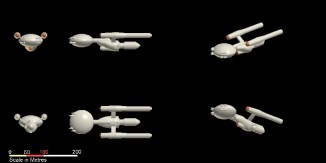
To meet the new performance requirements, numerous changes were made. To increase the cruising and maximum speeds, a more powerful warp drive with larger reactor  was installed requiring the addition of a separate “reactor hull”. In addition, the 129-m-long nacelles were replaced by 157-m-long units. As well as the increase in firepower the missile load was increased, and the shuttle bay enlarged.  These  changes further decreased the space that could be used for crew quarters, stores, and life-support systems. Dragon was now 257 m long, with an estimated displacement of 180,000 tons, and the various technical issues were still to be overcome. This is the Mk2 configuration.

In December 2165, Hull #1 was christened USS Fafnir (NCC-213) and launched to begin trials despite the ongoing integration problems. Upon commencement of trials  construction was authorized to begin on the next 3 ships of the class. However the trials of Fafnir quickly revealed numerous problems. The most severe being that the firing of a full missile salvo from the forward missile tubes at attack speed  caused the mounts for the p forward deflector and targeting sensors to become misaligned. This was resolved by structural reinforcement. High speed warp runs revealed harmonic flexing from the nacelle supports propagating throughout the length of the ship – these vibrations played havoc with navigation, weapons targeting, and prevented Fafnir from reaching design speeds. In the longer term these vibrations would lead to fatigue failure possibly resulting in the catastrophic loss of spaceframe integrity. To resolve these issues it was necessary to shorten and thicken the neck connecting the primary and secondary hulls and adding redundant supports for the nacelles on the reactor hull. Fafnir was now 247 m long but displaced 194,000 tons

By October 2166 most of the outstanding problems were being solved: the lead ship, USS Fafnir, was commissioned. Unfortunately by  2167 Starfleet’s requirements had changed, and the defensive posture of the Dragon meant they were ill suited for use in a exploration role. The lack of internal space owing to the level of equipment and weaponry fitment meant that there was no space for the installation of laboratories, scientific equipment, crew quarters, common areas, and long-term life-support systems. With the Romulan threat in abeyance, the Dragon had become a costly and immobile white elephant, and  in November 2167 Starfleet cancelled the final 10 ships of the class before construction had begun.

Despite these problems the 10 completed Dragons proved to be rugged and reliable ships –  however, all Dragons were withdrawn from front-line service by 2180 without ever having fired a shot in anger.

The Dragon-class heavy cruiser USS Jörmungandr (NCC-218) is on display in the Starfleet Museum.

Class: XI
Year: 2165
Ship Source: Starfleet Museum
Ship Datasheet: Coming Soon

Dragon Mk2 Configuration:

dragon2

Commissioned Ships

  • USS Fafnir NCC-213 completed in this configuration, but was modified during trials

2164 – Dragon (Design)

After the end of the Romulan war, most ships in the  Starfleet were small, lightly armed exploratory cruisers (such as the former UESN Daedalus and Comet classes). Most of the UESN’s heavy cruisers (Conqueror class) and fighter-carriers (Yorktown class) had been mothballed, repurposed, scrapped, or sold off to local defense forces, with only a small number entering service with Starfleet.

To meet any potential remaining Romulan  threat, Starfleet needed to replace its Conqueror-class heavy cruisers.  The large crew complements and offensive mission profile made them poorly suited for a more defensive role.

In April 2163 Starfleet issued a request for proposals for the Dragon class of border-defense heavy cruisers. The requirement was for firepower (both missile and beam weaponry) at least 33% greater than that of Conqueror. Cruising and maximum speeds were wf 3.4 and wf 4.5,again an improvement over the Conqueror. Displacement was planned to be 150,000 tons or less with a crew of 430 officers – both approximately a third of those of Conqueror. These ships were planned to be less expensive to design, construct, and operate, but still  be more effective for border defence than the wartime Cruisers. 20 Ships were planned, to commission for 2166 onwards. This baseline ship is shown as the Dragon Mk1 on the Data sheet.

The successful design was in essence a scaled up Daedalus, using some Comet style components as well. Construction of the  class began in August 2164, but problems were encountered as the first Dragon began to be fitted out with various components supplied by subcontractors. The challenging requirements led to many of these systems being designed specifically for the Dragon class, and also to these systems having an impact on the overall design. In addition Starfleet Intelligence threat analysis led to a requirement for across-the-board performance increases for all ship’s systems. Accordingly, the damage and ranges of all weaponry were to be increased by an average of 25%;  and cruising and maximum speeds were increased to wf 3.6 and wf 4.7. This improvement was to be delivered from just a 10% increase in crew size and displacement.

To meet the new performance requirements, numerous changes were made. To increase the cruising and maximum speeds, a more powerful warp drive with larger reactor  was installed requiring the addition of a separate “reactor hull”. In addition, the 129-m-long nacelles were replaced by 157-m-long units. As well as the increase in firepower the missile load was increased, and the shuttle bay enlarged.  These  changes further decreased the space that could be used for crew quarters, stores, and life-support systems. Dragon was now 257 m long, with an estimated displacement of 180,000 tons, and the various technical issues were still to be overcome. This is the Mk2 configuration.

In December 2165, Hull #1 was christened USS Fafnir (NCC-213) and launched to begin trials despite the ongoing integration problems. Upon commencement of trials  construction was authorized to begin on the next 3 ships of the class. However the trials of Fafnir quickly revealed numerous problems. The most severe being that the firing of a full missile salvo from the forward missile tubes at attack speed  caused the mounts for the p forward deflector and targeting sensors to become misaligned. This was resolved by structural reinforcement. High speed warp runs revealed harmonic flexing from the nacelle supports propagating throughout the length of the ship – these vibrations played havoc with navigation, weapons targeting, and prevented Fafnir from reaching design speeds. In the longer term these vibrations would lead to fatigue failure possibly resulting in the catastrophic loss of spaceframe integrity. To resolve these issues it was necessary to shorten and thicken the neck connecting the primary and secondary hulls and adding redundant supports for the nacelles on the reactor hull. Fafnir was now 247 m long but displaced 194,000 tons

By October 2166 most of the outstanding problems were being solved: the lead ship, USS Fafnir, was commissioned. Unfortunately by  2167 Starfleet’s requirements had changed, and the defensive posture of the Dragon meant they were ill suited for use in a exploration role. The lack of internal space owing to the level of equipment and weaponry fitment meant that there was no space for the installation of laboratories, scientific equipment, crew quarters, common areas, and long-term life-support systems. With the Romulan threat in abeyance, the Dragon had become a costly and immobile white elephant, and  in November 2167 Starfleet cancelled the final 10 ships of the class before construction had begun.

Despite these problems the 10 completed Dragons proved to be rugged and reliable ships –  however, all Dragons were withdrawn from front-line service by 2180 without ever having fired a shot in anger.

The Dragon-class heavy cruiser USS Jörmungandr (NCC-218) is on display in the Starfleet Museum.

Class: X
Year: 2164
Ship Source: Starfleet Museum
Ship Datasheet: Coming Soon

Dragon Mk1 Configuration:

dragon1

Commissioned Ships

  • USS Fafnir NCC-213 was commenced in this configuration but was modified before commissioning,

2256 – Derf

The Derf was designed as a destroyer leader (Daring Class), but improvements in sensor technology in the Four Years War  rendered this type of ship obsolete. It was then proposed to be re-roled as an exploration cruiser (Derf class), but the decision to produce further ships of the Constitution and Anton classes meant that it could not fulfill that role either. Finally the USS Derf was borrowed for a demonstration of the buoy tender concept. This demonstration was so successful that serial production of the Derf was ordered immediately and eventually totaled 600 vessels over a period of 35 years. Few vessels in Starfleet history have achieved either that level or longevity of production and it is certain that had the class been adopted in either of the other two intended roles it would not have gotten anywhere near either figure.

USS Derf was the only ship of this design commissioned in the exploration cruiser configuration (in January 2256), but she was soon converted for trials as a tender in July 2256.

Class: IX Year: 2256
Ship Source: FASA Original/ Additional material by Lee Wood/Steve Bacon Ship Datasheet:

derf_side

2269 – Brenton

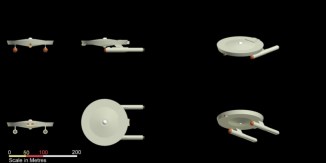
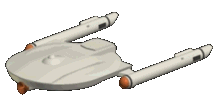
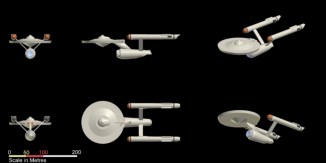
The Brenton class cruiser was designed as a complement to the Constitution class vessels and a replacement for the ageing Baton Rouge class ships in front line areas. An excellent example of Starfleet’s multi-mission design philosophy, the Brenton can readily serve under Galaxy Exploration Command or Military Operations Command. It also serves as a command ship for Starfleet operations.

The Brenton is economical to build and cheaper to operate than most other similar sized cruisers. It has a smaller crew than Constitution or later Enterprise class heavy cruisers, but can serve in similar roles as the heavy cruisers. The Brenton was designed more for combat than research, although it does have adequate facilities on board for research and exploration. It is not classed as a heavy cruiser due to lack of a secondary hull, however due to the immense width of the class it does not lack internal space.

The Brenton was designed for the older style warp nacelles from the Constitution class era, but after the first five units this was changed during construction when the newer design became standard usage. Its aft-firing torpedo has caused many an opponent to think twice before attacking from the rear. In fact, when the Brenton class first saw combat with the Klingons, the Klingons were allowed to approach from the rear. The Klingons, seeing the perfect chance to attack, were annihilated at close range by the “stupid, crippled Federation captains”, as was quoted by one captured Klingon commander after the engagement. This action has caused the Klingons to treat Brentons with respect.

Class: XI Year: 2269
Ship Source: Based on FASA Brenton Ship Datasheet: Download PDF

brenton-old-100