2154 – Marshall

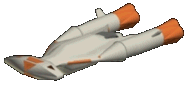
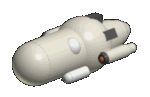
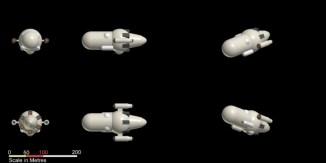
“The ambush and loss of the UES Patton began the Romulan War. The Marshall class was the Earth’s staunchest line of defence, and these ships’ superior performance and firepower provided a crucial tactical edge. In fact, the class supposed to succeed it could not better its specifications and so was never built, the reason why the Marshall class had the longest commissioned lifespan in interstellar history (at that time).”

The Marshall class destroyer was produced in vast numbers during the Romulan War. It was not the most powerful ship of its type, but it was easy and quick to produce at a time when every ship that could be built was a valuable addition to the Fleet. It was generally used as a convoy escort and patrol vessel. The USS Patton of this class has the dubious distinction of being the first ship destroyed in the Romulan War

Class: III Year: 2154
Ship Source: Space Flight Chronology Ship Datasheet: Download PDF

marshall_sharp

2155 – U22 Sabinus (“Cabbage”)

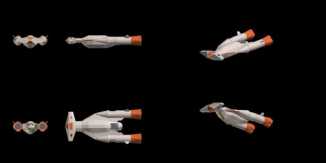
The U-22 (codenamed ‘Cabbage’ by the UESN) entered service in 2155, and was one of the most commonly encountered Romulan Cruisers during the war. The design was created to allow fleet advances across interstellar distance. They were equipped with a formidable arsenal of cluster missiles and Star Bombs, and also mounted the most powerful plasma weapon yet produced, and this could be carried for distances further than any other Romulan Cruiser save for the U-13A.

However, this massive capability came at a price; the amount of deuterium fuel required by the fusion reactors to give the required range meant that the ships weighed an estimated 500,000mt. Plans to use the twin-engine system developed for the U-20 were abandoned due to delays in that program, and a modified version of the long serving RFTL-3 was adopted in a triple nacelle arrangement. The massive mass of this class badly affected its manoeuvrability and performance at warp (2.5 maximum speeds).

Early in the War the U-22 was used to great effect, the firepower overwhelming many Earth Alliance ships, and the sheer size of the vessel meant that the damage inflicted on the U-22 was easily absorbed. Later in the war as newer designs entered service with Earth and its allies, the slow ponderous U-22s became easy prey.

The vulnerability of the U-22 was demonstrated very clearly at the battle of Hell’s Gate on 21-23 October 2157. This battle saw the Earth Alliance forces crush a massive Romulan Invasion attempt. 27 U-22 Cruisers were committed to this battle, and not even one survived, it is estimated that the Romulan loss of life in this battle was in excess of 30,000 crew and troops.

The cruiser was designated as the U-22A, at the start of the war some 75 U-22As were in service, and these were joint by a further 30 built during the war. Numerous variants of the U-22 also served during the war, despite the change in roles they were all classified as part of the same series and retained the U-22 designation. The U-22B (Codename ‘Tonsil’) was a tanker built to support long-range U-22A operations, production totalled 15. Armament was reduced to just the defensive cluster missiles.

U-22C (Codename ‘Rodent’) was used as a subspace sensor/communications ship, often deployed on long intelligence gathering sorties. This class retained the plasma cannon and cluster missile, but dispensed with the star bombs to allow for the fitment of advanced sensor equipment. Only 10 of these specialist intelligence ships were built. U-22D (Codename ‘Syrup’) was a specialist troop transport/assault ship; it could carry some 2000 troops. The weapons fit dispensed with plasma weapon, but retained a full missile arsenal for self-defence and planetary assault. The U-22D was the second most common variant, with some 35 seeing service.

The U-22 suffered from the compromise made in its design, Romulan fusion engine technology meant that the only way to gain a long range was to carry massive amounts of deuterium fuel, this fuel meant that the ship’s power efficiency and speed would always be inferior to ships built for speed and manoeuvrability, especially when those ships also used matter/antimatter propulsion.

Class: XVIII Year: 2155
Ship Source: The Starfleet Museum Ship Datasheet: Download PDF

u22-100

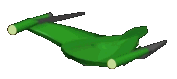
2151 – U19 “Warbird” Class

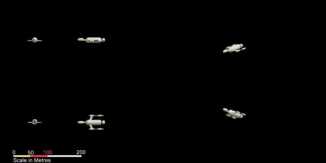
The U-19B entered service in 2154. If it had been available in large numbers, it is possible that this ship would have won the war for the Romulan Empire.

The original U-19A began testing and evaluation in 2151, the trials proved it to be a superb vessel; it far outclassed any Earth ship, and was not far behind Klingon or Vulcan technology.

The U-19A prototypes were assigned to the Tal’shiar for testing. The Tal’shiar had obtained a number of Suliban cloaking devices, and installed them on these ships intending to use them as surveillance or covert operation ships. One of the ships was used to obtain close in scans of the Earth’s NX-01 UES Enterprise in 2152 after that vessel strayed into a minefield.

In November 2152, the three ships, in company with three U-13As, were deployed on an intelligence-gathering mission in what is now known to be Tholian space. The U-13s, acting as support ships were trailing behind the U-19s when they vanished from sensors. When the U-13s caught up, they found the U-19s caught in some kind of subspace flux. No other ships were in the vicinity or had been detected on sensors, and it was concluded that the cloaking devices were to blame. As the only people with real knowledge of the cloaking device technology were aboard the ships, the cloak programme suffered a setback from which it would take almost a century to recover. Additionally, only three cloaks had been procured from the Suliban, and an increase in tension following Suliban incursions precluded negotiations for further units.

The fourth prototype U-19 was completed to the same design, but without the cloak. Concerns existed about the cost and time required to build the ships, the U-19 cost 8 times more than a U-15, and took over four years to build each unit. The U-19A design was modified to simpler hull and nacelle design to become the U-19B. The U-19B still cost 6 times more than and requires three years to build, compared to 8 months for one of the simpler U-15s. This was largely due to the use of the immensely light and strong, but scarce and expensive metal Tritanium in the primary hull structure and plating. The wing assembly used duranium as all other Romulan ships did.

As a result, only 24 U-19Bs were completed before the end of the war (and a further 12 post war), and most of these were deployed along the Klingon Frontier to stop a much-feared invasion while the Fleet was occupied elsewhere. A single U-19C was completed to evaluate the use of duranium for the primary hull, but was deemed a failure, and was cannibalised to produce the U-21 prototype.

There is no doubt that had mass production of the U-19 been practical the outcome of the war would have been less certain, and were it not for the intervention of what is now called the Tholian (or Defiant) rift the cloaking ability of the U-19A could have caused havoc

Class: X Year: 2154
Ship Source: Star Trek Enterprise Ship Datasheet: Coming Soon

u19-100

2154 – Pioneer

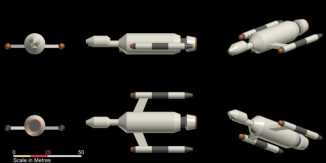
The Pioneer Class was adapted from the Bison class cargo vessel, and at the Outbreak of the Romulan war was the Earth’s premier combat vessel. Despite her extreme size, caused by the massive fuel tanks, like all fusion powered ships she lacked range and relied on refuelling when on any long duration missions. The class performed valiantly during the early stages of the war.

  • Class: XVII
  • Year: 2154
  • Ship Source: The Starfleet Museum Ship
  • Datasheet: Download PDF

pioneer_side_large