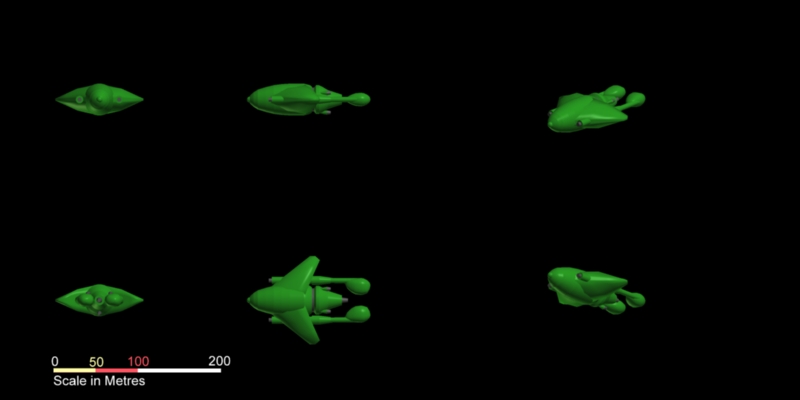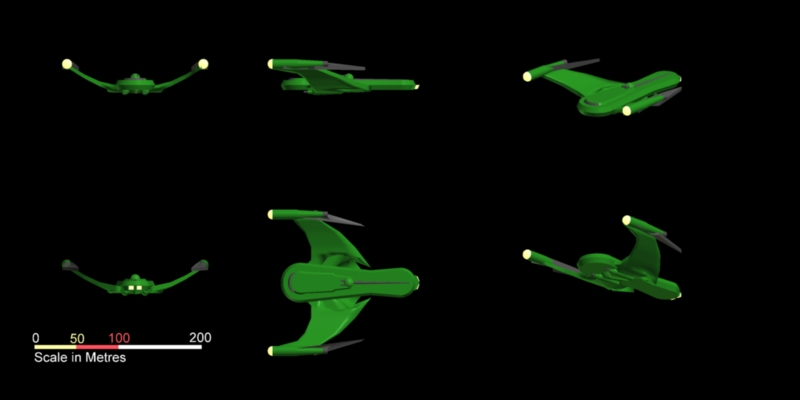

2165 – Dragon (as built)

After the end of the Romulan war, most ships in the  Starfleet were small, lightly armed exploratory cruisers (such as the former UESN Daedalus and Comet classes). Most of the UESN’s heavy cruisers (Conqueror class) and fighter-carriers (Yorktown class) had been mothballed, repurposed, scrapped, or sold off to local defense forces, with only a small number entering service with Starfleet.

To meet any potential remaining Romulan  threat, Starfleet needed to replace its Conqueror-class heavy cruisers.  The large crew complements and offensive mission profile made them poorly suited for a more defensive role.

In April 2163 Starfleet issued a request for proposals for the Dragon class of border-defense heavy cruisers. The requirement was for firepower (both missile and beam weaponry) at least 33% greater than that of Conqueror. Cruising and maximum speeds were wf 3.4 and wf 4.5,again an improvement over the Conqueror. Displacement was planned to be 150,000 tons or less with a crew of 430 officers – both approximately a third of those of Conqueror. These ships were planned to be less expensive to design, construct, and operate, but still  be more effective for border defence than the wartime Cruisers. 20 Ships were planned, to commission for 2166 onwards. This baseline ship is shown as the Dragon Mk1 on the Data sheet.

The successful design was in essence a scaled up Daedalus, using some Comet style components as well. Construction of the  class began in August 2164, but problems were encountered as the first Dragon began to be fitted out with various components supplied by subcontractors. The challenging requirements led to many of these systems being designed specifically for the Dragon class, and also to these systems having an impact on the overall design. In addition Starfleet Intelligence threat analysis led to a requirement for across-the-board performance increases for all ship’s systems. Accordingly, the damage and ranges of all weaponry were to be increased by an average of 25%;  and cruising and maximum speeds were increased to wf 3.6 and wf 4.7. This improvement was to be delivered from just a 10% increase in crew size and displacement.

To meet the new performance requirements, numerous changes were made. To increase the cruising and maximum speeds, a more powerful warp drive with larger reactor  was installed requiring the addition of a separate “reactor hull”. In addition, the 129-m-long nacelles were replaced by 157-m-long units. As well as the increase in firepower the missile load was increased, and the shuttle bay enlarged.  These  changes further decreased the space that could be used for crew quarters, stores, and life-support systems. Dragon was now 257 m long, with an estimated displacement of 180,000 tons, and the various technical issues were still to be overcome. This is the Mk2 configuration.

In December 2165, Hull #1 was christened USS Fafnir (NCC-213) and launched to begin trials despite the ongoing integration problems. Upon commencement of trials  construction was authorized to begin on the next 3 ships of the class. However the trials of Fafnir quickly revealed numerous problems. The most severe being that the firing of a full missile salvo from the forward missile tubes at attack speed  caused the mounts for the p forward deflector and targeting sensors to become misaligned. This was resolved by structural reinforcement. High speed warp runs revealed harmonic flexing from the nacelle supports propagating throughout the length of the ship – these vibrations played havoc with navigation, weapons targeting, and prevented Fafnir from reaching design speeds. In the longer term these vibrations would lead to fatigue failure possibly resulting in the catastrophic loss of spaceframe integrity. To resolve these issues it was necessary to shorten and thicken the neck connecting the primary and secondary hulls and adding redundant supports for the nacelles on the reactor hull. Fafnir was now 247 m long but displaced 194,000 tons

By October 2166 most of the outstanding problems were being solved: the lead ship, USS Fafnir, was commissioned. Unfortunately by  2167 Starfleet’s requirements had changed, and the defensive posture of the Dragon meant they were ill suited for use in a exploration role. The lack of internal space owing to the level of equipment and weaponry fitment meant that there was no space for the installation of laboratories, scientific equipment, crew quarters, common areas, and long-term life-support systems. With the Romulan threat in abeyance, the Dragon had become a costly and immobile white elephant, and  in November 2167 Starfleet cancelled the final 10 ships of the class before construction had begun.

Despite these problems the 10 completed Dragons proved to be rugged and reliable ships –  however, all Dragons were withdrawn from front-line service by 2180 without ever having fired a shot in anger.

The Dragon-class heavy cruiser USS Jörmungandr (NCC-218) is on display in the Starfleet Museum.

Class: XI
Year: 2165
Ship Source: Starfleet Museum
Ship Datasheet: Coming Soon

Dragon Mk2 Configuration:
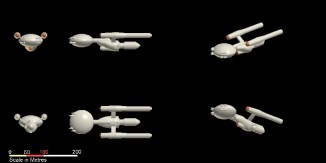
dragon2

Commissioned Ships

  • USS Fafnir NCC-213 completed in this configuration, but was modified during trials

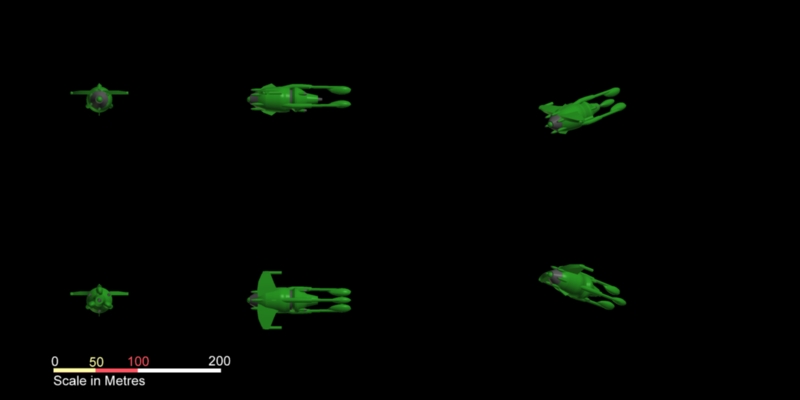
2164 – Dragon (Design)

After the end of the Romulan war, most ships in the  Starfleet were small, lightly armed exploratory cruisers (such as the former UESN Daedalus and Comet classes). Most of the UESN’s heavy cruisers (Conqueror class) and fighter-carriers (Yorktown class) had been mothballed, repurposed, scrapped, or sold off to local defense forces, with only a small number entering service with Starfleet.

To meet any potential remaining Romulan  threat, Starfleet needed to replace its Conqueror-class heavy cruisers.  The large crew complements and offensive mission profile made them poorly suited for a more defensive role.

In April 2163 Starfleet issued a request for proposals for the Dragon class of border-defense heavy cruisers. The requirement was for firepower (both missile and beam weaponry) at least 33% greater than that of Conqueror. Cruising and maximum speeds were wf 3.4 and wf 4.5,again an improvement over the Conqueror. Displacement was planned to be 150,000 tons or less with a crew of 430 officers – both approximately a third of those of Conqueror. These ships were planned to be less expensive to design, construct, and operate, but still  be more effective for border defence than the wartime Cruisers. 20 Ships were planned, to commission for 2166 onwards. This baseline ship is shown as the Dragon Mk1 on the Data sheet.

The successful design was in essence a scaled up Daedalus, using some Comet style components as well. Construction of the  class began in August 2164, but problems were encountered as the first Dragon began to be fitted out with various components supplied by subcontractors. The challenging requirements led to many of these systems being designed specifically for the Dragon class, and also to these systems having an impact on the overall design. In addition Starfleet Intelligence threat analysis led to a requirement for across-the-board performance increases for all ship’s systems. Accordingly, the damage and ranges of all weaponry were to be increased by an average of 25%;  and cruising and maximum speeds were increased to wf 3.6 and wf 4.7. This improvement was to be delivered from just a 10% increase in crew size and displacement.

To meet the new performance requirements, numerous changes were made. To increase the cruising and maximum speeds, a more powerful warp drive with larger reactor  was installed requiring the addition of a separate “reactor hull”. In addition, the 129-m-long nacelles were replaced by 157-m-long units. As well as the increase in firepower the missile load was increased, and the shuttle bay enlarged.  These  changes further decreased the space that could be used for crew quarters, stores, and life-support systems. Dragon was now 257 m long, with an estimated displacement of 180,000 tons, and the various technical issues were still to be overcome. This is the Mk2 configuration.

In December 2165, Hull #1 was christened USS Fafnir (NCC-213) and launched to begin trials despite the ongoing integration problems. Upon commencement of trials  construction was authorized to begin on the next 3 ships of the class. However the trials of Fafnir quickly revealed numerous problems. The most severe being that the firing of a full missile salvo from the forward missile tubes at attack speed  caused the mounts for the p forward deflector and targeting sensors to become misaligned. This was resolved by structural reinforcement. High speed warp runs revealed harmonic flexing from the nacelle supports propagating throughout the length of the ship – these vibrations played havoc with navigation, weapons targeting, and prevented Fafnir from reaching design speeds. In the longer term these vibrations would lead to fatigue failure possibly resulting in the catastrophic loss of spaceframe integrity. To resolve these issues it was necessary to shorten and thicken the neck connecting the primary and secondary hulls and adding redundant supports for the nacelles on the reactor hull. Fafnir was now 247 m long but displaced 194,000 tons

By October 2166 most of the outstanding problems were being solved: the lead ship, USS Fafnir, was commissioned. Unfortunately by  2167 Starfleet’s requirements had changed, and the defensive posture of the Dragon meant they were ill suited for use in a exploration role. The lack of internal space owing to the level of equipment and weaponry fitment meant that there was no space for the installation of laboratories, scientific equipment, crew quarters, common areas, and long-term life-support systems. With the Romulan threat in abeyance, the Dragon had become a costly and immobile white elephant, and  in November 2167 Starfleet cancelled the final 10 ships of the class before construction had begun.

Despite these problems the 10 completed Dragons proved to be rugged and reliable ships –  however, all Dragons were withdrawn from front-line service by 2180 without ever having fired a shot in anger.

The Dragon-class heavy cruiser USS Jörmungandr (NCC-218) is on display in the Starfleet Museum.

Class: X
Year: 2164
Ship Source: Starfleet Museum
Ship Datasheet: Coming Soon

Dragon Mk1 Configuration:

dragon1

Commissioned Ships

  • USS Fafnir NCC-213 was commenced in this configuration but was modified before commissioning,

2159 – U25 Tyrannus Class (“Clavicle”)

The introduction of matter/anti-matter power plants into the majority of new Earth Alliance ship designs from 2158 onwards meant that in virtually every confrontation the Romulans were outmatched.

The Romulan fleet had invested heavily into developing artificial quantum singularities as a power source, to try to counter these new power plants. This meant however that they neglected research into the far simpler matter/anti-matter source, and only put limited funds into improving their fusion reactor systems, meaning that no significant improvements occurred in this field until very late in the war.

The U-25A (codenamed ‘Clavicle’), which entered service in 2159, benefited from the new fusion reactor research, and was the first Romulan cruiser that could match most Earth vessels in a confrontation since the advent of matter/anti-matter power in the Earth Alliance ships. The U-25A returned to the flatter shape of pre-war ships, as the Romulan fleet acknowledged that the increase in production time and cost was far outweighed by the improved warp dynamics it offered. The combination of this improved shape and the new power plant gave a top speed in excess of warp 4.2.

The use of Fusion, which relied on ample supplies of deuterium fuel, limited the range, but as with the U-24, the Romulan fleet was now fighting within range of its home bases, so this was no longer a priority. Firepower was still a priority; the U-25A carried an impressive mixed and balanced arsenal. When used cleverly the U-25A was a good as most opposition it would face. In a chase, the weaknesses of the limited range would soon show, but when used to ambush enemy forces the class was devastating. Even in an ambush situation, the U-25A had to destroy its target before reinforcements arrived, as full speed would soon exhaust the fuel supply if pursued.

The other factor about the U-25A that weakened it was the power plant itself. The technical achievement in almost doubling the power output was impressive, but the penalty was that if pushed too hard the reactor could easily overload. Reactor explosion, rather than enemy fire, accounted for half of all U-25A losses. 25 U-25A were built in total, of which 15 saw Romulan war service, and of these 11 were destroyed. The limited numbers produced, and the lateness of the introduction into service meant that the U-25 had only limited influence on the outcome of the war. It did, however, reassert the Romulan style of ship design that later became synonymous with all their vessels.

Post-war improved U-25B and C variants saw service, some of these ships survived in the fleet until 2200. The U-25B (2165) introduced improved shields (a major lesson learnt from the war) and an improved plasma cannon. The final version, U-25C changed the balance of the design by mounting more, less powerful starbombs, to compensate for the fitting of a second plasma cannon, as well as enhanced beam weapons.

u25-100


2158 – U24 Veronus Class (“Chowder”)

The U-24 (Codename ‘Chowder’) was a Strike Cruiser, for use as part of the defensive strategy. Compared to the U-22 Class the U-24 was a far lighter and more manoeuvrable design. This performance improved also included an increase in maximum speed to Warp 3.2.

The U-24 gradually replaced the U-22 in production as the Romulans shifted from offence to defence; operating close to bases meant that Cruisers no longer required the amount of fuel that the U-22 had carried to extend its reach.

In terms of armament, the U-24 did still pack an appreciable punch, again carrying star bomb anti ship missiles and defensive cluster missiles. The class also carried a nose mounted plasma cannon, although this was of lower power than that of the U-22. Frequently, U-24s were employed in an anti capital ship role, their speed and manoeuvrability giving an edge over the lumbering Earth Battle Cruisers and Carriers. They proved to be vulnerable themselves, as the lighter structure that gave the U-24s their speed made them vulnerable to attack from nimble Minotaur class fighters and Powhatan class Cruisers.

U-24s managed to destroy 5 Yorktown class carriers, and 19 other capital ships of various types, but that was at enormous cost, of the 112 U-24s deployed during the war, ships destroyed or listed as missing totalled 82.

Three distinct variants of the U-24 exist. The most common was the U-24A, which entered service in 2258. This mounted a mix of defensive and offensive missiles as well as the Plasma Cannon, 81 of the ships built during the war were of this type. Production continued post-war and a further 38 ships were built of this mark. The second variant (again in service from 2158) was the U-24B, which carried only star bomb anti ship missiles. The Star bomb variant carried by this mark was the lightest (and least powerful) produced by the Romulans, the RM-SB4. It could however carry ten of the weapons, and it retained its plasma cannon as a back up. Some 30 of the completed ships were of this model.

The U-24C, of which saw only a single prototype built, adopted an all or nothing approach. This variant dispensed with all weapons except for the star bombs. As a result, it could carry sixteen of the light RM-SB4s for use against high value targets. The variant was also fitted with a further star bomb in its nose, for use as a last resort weapon in ramming actions.  Intended for use in the defence of Romulus, this variant began testing in mid 2159.  Luckily, for both sides, the war ended before this model saw action. Testing indicated that the ship was woefully underpowered, and could only fire a useful salvo if not manoeuvring or not powering the already inadequate defensive screens, additionally it lost the manoeuvrability that made the U-24A so devastating.

The U-24 was a departure from the larger designs that preceded it. Many things including the changing nature of the conflict and the need for quick to produce ships caused this change. However, the striking power of the U-24 was almost equal to that of many earlier and far larger cruisers; both the Romulan and Federation fleets followed this trend post war, meaning the leviathans that saw action in the Romulan War soon faded into history

Class: VI Year: 2158
Ship Source: The Starfleet Museum Ship Datasheet: Download PDF

u24-100

2159 – U26 Juggernaut

Construction of the Juggernaut class Battle cruiser began in 2152. By late 2159, the ship was finally ready to begin trials, but on 30 November 2159 , a daring combined Earth/Andorian raid snatched the vessel from its dock.

The second Juggernaut class ship was still incomplete at the time of the truce.

The Juggernaut had the potential to be the most powerful ship in known space, and the design called for it to carry up to 50 star bombs, which would have made it capable of destroying whole fleets on its own.

The second and last Juggernaut class ship finally entered service in 2169, and was destroyed in a border skirmish with the Klingons, but not until it had destroyed nine Klingon cruisers in 2185.

Class: XIV Year: 2159
Ship Source: Steve Bacon/FASA Ship Datasheet: Coming Soon

u20100

2155 – U21 stelal’deletham (Defender of Stars) Class

The U-21 entered service in 2155 and saw action in almost all of the battles of the Romulan War. The ship combined the highly effective power plant and wings of the U-19, with the light and simple to manufacture hull of the U-15.

The main delay in building the U-19 came from the building of the primary hull, as it incorporated a number of stealth features (even after the deletion of the cloak) and required the use of the latest computer for control purposes. An additional problem was that the hull relied on tritanium, a strategic resource the Romulans could only obtain in small quantities (usually by piracy). The wings of the U-19 on the other hand used duranium, as all other Romulan Starships designs did. A single U-19C with a duranium primary hull was built, but the increased amount of hull material required to give structural strength resulted in a 25% weight growth that the engines could not handle.

The simpler U-15 hull offered a simple solution. Even accounting for the heavier, less strong material, a U-15 hull weighed 10% less than a U-21 hull, and the appeal of combining the two was unquestionable. A U-15C hull was mated to the U-19C’s wings to produce the prototype U-21A. The ship was as fast as a U-19, and only slightly less manoeuvrable. Most importantly it only cost 75% more than the cost of a standard U-15, and took only 50% longer to build, and gave a 150% improvement in Combat Efficiency over the U-15.

45 U-15Cs were converted to produce the U-21A, and a further 143 new build ships were produced as U-21Bs. The U-21A mounted only cluster missiles, but the U-21B added a plasma cannon. Both variants carried drill beams and a pair of star bombs.

One notable action in 2155 saw a U-21 apparently destroy the UES Merlin, compelling evidence now suggest that both of these ships were somehow thrown forward in time by some 129 years, where both vessels were encountered by the Brenton class cruiser USS Hatton. The USS Hatton was forced to destroy the U-21-029, effectively making that ship the last vessel destroyed in the Romulan War.

The U-21 was the match of most Earth and Allied vessels until 2157 when the balance of power shifted with commissioning of the Earth’s new Battle Cruiser classes.

U-21s persisted in the post war fleet until around 2200.

Class: IX Year: 2155
Ship Source: Steve Bacon Ship Datasheet: Coming Soon

u21-100

2155 – U22 Sabinus (“Cabbage”)

The U-22 (codenamed ‘Cabbage’ by the UESN) entered service in 2155, and was one of the most commonly encountered Romulan Cruisers during the war. The design was created to allow fleet advances across interstellar distance. They were equipped with a formidable arsenal of cluster missiles and Star Bombs, and also mounted the most powerful plasma weapon yet produced, and this could be carried for distances further than any other Romulan Cruiser save for the U-13A.

However, this massive capability came at a price; the amount of deuterium fuel required by the fusion reactors to give the required range meant that the ships weighed an estimated 500,000mt. Plans to use the twin-engine system developed for the U-20 were abandoned due to delays in that program, and a modified version of the long serving RFTL-3 was adopted in a triple nacelle arrangement. The massive mass of this class badly affected its manoeuvrability and performance at warp (2.5 maximum speeds).

Early in the War the U-22 was used to great effect, the firepower overwhelming many Earth Alliance ships, and the sheer size of the vessel meant that the damage inflicted on the U-22 was easily absorbed. Later in the war as newer designs entered service with Earth and its allies, the slow ponderous U-22s became easy prey.

The vulnerability of the U-22 was demonstrated very clearly at the battle of Hell’s Gate on 21-23 October 2157. This battle saw the Earth Alliance forces crush a massive Romulan Invasion attempt. 27 U-22 Cruisers were committed to this battle, and not even one survived, it is estimated that the Romulan loss of life in this battle was in excess of 30,000 crew and troops.

The cruiser was designated as the U-22A, at the start of the war some 75 U-22As were in service, and these were joint by a further 30 built during the war. Numerous variants of the U-22 also served during the war, despite the change in roles they were all classified as part of the same series and retained the U-22 designation. The U-22B (Codename ‘Tonsil’) was a tanker built to support long-range U-22A operations, production totalled 15. Armament was reduced to just the defensive cluster missiles.

U-22C (Codename ‘Rodent’) was used as a subspace sensor/communications ship, often deployed on long intelligence gathering sorties. This class retained the plasma cannon and cluster missile, but dispensed with the star bombs to allow for the fitment of advanced sensor equipment. Only 10 of these specialist intelligence ships were built. U-22D (Codename ‘Syrup’) was a specialist troop transport/assault ship; it could carry some 2000 troops. The weapons fit dispensed with plasma weapon, but retained a full missile arsenal for self-defence and planetary assault. The U-22D was the second most common variant, with some 35 seeing service.

The U-22 suffered from the compromise made in its design, Romulan fusion engine technology meant that the only way to gain a long range was to carry massive amounts of deuterium fuel, this fuel meant that the ship’s power efficiency and speed would always be inferior to ships built for speed and manoeuvrability, especially when those ships also used matter/antimatter propulsion.

Class: XVIII Year: 2155
Ship Source: The Starfleet Museum Ship Datasheet: Download PDF

u22-100

2151 – U19 “Warbird” Class

The U-19B entered service in 2154. If it had been available in large numbers, it is possible that this ship would have won the war for the Romulan Empire.

The original U-19A began testing and evaluation in 2151, the trials proved it to be a superb vessel; it far outclassed any Earth ship, and was not far behind Klingon or Vulcan technology.

The U-19A prototypes were assigned to the Tal’shiar for testing. The Tal’shiar had obtained a number of Suliban cloaking devices, and installed them on these ships intending to use them as surveillance or covert operation ships. One of the ships was used to obtain close in scans of the Earth’s NX-01 UES Enterprise in 2152 after that vessel strayed into a minefield.

In November 2152, the three ships, in company with three U-13As, were deployed on an intelligence-gathering mission in what is now known to be Tholian space. The U-13s, acting as support ships were trailing behind the U-19s when they vanished from sensors. When the U-13s caught up, they found the U-19s caught in some kind of subspace flux. No other ships were in the vicinity or had been detected on sensors, and it was concluded that the cloaking devices were to blame. As the only people with real knowledge of the cloaking device technology were aboard the ships, the cloak programme suffered a setback from which it would take almost a century to recover. Additionally, only three cloaks had been procured from the Suliban, and an increase in tension following Suliban incursions precluded negotiations for further units.

The fourth prototype U-19 was completed to the same design, but without the cloak. Concerns existed about the cost and time required to build the ships, the U-19 cost 8 times more than a U-15, and took over four years to build each unit. The U-19A design was modified to simpler hull and nacelle design to become the U-19B. The U-19B still cost 6 times more than and requires three years to build, compared to 8 months for one of the simpler U-15s. This was largely due to the use of the immensely light and strong, but scarce and expensive metal Tritanium in the primary hull structure and plating. The wing assembly used duranium as all other Romulan ships did.

As a result, only 24 U-19Bs were completed before the end of the war (and a further 12 post war), and most of these were deployed along the Klingon Frontier to stop a much-feared invasion while the Fleet was occupied elsewhere. A single U-19C was completed to evaluate the use of duranium for the primary hull, but was deemed a failure, and was cannibalised to produce the U-21 prototype.

There is no doubt that had mass production of the U-19 been practical the outcome of the war would have been less certain, and were it not for the intervention of what is now called the Tholian (or Defiant) rift the cloaking ability of the U-19A could have caused havoc

Class: X Year: 2154
Ship Source: Star Trek Enterprise Ship Datasheet: Coming Soon

u19-100