
2158 – U24 Veronus Class (“Chowder”)

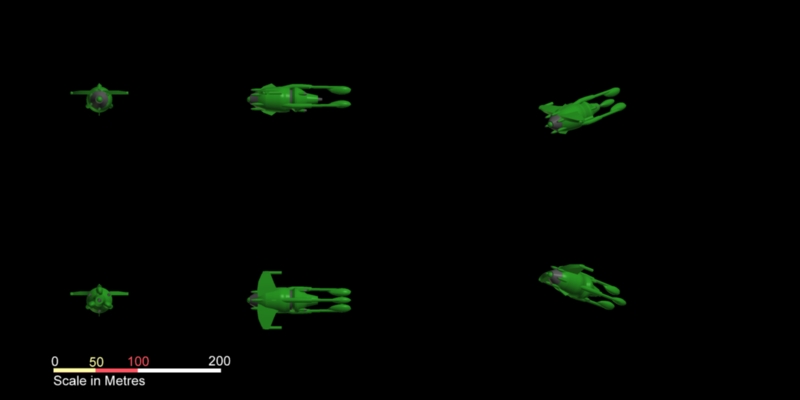
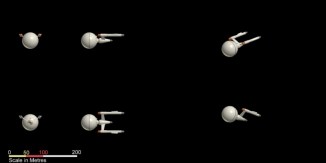
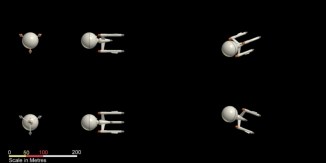
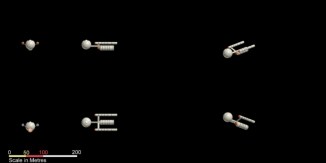
The U-24 (Codename ‘Chowder’) was a Strike Cruiser, for use as part of the defensive strategy. Compared to the U-22 Class the U-24 was a far lighter and more manoeuvrable design. This performance improved also included an increase in maximum speed to Warp 3.2.

The U-24 gradually replaced the U-22 in production as the Romulans shifted from offence to defence; operating close to bases meant that Cruisers no longer required the amount of fuel that the U-22 had carried to extend its reach.

In terms of armament, the U-24 did still pack an appreciable punch, again carrying star bomb anti ship missiles and defensive cluster missiles. The class also carried a nose mounted plasma cannon, although this was of lower power than that of the U-22. Frequently, U-24s were employed in an anti capital ship role, their speed and manoeuvrability giving an edge over the lumbering Earth Battle Cruisers and Carriers. They proved to be vulnerable themselves, as the lighter structure that gave the U-24s their speed made them vulnerable to attack from nimble Minotaur class fighters and Powhatan class Cruisers.

U-24s managed to destroy 5 Yorktown class carriers, and 19 other capital ships of various types, but that was at enormous cost, of the 112 U-24s deployed during the war, ships destroyed or listed as missing totalled 82.

Three distinct variants of the U-24 exist. The most common was the U-24A, which entered service in 2258. This mounted a mix of defensive and offensive missiles as well as the Plasma Cannon, 81 of the ships built during the war were of this type. Production continued post-war and a further 38 ships were built of this mark. The second variant (again in service from 2158) was the U-24B, which carried only star bomb anti ship missiles. The Star bomb variant carried by this mark was the lightest (and least powerful) produced by the Romulans, the RM-SB4. It could however carry ten of the weapons, and it retained its plasma cannon as a back up. Some 30 of the completed ships were of this model.

The U-24C, of which saw only a single prototype built, adopted an all or nothing approach. This variant dispensed with all weapons except for the star bombs. As a result, it could carry sixteen of the light RM-SB4s for use against high value targets. The variant was also fitted with a further star bomb in its nose, for use as a last resort weapon in ramming actions.  Intended for use in the defence of Romulus, this variant began testing in mid 2159.  Luckily, for both sides, the war ended before this model saw action. Testing indicated that the ship was woefully underpowered, and could only fire a useful salvo if not manoeuvring or not powering the already inadequate defensive screens, additionally it lost the manoeuvrability that made the U-24A so devastating.

The U-24 was a departure from the larger designs that preceded it. Many things including the changing nature of the conflict and the need for quick to produce ships caused this change. However, the striking power of the U-24 was almost equal to that of many earlier and far larger cruisers; both the Romulan and Federation fleets followed this trend post war, meaning the leviathans that saw action in the Romulan War soon faded into history

Class: VI Year: 2158
Ship Source: The Starfleet Museum Ship Datasheet: Download PDF

u24-100

2155 – U22 Sabinus (“Cabbage”)

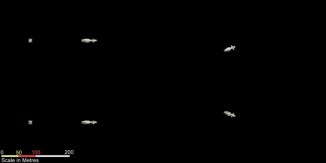
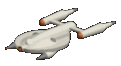
The U-22 (codenamed ‘Cabbage’ by the UESN) entered service in 2155, and was one of the most commonly encountered Romulan Cruisers during the war. The design was created to allow fleet advances across interstellar distance. They were equipped with a formidable arsenal of cluster missiles and Star Bombs, and also mounted the most powerful plasma weapon yet produced, and this could be carried for distances further than any other Romulan Cruiser save for the U-13A.

However, this massive capability came at a price; the amount of deuterium fuel required by the fusion reactors to give the required range meant that the ships weighed an estimated 500,000mt. Plans to use the twin-engine system developed for the U-20 were abandoned due to delays in that program, and a modified version of the long serving RFTL-3 was adopted in a triple nacelle arrangement. The massive mass of this class badly affected its manoeuvrability and performance at warp (2.5 maximum speeds).

Early in the War the U-22 was used to great effect, the firepower overwhelming many Earth Alliance ships, and the sheer size of the vessel meant that the damage inflicted on the U-22 was easily absorbed. Later in the war as newer designs entered service with Earth and its allies, the slow ponderous U-22s became easy prey.

The vulnerability of the U-22 was demonstrated very clearly at the battle of Hell’s Gate on 21-23 October 2157. This battle saw the Earth Alliance forces crush a massive Romulan Invasion attempt. 27 U-22 Cruisers were committed to this battle, and not even one survived, it is estimated that the Romulan loss of life in this battle was in excess of 30,000 crew and troops.

The cruiser was designated as the U-22A, at the start of the war some 75 U-22As were in service, and these were joint by a further 30 built during the war. Numerous variants of the U-22 also served during the war, despite the change in roles they were all classified as part of the same series and retained the U-22 designation. The U-22B (Codename ‘Tonsil’) was a tanker built to support long-range U-22A operations, production totalled 15. Armament was reduced to just the defensive cluster missiles.

U-22C (Codename ‘Rodent’) was used as a subspace sensor/communications ship, often deployed on long intelligence gathering sorties. This class retained the plasma cannon and cluster missile, but dispensed with the star bombs to allow for the fitment of advanced sensor equipment. Only 10 of these specialist intelligence ships were built. U-22D (Codename ‘Syrup’) was a specialist troop transport/assault ship; it could carry some 2000 troops. The weapons fit dispensed with plasma weapon, but retained a full missile arsenal for self-defence and planetary assault. The U-22D was the second most common variant, with some 35 seeing service.

The U-22 suffered from the compromise made in its design, Romulan fusion engine technology meant that the only way to gain a long range was to carry massive amounts of deuterium fuel, this fuel meant that the ship’s power efficiency and speed would always be inferior to ships built for speed and manoeuvrability, especially when those ships also used matter/antimatter propulsion.

Class: XVIII Year: 2155
Ship Source: The Starfleet Museum Ship Datasheet: Download PDF

u22-100

2196 – Paris

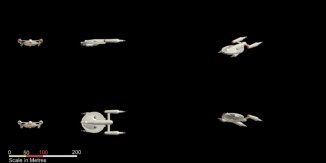
The Paris is a Multipurpose Light Cruiser design from the 2190’s. It was the first class to use the then experimental FFTL-1B and was often used for colonial patrol and escort duties.

The ship’s standard armanant of four lasers, and a single torpedo tube could be augmented by a bolt on cannon or torpedo tube. The class adopted a defensive role after 2221, before final retirement in 2261.

USS Damascus a participant in actions at Garner 441, Bisei-Shinnihon G, and Lisyk VIII, is on display at the Starfleet Museum.

  • Class: IV
  • Year: 2196
  • Ship Source: Starfleet Museum
  • Ship Datasheet: Download PDF

paris_large_sideCommissioned Ships:

USS Paris NCC-882
USS Berlin NCC-883
USS Madrid NCC-884
USS Amsterdam NCC-885
USS Roma NCC-886
USS Praha NCC-887
USS Lisboa NCC-888
USS Oslo NCC-889
USS Kiev NCC-890
USS Bratislava NCC-891
USS New York NCC-892
USS Houston NCC-893
USS Chicago NCC-894
USS Miami NCC-895
USS Toronto NCC-896
USS Mojave NCC-897
USS Havana NCC-898
USS Rio de Janeiro NCC-899
USS Santiago NCC-900
USS São Paulo NCC-901
USS Tripoli NCC-902
USS Lagos NCC-903
USS Nairobi NCC-904
USS Dar es Salaam NCC-905
USS Karachi NCC-906
USS Delhi NCC-907
USS Teheran NCC-908
USS Baghdad NCC-909
USS Damascus NCC-910
USS Amman NCC-911
USS Jerusalem NCC-912
USS Kabul NCC-913
USS Bangkok NCC-914
USS Seoul NCC-915
USS Shanghai NCC-916
USS Beijing NCC-917
USS Manila NCC-918
USS Tycho City NCC-919
USS Port Lowell NCC-920
USS Cosmograd NCC-921

2184 – Gagarin

The 2179 Moskva class was very successful, but Starfleet reserved them for high-priority defensive and exploration missions outside the Federation borders. It was recognised that lower priority missions could be performed by smaller, less powerful ships. To meet this demand proposals were requested for the new Gagarin light cruiser, which was to be 50% smaller scale in terms of displacement, weaponry, and crew size compared to the Moskva.

Although based on the  Moskva, advances in technology allowed similar capabilities in a smaller hull. The most important of these being a much lighter and smaller warp drive system.  The primary hull was based on that of Moskva, drawing on the lessons of that design it was designed to improve warp field efficiency. The secondary hull also improved on that of the Moskva in terms of warp dynamics and use of space.

The equipment fit reflected the multi role nature of the design which was intended to perform a wide range of both exploratory and low risk military missions. The four deck primary hull contained smaller versions of the scientific facilities and sensors of  the Moskva.

The USS Gagarin (NCC-502)  joined Starfleet in 2184 and the remaining 39 ships of the class were delivered at intensive pace over the next 3 years. After withdrawal from front-line service in the 2220s, Gagarins were either sold off or used in roles such as couriers, light cargo transports, and survey ships.  The former USS Leonov (NCC-507), served for many years in a civilian scientific and academic role, and while in use by the American Continent Institute (as SS Columbia)  was lost in 2236 with all hands. USS Goddard (NCC-526) was used as a training ship by Starfleet Academy  but was scrapped in 2266 after a serious reactor accident in which several cadets and instructors (including Fleet Captain Christopher Pike) were killed or severely injured.

The  USS Bleriot (NCC-539), is on display at the Starfleet Museum.


Class: IV Year: 2184
Ship Source: Starfleet Museum Ship Datasheet: Download PDF

gagarin_large_side

Commissioned Ships

USS Gagarin NCC-502
USS Shephard NCC-503
USS Titov NCC-504
USS Glenn NCC-505
USS Grissom NCC-506
USS Leonov NCC-507
USS Tereshkova NCC-508
USS Lovell NCC-509
USS Komarov NCC-510
USS Dobrovolsky NCC-511
USS Borman NCC-512
USS Collins NCC-513
USS Christopher NCC-514
USS Richey NCC-515
USS Archytas NCC-516
USS Kai-Fung-Fu NCC-517
USS Al-Rammah NCC-518
USS Fontana NCC-519
USS Haas NCC-520
USS Hyder Ali NCC-521
USS Congreve NCC-522
USS Ruggieri NCC-523
USS Burney NCC-524
USS Golightly NCC-525
USS Goddard NCC-526
USS Tsiolkovsky NCC-527
USS Oberth NCC-528
USS Korolev NCC-529
USS Sänger NCC-530
USS Ley NCC-531
USS Montgolfier NCC-532
USS Lilienthal NCC-533
USS Weisskopf NCC-534
USS Wright NCC-535
USS Santos-Dumont NCC-536
USS Zeppelin NCC-537
USS Sikorsky NCC-538
USS Blériot NCC-539
USS Earhart NCC-540
USS Yeager NCC-541

2179 – Moskva

The Moskva class originated from the 2169 design competition to provide a replacement for the Daedalus class. That competition was won in 2171by the Wasp class, the Moskva losing out. By 2173 doubts emerged over the capability of the Wasp class to meet its designed specification, and a requirement was issued for a second class of cruiser. This was awarded in 2175 to a revised Moskva class, 31 of which were ordered.

The class was recognized as an advance in starship design. The most important feature was the reversion to a discoid primary hull (as used in the NX class of 30 years earlier). Most earlier designs used a spherical primary hull for reasons of cost (geometry dictates that a spherical hull has the smallest surface area for a given volume – therefore, construction costs are lower and shields are more efficient) and institutional inertia (most exploratory cruisers originating until that time from the United Earth Space Probe Agency, and its successor organizations had spherical hulls).

As the Wasp class had shown, warp field geometry is problematic when a spherical hull with its relatively large frontal area is used. The discoid hull was also found to have a channeling effect on the warp field flow towards the Bussard ram scoops of the warp nacelles, this improved field efficiency at all power levels and speeds. As the understanding of warp field mechanics improved, the reversion to saucer-shaped primary hulls would intensify on later vessels Starfleet produced.

The first ship of the new class, USS Moskva, entered service with Starfleet in April 2179. An additional 30 ships commissioned between 2179 and 2183.

The class had an excellent safety record, with no ships lost to mechanical failures. However, in 2186 an incident occurred aboard USS Johannesburg when a faulty monitor indicated a runaway overload within the plasma flow governor.With a warp core breach apparently imminent the warp nacelles and warp bustle were separated. Although unnecessary the seperation caused the warp core to initiate its automatic shut-down routine. The seperated sections of the ship were successfully re-mated at a Starbase 29.
Although most of the class had left front-line service by 2215, some served on as auxiliaries and training vessels until the 2240s, others were used as testbeds for new technologies. Additionally, the Taurus class tugs (2182) and Sanford class repair tenders ( 2185) were derived from the Moskva class design.

USS Aurora, a participant of the Battle of Eohippus IV, is on display at the Starfleet Museum.

Moskva_large

Commissioned Ships:

USS Moskva NCC-374
USS Orion NCC-375
USS Callisto NCC-376
USS Aurora NCC-377
USS Pallas NCC-378
USS Africa NCC-379
USS Thresher NCC-380
USS Osaka NCC-381
USS Johannesburg NCC-382
USS Titan NCC-383
USS Theiss NCC-384
USS Nostromo NCC-385
USS San Francisco NCC-386
USS Gato NCC-387
USS Vincennes NCC-388
USS America NCC-389
USS Von Braun NCC-390
USS Susan Calvin NCC-391
USS Tyrell NCC-392
USS Ganymede NCC-393
USS Metropolis NCC-394
USS Apollo NCC-395
USS Barsoom NCC-396
USS Thunder Child NCC-397
USS Seymour Cray NCC-398
USS McManus NCC-399
USS Wah Chang NCC-400
USS Ingraham NCC-401
USS Vostok NCC-402
USS Shanghai NCC-403
USS Trumbull NCC-404


2175 – Wasp II

The Wasp was intended as a successor to the Daedauls class. The lead ship of the new class, USS Wasp, was launched in December 2173 and commissioned in November 2174.

The large primary hull of the Wasp class, and the overall increase in size over the Daedalus class was intended to improve the range and habitablility of the design when compared to its predecessor. Another intention was to provide greater crew safety than on previous designs. This increased safety was demonstrated in 2177 when the USS Cumberland suffered a warp core containment breach while on a survey mission. The secondary hull was evacuated, and the primary hull was then successfully detached and maneuvered to a safe distance by the time the warp core exploded. No casualties were sustained during evacuation and separation. The command hull of Cumberland (which had been christened “The Deathstar” by the crew) entered orbit around Theta Draconis VII 5 months later. She was subsequently towed to spacedock, where a new engineering hull was attached, and the ship was relaunched 14 months after the accident.

The warp performance of the Wasp class was worse than expected. This was due to two causes, firstly owing to production delays the first eight ships were forced to use three FFTL- 2A warp engines rather than two of the more powerful FFTL-3A warp engines as had been intended. Although in trials the three engine fit was successful, in active service the Warp fields proved hard to keep aligned. When the FFTL-3A engined ships finally appeared they were found to be only marginally more capable. As a result the last 5 ships in the projected 20 ship class were canceled after construction had already begun. All 8 Mk 1 ships built were converted to the Mk 2 standard as it was a more reliable and simpler to maintain engine installation.

Of the 15 ships built, 3 were lost in the line of duty and 1 is overdue and presumed lost. Five ships were later sold to commercial concerns and converted to starliners or transports. After being decommissioned in 2217, USS Kearsage was restored to her original three-nacelle configuration and is now on display at the Starfleet Museum.


Class: VI Year: 2177
Ship Source: Starfleet Museum Ship Datasheet: Download PDF

wasp_2_large_SIDE

Commissioned Ships

USS Wasp NCC-223
USS Decatur NCC-224
USS Ranger NCC-225
USS Kearsarge NCC-226
USS Jupiter NCC-227
USS Ericsson NCC-228
USS Cumberland NCC-229
USS Mars NCC-230
USS Holland NCC-231
USS Bushnell NCC-232
USS Armstrong NCC-233
USS Hunley NCC-234
USS Tang NCC-235
USS Nautilus NCC-236
USS Nelson NCC-237

*Hull numbers NCC-238 to NCC-242 were assigned, but construction was canceled.


2174 – Wasp I

The Wasp was intended as a successor to the Daedauls class. The lead ship of the new class, USS Wasp, was launched in December 2173 and commissioned in November 2174.

The large primary hull of the Wasp class, and the overall increase in size over the Daedalus class was intended to improve the range and habitablility of the design when compared to its predecessor. Another intention was to provide greater crew safety than on previous designs. This increased safety was demonstrated in 2177 when the USS Cumberland suffered a warp core containment breach while on a survey mission. The secondary hull was evacuated, and the primary hull was then successfully detached and maneuvered to a safe distance by the time the warp core exploded. No casualties were sustained during evacuation and separation. The command hull of Cumberland (which had been christened “The Deathstar” by the crew) entered orbit around Theta Draconis VII 5 months later. She was subsequently towed to spacedock, where a new engineering hull was attached, and the ship was relaunched 14 months after the accident.

The warp performance of the Wasp class was worse than expected. This was due to two causes, firstly owing to production delays the first eight ships were forced to use three FFTL- 2A warp engines rather than two of the more powerful FFTL-3A warp engines as had been intended. Although in trials the three engine fit was successful, in active service the Warp fields proved hard to keep aligned. When the FFTL-3A engined ships finally appeared they were found to be only marginally more capable. As a result the last 5 ships in the projected 20 ship class were canceled after construction had already begun. All 8 Mk 1 ships built were converted to the Mk 2 standard as it was a more reliable and simpler to maintain engine installation.

Of the 15 ships built, 3 were lost in the line of duty and 1 is overdue and presumed lost. Five ships were later sold to commercial concerns and converted to starliners or transports. After being decommissioned in 2217, USS Kearsage was restored to her original three-nacelle configuration and is now on display at the Starfleet Museum.

Class: VI Year: 2174
Ship Source: Starfleet Museum Ship Datasheet: Download PDF

wasp_1_large_side

Commissioned Ships (Mk 1)

USS Wasp NCC-223
USS Decatur NCC-224
USS Ranger NCC-225
USS Kearsarge NCC-226
USS Jupiter NCC-227
USS Ericsson NCC-228
USS Cumberland NCC-229
USS Mars NCC-230

2160 – Daedalus

Compared to the Comet class that it was developed from, the Daedalus was a far lighter vessel. The Mk 1, which the first 25 ships were built as was designed as an exploration vessel, hence the relatively weak armanent. The 25 Mk 2 ships were intended as mixed use Cruisers, so were more heavily armed.

The Daedalus had many changes to its structure, equipment, and drive system compared to the Comet. These included simplifying the spaceframe, reducing offensive and defensive weaponry, moving the shuttle bay to the rear of the secondary hull, adding scientific facilities, enhancing the sensor suite and increasing the ship’s range. In addition, for the first time, the bridge was placed atop the command hull.
The UES Daedalus joined the fleet in September 2160, just 1 month before the end of the war. Due to their exploration mission profile these ships cruisers were used on scientific missions far from the front line. On these internal missions, the class served admirably without major malfunctions or system failures.

In a formal ceremony held on October 14, 2161 UES Daedalus (CCM-127) was struck from the UESN list and recommissioned as the Federation Starfleet’s first cruiser, USS Daedalus (NCC-150). Although the Deadalus class ships were not the fastest, largest, or most powerful explorers, they made first contact with more civilizations and mapped more star systems at the greatest risk to their crews than any other explorer type of their generation.

USS Carolina, a Mk1 Daedalus Class is now on display in the Starfleet Museum

Class: IV Year: 2160
Ship Source: Starfleet Museum Ship Datasheet: Download PDF

daedalus_large_side

Commissioned Ships (UESN/UFP)

UES/USS Daedalus CLM-127/NCC-150
UES/USS Icarus CLM-128/NCC-151
UES/USS Phoenix CLM-129/NCC-152
UES/USS Valiant CLM-130/NCC-153
UES/USS Clarke CLM-131/NCC-154
UES/USS Dakota CLM-132/NCC-155
UES/USS Proteus CLM-133/NCC-156
UES/USS Voyager CLM-134/NCC-157
UES/USS Columbus CLM-135/NCC-158
UES/USS Diana CLM-136/NCC-159
UES/USS Carolina CLM-137/NCC-160
UES/USS Soyuz CLM-138/NCC-161
UES/USS Apollo CLM-139/NCC-162
UES/USS Louisiana CLM-140/NCC-163
UES/USS Torvaldson CLM-141/NCC-164
UES/USS Sputnik CLM-142/NCC-165
UES/USS Jefferson CLM-143/NCC-166
UES/USS Tokyo CLM-144/NCC-167
UES/USS Arronax CLM-145/NCC-168
UES/USS Mir CLM-146/NCC-169
UES/USS Bowman CLM-147/NCC-170
UES/USS Roosevelt CLM-148/NCC-171
UES/USS Dolphin CLM-149/NCC-172
UES/USS Essex CLM-150/NCC-173
UES/USS Robinson CLM-151/NCC-174
USS Frontier NCC-175
USS Horizon NCC-176
USS Liberty NCC-177
USS Asimov NCC-178
USS Zond NCC-179
USS Marco Polo NCC-180
USS Spaulding NCC-181
USS Lincoln NCC-182
USS Maury NCC-183
USS Viking NCC-184
USS Johnson NCC-185
USS Shenandoah NCC-186
USS Nelson NCC-187
USS Independence NCC-188
USS Archon NCC-189
USS Columbia NCC-190
USS Challenger NCC-191
USS Discovery NCC-192
USS Atlantis NCC-193
USS Endeavor NCC-194
USS Gaines NCC-195
USS Venera NCC-196
USS Buena Vista NCC-197
USS Cassini NCC-198
USS Cochrane NCC-199


2158 – Comet

Following the successful tests of the Fireball class, the UESN made plans for introducing the design into military service to boost the war effort. The Only changes made to the excellent Fireball design were addition of weapons, and the upgrading of the shields to FDS-2.

The Comet class light cruiser began to enter service in October 2158. They were amongst the fastest ships of the Romulan war and saw extensive service as scouts and light strike cruisers. Originally 50 of the class were been ordered, but the end of the war saw the final 25 cancelled in favor of 25 of the Comet derived Daedalus class exploratory cruisers. 23 Comet class ships survived the war, and were allocated to Starfleet, where they served until 2192.

The Comet class cruiser USS Meteor is now on display at the Starfleet Museum.

The Experimental NG (New Generation) engines and shield systems were redesignated as part of the Federation Designation System in 2161.

  • Class: V
  • Year: 2158
  • Ship Source: Starfleet Museum
  • Ship Datasheet: Download PDF

comet_side_large

Commissioned Ships (UESN)

UES Comet CLM-102
UES Meteor CLM-103
UES Aurora CLM-104
UES Nova CLM-105
UES Pulsar CLM-106
UES Nebula CLM-107
UES Quasar CLM-108
UES Eclipse CLM-109
UES Equinox CLM-110
UES Solstice CLM-111
UES Corona CLM-112
UES Constellation CLM-113
UES Galaxy CLM-114
UES Flare CLM-115
UES Proxima CLM-116
UES Polaris CLM-117
UES Zodiac CLM-118
UES Mercury CLM-119
UES Venus CLM-120
UES Luna CLM-121
UES Mars CLM-122
UES Jupiter CLM-123
UES Saturn CLM-124
UES Uranus CLM-125
UES Neptune CLM-126