2246 – Monoceros I

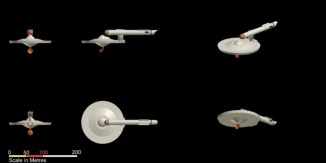
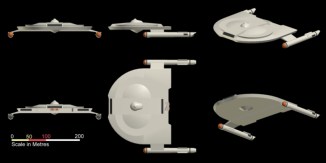
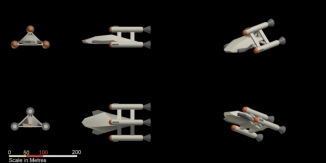
The Monoceros class scout was designed to provide Starfleet with a light scout which was cheap and easy to build. First commissioned in 2246 (1/89), further ship production was delayed after a design flaw in the warp field balance coil was discovered. At high warp speeds, the ship tended to “rise” out of its own warp field, causing the ship to violently exit warp. The problem was corrected by reconfiguring the control computer software.

The Monoceros II was also designed to act as a demonstrator for the improved generation of linear warp drives then in development. The SCNN nacelle and reactor arrangement adopted for the single FWB-1 warp engine was lighter than the equivalent PB series installation. Fitment of a full-blown linear drive assembly with hull mounted warp core was dismissed in this design on safety grounds. It would be a further 10 years before work began on a class mounting such a system.

The experience gained in operating the SCNN equipped Monoceros II class paved the way directly for later SCNN engined vessels (such as the Endeavour class) and also demonstrated the benefits that ships equipped with linear drives had compared to those with circumferential warp drives. Of the 16 ships commissioned, not a single vessel was lost to warp drive related problems, but some nine vessels were lost to enemy action. The decommissioning of the class in 2257 (1/99) was the result of the need to continue the testing of the new engines on the few surviving ships of the class. Accordingly all seven survivors continued to be operated as test-beds by both the engine manufacturers and the Starfleet Corps of Engineers, the last not being retired until 2272 (2/17).

The Monoceros did see action in the Four Years War, albeit limited. In 2253 (1/95), the USS Vulpecula was responsible for inflicting minor damage on several unescorted Klingon G-4 transports. The captain and crew of the Vulpecula received Starfleet’s highest commendations for this action. Most ships of this class, however, served as sentry ships for assembled fleets.

An interesting footnote to the ship’s history is the origin of the class name. It has been told that Commodore Charles Tatum, who was overseeing the design of the proposed scout, was studying the ship schematics at home when his seven year old daughter became curious as to her father’s work. The commodore light-heartedly asked his daughter what the ship should be called, and she promptly answered, “Unicorn!” Impressed, the commodore (after changing the name to its Latin derivative) submitted the name and it was eventually approved.

Class: IV Year: 2246
Ship Source: Starfleet Technical Manual/Lee Wood Ship Datasheet: Download PDF

new_monoceros-pb-100

2269 – Brenton

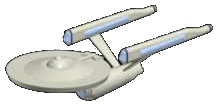
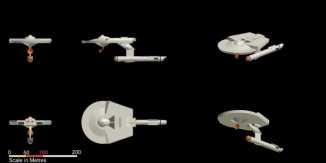
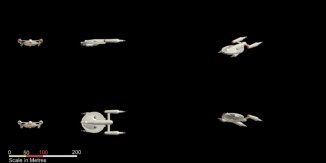
The Brenton class cruiser was designed as a complement to the Constitution class vessels and a replacement for the ageing Baton Rouge class ships in front line areas. An excellent example of Starfleet’s multi-mission design philosophy, the Brenton can readily serve under Galaxy Exploration Command or Military Operations Command. It also serves as a command ship for Starfleet operations.

The Brenton is economical to build and cheaper to operate than most other similar sized cruisers. It has a smaller crew than Constitution or later Enterprise class heavy cruisers, but can serve in similar roles as the heavy cruisers. The Brenton was designed more for combat than research, although it does have adequate facilities on board for research and exploration. It is not classed as a heavy cruiser due to lack of a secondary hull, however due to the immense width of the class it does not lack internal space.

The Brenton was designed for the older style warp nacelles from the Constitution class era, but after the first five units this was changed during construction when the newer design became standard usage. Its aft-firing torpedo has caused many an opponent to think twice before attacking from the rear. In fact, when the Brenton class first saw combat with the Klingons, the Klingons were allowed to approach from the rear. The Klingons, seeing the perfect chance to attack, were annihilated at close range by the “stupid, crippled Federation captains”, as was quoted by one captured Klingon commander after the engagement. This action has caused the Klingons to treat Brentons with respect.

Class: XI Year: 2269
Ship Source: Based on FASA Brenton Ship Datasheet: Download PDF

brenton-old-100

2268 – Durrett Prototype

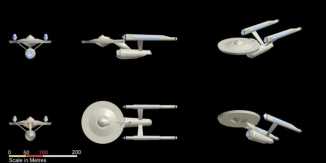
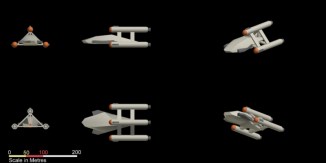
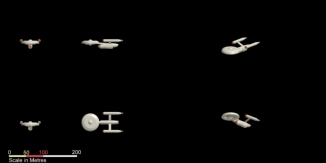
The Durrett class cruiser is one of the most flexible starship designs in Starfleet’s inventory. Second only to its larger cousin, the Reliant class, the Durrett excels in the arena of multi-mission starship design. Able to perform research missions and military support missions equally well, the Durrett is always a favorite among those having served aboard them.

The Durrett was designed at the time when the Anton class was ending its career. Needing another research vessel to replace the Anton class, the Durrett class was chosen as its replacement. With its one nacelle configuration, the Durrett had less power than the Anton Mk IV, but the Durrett design utilized its available power more efficiently. Overall, the Durrett had better maneuverability, better shielding, and more flexible weaponry than the Anton.

As the Durrett project was nearing completion at the Sol II shipyards, the USS Reliant, an Anton class cruiser, had just completed the first of several experimental upgrades to its spaceframe. These upgrades eventually culminated in the Reliant class. Starfleet did not hesitate, however, to continue both projects: only nine Anton class cruisers were still in service to be refitted to Reliant class standards. With a large hole in Starfleet’s dedicated research vessel inventory, the Reliant and Durrett began production simultaneously. The success of the Reliant upgrade did lead to significant changes in appearance and fit out compared to the prototype, although most key systems remained unchanged.

Class: VIII Year: 2268
Ship Source: Based on FASA Durrett Ship Datasheet: Download PDF

durrett_large

2208 – Mann

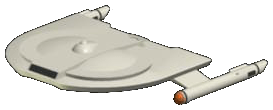
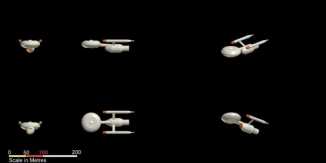
“The Mann class was employed primarily for strategic purposes by the Star fleet command, providing defence and security within the ever growing Federation jurisdiction. Using advanced third generation propulsion, these ships used pure matter/antimatter annihilation and were amongst the fastest to warp. The USS Endurance (of this class) supervised the largest spacelift in Federation history, where the over ten million inhabitants of Bayard’s planet were successfully evacuated.”

The design restored much confidence in the light cruiser program after the Tritium debacle, and the ships were sought after postings due to their modern looking design and ample interior space.

The class remained in active service until 2250, when it was deemed uneconomical to further refit them as the once radical design was deemed obsolete. Two ships were sold onto the AOFW and were refitted with modern warp drives and remained in use until 2290.

Class: V Year: 2208
Ship Source: Spaceflight Chronology Ship Datasheet: Download PDF

mann_large_side


2201 – Modified Tritium

The first great experiment, and the first great failure.

The design drew from the supposed strengths of the three engine version of the Wasp class, unfortunately the designers failed to take account of the very different warp dynamics of the Tritium design compared to the eariler vessel. The designers also did not pay heed to the difficulties suffered by the Wasp programme.

The failure of the triple engine design of the Tritium was one of the most costly failures in the History of Starfleet. Although the design showed the promise of the three engine layout to boost power, it would be another 15 years before computer advances allowed the three engine warp field to be successfully balanced in the Quetzalcoatl class.

On paper a powerful ship, under impulse power the design performed superbly, with power to spare. At warp the design was shown to be far slower than designed for, and the fuel consumption meant the range was half of that predicted, additionally the warp drive system required five times more maintenance than an equivalent twin engine system.

Compared to the original, the Modified Tritiums have lengthened warp nacelles and shorter outlet cones in an attempt to improve warp dynamics, it made no difference to the problems of the design.

“The Tritium class has the dubious distinction of being the worst major ship ever built by the UFP. Insurmountable design flaws surfaced during its validation phase, and though six Tritium class ships were constructed in a vain attempt to overcome glaring shortcomings, the Federation finally cut its losses and cancelled the series. As a costly reminder to future generations, the Tritium may also be viewed as the Spaceflight museum on Memory Alpha.”


Class: V Year: 2201
Ship Source: Spaceflight Chronology Ship Datasheet: Download PDF

tritium2_large_SIDE

2200 – Tritium

The first great experiment, and the first great failure.

The design drew from the supposed strengths of the three engine version of the Wasp class, unfortunately the designers failed to take account of the very different warp dynamics of the Tritium design compared to the eariler vessel. The designers also did not pay heed to the difficulties suffered by the Wasp programme.

The failure of the triple engine design of the Tritium was one of the most costly failures in the History of Starfleet. Although the design showed the promise of the three engine layout to boost power, it would be another 15 years before computer advances allowed the three engine warp field to be successfully balanced in the Quetzalcoatl class.

On paper a powerful ship, under impulse power the design performed superbly, with power to spare. At warp the design was shown to be far slower than designed for, and the fuel consumption meant the range was half of that predicted, additionally the warp drive system required five times more maintenance than an equivalent twin engine system.

“The Tritium class has the dubious distinction of being the worst major ship ever built by the UFP. Insurmountable design flaws surfaced during its validation phase, and though six Tritium class ships were constructed in a vain attempt to overcome glaring shortcomings, the Federation finally cut its losses and cancelled the series. As a costly reminder to future generations, the Tritium may also be viewed as the Spaceflight museum on Memory Alpha.”


Class: V Year: 2200
Ship Source: Spaceflight Chronology Ship Datasheet: Download PDF

tritium1_large_SIDE

2196 – Paris

The Paris is a Multipurpose Light Cruiser design from the 2190’s. It was the first class to use the then experimental FFTL-1B and was often used for colonial patrol and escort duties.

The ship’s standard armanant of four lasers, and a single torpedo tube could be augmented by a bolt on cannon or torpedo tube. The class adopted a defensive role after 2221, before final retirement in 2261.

USS Damascus a participant in actions at Garner 441, Bisei-Shinnihon G, and Lisyk VIII, is on display at the Starfleet Museum.

  • Class: IV
  • Year: 2196
  • Ship Source: Starfleet Museum
  • Ship Datasheet: Download PDF

paris_large_sideCommissioned Ships:

USS Paris NCC-882
USS Berlin NCC-883
USS Madrid NCC-884
USS Amsterdam NCC-885
USS Roma NCC-886
USS Praha NCC-887
USS Lisboa NCC-888
USS Oslo NCC-889
USS Kiev NCC-890
USS Bratislava NCC-891
USS New York NCC-892
USS Houston NCC-893
USS Chicago NCC-894
USS Miami NCC-895
USS Toronto NCC-896
USS Mojave NCC-897
USS Havana NCC-898
USS Rio de Janeiro NCC-899
USS Santiago NCC-900
USS São Paulo NCC-901
USS Tripoli NCC-902
USS Lagos NCC-903
USS Nairobi NCC-904
USS Dar es Salaam NCC-905
USS Karachi NCC-906
USS Delhi NCC-907
USS Teheran NCC-908
USS Baghdad NCC-909
USS Damascus NCC-910
USS Amman NCC-911
USS Jerusalem NCC-912
USS Kabul NCC-913
USS Bangkok NCC-914
USS Seoul NCC-915
USS Shanghai NCC-916
USS Beijing NCC-917
USS Manila NCC-918
USS Tycho City NCC-919
USS Port Lowell NCC-920
USS Cosmograd NCC-921

2184 – Gagarin

The 2179 Moskva class was very successful, but Starfleet reserved them for high-priority defensive and exploration missions outside the Federation borders. It was recognised that lower priority missions could be performed by smaller, less powerful ships. To meet this demand proposals were requested for the new Gagarin light cruiser, which was to be 50% smaller scale in terms of displacement, weaponry, and crew size compared to the Moskva.

Although based on the  Moskva, advances in technology allowed similar capabilities in a smaller hull. The most important of these being a much lighter and smaller warp drive system.  The primary hull was based on that of Moskva, drawing on the lessons of that design it was designed to improve warp field efficiency. The secondary hull also improved on that of the Moskva in terms of warp dynamics and use of space.

The equipment fit reflected the multi role nature of the design which was intended to perform a wide range of both exploratory and low risk military missions. The four deck primary hull contained smaller versions of the scientific facilities and sensors of  the Moskva.

The USS Gagarin (NCC-502)  joined Starfleet in 2184 and the remaining 39 ships of the class were delivered at intensive pace over the next 3 years. After withdrawal from front-line service in the 2220s, Gagarins were either sold off or used in roles such as couriers, light cargo transports, and survey ships.  The former USS Leonov (NCC-507), served for many years in a civilian scientific and academic role, and while in use by the American Continent Institute (as SS Columbia)  was lost in 2236 with all hands. USS Goddard (NCC-526) was used as a training ship by Starfleet Academy  but was scrapped in 2266 after a serious reactor accident in which several cadets and instructors (including Fleet Captain Christopher Pike) were killed or severely injured.

The  USS Bleriot (NCC-539), is on display at the Starfleet Museum.


Class: IV Year: 2184
Ship Source: Starfleet Museum Ship Datasheet: Download PDF

gagarin_large_side

Commissioned Ships

USS Gagarin NCC-502
USS Shephard NCC-503
USS Titov NCC-504
USS Glenn NCC-505
USS Grissom NCC-506
USS Leonov NCC-507
USS Tereshkova NCC-508
USS Lovell NCC-509
USS Komarov NCC-510
USS Dobrovolsky NCC-511
USS Borman NCC-512
USS Collins NCC-513
USS Christopher NCC-514
USS Richey NCC-515
USS Archytas NCC-516
USS Kai-Fung-Fu NCC-517
USS Al-Rammah NCC-518
USS Fontana NCC-519
USS Haas NCC-520
USS Hyder Ali NCC-521
USS Congreve NCC-522
USS Ruggieri NCC-523
USS Burney NCC-524
USS Golightly NCC-525
USS Goddard NCC-526
USS Tsiolkovsky NCC-527
USS Oberth NCC-528
USS Korolev NCC-529
USS Sänger NCC-530
USS Ley NCC-531
USS Montgolfier NCC-532
USS Lilienthal NCC-533
USS Weisskopf NCC-534
USS Wright NCC-535
USS Santos-Dumont NCC-536
USS Zeppelin NCC-537
USS Sikorsky NCC-538
USS Blériot NCC-539
USS Earhart NCC-540
USS Yeager NCC-541

2179 – Moskva

The Moskva class originated from the 2169 design competition to provide a replacement for the Daedalus class. That competition was won in 2171by the Wasp class, the Moskva losing out. By 2173 doubts emerged over the capability of the Wasp class to meet its designed specification, and a requirement was issued for a second class of cruiser. This was awarded in 2175 to a revised Moskva class, 31 of which were ordered.

The class was recognized as an advance in starship design. The most important feature was the reversion to a discoid primary hull (as used in the NX class of 30 years earlier). Most earlier designs used a spherical primary hull for reasons of cost (geometry dictates that a spherical hull has the smallest surface area for a given volume – therefore, construction costs are lower and shields are more efficient) and institutional inertia (most exploratory cruisers originating until that time from the United Earth Space Probe Agency, and its successor organizations had spherical hulls).

As the Wasp class had shown, warp field geometry is problematic when a spherical hull with its relatively large frontal area is used. The discoid hull was also found to have a channeling effect on the warp field flow towards the Bussard ram scoops of the warp nacelles, this improved field efficiency at all power levels and speeds. As the understanding of warp field mechanics improved, the reversion to saucer-shaped primary hulls would intensify on later vessels Starfleet produced.

The first ship of the new class, USS Moskva, entered service with Starfleet in April 2179. An additional 30 ships commissioned between 2179 and 2183.

The class had an excellent safety record, with no ships lost to mechanical failures. However, in 2186 an incident occurred aboard USS Johannesburg when a faulty monitor indicated a runaway overload within the plasma flow governor.With a warp core breach apparently imminent the warp nacelles and warp bustle were separated. Although unnecessary the seperation caused the warp core to initiate its automatic shut-down routine. The seperated sections of the ship were successfully re-mated at a Starbase 29.
Although most of the class had left front-line service by 2215, some served on as auxiliaries and training vessels until the 2240s, others were used as testbeds for new technologies. Additionally, the Taurus class tugs (2182) and Sanford class repair tenders ( 2185) were derived from the Moskva class design.

USS Aurora, a participant of the Battle of Eohippus IV, is on display at the Starfleet Museum.

Moskva_large

Commissioned Ships:

USS Moskva NCC-374
USS Orion NCC-375
USS Callisto NCC-376
USS Aurora NCC-377
USS Pallas NCC-378
USS Africa NCC-379
USS Thresher NCC-380
USS Osaka NCC-381
USS Johannesburg NCC-382
USS Titan NCC-383
USS Theiss NCC-384
USS Nostromo NCC-385
USS San Francisco NCC-386
USS Gato NCC-387
USS Vincennes NCC-388
USS America NCC-389
USS Von Braun NCC-390
USS Susan Calvin NCC-391
USS Tyrell NCC-392
USS Ganymede NCC-393
USS Metropolis NCC-394
USS Apollo NCC-395
USS Barsoom NCC-396
USS Thunder Child NCC-397
USS Seymour Cray NCC-398
USS McManus NCC-399
USS Wah Chang NCC-400
USS Ingraham NCC-401
USS Vostok NCC-402
USS Shanghai NCC-403
USS Trumbull NCC-404