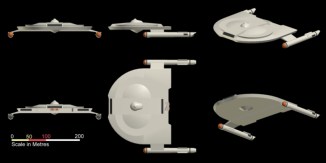
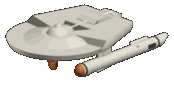
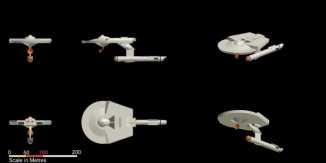
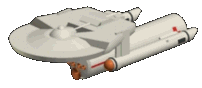
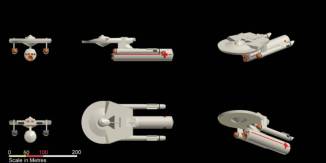
2251 – V4B Vastam cl’vangas (Wing of Vengeance)

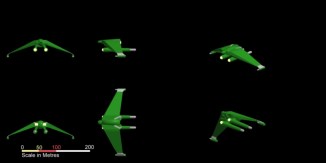
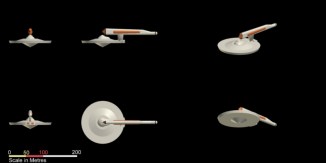
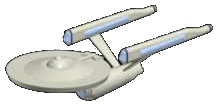
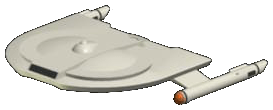
The V-4 class has, by far, the most unusual design to come from Romulan engineers; fashioned like a giant wing, it was created not only for aesthetics but for combat.  When the vessels were first introduced, they were intended to lead an expansion effort, but the war between the Klingons and Federation caused them to be sent to patrol the Klingon border.  The Type 2 mounted a more powerful impulse drive system and improved disruptors, which accounted for its greater combat efficiency.

The V-4s were painted by crewmembers in a variety of patterns.  These ships, though popular with their crews, were removed from service sometime after Stardate 2/16 for more powerful designs.  Of the approximately 135 built, about 65 are in reserve fleets.  Six are reported to be used as training vessels, and two are used as spaceborn museums, one each stationed at Remus and at Corill.  Eighteen are known to be operating in the civil sector.

On Stardate 1/9611, nine of these vessels are known to have been sent into the Triangle to liberate a small system from the Klingons.  The Romulans pressed the attack against the three D-7s protecting the system, immediately destroying two and driving the other away.  Flushed with victory, the Romulan commander sent five of his group after the fleeing enemy, but they encountered nine D-7s and three D-10s arriving to reinforce the area.  The Romulans flew into a classic trap laid by the Klingon battlegroup, and three were destroyed before getting off one shot.  The remaining Romulans miraculously crippled four of the Klingon vessels before one was crippled itself and the remaining vessel fled.  The Klingons abandoned the effort and withdrew from the area.

This battle caused a stir in the Klingon High Command, as the ship had never before been encountered.  Because the stories told of its abilities were inflated to make the Klingon fleet commander look good, the V-4s enjoyed an undeserved notoriety amongst the Klingons for many years.

The class is named from the Romulan vastam cl’vangas (wing of vengeance), in reference to the vessel’s combat capabilities.

Class: Year:
Ship Source: FASA Ship Datasheet: Coming Soon

v4-long-100

2252 – Portsmith

“The Portsmith class was a small cheap destroyer designed for mass production. During the four years war vast numbers were built to act in numerous roles. Despite its size and low cost, the class was amongst the more powerful destroyers in service during the war. Post war the class was not fitted with phasers as the cost of conversion would have exceeded the cost of construction.”

The Mk1 Portsmith Class entered service in 2246 as a cheap simple customs cutter, and was produced at numerous merchant and military shipyards throughout the Federation. The design had no weapons save for four lasers, and was powered by the heavy but effective FWH-1 warp drive system, In all some 300 were built between 2246 and 2252.

The growing hostilities prior to the advent of the Four Years war in 2252 found the Federation desperately short of effective escorts. A program was instituted to design a new escort destroyer class for mass production. It was realised that designing a new class from scratch would take a number of years. It was suggested that the existing Portsmith class could form the basis for a very capable Light Destroyer.

The FWH-1 engines of the Mk1 were replaced by the new FWA-2, and the ship had three accelerator cannons crammed into the former cargo hold. The resultant ship was a revelation to Starfleet Commanders, the more efficient Warp Drive, coupled to the heavy weapon load (for the size of vessel) meant that the Mk2 had a combat efficiency better than full size destroyers, and indeed better than some cruisers.

The price paid for this efficiency was two fold, the range of the Portsmith could not compare to that of the larger destroyers, and the superstructure, although reinforced compared to the Mk1 was not as resilient as that of the larger destroyers. However when deployed in groups escorting convoys the capabilities of the Portsmith meant that they were a force to be reckoned with. Some 360 Mk2s were built, and a large number of Mk1s were upgraded.

Postwar, the Portsmith class had no real role, although a large number were retained in reserve fleets until the 2270’s. A large number of these ships were sold onto planetary defence forces, or onto the civil sector after being disarmed.

Class: IV Year: 2252
Ship Source: Spaceflight Chronology Ship Datasheet: Download PDF

portsmith_large

2256 – Derf

The Derf was designed as a destroyer leader (Daring Class), but improvements in sensor technology in the Four Years War  rendered this type of ship obsolete. It was then proposed to be re-roled as an exploration cruiser (Derf class), but the decision to produce further ships of the Constitution and Anton classes meant that it could not fulfill that role either. Finally the USS Derf was borrowed for a demonstration of the buoy tender concept. This demonstration was so successful that serial production of the Derf was ordered immediately and eventually totaled 600 vessels over a period of 35 years. Few vessels in Starfleet history have achieved either that level or longevity of production and it is certain that had the class been adopted in either of the other two intended roles it would not have gotten anywhere near either figure.

USS Derf was the only ship of this design commissioned in the exploration cruiser configuration (in January 2256), but she was soon converted for trials as a tender in July 2256.

Class: IX Year: 2256
Ship Source: FASA Original/ Additional material by Lee Wood/Steve Bacon Ship Datasheet:

derf_side

2255 – Daring

The Daring was designed as a destroyer leader, but improvements in sensor technology in the Four Years War  rendered this type of ship obsolete. It was then proposed to be re-roled as an exploration cruiser (Derf class), but the decision to produce further ships of the Constitution and Anton classes meant that it could not fulfill that role either. Finally the USS Derf was borrowed for a demonstration of the buoy tender concept. This demonstration was so successful that serial production of the Derf was ordered immediately and eventually totaled 600 vessels over a period of 35 years. Few vessels in Starfleet history have achieved either that level or longevity of production and it is certain that had the class been adopted in either of the other two intended roles it would not have gotten anywhere near either figure.

Of the 26 Daring Class hulls laid down, only five commissioned (Daring, Diamond, Diomede, Derwent and Daedalus) in their intended role. USS Derf commissioned in the exploration cruiser configuration before being converted for trials as a tender in 2255. The other five were also subsequently converted to the tender configuration in 2256, and the other 20 were commissioned in that configuration

Class: IX Year: 2255
Ship Source: FASA Original/ Additional material by Lee Wood/Steve Bacon Ship Datasheet:

derf_side

2256 – Derf

The early history of the Derf Class is an amazing story of near abandonment. The Derf was designed as a destroyer leader (Daring class), but improvements in small ship sensor technology during the Four Years War rendered this type of ship obsolete. It was then re-roled as an exploration cruiser (Derf class), but the decision to produce further ships of the Constitution and Anton classes meant that it could not fulfill that role either. Finally the USS Derf was borrowed for a demonstration of the buoy tender concept. This demonstration was so successful that serial production of the Derf was ordered immediately and eventually totaled 600 vessels over a period of 35 years. Few vessels in Starfleet history have achieved either that level or longevity of production and it is certain that had the class been adopted in either of the other two intended roles it would not have gotten anywhere near either figure.

The Derf class tender has been operational in Starfleet for more than 25 years. When it entered service in July of 2256 (1/9807), the Derf class marked a new concept in navigational beacon repair. Before its introduction, marker buoys and navigational beacons had to be retrieved and returned to a repair facility to be serviced. Derf class tenders eliminated this need because they carried repair facilities on board.

When a Derf arrives at a malfunctioning beacon’s location, a shuttle uses a tractor beam on the beacon and tows it into the lower hull, which is the tender’s main repair facility. The beacon is then placed on an assembly line and repaired robotically. When the work is finished, the shuttle tows the beacon back into the spacelanes, and the Derf moves on.

Although the Derf is not designed as a fighting vessel, it is capable of aggressive defense. Most repair missions take place along the borders between the major powers, where the chances of encountering enemy ships is very high. Because of this high risk, the Derf is armed with medium-range phasers.

This protection does not prevent them from falling prey to enemy ships. In February 2263 (2/0702), the USS Acropolis responded to signals from a malfunctioning marker buoy. As its shuttle neared the beacon, a Klingon warship appeared and opened fire before defensive action could be taken. The volley crippled the Acropolis’ engines, and the tender was boarded and towed into Klingon territory.

Intelligence later discovered that the beacon had been planted by Klingon operatives to entrap the repair tender. It is theorized that the Klingons gained technical information concerning robotics and repair techniques that they lacked, but it is not known just what gain this action brought them in the overall situation. Some analysts believe that study of the robotic repair systems will make it possible for Klingons to alter the functioning of navigation beacons robotically, creating potential havoc in border spacelanes. However, a crash program of buoy upgrading and fitting of encryption systems, which occupied the entire fleet of Derf’s and many other ships, prevented this from happening.

The design of the Derf evolved over a number of Marks. The Mk II would have offered improved impulse and warp drives compared to the Mk I, but a further improved Mk III was designed while the early Mk IIs were being tested. All Mk IIs were updated to Mk III specifications to keep the number of variations within the fleet as low as possible.

In 2285 (2/22), a number of Derfs were taken in hand for conversion to a new Mk V standard. The increase in tensions on the Klingon frontier meant that Derfs now required an armed escort in order to operate safely. The Mk V refit introduced improved shields and enhanced weapons in order to allow the ship to operate without escort in most situations. Not all ships have been refitted to this standard, but all new production was to this standard until production ceased. The Derf class was built at Merak by Chandley Works, Ltd. Buoy maintenance is now carried out by civilian ships in most areas of the Federation, but Starfleet maintains a fleet of Derfs in both active service and reserve to maintain those in more dangerous areas.

The Derf class is now a surprisingly sought after posting amongst many young officers. The reasons for this are varied. All active ships are assigned to border areas, so there is a chance to see the “enemy” in the flesh, it (in Mk V form) is a tough ship to best in combat, and perhaps most importantly it is one of the few classes still in service from the “classic” era of starship technology.

Of the 691 Derfs built, 8 Mk Is, 351 Mk IIIs, 61 Mk IVs and 72 Mk Vs remain in active service, and 38 Mk Is and 25 Mk IIIs are in reserve fleets. Two Mk Is, 2 Mk IIIs and 2 Mk IVs are used by Starfleet Training Command; 12 Mk Is, 8 Mk IIIs and 2 Mk IVs have been destroyed; 1 Mk III has been captured by the Klingons; 1 Mk I, 3 Mk IIIs and 1 Mk V are listed as missing; 4 Mk Is, 4 Mk IIIs, 3 Mk IVs and 2 Mk Vs have been scrapped; and 2 Mk Is and 1 Mk III have been sold to the private sector.

Class: IX Year: 2256
Ship Source: FASA Original/ Additional material by Lee Wood/Steve Bacon Ship Datasheet: Download PDF

derf_side

2252 – Monoceros II

The Monoceros class scout was designed to provide Starfleet with a light scout which was cheap and easy to build. First commissioned in 2246 (1/89), further ship production was delayed after a design flaw in the warp field balance coil was discovered. At high warp speeds, the ship tended to “rise” out of its own warp field, causing the ship to violently exit warp. The problem was corrected by reconfiguring the control computer software.

The Monoceros II was also designed to act as a demonstrator for the improved generation of linear warp drives then in development. The SCNN nacelle and reactor arrangement adopted for the single FWB-1 warp engine was lighter than the equivalent PB series installation. Fitment of a full-blown linear drive assembly with hull mounted warp core was dismissed in this design on safety grounds. It would be a further 10 years before work began on a class mounting such a system.

The experience gained in operating the SCNN equipped Monoceros II class paved the way directly for later SCNN engined vessels (such as the Endeavour class) and also demonstrated the benefits that ships equipped with linear drives had compared to those with circumferential warp drives. Of the 16 ships commissioned, not a single vessel was lost to warp drive related problems, but some nine vessels were lost to enemy action. The decommissioning of the class in 2257 (1/99) was the result of the need to continue the testing of the new engines on the few surviving ships of the class. Accordingly all seven survivors continued to be operated as test-beds by both the engine manufacturers and the Starfleet Corps of Engineers, the last not being retired until 2282 ((2/27).

The Monoceros did see action in the Four Years War, albeit limited. In 2253 (1/95), the USS Vulpecula was responsible for inflicting minor damage on several unescorted Klingon G-4 transports. The captain and crew of the Vulpecula received Starfleet’s highest commendations for this action. Most ships of this class, however, served as sentry ships for assembled fleets.

An interesting footnote to the ship’s history is the origin of the class name. It has been told that Commodore Charles Tatum, who was overseeing the design of the proposed scout, was studying the ship schematics at home when his seven year old daughter became curious as to her father’s work. The commodore light-heartedly asked his daughter what the ship should be called, and she promptly answered, “Unicorn!” Impressed, the commodore (after changing the name to its Latin derivative) submitted the name and it was eventually approved.

Class: IV Year: 2246
Ship Source: Starfleet Technical Manual/Lee Wood Ship Datasheet: Download PDF

new_monoceros-scnn-100

2269 – Brenton

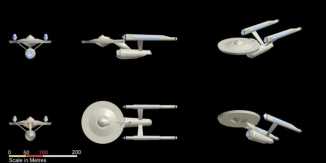
The Brenton class cruiser was designed as a complement to the Constitution class vessels and a replacement for the ageing Baton Rouge class ships in front line areas. An excellent example of Starfleet’s multi-mission design philosophy, the Brenton can readily serve under Galaxy Exploration Command or Military Operations Command. It also serves as a command ship for Starfleet operations.

The Brenton is economical to build and cheaper to operate than most other similar sized cruisers. It has a smaller crew than Constitution or later Enterprise class heavy cruisers, but can serve in similar roles as the heavy cruisers. The Brenton was designed more for combat than research, although it does have adequate facilities on board for research and exploration. It is not classed as a heavy cruiser due to lack of a secondary hull, however due to the immense width of the class it does not lack internal space.

The Brenton was designed for the older style warp nacelles from the Constitution class era, but after the first five units this was changed during construction when the newer design became standard usage. Its aft-firing torpedo has caused many an opponent to think twice before attacking from the rear. In fact, when the Brenton class first saw combat with the Klingons, the Klingons were allowed to approach from the rear. The Klingons, seeing the perfect chance to attack, were annihilated at close range by the “stupid, crippled Federation captains”, as was quoted by one captured Klingon commander after the engagement. This action has caused the Klingons to treat Brentons with respect.

Class: XI Year: 2269
Ship Source: Based on FASA Brenton Ship Datasheet: Download PDF

brenton-old-100

2268 – Durrett Prototype

The Durrett class cruiser is one of the most flexible starship designs in Starfleet’s inventory. Second only to its larger cousin, the Reliant class, the Durrett excels in the arena of multi-mission starship design. Able to perform research missions and military support missions equally well, the Durrett is always a favorite among those having served aboard them.

The Durrett was designed at the time when the Anton class was ending its career. Needing another research vessel to replace the Anton class, the Durrett class was chosen as its replacement. With its one nacelle configuration, the Durrett had less power than the Anton Mk IV, but the Durrett design utilized its available power more efficiently. Overall, the Durrett had better maneuverability, better shielding, and more flexible weaponry than the Anton.

As the Durrett project was nearing completion at the Sol II shipyards, the USS Reliant, an Anton class cruiser, had just completed the first of several experimental upgrades to its spaceframe. These upgrades eventually culminated in the Reliant class. Starfleet did not hesitate, however, to continue both projects: only nine Anton class cruisers were still in service to be refitted to Reliant class standards. With a large hole in Starfleet’s dedicated research vessel inventory, the Reliant and Durrett began production simultaneously. The success of the Reliant upgrade did lead to significant changes in appearance and fit out compared to the prototype, although most key systems remained unchanged.

Class: VIII Year: 2268
Ship Source: Based on FASA Durrett Ship Datasheet: Download PDF

durrett_large

2255 – Kildare

With the outbreak of the four years war, the need for more medical ships became apparent. Four Dollond, and two Doppler class transports were taken up from mercantile service and converted to Kildare standards. The modifications were similar to those that created the Nightingale class, namely improved shields and interior modifications.

Compared to the early Nightingale, the Kildare has far superior hangar facilities. As a result the Nightingale is used primarily as a hospital ship, ferrying wounded back from the war zones to the home planets of the Federation, while the Kildare is used more often in a casualty receiving role, or as rescue vessel.

The Kildares were retained in the fleet post war in a humanitarian and rescue role.


Class: VII Year: 2255
Ship Source: General Plans and Specifications – Dollond Class MK-VIC Heavy Transport Patrick Lichty & Associates Ship Datasheet: Coming Soon

kildare-70